Bethel Burying Ground Project

Bethel Burying Ground Project

  • ABOUT THE BETHEL BURYING GROUND PROJECT

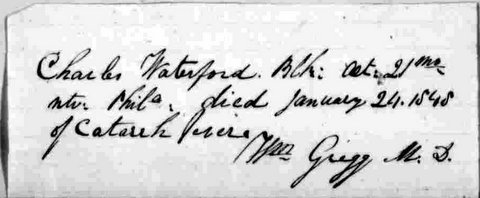
One-year-old Charles Waterford died this date, January 24th, in 1848 and was buried at Bethel Burying Ground

Posted by Terry Buckalew on January 24, 2015
Posted in: Diseases, On This date, Photographs. Tagged: African American burial grounds, African American cemeteries, African American History, archaeology, Bethel Burying Ground, Mother Bethel African Methodist Episcopal Church, Philadelphia, Richard Allen. Leave a comment

Waterford


One-year-old Charles Waterford died January 24, 1848 of Catarrh Fever and was buried at Bethel Burying Ground. The infant lived with his parents, Charles (porter) and Eliza Ann Waterford (washwoman), at 5 Taylor’s Alley near Front and Chestnut Streets.  It is likely that Mr. Waterford was employed at the nearby wharfs. 

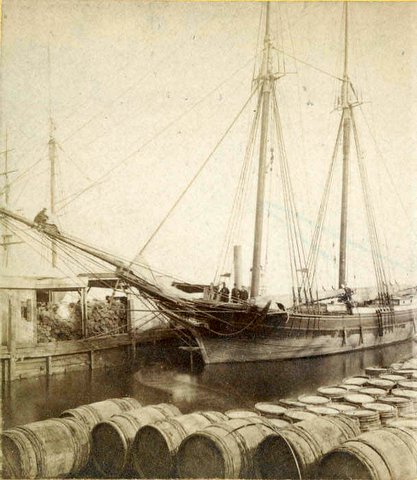
Schooner at Chestnut Street wharf Phila-

A schooner being unloaded at the Chestnut Street Wharf in 1868. From The Free Library of Philadelphia Collection.*


Baby Charles died of “Catarrh.” This is not a disease, it is a symptom. The word simply means a dramatic and significant increase in mucous. This could be caused by many illnesses including the flu, pneumonia, bronchitis or Typhoid.

*For further history on the Delaware River wharfs please see Philadelphia’s Lost Waterford by Harry Kyriakodis. 

One-year-old Emelia Bundy died this day, January 21th, in 1823 and was buried at Bethel Burying Ground

Posted by Terry Buckalew on January 22, 2015
Posted in: On This date, Photographs. Tagged: African American burial grounds, African American cemeteries, African American History, archaeology, Bethel Burying Ground, Mother Bethel African Methodist Episcopal Church, Philadelphia, Richard Allen. Leave a comment

Emelia Bundy

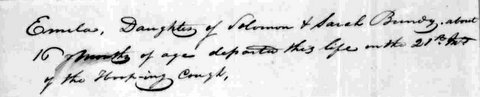
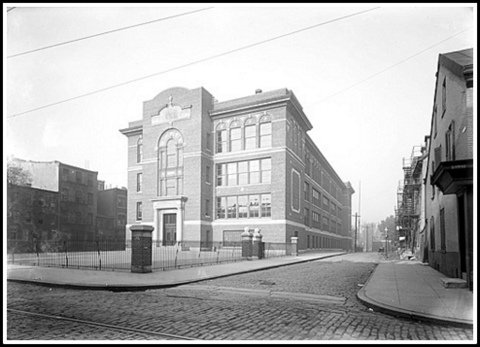
 One-year-old Emelia Bundy died this day, January 20th, in 1823 of Whooping Cough and was buried at Bethel Burying Ground. She lived with her parents, Solomon (waiter) and Sarah (day work), at 14 Elizabeth Street which was eventually became 614 Delancey Street in the Society Hill section of the city. In 1909, this street was demolished for the erection of the new George A. McCall Public School pictured below. According to the 2 June 1918 edition of the Philadelphia Inquirer, the school was built “on the ruins of what was then a district where crime and distress ruled together.”

McCall School

McCall Public School – From the Free Library of Philadelphia Collection


THE NEIGHBORHOOD – “OUTRAGE”

Posted by Terry Buckalew on January 19, 2015
Posted in: Neighborhood, Photographs. Leave a comment
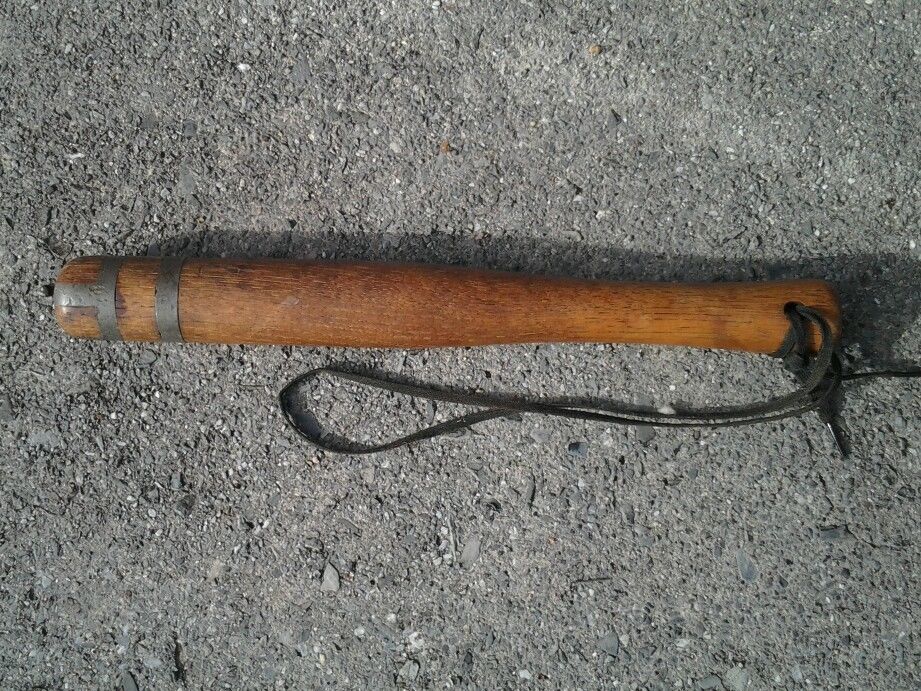
mace1

A 19th-century police mace or billy club

From the April 11, 1838 edition of the Public Ledger:

“OUTRAGE – A respectable and responsible citizen informs us that late on Saturday night, or early Sunday morning last, he, together with other residents of Catherine street between Fourth and Fifth streets, was awakened by the cries of a woman, and on looking out, saw a woman lying upon the pavement, while a watchman was abusing her. Our informant says that the watchman partially raised her, dragged her over the rough stones, and struck her several times with his rattle or mace, and did not desist till the people at the windows reproved him for his brutality. At each blow the woman screamed, and entreated him to let her go home, in tones fitted to soften any but a savage. But he continued to drag her upon the pavement, towards the “Hall.” (1) Our correspondent states that he understood the name of the watchman to be Mitchell.  

We give this statement, in substance as we receive it, vouching for it truth though our informant is too respectable to be harshly doubted; and we publish it for the purpose of preventing such scandalous abuses of authority. A watchman has no right to strike a prisoner unless he resists; nor then, unless the resistance be so violent as to put the watchman in danger, or to render the striking absolutely necessary to secure the prisoner. But all violence beyond this absolute necessity, is criminal and punishable. But in the case of a woman, such resort is rare, if ever necessary, and no man but a dastardly villain will ever lay his hand upon one in violence. If she resist, he should call assistance, and the secure her gently. But no one deserves to be called a man, will ever do what is imputed to this watchman.”

This incident occurred just yards away from the rear or north side of Bethel Burying Ground. In all likelihood, the victim was a patron of Margaret Flanagan’s saloon whose door stood very near at the southwest corner of 5th and Catharine Streets. The neighborhood was already a tough violent Irish working-class area when a volunteer fire company established its’ firehouse in the 500 block of Queen Street in 1833. The existence of the Merion Hose Company was to add significantly to the living conditions in west Southwark. More on Marion in another posting. 

(1) The local police station was situated in Moyamensing Hall, located in the 900 block of Christian Street about 4 blocks away. 

Ignatius Beck lies buried at Bethel Burying Ground

Posted by Terry Buckalew on January 18, 2015
Posted in: Ignatius Beck. Tagged: African American burial grounds, African American cemeteries, African American History, archaeology, Bethel Burying Ground, Mother Bethel African Methodist Episcopal Church, Philadelphia, Richard Allen. Leave a comment

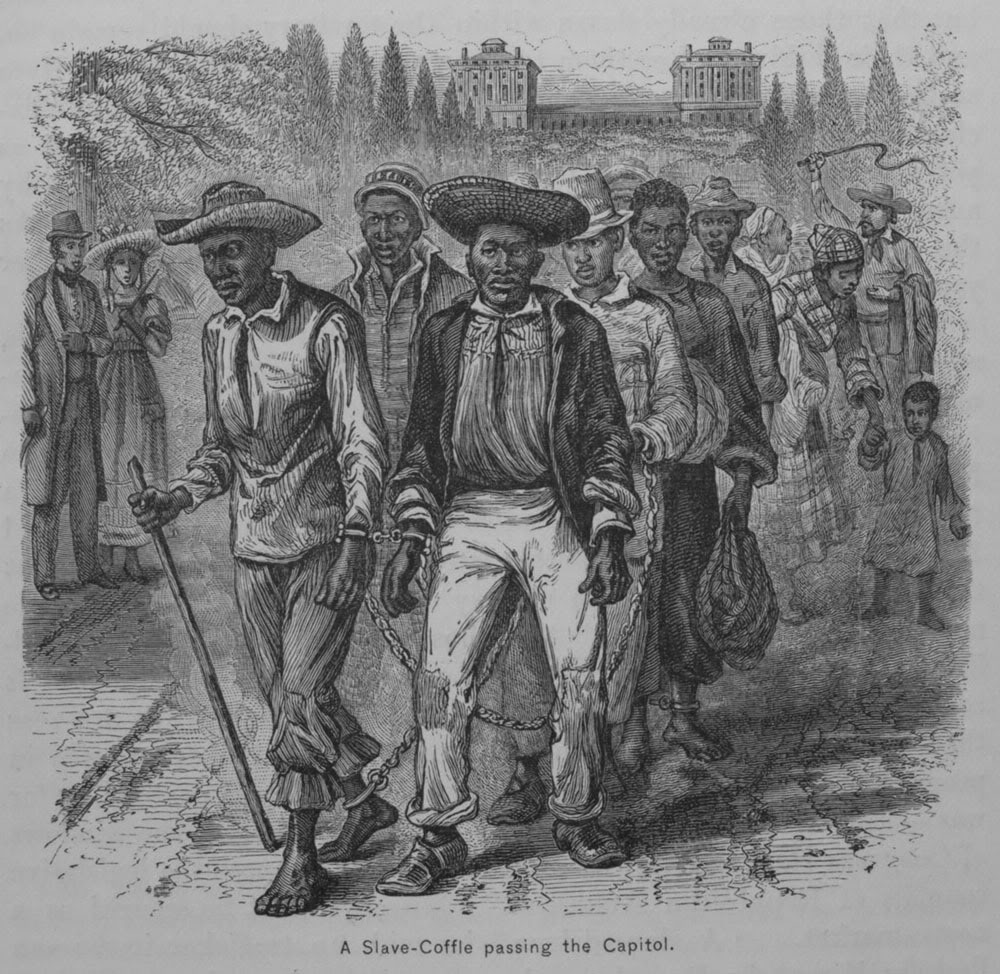
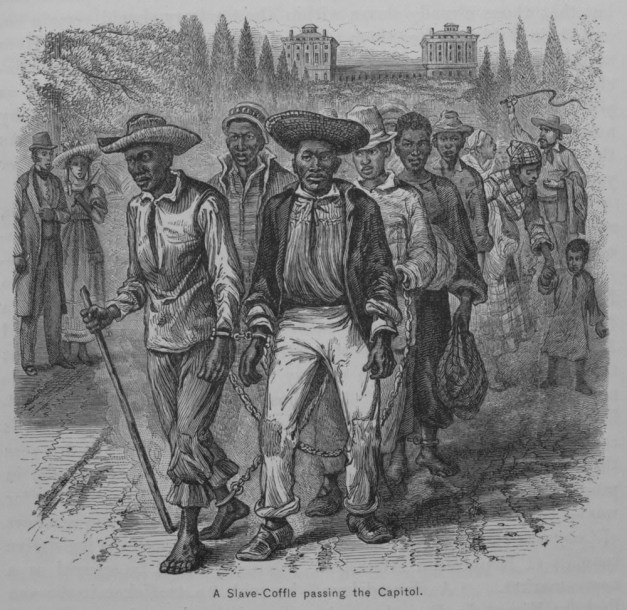
Slave Coffe


Introduction

Ignatius Beck was a common man forced by prejudiced state of affairs to uncommon levels of accomplishment and action. He was a person of courage, integrity and sound judgment, who was proclaimed “respectable in his appearance and demeanor, and unimpeached by a whisper against his veracity or general character.”[1]  Acknowledged respectfully in his later years by the African American community as “Uncle Beck,” he was a dedicated family man and an early member of Mother Bethel A.M.E. Church. Beck was a trusted[2] associate of its founder, Reverend Richard Allen,[3] who appointed him a “Class Leader.”[4] In addition, Beck was the first chairman (1830) of the Free Produce Society of Philadelphia. The Society advocated for the purchase of food and textiles only raised by the labor of freemen and to boycott those items that were raised by the labors of enslaved men and women.[5]

Enslaved Capitol Builder

Mr. Beck was born to an enslaved mother on Joseph Beck’s tobacco plantation in either 1774 or 1775. The plantation was on the outskirts of what is now Bowie, Maryland. In 1791, at the age of sixteen he was legally guaranteed manumission at his 25th birthday. However, when he was nineteen years old he was “rented” out as a laborer to the contractor that was building the United States Capitol Building in the nearby District of Columbia. Federal archival records show payments for “Negro hire” to assist in the construction of the United States Capitol Building beginning on February 11, 1795 and ending on May 17, 1801. In total there were 385 payments made out during that period. Initially, the contracted annual rate for slaves was $60 which all went to the slave’s owner. The owner’s only obligations were to provide a set of adequate clothes and a blanket which offered little protection against the deadly mosquitoes in summer and the bitter cold in winter. Beck’s duties could have included timber and stone sawing, brick making, bricklaying and the strenuous hauling that comes from these tasks.[6]

Blackball maker

After 25 years of being enslaved Ignatious was freed in in either 1800 or 1801 and made his way north to Philadelphia. One of the decisions that a newly freed slave makes is choosing a last name. He chose the name of his former master.

Initially, the Beck family lived at an unknown address on south 7th Street in Philadelphia, Pennsylvania. In 1810 they moved to 14 St. Mary’s Street (now Rodman Street), which runs between 6th and 8th Streets and Lombard and Pine Streets. The tenement was located on what is now Starr Gardens Playground and within sight of Mother Bethel A.M.E. Church. Mr. Beck worked out of his home making blackball. Beeswax, lampblack and animal fat were mixed in combination to make a substance that was rolled into one-ounce balls. The predecessor to shoe polish, this “blackball” was used to blacken and preserve shoes, boots and military leather equipment. With the invention of shoe polish in 1800 the use of blackball was only used by certain segment of the military. Each maker of blackball had their own formula and Beck’s must have been was very popular because the city directories have him manufacturing it out of his home until at least 1814; fourteen years after shoe polish became available.[7]

Kidnapped

Residing on St. Mary’s Street in 1810 and struggling with the cost of raising a family, Beck cast his fate to the wind. He was approached by a seemingly respectable and well to do white man with an offer of employment. Beck was to accompany him as his man servant to North Carolina for a period of time and for this service he would be well paid. Financial circumstances dictating the decision and he agreed to the terms. The arrangement was going well as the two men approached an inn on a Saturday evening just on the North Carolina side of the border from Virginia. The next morning, the Sabbath, the white man suggested that Beck might want to accompany a local group of slaves owned by the inn keeper to a Baptist meeting seven miles down the road from the inn. Disposed to do so, he made the journey and returned to the inn that evening only to find his employer had departed. Bewildered, Beck asked the inn keeper how he was to get back home to Philadelphia. The malefactor replied that he was “home” and that he now belonged to him as he bought the duped Black man from “his master.”

Now a prisoner in a hostile land the “shrewd and sensible man” did not rebel or fight back against his kidnapper. Temporarily accepting his position he went about convincing the whites around him that he was not a threat to escape or seek revenge. Gently, Beck went about inquiring if there was a white man in the area who might be sympathetic to his plight. He was told to seek out a local man, a justice of the peace, who “appeared quite friendly.” At great risk he introduced himself to this individual who listened to the history of the case and with “great joy” heard the compassionate man state that “he was willing to render all the assistance in his power.”

The sympathetic magistrate asked Beck what evidence he might have to prove his claim. Ignatius stated that the Reverend Richard Allen, pastor of the Bethel African Methodist Episcopal Church in Philadelphia, would be able to substantiate his claims. The magistrate wrote Allen and told Beck to go back to the inn while they waited for a reply. However, the slave master caught wind of the plot and Ignatius fled to the magistrate’s home where he was kept in the cellar for hiding as slave catchers and night riders roamed the country side attempting to collect the bounty on the fugitive’s head. In the intervening time, Reverend Allen received the request and solicited the assistance of Isaac Hopper, an uncompromising Quaker abolitionist and activist who was known as the “Father of the Underground Railroad.” Allen and Hopper put together the necessary letters and official documents proving that Ignatius was indeed a freeman and a person of “unimpeachable general character.”

The brave magistrate received the documents, but fearing that Beck would not receive justice from the local vigilantes he hatched a plan. The magistrate had his son escort the escapee on a dangerous journey north for 100 miles while dodging the local slave catchers and their bloodhounds. Successful in their mission, Beck was given forged papers by the young, white Virginian “to prosecute the remainder of his journey.” Beck completed his journey home without reported further incident. After several weeks home he saw his kidnapper on the streets of Philadelphia and followed him to a residence on Lombard Street. Isaac Hopper, a Quaker abolitionist, procured a warrant for the kidnapper’s arrest. Hopper accompanied the constable to the Lombard Street residence, but the offender had fled and was never heard of again by Beck or the local abolitionists.[8]

Soldier in the War of 1812

Martin R. Delany (1812-85) was a historian, journalist, abolitionist, Harvard graduate, physician, and judge. He was the first African American commissioned a major in the Army and widely considered America’s first African American Nationalist, the forerunner of Marcus Garvey, Paul Robeson, and Malcolm X. In his role as historian he wrote and published “one of the most important books to be written by a free African American in the nineteenth century.”[9] In his seminal work, “The Condition, Elevation, Emigration and Destiny of the Colored People of the United States,”[10] Delany writes of the response and participation of Philadelphia African Americans to the call to arms (picks and shovels actually) by the Reverends Richard Allen and Absalom Jones. With the looming threat of invasion by the British on Philadelphia, the Engineer Corps of the U.S. Army requested assistance from the citizens of Philadelphia in erecting ramparts or breastwork on the west side of the Schuylkill near Gray’s Ferry. The African American community’s response was robust. Primary sources (government documents) do not exist for an official register or list of names for the company of men that responded. Estimates of their numbers range from 1,000 to 2,500. However, Delaney reports from Federal court documents and possibly from oral histories, that Ignatius Beck was one of the “Black Warriors” or “Black Pioneers” of 1812. He would have been approximately 38 years of age.

Underground Railroad Pioneer

In 1847, the African American owned and edited abolitionist newspaper, The Ram’s Horn acknowledged and praised Beck as being a co-founder of the Underground Railroad and in the vanguard of establishing the fugitive slave network as a working system of stations, stations masters, cars and coaches. An “estimable” man worthy of respect and honor, the newspaper went on to write about Beck that he was one of a very few in the early years of the Underground Railroad to be a vigilant manager of the network and a keystone in its success.[11]

Religious Man

Ignatious was an early member of Mother Bethel African Methodist Episcopal Church in Philadelphia, Pennsylvania. Beck was a trusted[12] associate of its founder, Reverend Richard Allen,[13] who appointed him a “Class Leader.” In this position he acted as a “proxy pastor” and someone who heads a small group of congregants and looks after their spiritual and secular needs.”[14] Additionally, he was Mother Bethel’s sexton for several years. In this capacity he was responsible for the burials at Bethel Burying Ground.[15]

Community Organizer

Mr. Beck was the first chairman (1830) of the Free Produce Society of Philadelphia. The Society advocated for the purchase of food and textiles only raised by the labor of freemen and to boycott those items that were raised by the labors of enslaved men and women.[16]

The Stansbury Case

In January of 1839, William Stansbury, a free black man, was “seized in the streets of Philadelphia” by the notorious slave catcher George F. Alberti and accused of being a fugitive slave. The allegation was that he escaping from his enslavement in Prince George’s County, Maryland twenty-three years earlier. Mr. Stansbury’s case was quickly taken up by The Pennsylvania Abolition Society and two highly experienced attorneys, Charles Gilpin and David Paul Brown, were charged with defending Mr. Stansbury.

In a landmark case tried before Judge Joseph Hopkinson of the United States District Court for Eastern Pennsylvania in Philadelphia, Ignatius Beck was the key witness for the defense. The two month long trial began on January 31, 1839 and ending in March of the same year. Judge Hopkinson decided that William Stansbury was a freeman and not a fugitive slave. In his ruling, Hopkins stated that Beck was “a very important witness” who was submitted to a “very severe cross-examination” and showed himself to be “respectable in his appearance and demeanor, and unimpeached by a whisper against his veracity or general character.” Ignatius Beck was 65 years of age.[17]

The Citizen

For the next 10 years Beck was employed as a rope maker, chimney sweep, master sweep and a dealer of unspecified “material.” He would serve his community, church and family well. He died on October 14, 1849 at 75 years of age from Tuberculosis. He was residing at 31 Barclay Street (now Delancey Street) near 6th and Spruce Streets. He appear to have been living with a daughter (dressmaker) and 2 sons (seamen) near the time of his dead. His spouse is presumed deceased.[18] He is buried on Queen Street in Bethel Burying Ground where he once toiled.[19]

[1] This observation by stated by Judge Joseph Hopkinson of the U.S. District Court for Eastern Pennsylvania, The Law Reporter, editor, P.W. Chandler, vol. II, May, 1839-April, 1840, p. 110. This is available electronically at Google Books.

[2] Joseph A. Borome, “The Vigilant Committee of Philadelphia,” Pennsylvania Magazine of History and Biography, v. 92, no. 3, July, 1968, 320-351, 339. On at least one occasion Beck was trusted by Rev. Allen to carry cash to be delivered that was collected at the Church for the benefit of The Vigilant Committee.

[3] D.E. Meaders, Kidnappers in Philadelphia: Isaac Hopper’s Tales of Oppression, 1780-1843, Second Edition, ed., E.L. Wonkeryor; Africana Homestead Legacy Publishers, Cherry Hill, NJ, 2009, 255-256; National Anti-Slavery Standard, 20 Jan 1842, 130.

[4] A “Class Leader” at Mother Bethel was someone who held weekly classes of about 12 congregants. The focus of which was to shepherd the faithful by inquiring how they were prospering and also  to advise, reprove, comfort or exhort, collect funds and report the spiritual and physical condition of the participates to the ministers of the Church. The leader of such a class had to be a person of “sound judgment.” See The Doctrines and Disciplines of the A.M.E. Church, 26th Edition, 1916, 48, 59-60. This is available at Google Books.

[5] Benjamin Lundy, editor., The Genius of Universal Emancipation, a Monthly Periodical Work, vol. 1, Third Series, April 1830, p. 163.

[6] Allen, William C., History of Slave Laborers in the Construction of the U.S. Capital Building, 2005. Available at

http://artandhistory.house.gov/art_artifacts/slave_labor_reportl.pdf; Arnebeck, Bob, Through a Fiery Trial: Building Washington, 1790-1800 (NY: Madison Books, 1991); See also http://bobarnebeck.com/slavespt4.html.; Arnebeck, Bob, Slave Labor in the Capital: Building Washington’s Ionic Federal Landmarks (US: The History Press, 2014), 29, 94, 138.

[7] Allen, F.J., The Shoe Industry (NY: Holt & Co., 1922), 382; Earle, A.M., Two Centuries of Costume in America, Vol. II (NY: Macmillan, 1903), 756; Philadelphia City Directories are available at PhillyHistory.org and both books are available online at Google Books.

[8] Meaders.

[9] Rodriguez, Junius P., Slavery in the United States: A Social, Political, And Historical …, Volume 2, (CA: ABC-CLIO, 20027), 251.

[10] Delaney, Martin R., The Condition, Elevation, Emigration and Destiny of the Colored People of the United States (CA: ABC-CLIO, 2007), 72-75. (This book is available on Google Books.)

[11] The Ram’s Horn, November 5, 1847.

[12] Joseph A. Borome, “The Vigilant Committee of Philadelphia,” Pennsylvania Magazine of History and Biography, v. 92, no. 3, July, 1968, 320-351, 339. On at least one occasion, Beck was trusted by Rev. Allen to carry cash to be delivered that was collected at the Church for the benefit of The Vigilant Committee.

[13] Meaders; National Anti-Slavery Standard, 20 Jan 1842, 130.

[14]See Henry McNeal Tanner, Methodist Polity, ed., A. Lee Henderson (Nashville, TN: AMEC Sunday School Union, 1986), 157.

[15] “Pennsylvania, Philadelphia City Death Certificates, 1803-1915,” index and images, FamilySearch (https://familysearch.org/pal:/MM9.1.1/JX7L-23T: accessed 09 Jun 2014), Egnesh Beck, 19 Feb 1817; citing, Department of Records; FHL microfilm 1862806.

[16] Benjamin Lundy, editor, The Genius of Universal Emancipation, a Monthly Periodical Work, vol. 1, Third Series, April 1830, p. 163.

[17] See footnote #1.

[18] 1847 Philadelphia African-American Census at http://fm12.swarthmore.edu/1847/full.php?rid=204&trc=4308.

[19] Obit, Public Ledger, 17 Oct 1849; Death Certificate available at https://familysearch.org/ark:/61903/1:1:JK98-RYZ.

 

THE NEIGHBORHOOD – INTRODUCTION

Posted by Terry Buckalew on January 15, 2015
Posted in: Neighborhood. Tagged: African American burial grounds, African American cemeteries, African American History, Bethel Burying Ground, Mother Bethel African Methodist Episcopal Church, Philadelphia, Richard Allen. Leave a comment

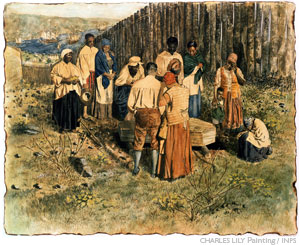
“The African Burial Ground” by Charles Lilly, 1994; New York Public Library, Schomburg Center for Black Culture

The above painting depicts a burial, late 17th or early 18th century, at the “Negroes Burial Ground,” now the African Burial Ground National Monument in Lower Manhattan. It shows the burial in a remote location surrounded by tall barricades that provide seclusion and privacy. The Bethel Burying Ground had none of this seclusion with possibly the exception of the first several years of its existence. For the vast majority of the 19th century, it was literally surrounded by tenements filled with the poor working class Irish that was the Black community’s sworn enemy.   Given the violent and frightful nature of the relationship between the two ethnic groups it is baffling how the little burying ground remained active for 55 years (1810-65). Although I have not found one single newspaper report of vandalism or of an assault on mourners. 

In 1810, the violent riots of 1834, 1835, 1842 and 1849 were decades away from this corner of Southwark that consisted of pastures and shanties. The streets for Catharine and Queen had just recently been extended to 6th Street which gave farmers and merchants a more direct route to the popular Queen Street Wharf on the Delaware River.  The roads were dirt down to 2nd or 3rd Street and would quickly turn to mud in the rain and snow for both freight wagon and funeral bier. In 1810 no matter which route the funeral procession took it would have traveled on dirt roads. Bethel Church was a half mile and after the funeral service and up until the 1840s the Irish controlled the unions that controlled the drivers of hacks, waggoners, carters and draymen. “They would not serve at the funerals of colored persons,” according to journalist William Carl Bolivar and so the coffin would have had to be carried or placed in a push cart and taken to the burial ground. (1) 

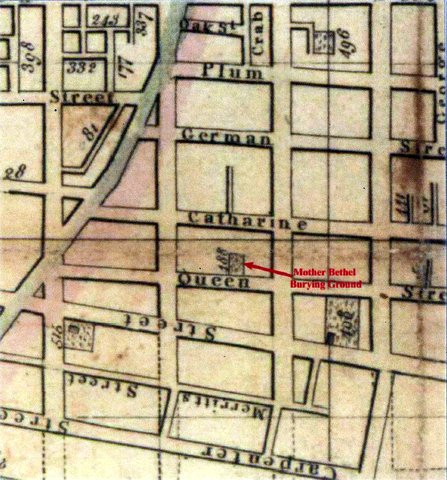
1810 Map

1810 Paxton map taken from “Phase IB Archaeological Investigations of the Mother Bethel Burying Ground, 1810 – Circa 1864,” URS, Inc. 2013

 The above is part of an 1810 street map of the County of Philadelphia. It clearly shows the beginnings of the new cemetery and its sparse surroundings. 

In contrast below is part of an 1825 street map that shows just how much the neighborhood changed in 15 years. The shaded areas are all tenements and rowhouses that encircle the Bethel Burying Ground. 

1825 Map (1)

(1) Philadelphia Tribune, 10 October 1914 and North American, 2 August 1839.

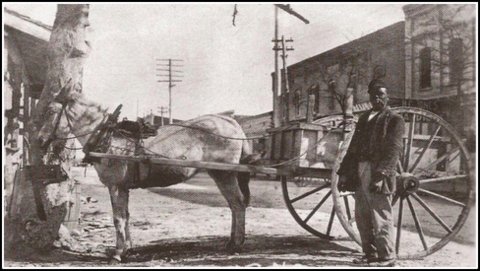
Drayman

A Black drayman and his cart.

Andrew Brown died this date, January 12th, in 1849 at the age of forty-three and was buried at Bethel Burying Ground

Posted by Terry Buckalew on January 12, 2015
Posted in: On This date. Tagged: African American burial grounds, African American cemeteries, African American History, archaeology, Bethel Burying Ground, Mother Bethel African Methodist Episcopal Church, Richard Allen. Leave a comment
Iron Melter

Andrew Brown died of Typhoid Fever on 13 Jan 1849 and was buried at Bethel Burying Ground.

 Mr. Brown’s occupation was that of an iron melter. He likely would have worked in an iron foundry feeding a Cupola Furnace as pictured above. A grueling job at best and in the heat of the Summer it would have been hellish. According to the 1847 African-American Census, Mr. Brown was paid $7.50 a week for his labor. His spouse brought home $1.50 a week as a wash woman. With this they supported their four daughters and paid a monthly rent of $4.50 for a set of 3 rooms in the 1200 block of Pearl Street near 12th and Vine Streets in what is now known as the Chinatown district of the city. 

For more information on the foundry industry during this era in Philadelphia, please go to – Edwin T. Freedley, Philadelphia and its Manufactures and Elizabeth M. Geffen, “Industrial Development and Social Crisis 1841-1854,” in Philadelphia: A 300-Year History, 307 – 362. Both are available at GoogleBooks.

Four-year-old Elizabeth Smith died on this date, January 9th, in 1849 and was buried at Bethel Burying Ground

Posted by Terry Buckalew on January 9, 2015
Posted in: Documents, Newspaper Articles, On This date, Photographs, Uncategorized. Tagged: African American burial grounds, African American cemeteries, African American History, archaeology, Bethel Burying Ground, Mother Bethel African Methodist Episcopal Church, Philadelphia, Richard Allen. Leave a comment
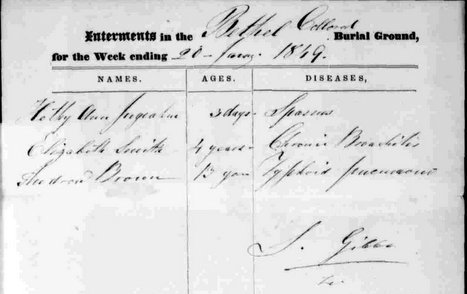
E. Smith (1)

Four-year-old Elizabeth Smith died on this date, January 9th, in 1849 of Chronic Bronchitis and was buried at Bethel Burying Ground

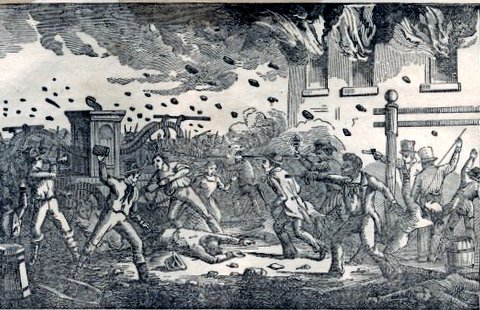
 Elizabeth and her family lived in the 700 block Bedford Street in the Moyamensing section of the county. Bedford Street was in a poor Black neighborhood constantly victimized by a viciously racist Irish gang calling itself the “Killers.” Called the “most prominent gang of the era”*, this band terrorized its victim with brutal beatings and attacks with straight razors and knives.** This is the gang that was involved in the anti-Black riots of the 1830s and 40s and started the infamous California House Riot, only nine months after little Elizabeth died.*** 

California House Riot

California House Riot – Source: “The life and adventures of Charles Anderson Chester: the notorious leader of the Philadelphia “killers”. . . 1850.

Looking at the 1847 African American Census, it is probable that Elizabeth’s father Edward Smith, a porter in a store. As of 1847 there was a total of eight members of the family (5 females and 3 males) at the no. 81 Bedford Street residence for which they paid $6 a month in rent. Mr. Smith brought home $4.50 a week from his work.


*Allen Steinberg, “The Transformation of Criminal Justice, Philadelphia 1800-1880,” 145.

** Philadelphia Inquirer, 23 July 1849.

***John Runcie, ” ‘Hunting the Nigs’ in Philadelphia: the Race Riot of August 1834″ Pennsylvania History, 39, 2, April 1972, 187-218 and Harry C. Silcox, “Philadelphia Politics from the Bottom Up – The Life of Irishman William McMullen, 1824-1901.”


Three-month-old Jeremiah Davis, Jr. died on this date, January 6th, in 1849 and was buried at Bethel Burying Ground

Posted by Terry Buckalew on January 6, 2015
Posted in: Diseases, On This date, Photographs. Tagged: African American burial grounds, African American cemeteries, African American History, archaeology, Bethel Burying Ground, Mother Bethel African Methodist Episcopal Church, Richard Allen. Leave a comment
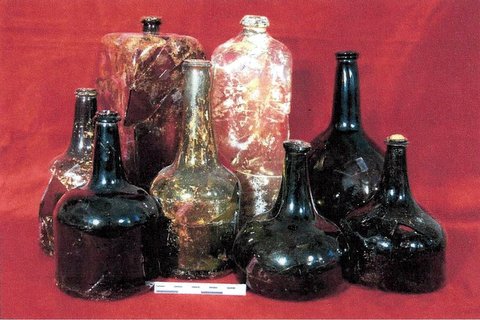
Taylor Alley Bottles

Glass bottles discovered during an archeological project in a privy very near the Davis’ home. See http://www.phillyarchaeology.net/wp-content/uploads/2012/08/Area-F.pdf


Three-month-old Jermeiah, Jr. died this date in 1849 from Hydrocephalus and is buried at Bethel Burying Ground. He was identified by the physician that signed his death certificate as being “mulatto.” The Davis family lived at #2 Taylor’s Alley (now Ionic Street) which ran east-west between Front and 2nd Streets. Jeremiah, Sr. was a waiter making $12 a month and Ms. Davis was a self-employed dressmaker.** They had been members of Old St. George’s Methodist Church before leaving with Richard Allen and Absalom Jones to worship as they pleased.* 

The Taylor’s Alley in the August 9, 1832 edition of the Nation Gazette was characterized as being a long time “grievous nuisance.” There were saloons on every corner and the alley housed a notorious “dance house” with a “Ball-room” that was “one of the most notorious dens of iniquity in our city.” There always seemed to be “mobs” of young men fighting in the street and large groups of men being arrested for illegal gambling in neighboring houses. In addition, there were constant fires in the neighborhood claiming many lives.*** 

Hydrocephalus in the 19th century was usually due to tubercular meningitis and was marked by atrophy of the brain and convulsions. ****


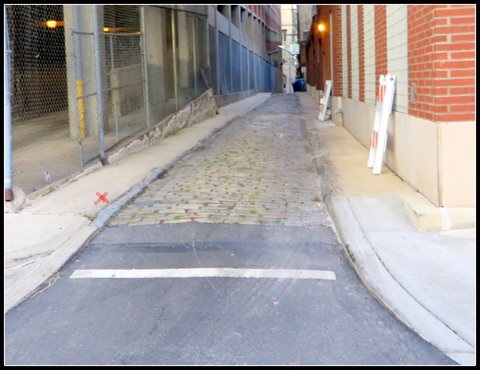
Taylor's Alley

Taylor’s Alley (now Ionic St.). The Davis’ front steps would have been where the red “X” is on the left.


*See Ancestry.com

**1847 African American Census. http://www.swarthmore.edu/Library/friends/paac1847/main.html

***”Mysteries of City Life,” James Reese, p. 21 (1849). 

**** Webster’s New International Dictionary, Reference History Edition (Springfield, Massachusetts: G. & C. Merriam Company, 1910).

Bethel Church Trustees rent out the Burying Ground in 1869 to be use as an industrial storage yard and cause a scandal

Posted by Terry Buckalew on January 3, 2015
Posted in: Bethel Burying Ground Timeline, Documents, Newspaper Articles, Photographs, Uncategorized. Leave a comment
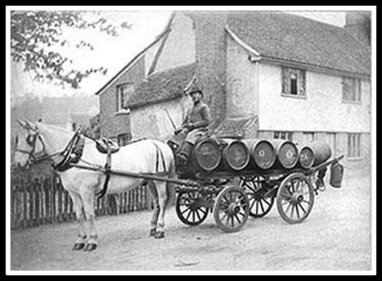
dray

A dray loaded with hogsheads

“The African A.M.E. Church of the City of Philadelphia to Barnabas H. Bartol … party of 1st part leases to party of 2nd part of a lot on north side of Queen St. between 4th and 5th….” the same having been used and occupied by the parties of the first part hereto commonly known as the Bethel Church for the purposes of burial.”         City of Philadelphia Deed Book JTO 209, 1869 January 1, p. 30.


      Bishop Benjamin Tucker Tanner calls attention to the disgrace of Bethel trustees who have let the “consecrated grounds” of the church’s “Old Burial Ground” on Queen Street crumble. The plot is in gross disrepair and has been rented out for $500 a month to a company that dumps rubbish, old hogsheads, barrels and lumber over the graves.                                                                     Christian Recorder 3 August 1872

  In June of 1873, Bartol (the lessee of the plot) sought to be released from his agreement. The Bethel Trustees, led by Theodore Gould, did so on June 6, 1873 for a cash settlement and the erection of a “good fence” around the lot.         Minutes of the Bethel Trustees, 6 June 1873 


“Sixty years after the purchase of the ground that was long used by Mother Bethel as a burial ground,” the Trustees of Bethel rented the burial ground out on the first of January, 1869 to Barnabas H. Bartol, a sugar refiner, for 10 years at $500 per year; the lot is to be used for the storage of wagons and drays.                                                    The Philadelphia Tribune, 3 December 1921   

Bethel Church officials sell Bethel Burying Ground to the City of Philadelphia in 1889 without removing the human remains

Posted by Terry Buckalew on December 30, 2014
Posted in: On This date. Tagged: African American burial grounds, African American cemeteries, African American History, archaeology, Bethel Burying Ground, Mother Bethel African Methodist Episcopal Church, Richard Allen. Leave a comment


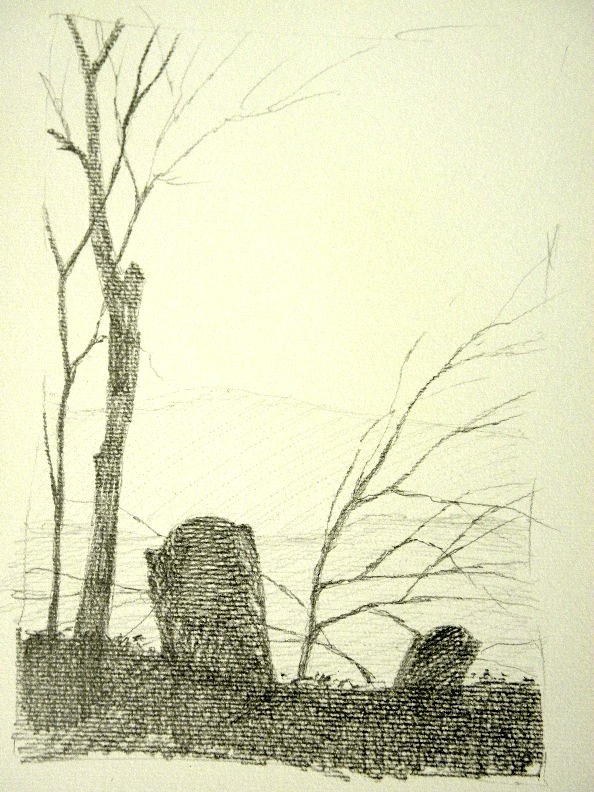
Sketch Jackie 2

On December 2, 1889 a special meeting was called for of the Mother Bethel Corporation where President D.W. Parvis stated the City of Philadelphia has “ordained” that the Bethel Burying Ground be used for a city park. In addition, it is necessary for the Corporation to vote to empower the trustees to sell the plot for $10,000* and the money is to be directed to be used for the improvement of the 6th and Lombard Streets properties. The Corporation voted unanimously 20-0 in favor of the sale. There is no mention of removing the remains of the 5,000+ individuals buried on Queen Street in the official record. (Minutes of the Bethel Trustees)

 The trustees of Bethel Church had a cemetery that was no longer bringing in revenue for its upkeep. There were continuous complaints to the Board of Health about human remains being uncovered after a heavy rain. Add to that the burden of a newly constructed church with large mortgage payments and the cold hard fact that the Church’s treasury was overdrawn according to Church records. Also, there were several Church owned income properties at 6th and Lombard Streets that were in immediate need of renovation. At the same time, there was a vigorous campaign by the city to establish “pocket parks” in the poorer neighborhoods to occupy the children’s time and hopefully reduce delinquency and crime. The burial ground property was one of the first lots identified by the city council to be transformed into a green space. According to one source, it was the only open space in the ward. The offer of $10,000* for the lot must have seemed like it was God sent to the trustees. “Ordained” indeed! 

By all accounts, the condition of the graveyard in 1889 was a rubbish strewn, “hard clay” lot that was used as a trash dump and a space for neighborhood children to play. It was common knowledge that it was an old cemetery with the bodies washing up and all the tombstone rubble near the surface. However, the lot remained untouched for the next ten years and 1t wasn’t until June of 1899 that the city council approved the appropriation of $10,000 for the improvement of the property and to repave Queen Street between Fourth and Fifth Streets. A contractor was hired to ready “Weccacoe Square” for “promenaders.” It was reported that the property is the site of “an abandoned burial ground for colored people.” (see Philadelphia Inquirer, 24 June 1889 and 20 August 1890)

( *In 2014 that $10,000 would be valued at approximately $240,000.)

Posts navigation

← Older Entries
Newer Entries →
  • Recent Posts

    • Three dead as church wall falls on this date, May 1st, in 1841.
    • The ten-month-old Baby Colgate died this date, June 20th, in 1847, and was buried at Bethel Burying Ground.
    • Fifty-eight-year-old Rachel Dawson died this date, May 3rd, in 1839, and was buried at Bethel Burying Ground.
    • Twenty-eight-year-old Robert Swails died on this date, March 31st in 1849, and was buried at Bethel Burying Ground.
    • Forty-year-old Jacob “Jesse” Howard died on this date, January 29th, in 1840, and was buried at Bethel Burying Ground.
  • Archives

    • May 2024
    • June 2023
    • May 2023
    • March 2023
    • January 2023
    • December 2022
    • November 2022
    • October 2022
    • September 2022
    • August 2022
    • May 2022
    • April 2022
    • March 2022
    • February 2022
    • January 2022
    • December 2021
    • November 2021
    • October 2021
    • September 2021
    • August 2021
    • July 2021
    • June 2021
    • May 2021
    • April 2021
    • March 2021
    • February 2021
    • January 2021
    • December 2020
    • November 2020
    • October 2020
    • September 2020
    • August 2020
    • July 2020
    • June 2020
    • May 2020
    • April 2020
    • March 2020
    • February 2020
    • January 2020
    • December 2019
    • November 2019
    • October 2019
    • September 2019
    • August 2019
    • July 2019
    • June 2019
    • May 2019
    • April 2019
    • March 2019
    • February 2019
    • January 2019
    • December 2018
    • November 2018
    • October 2018
    • September 2018
    • August 2018
    • July 2018
    • June 2018
    • May 2018
    • April 2018
    • March 2018
    • February 2018
    • January 2018
    • December 2017
    • November 2017
    • October 2017
    • September 2017
    • August 2017
    • July 2017
    • June 2017
    • May 2017
    • April 2017
    • March 2017
    • February 2017
    • January 2017
    • December 2016
    • November 2016
    • October 2016
    • September 2016
    • August 2016
    • July 2016
    • June 2016
    • May 2016
    • April 2016
    • March 2016
    • February 2016
    • January 2016
    • December 2015
    • November 2015
    • October 2015
    • September 2015
    • August 2015
    • July 2015
    • June 2015
    • May 2015
    • April 2015
    • March 2015
    • February 2015
    • January 2015
    • December 2014
    • November 2014
    • October 2014
  • Categories

    • Archaeology
    • BBG History
    • Bethel Burying Ground Name Directory
    • Bethel Burying Ground Timeline
    • Burial services
    • Diseases
    • Documents
    • Freemasonry
    • Ignatius Beck
    • It's a fact
    • Maps
    • Neighborhood
    • Newspaper Articles
    • On This date
    • Photographs
    • Uncategorized
    • Videos
  • Meta

    • Create account
    • Log in
    • Entries feed
    • Comments feed
    • WordPress.com
Blog at WordPress.com.
Bethel Burying Ground Project
Blog at WordPress.com.
  • Subscribe Subscribed
    • Bethel Burying Ground Project
    • Join 48 other subscribers
    • Already have a WordPress.com account? Log in now.
    • Bethel Burying Ground Project
    • Subscribe Subscribed
    • Sign up
    • Log in
    • Report this content
    • View site in Reader
    • Manage subscriptions
    • Collapse this bar
 

Loading Comments...