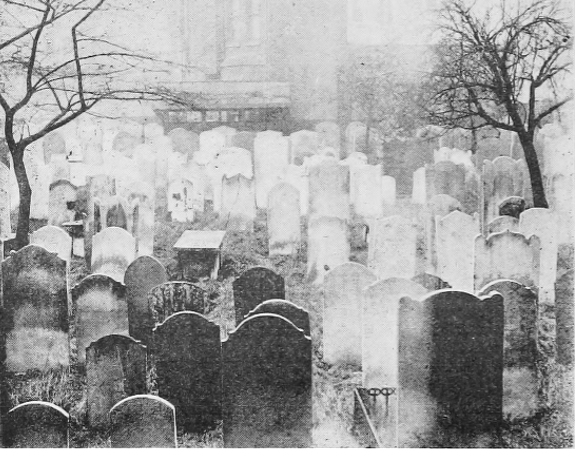
Bethel Burying Ground Project

Bethel Burying Ground Project

  • ABOUT THE BETHEL BURYING GROUND PROJECT

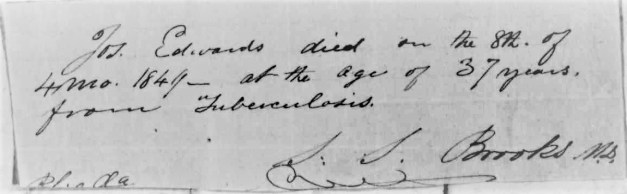
Thirty-seven-year-old Joseph Edwards died this date, April 8th, in 1849 and was buried at Bethel Burying Ground.

Posted by Terry Buckalew on April 8, 2019
Posted in: On This date. Tagged: African American burial grounds, African American cemeteries, African American History, African Methodist Episcopal Church, archaeology, Bethel Burying Ground, Mother Bethel, Mother Bethel African Methodist Episcopal Church, Philadelphia, Richard Allen. Leave a comment

EDWARDS

Thirty-seven-year-old Joseph Edwards died this date, April 8th, in 1849 of Tuberculosis and was buried at Bethel Burying Ground. The 1847 Philadelphia African American Census reports that two years before his death Mr. Edwards was too ill to work. The Census also shows that Ms. Edwards* was employed as a nurse and another member of the residence was employed as a domestic earning $1.50 a week. The Edwards and the unidentified woman lived in a room at #8 Madison Court for which they paid $3.50 a month. 
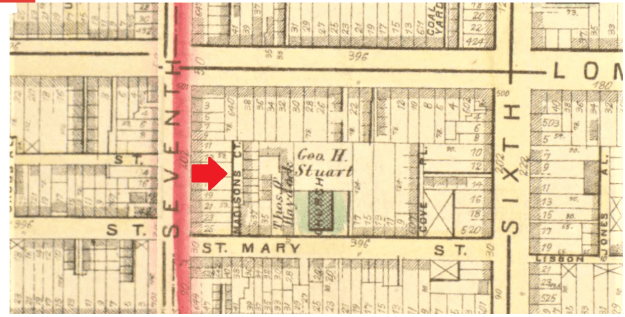
Madison Court

Madison’s Court was a slum within a slum. This dead-end alley branched off St. Mary’s Street which had a wide reputation of being the worst-of-the-worst living environment in the city of Philadelphia. The sun never shone in the ill-ventilated rooms of these tenements. This made it a perfect haven for deadly respiratory diseases, such as Tuberculosis, that killed Mr. Edward.

Dead End alley

Eleven Black families totaling forty-five men, women and children lived on small Madison’s Court, according to the 1847 Census. No one would choose to live here. Historically, this neighborhood was one step away from the House of Refuge and its adjoining potter’s field. And yet, Mr. Edwards’ family made sure that he had a dignified burial at a respectable cemetery.  

Official Border

*There are a number of individuals with the last name “Edwards” buried at Bethel Burying Ground. There is some evidence that points to the possibility of Harriet Edwards being Joseph Edwards’ spouse. She died at 40 years old of a lung infection on February 22, 1851, and likely was buried next to her husband.
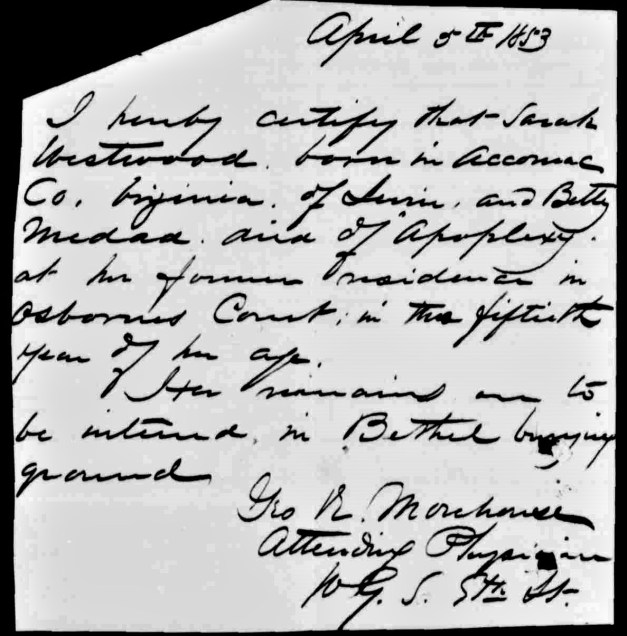


Fifty-year-old Sarah Westwood died this date, April 5th, in 1853 and was buried at Bethel Burying Ground.

Posted by Terry Buckalew on April 5, 2019
Posted in: Uncategorized. Leave a comment

WESTWOOD

Fifty-year-old Sarah Westwood died this date, April 5th in 1853, of Apoplexy (stroke) and was buried at Bethel Burying Ground. Ms. Westwood, a widow, was born in Accomack County, Virginia and was the daughter of Irvin and Betty Midad. They very likely had been enslaved. According to the 1852 and 1853 city directories, Ms. Westwood was occupied as a wash woman. 


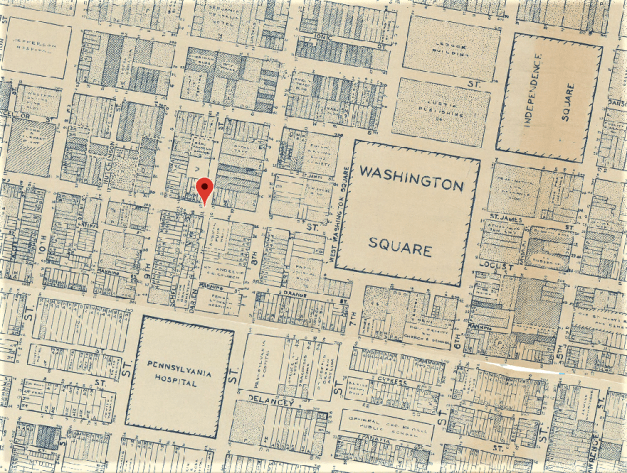
Ms. Westwood lived in a room at #6 Osborn’s Court for which she would have paid approximately $2 a month. She likely earned between $.75 to $1.25 a week doing laundry. Osborn’s Court was a two block long narrow thoroughfare near 8th and Walnut Streets. 

Darien map 2

The red pin in the map above shows the location of Osborn’s Court located near both Pennsylvania Hospital, founded in 1751, and Washington Square. Osborn’s Court is now named Darien Street.

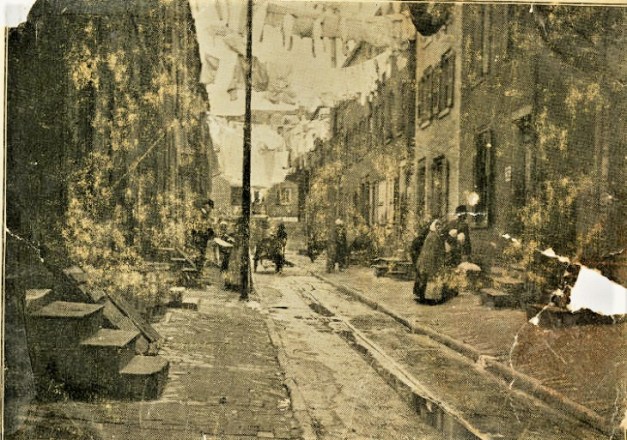
Darien St. Photo

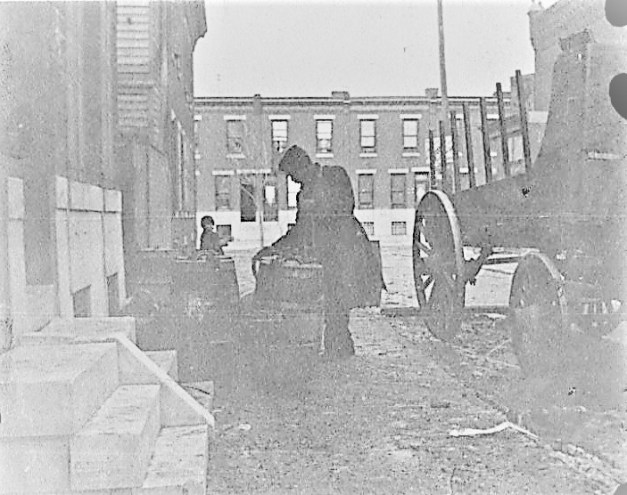
1912 photo of Darien Street, formerly Osborn’s Court.

Ms. Westwood was 50 years old when she died. This was seven years more than the average age (42.3 years) of the adult* females buried at Bethel Burying Ground. The average age for males buried there was 42.9 years.

Ms. Westwood was buried on a day that started out rainy but turned fair by 9 am. The temperature rose to 50 degrees.

Official Border

*All females 16 years of age and older.

Thirty-four-year-old John Goodin died this date, April 3rd, in 1853 and was buried at Bethel Burying Ground.

Posted by Terry Buckalew on April 3, 2019
Posted in: On This date. Tagged: African American burial grounds, African American cemeteries, African American History, African Methodist Episcopal Church, AME Zion, archaeology, Bethel Burying Ground, Mother Bethel, Mother Bethel African Methodist Episcopal Church, Philadelphia, Richard Allen. Leave a comment

GOODIN

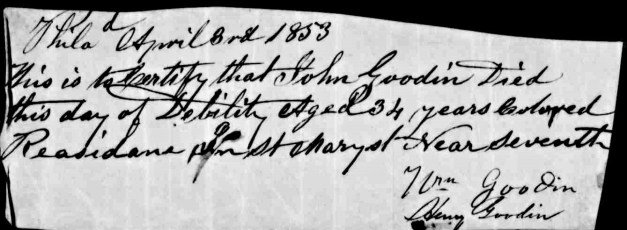
Thirty-four-year-old John Goodin died this date, April 3rd, in 1853 of Debility and was buried at Bethel Burying Ground. Debility is a symptom, not a cause of death. This condition could follow numerous chronic and acute illnesses. The 1847 African American Census reports Mr. Goodin was employed as a porter, earning a relatively good wage of $6 a week. His unnamed spouse worked as a wash woman. Also living at 320 Cedar Street with the couple was a child and two other unnamed adults. The monthly rent was $7.50. In addition, all four of the adults belonged to a beneficial society.

Grain Distiller

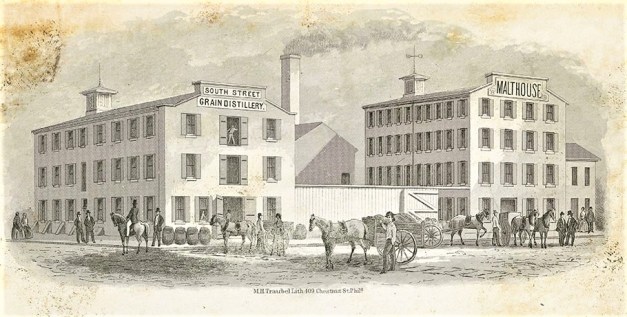
Mr. Goodin may have been employed at the South Street Distillery two blocks from his home. This business was known for its own brand of Rye Whiskey. The above illustration shows porters hauling material to and from the business.

Black brothers

John Goodin’s death certificate was signed by William and Henry Goodin. It appears that they might have been John’s brothers. According to the 1850 U.S. Census, Henry Goodin was a 32-year-old laborer who was born in Maryland. He was married with three children. His youngest and the only boy was named “John.” Information on Henry Goodin is slim. In the 1852 City Directory, there is someone with that name residing at #20 Middle Alley and occupied as a tailor. 

 By the time of Mr. John Goodin’s death, he lived on St. Mary’s Street near 7th Street. Known by both races as the “heart of the slums,”  it would have been quite an economic fall for the family. St. Mary’s was a narrow thoroughfare lined with dilapidated hovels that were home to speakeasies,  prostitution, gambling, and rooming houses that were overrun by rats. In addition, St. Mary’s Street was a perennial target of white mob violence, especially in 1840, 1842 and 1849.

Screenshot 2019-04-02 17.19.07

Mr. Goodin died on a cool rainy day in early April where the temperature only rose to 48 degrees. Interestingly, a year later, a John Goodin, Sr., age 70, would die of a brain disease. It is unknown if they were related. Both were buried at Bethel Burying Ground.

Official Border

Thirty-one-year-old Robert Carson died this date, March 26th, in 1841 and was buried at Bethel Burying Ground.

Posted by Terry Buckalew on March 26, 2019
Posted in: On This date. Tagged: African American burial grounds, African American cemeteries, African American History, African Methodist Episcopal Church, archaeology, Bethel Burying Ground, Mother Bethel, Mother Bethel African Methodist Episcopal Church, Philadelphia, Richard Allen. Leave a comment

CARSON

Thirty-one-year-old Robert Carson died this date, March 26th, in 1841 of the deadly effects of a “Lumbar Abscess.” He lived on Broad Street, just below Arch Street. The 1837 Philadelphia African American Census shows that Mr. Carson was employed as a porter. He was married and there were five others in the family besides the couple. The ages, genders or relationships of these five individuals are not reported. All seven in the family were born in  Pennsylvania. Ms. Carson’s first name was not reported. Her occupation is recorded as “own work” which I take to mean homemaker. 

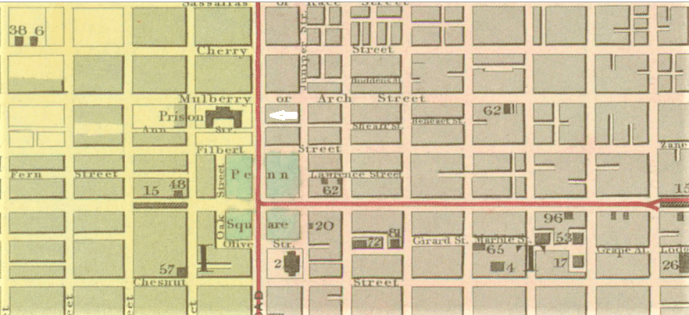
arch st map 1

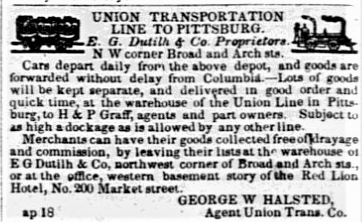
The Carson family lived in a room on Broad Street, just a block north of Penn Square which is now the location of Philadelphia’s historic City Hall. In 1841, it was a large public square. The rent for their room was $4 per month, according to the 1838 African American Census. Mr. Carson probably made $4-$5 a week as a porter, most likely at the warehouse of E.G. Dutilh & Co., located directly across Broad Street from his home.

Arch St advertisement

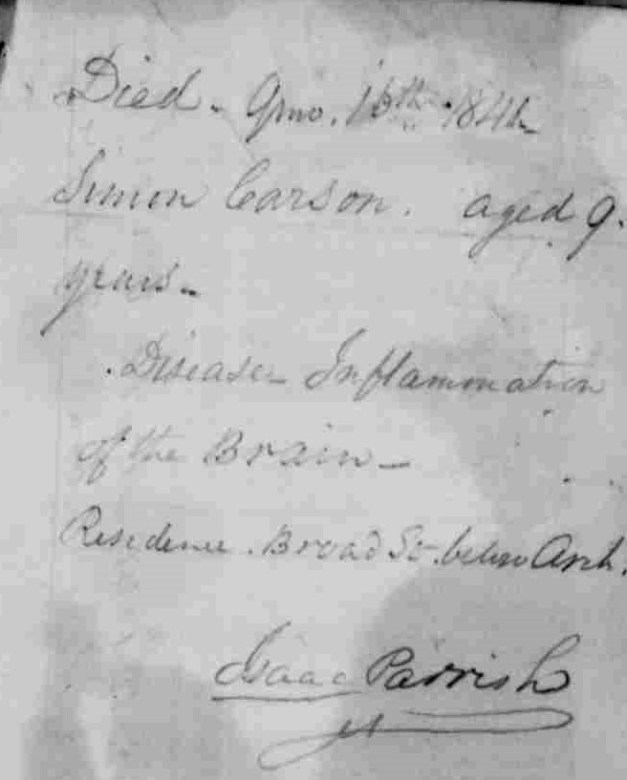
Tragically, Mr. Carson’s nine-year-old son, Simon, died six months after his father of brain inflammation, possibly meningitis or a similar virus. The child’s death certificate was written on a greasy piece of paper, perhaps from a paper bag.

SIMON CARSON

Both father and son are buried at Bethel Burying Ground.

Official Border


Thirty-one-year-old George Griffiths died this date, March 24th, in 1841 and was buried at Bethel Burying Ground.

Posted by Terry Buckalew on March 24, 2019
Posted in: On This date. Tagged: African American burial grounds, African American cemeteries, African American History, African Methodist Episcopal Church, archaeology, Bethel Burying Ground, Mother Bethel, Mother Bethel African Methodist Episcopal Church, Philadelphia, Richard Allen. Leave a comment

GRIFFITHSThirty-one-year-old George Griffiths died this date, March 24th, in 1841 of Small Pox and was buried at Bethel Burying Ground. The 1840 U.S. Census shows that he was married and that the couple had a daughter. The 1839 City Directory reports his occupation as a laborer. Ms. Griffiths worked as a “day worker.” Her first name was not recorded. The Griffiths’ family lived in Marriot’s Lane between 2nd and 3rd Streets in the Olde City section of Philadelphia. 
Montrose 2

Above is a 1910 photograph of Montrose Street (formerly Marriot’s Lane).

Mr. Griffiths was a victim of a small epidemic of Smallpox in 1841 Philadelphia. The Board of Health’s records show that he was one of the 249 victims who died that year. The worst plague of Small Pox took the lives of 4,464 Philadelphians between 1871-1872.

The last known case occurred in the United States in 1949 due to a worldwide vaccination programs. The first smallpox vaccine was created in 1758. The success of vaccination from the deadly effects of this disease was brought to America by an enslaved Black man named Onesimus.* It is not known if Mr. Griffiths was vaccinated. A small percentage of those vaccinated still died from the disease.

Onesimus-featured-web-750x400

Onesimus

George Griffiths was buried at Bethel Burying Ground on a “summer like” day in March. The temperature rose to a high of sixty-seven degrees. “People sat with their windows open, and the doors of the churches, as in midsummer, were not closed.”**

Official Border

*For more on this man, please go to —–https://en.wikipedia.org/wiki/Onesimus_(Boston_slave)

**”North American,” 29 March 1841.

Fifty-year-old Sarah Larey died this date, March 19th, in 1840 and was buried at Bethel Burying Ground.

Posted by Terry Buckalew on March 19, 2019
Posted in: On This date. Tagged: African American burial grounds, African American cemeteries, African American History, African Methodist Episcopal Church, archaeology, Bethel Burying Ground, Mother Bethel, Mother Bethel African Methodist Episcopal Church, Philadelphia, Richard Allen. Leave a comment

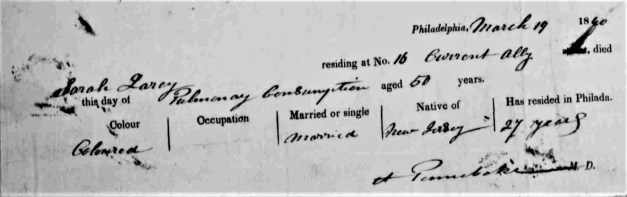
S. Larey

Sarah Larey died this date, March 19th, in 1840 of Tuberculosis and was buried at Bethel Burying Ground. Born in New Jersey, she came to Philadelphia in 1813 when she was approximately thirty-three-year-old. It was reported on the death certificate that she was married, however, I haven’t been able to locate with certainty the name of that spouse.  

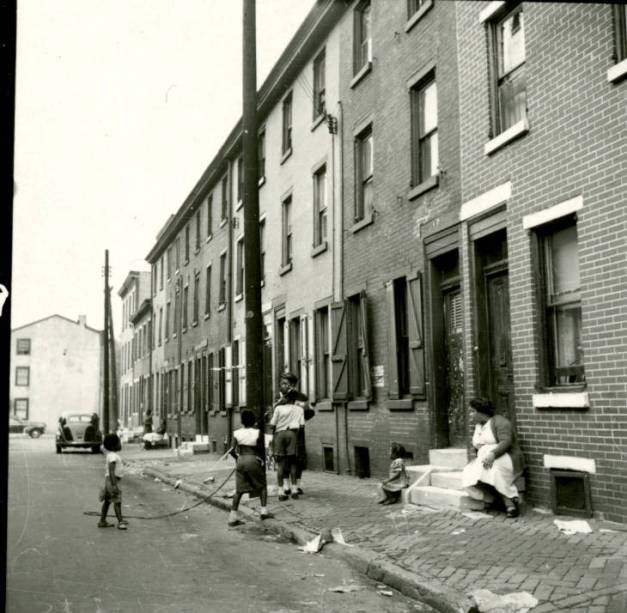
Warnock Street

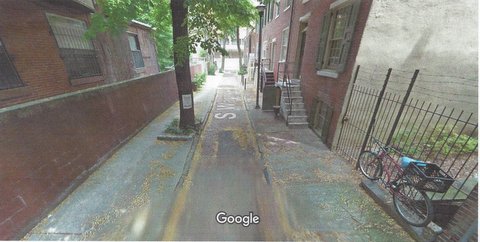
Ms. Larey lived with her family in Currant Alley, now Warnock Street. It is located between Locust and Spruce Streets between 10th and 11th Streets. Above is a photo of Warnock Street in 1926. Below is a photo of what Warnock Street looks like currently.

warnock

Ms. Larey may have been witness to the “riot” that took place in her neighborhood during the summer of 1839.

Screenshot 2019-03-19 16.03.16

“Public Ledger,” 13 August 1839

Official Border


Forty-one-year-old George Hansen died this date, March 15th, in 1846 and was buried at Bethel Burying Ground.

Posted by Terry Buckalew on March 15, 2019
Posted in: On This date. Tagged: African American cemeteries, African American History, African Methodist Episcopal Church, archaeology, Bethel Burying Ground, Mother Bethel, Mother Bethel African Methodist Episcopal Church, Philadelphia, Richard Allen. Leave a comment

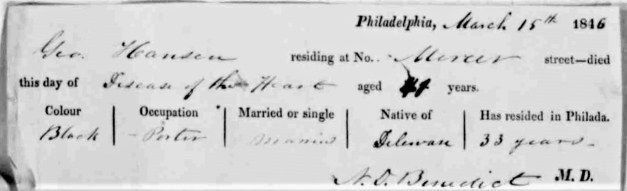
George Hanson

Forty-one-year-old George Hansen died this date, March 15th, in 1846 of heart disease and was buried at Bethel Burying Ground. He was born in Delaware in 1805 and moved to Philadelphia when he was eight years old. At the time of Mr. Hansen’s death, he was employed as a porter. His spouse, Mary Hansen, was employed as a domestic or “day worker.” It is not clear but they may have had a daughter. According to the 1838 Philadelphia African American Census, Ms. Hansen was born in Pennsylvania.

2aefd56eccf0edb1e6227c8348f94409

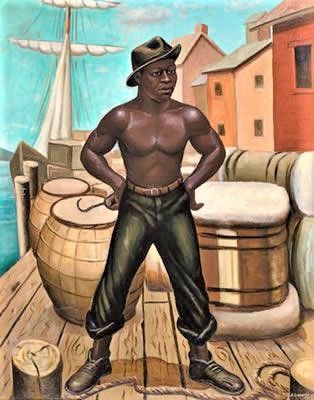
Porters worked where ever something needed to be carried or hauled. Black men were employed in a variety of jobs from hotel porter to longshoremen on the docks of the Delaware and Schuylkill Rivers. They had to labor regardless if it was the steaming heat of the summer or the deadly cold of the winter. If you didn’t work, you didn’t get paid. If you didn’t get paid, the family didn’t eat or the rent wasn’t paid.

Mercer (1)

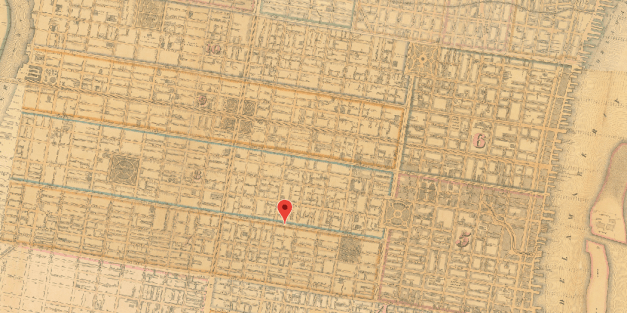
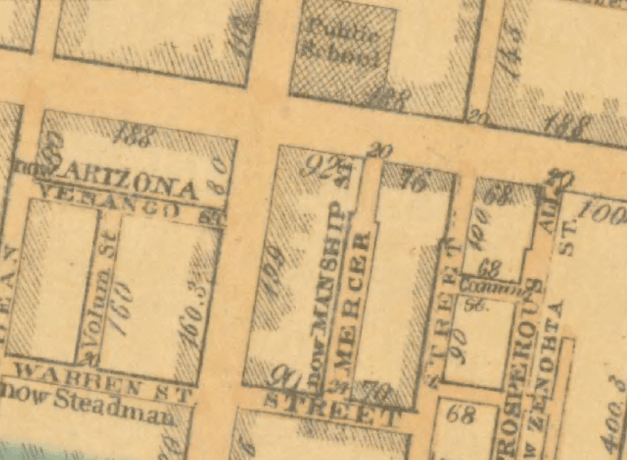
The Hansen family resided on Mercer Street, a short, narrow thoroughfare near 10th and Locust Streets in south-central Philadelphia. They lived in one room for which they paid approximately $2.50 a month. Mr. Hansen would have made between $3 and $5 a week and Ms. Hansen $1-$2. Mercer Street was renamed Manship Street after the Civil War. It no longer exists.

Mercer (2).png

Mr. Hansen died at forty-one-years old. The average age of death for Black males during this period was approximately 44-45 years of age.  

Official Border

George Hansen died on a warm and very windy March day. This was after two days of a strong storm that saw rainfall “in torrents” that flooded the city and put the Schuylkill River wharves under five feet of water. 

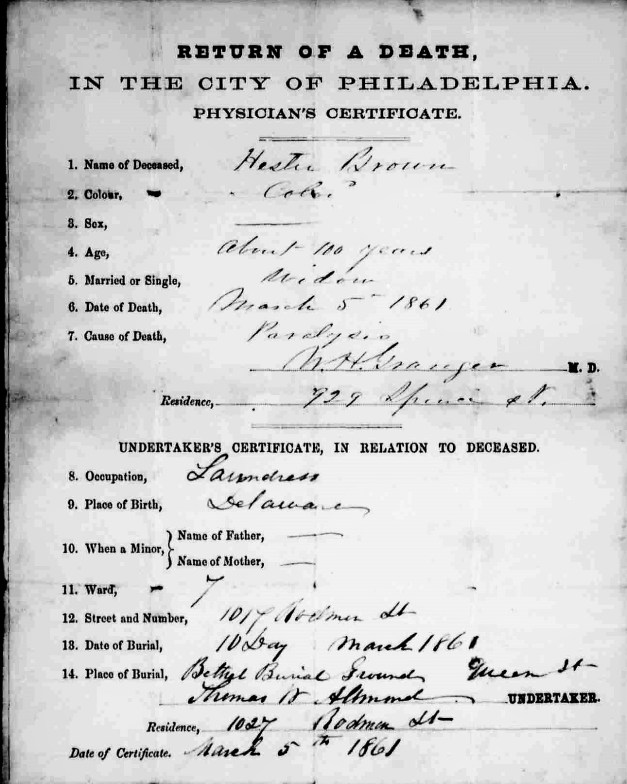
One-hundred-year-old Hester Brown died this date, March 5th, in 1861 and was buried at Bethel Burying Ground.

Posted by Terry Buckalew on March 5, 2019
Posted in: On This date. Tagged: African American burial grounds, African American cemeteries, African American History, African Methodist Episcopal Church, archaeology, Bethel Burying Ground, Mother Bethel, Mother Bethel African Methodist Episcopal Church, Philadelphia, Richard Allen. Leave a comment

HESTER BROWN

Approximately one-hundred-year-old Hester Brown died this date, March 5th, in 1861 and was buried at Bethel Burying Ground. I have not been able to find more personal information than what is on the death certificate. Born in Delaware in approximately 1761, she was most likely born to an enslaved mother at the least. Ms. Brown is not listed in any U.S. censuses or the Philadelphia African American censuses of 1836 and 1847. I also could not locate her in the Philadelphia city directories. Her death certificate reports that she was employed as a laundress. There were no mentions of her in the local newspapers of the era.

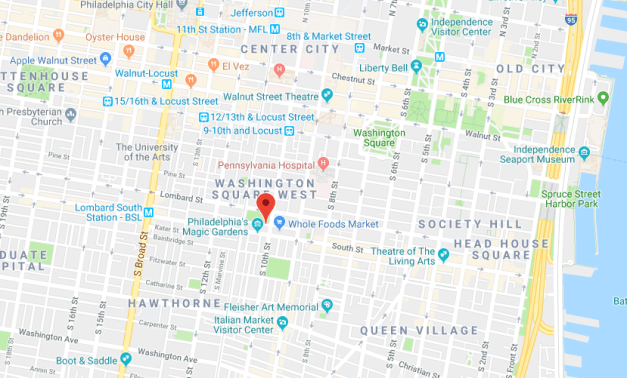
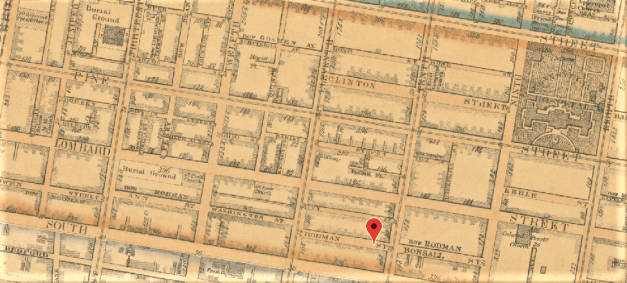
Ms. Brown lived in a room at 1017 Rodman Street, formerly known as Bonsall Street. 

modern rodman

Her address was at the southern limits of center city Philadelphia. 

Rodman map

The 900-1000 blocks of Rodman in 1861 was one of the thriving centers of African American family life. The LeCounts, Bolivars, Proctors, and Durhams, residents of those two blocks, were keystones in the building of educational, cultural, business, religious and civil rights institutions in 19th century Philadelphia. Perhaps none were more important as a role model than Hester Brown’s next door neighbor – The “Black Swan,” aka Elizabeth Taylor Greenfield.


Black Swan 1
Black Swan 2

Elizabeth Taylor Greenfield was born into slavery on a Natzeh, Mississippi plantation in 1819. Her life story is an amazing testament to the human spirit. She became a prominent vocalist that was the first Black person to sing for royalty during a concert attended by Queen Victoria in England. During her career, she traveled to Europe, Canada, and throughout the United States, performing to large crowds in concert and recital settings. In the antebellum United States, her concerts were often under heavy police guard because of the racist threats. She would tour in the Spring and Summer and, during the rest of the year, she was a vocal teacher to budding Black men and women seeking a singing career. Ms. Hester Brown certainly would have heard the beautiful tones wafting down Rodman Street.

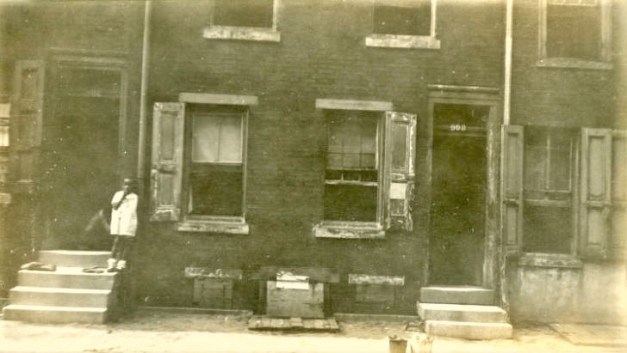
old Rodman Street

908-910 Rodman Street in hard times (1926)

Hester Brown died on a cold March day where the temperature briefly rose to 41 degrees. Ms. Brown was not buried at Bethel Burying Ground for ten days after her death. It is not possible to give a definitive reason for this. Sometimes, if the weather is bad and/or the ground is frozen solid, there could be a delay.  That doesn’t appear to be the case with Ms. Brown after reviewing the weather in 1861 for the months of February and March. It could be that she was indigent and, likely, could not afford a burial plot and Bethel Church eventually stepped up. 

Official Border

Coincidently, the funeral director, Thomas Allmond, who took care of Ms. Brown’s corpse, had his home and business at the same address as Ms. Brown, according to the 1860 city directory. Per the death certificate by 1861, he had moved down Rodman Street to 1027. 

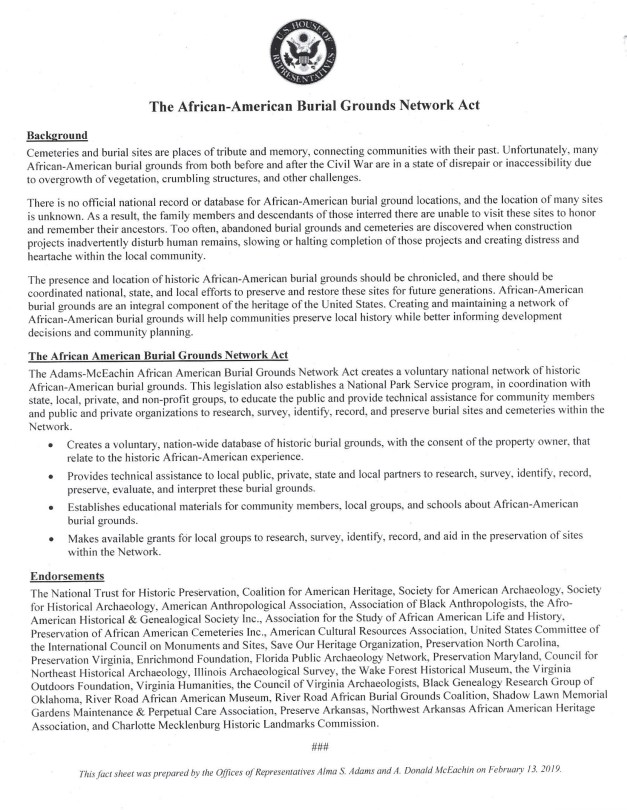
FYI -The African American Burial Grounds Network Act.

Posted by Terry Buckalew on February 23, 2019
Posted in: Uncategorized. Leave a comment

Scan

For current information on this legislation please click on the following –

https://www.forbes.com/sites/davidanderson/2019/02/13/new-legislation-seeks-to-protect-lost-african-american-burial-grounds/#25427ed05dd8

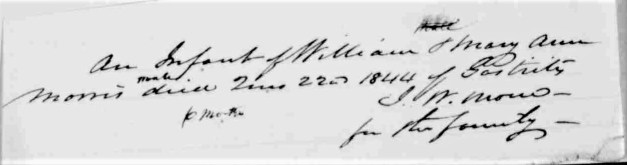
The six-month-old son of Mary Ann and William Morris died this date, February 22nd, in 1844 and was buried at Bethel Burying Ground.

Posted by Terry Buckalew on February 22, 2019
Posted in: On This date. Tagged: African American burial grounds, African American cemeteries, African American History, African Methodist Episcopal Church, archaeology, Bethel Burying Ground, Mother Bethel, Mother Bethel African Methodist Episcopal Church, Philadelphia, Richard Allen. Leave a comment

MORRIS

The six-month-old unnamed son of Mary Ann and William Morris died this date, February 22nd, in 1844 of Gastritis and was buried at Bethel Burying Ground. By 1847, according to the Philadelphia African American Census, Mr. Morris was no longer in public documents.* I have not been able to find a death certificate for him. The 1847 Census reports that Ms. Morris is occupied as a wash woman with two daughters at home between the ages of five and fifteen years of age. Both attend school and can read and write. They were born in Pennsylvania while Ms. Morris was not. Ms. Morris and her children regularly attended church services. She also was a member of a beneficial society in the church. The family lived in one 11’x11′ room at 19 Middle Alley for which they paid $1.25 in rent, likely the equivalent to what Ms. Morris earned in a week of work. Middle Alley was one of the most notorious and deadly pestholes in the city and districts of Philadelphia. Many residents, both adults and children, would die from want of food and medical attention. Infanticide was not uncommon and the city’s coroner was not an infrequent visitor to the unpaved “Murderer’s Row.”

PANAMA STREET


Middle Alley 2

The Morris infant died on a clear day where the temperature rose to 54 degrees. Sadly, Mary Ann Morris would die of Tuberculosis in Blockley Hospital seven years later and was buried in the local Potter’s Field. 

120404084815-catlett-c1-main

ornamental-borders_23-2147514387

*The death certificate is not signed by a physician. It is signed by George W. Morse. There is a man by that name listed in the 1844 City Directory as a “card manufacturer” or printer that prints business and social cards. This individual may have been Mr. Morris’ employer and perhaps gives us a hint at what Mr. Morris did for a living.

Posts navigation

← Older Entries
Newer Entries →
  • Recent Posts

    • Three dead as church wall falls on this date, May 1st, in 1841.
    • The ten-month-old Baby Colgate died this date, June 20th, in 1847, and was buried at Bethel Burying Ground.
    • Fifty-eight-year-old Rachel Dawson died this date, May 3rd, in 1839, and was buried at Bethel Burying Ground.
    • Twenty-eight-year-old Robert Swails died on this date, March 31st in 1849, and was buried at Bethel Burying Ground.
    • Forty-year-old Jacob “Jesse” Howard died on this date, January 29th, in 1840, and was buried at Bethel Burying Ground.
  • Archives

    • May 2024
    • June 2023
    • May 2023
    • March 2023
    • January 2023
    • December 2022
    • November 2022
    • October 2022
    • September 2022
    • August 2022
    • May 2022
    • April 2022
    • March 2022
    • February 2022
    • January 2022
    • December 2021
    • November 2021
    • October 2021
    • September 2021
    • August 2021
    • July 2021
    • June 2021
    • May 2021
    • April 2021
    • March 2021
    • February 2021
    • January 2021
    • December 2020
    • November 2020
    • October 2020
    • September 2020
    • August 2020
    • July 2020
    • June 2020
    • May 2020
    • April 2020
    • March 2020
    • February 2020
    • January 2020
    • December 2019
    • November 2019
    • October 2019
    • September 2019
    • August 2019
    • July 2019
    • June 2019
    • May 2019
    • April 2019
    • March 2019
    • February 2019
    • January 2019
    • December 2018
    • November 2018
    • October 2018
    • September 2018
    • August 2018
    • July 2018
    • June 2018
    • May 2018
    • April 2018
    • March 2018
    • February 2018
    • January 2018
    • December 2017
    • November 2017
    • October 2017
    • September 2017
    • August 2017
    • July 2017
    • June 2017
    • May 2017
    • April 2017
    • March 2017
    • February 2017
    • January 2017
    • December 2016
    • November 2016
    • October 2016
    • September 2016
    • August 2016
    • July 2016
    • June 2016
    • May 2016
    • April 2016
    • March 2016
    • February 2016
    • January 2016
    • December 2015
    • November 2015
    • October 2015
    • September 2015
    • August 2015
    • July 2015
    • June 2015
    • May 2015
    • April 2015
    • March 2015
    • February 2015
    • January 2015
    • December 2014
    • November 2014
    • October 2014
  • Categories

    • Archaeology
    • BBG History
    • Bethel Burying Ground Name Directory
    • Bethel Burying Ground Timeline
    • Burial services
    • Diseases
    • Documents
    • Freemasonry
    • Ignatius Beck
    • It's a fact
    • Maps
    • Neighborhood
    • Newspaper Articles
    • On This date
    • Photographs
    • Uncategorized
    • Videos
  • Meta

    • Create account
    • Log in
    • Entries feed
    • Comments feed
    • WordPress.com
Blog at WordPress.com.
Bethel Burying Ground Project
Blog at WordPress.com.
  • Subscribe Subscribed
    • Bethel Burying Ground Project
    • Join 48 other subscribers
    • Already have a WordPress.com account? Log in now.
    • Bethel Burying Ground Project
    • Subscribe Subscribed
    • Sign up
    • Log in
    • Report this content
    • View site in Reader
    • Manage subscriptions
    • Collapse this bar
 

Loading Comments...