Bethel Burying Ground Project

Bethel Burying Ground Project

  • ABOUT THE BETHEL BURYING GROUND PROJECT

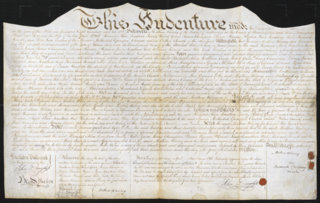
Original Deed of Sale for the Bethel Burying Ground from 1810

Posted by Terry Buckalew on November 11, 2014
Posted in: Documents, Photographs. Tagged: African American burial grounds, African American cemeteries, African American History, archaeology, Bethel Burying Ground, Mother Bethel African Methodist Episcopal Church, Philadelphia, Richard Allen. Leave a comment

Land indenture for Bethel Church

The above is the original “Indenture” or sale agreement for the purchase of the Bethel Burying Ground on April 10, 1810 by Richard Allen and the trustees of Bethel AME Church. The document is owned by the Smithsonian Institute and will be exhibited at the Smithsonian National Museum of African American History and Culture, opening on the National Mall in 2015. The document will be shown along with Harriet Tubman’s shawl, Nat Turner’s Bible, a Tuskegee Airmen fighter plane, Emmett Till’s coffin and an original slave cabin from Edisto Island, South Carolina. (Photo courtesy of the Smithsonian Institue.)

For a larger photo of the document please click on Smithsonian Document II

On this date, November 10th, in 1847 the Philadelphia Board of Health issues orders to BBG trustees

Posted by Terry Buckalew on November 9, 2014
Posted in: On This date. Tagged: African American burial grounds, African American cemeteries, African American History, archaeology, Bethel Burying Ground, Mother Bethel African Methodist Episcopal Church, Philadelphia, Richard Allen. Leave a comment

When initially established in 1810 the Bethel Burying Ground was a rural cemetery. Maps of the era show the land as a pasture used by local farmers for grazing cattle and sheep. There were no paved or graded roads, just dirt paths. However, this “suburb” of Philadelphia quickly grew, eventually placing the small cemetery literally in the backyards of tenements on Catherine Street and row homes on Queen and Weccacoe Streets.

And unfortunately in time, like many other graveyards in Philadelphia. BBG fell into poor condition and the trustees of Bethel Church were issued warnings several times in its existence (1810-1889) by the Philadelphia Board of Health to repair and clean up the nuisances asserted by the neighbors that bordered the burial ground.

On November 10, 1847 the Philadelphia Board of Health ruled that BBG was a public nuisance following complaints by neighbors and an inspection by Board members. They issued the an order to the Church’s trustees: “You are hereby notified, that in all future interments made therein each body shall be deposited in the grave six feet in depth, and filled up with earth to a level with the proper surface of the ground; and that nobody shall be kept upon any part of the said grounds, or in any place appertinent and thereto, for a longer period than two hours previous to it being interred as above directed.” Philadelphia Board of Health Minutes for November 10, 1847.

It appears from the archeological record that the trustees answer to the problems was to build a two-foot high brick wall around the graveyard and backfill it with soil. This not only solved the problem of human remains being exposed, but allowed the trustees to bury more bodies in a very crowded area.

“The fact that the cemetery wall is not anchored into the underlying subsoil—but rather sits on top of the buried historic ground surface—and is bounded on either side by visually distinct fill deposits—strongly suggests that this enclosure was originally constructed at or about the time that fill soils were deposited both inside the cemetery grounds and in the adjacent backyards, in order to fill up low-lying areas and level the ground surface. Based on findings from the Phase IA investigation, it was previously thought that this fill was perhaps brought in after the cemetery was closed—possibly during the tenure of Barnabas H. Bartol (1869–1873) or in conjunction with the city’s first improvements to Weccacoe Square in the early 1890s. However, information from the Phase IB study now suggests that this fill material was probably put down at a time relatively late in the period that Mother Bethel was still actively using the burial ground.” (Page 4.1 – Phase IB Archaeological Investigations of the Mother Bethel Burying Ground, 1810 – Circa 1864ER No. 2013-1516-101-A).
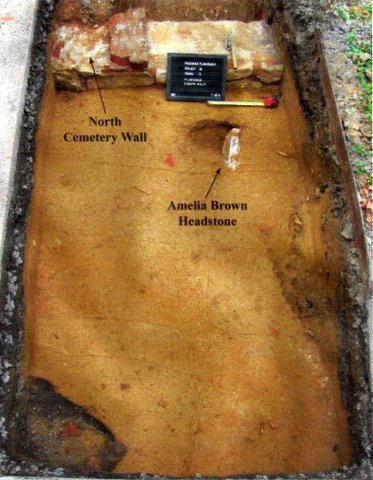
North Wall

Photo of the north retaining wall of the BBG with the headstone of Amelia Brown protruding from the soil. This photo is in the archeological report page 3.17.


“In the 18th and early 19th-century churchyards became increasingly crowded. They became filled and their management became a problem. The limited financial security of a congregation often led to a movement of places of worship and abandonment of burial grounds, which were then redeveloped, and several in Philadelphia have been examined. (Mortuary Monuments and Burial Grounds of the Historic Period, H.C. Mytum, p. 45.)

National Register of Historic Places application

Posted by Terry Buckalew on November 8, 2014
Posted in: Documents. Tagged: African American burial grounds, African American History, archaeology, Bethel Burying Ground, Mother Bethel African Methodist Episcopal Church, Philadelphia, Richard Allen. Leave a comment

In July of this year, The Friends of Bethel Burying Ground Coalition submitted paperwork to the Pennsylvania Historic and Museum Commission (PHMC) as the first step in having Bethel Burying Ground placed on the National Register of Historic Places which is administered by the National Park Service. This application was the work of several members of the Coalition and Dr. Aaron Wunsch of the University of Pennsylvania’s School of Design whose generous assistance was critical. There is a hearing by PHMC in February of 2015 to examine the viability of the Coalition’s application. If approved it will go to the National Park Service for review and judgment. To read the Coalition’s application please click on the following –  BBG NR Nom Final Draft (revised)

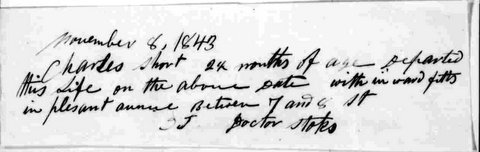
Two-year-old Charles Short died this date, November 8th, in 1843 and is buried at Bethel Burying Ground

Posted by Terry Buckalew on November 8, 2014
Posted in: On This date. Leave a comment

Charles Short

Two-year-old Charles Short “departed this life”, November 8th, in the year 1843. He resided with his family in the Northern Liberties neighborhood of the city. His home would have been near present-day  7th Street and Fairmount Avenue. The cause of Charles death was reportedly from “Inward Fits.” Also known at the time as “Spasmodic Croup.” The majority of the child inflicted with this disease did not die. However, when it did prove to be fatal it was from the child dying from suffocation due to the severity of the “fit” or spasm of the muscles in the throat. It is often seen as an early symptom of Hydrocephalus.

Video of archaeologist presenting findings at the Bethel Burying Ground, Philadelphia, PA, July 24, 2013.

Posted by Terry Buckalew on November 7, 2014
Posted in: Videos. Tagged: African American burial grounds, African American cemeteries, African American History, archaeology, Bethel Burying Ground, Mother Bethel African Methodist Episcopal Church, Philadelphia, Richard Allen. Leave a comment

In July 2013, the URS Corporation (URS) conducted a Phase IB archaeological investigation of the Mother Bethel African Methodist Episcopal Church Burying Ground (1810–circa 1864), located in the Queen Village neighborhood of Philadelphia. This investigation was performed on behalf of the Pennsylvania Horticultural Society (PHS) and in advance of planned renovations to the City of Philadelphia’s Weccacoe Playground property (circa 1906–present). Proposed improvements to the playground have the potential to impact portions of Mother Bethel’s cemetery, which remains preserved below the southwest corner of the larger property. This investigation was conducted in order to collect critical information that would allow playground renovations to move forward in a manner that would not impact historic burials, and that will ensure the long-term preservation of this significant African American burying ground.

Phase IB testing involved the excavation of four backhoe trenches within and along the boundaries of the cemetery. Trench excavations only extended to the point below surface at which archaeological evidence associated with the cemetery was encountered. In most instances, the burial-related evidence identified consisted of well-preserved grave shaft features; however, in a handful of cases, trench excavation was halted when decayed, intact coffin wood was exposed. At no point during this investigation were intact human skeletal remains exposed, uncovered, or disturbed.

Trench excavations succeeded in producing a significant amount of information related to the Mother Bethel Burying Ground. In particular, testing was able to determine that soils containing evidence of intact burial features are present immediately below the playground asphalt and gravel sub-base. While the depth below surface at which burial evidence was identified did vary somewhat across the cemetery, the shallowest depth at which grave shafts appeared was approximately 1.8 feet below the present surface. Evidence of intact burial remains was identified at depths of between 2.5 and 3 feet below the surface.

Additional findings from this investigation included:

  • the identification of the intact north and east walls bounding the cemetery;
  • no indication that burials extend beyond the known limits of the cemetery and its perimeter walls;
  • evidence that the cemetery grounds were filled in and leveled—most likely in the midnineteenth century, toward the end of its period of active use; the determination that intact burials are contained within these later fill soils;
  • historical documentation suggesting that the cemetery could contain a significantly greater number of burials than originally thought; and evidence suggesting that some unknown number of burials have been disturbed during prior construction and renovation activities within the playground

The above is from the URS report titled Phase IB Archaeological Investigations of the Mother Bethel Burying Ground, 1810 – Circa 1864 ER No. 2013-1516-101-A. To view the report see 10/28/14 posting.

To view a video of lead archeologist, Doug Mooney discussing his team’s findings click on – https://www.youtube.com/watch?v=Sxj-Nn2Xs-s&feature=youtu.be

Reverend Jacob Tapsico died this date, November 6th, in 1820 and was buried at Bethel Burying Ground

Posted by Terry Buckalew on November 6, 2014
Posted in: On This date. Tagged: African American burial grounds, African American cemeteries, African American History, Bethel Burying Ground, Mother Bethel African Methodist Episcopal Church, Philadelphia, Richard Allen. Leave a comment

TapsicoThe Reverend Jacob Tapsico died this date, November 6th, in 1820 of “convulsions.” He was 51 years of age.  A soap maker, he eventually became the second ordained Elder of the Mother Bethel A.M.E. Church and the second pastor of Mother Bethel. His home was on in the 700 block of Shippen Street (now Bainbridge Street) in the Bella Vista neighborhood of the city. For more information on Rev. Tapsico, please read Freedom’s Prophet by Richard S. Newman (p. 168).


The Bethel Burying Ground Name Directory

Posted by Terry Buckalew on November 5, 2014
Posted in: Bethel Burying Ground Name Directory. Tagged: African American burial grounds, African American cemeteries, African American History, Bethel Burying Ground, Mother Bethel African Methodist Episcopal Church, Philadelphia, Richard Allen. Leave a comment

INTRODUCTION TO THE BETHEL BURYING GROUND NAME DIRECTORY

 The Bethel Burying Ground Name Directory is an alphabetical databank of the individuals buried at the Bethel Burying Ground (BBG) that still had existing death certificates on file in the Philadelphia City Archives. There are several individuals listed that had no certificates, but information was gathered for these individuals from an obituary or newspaper article. These few are footnoted. Out of the official estimate of 5,000+ who were buried at BBG, approximately 2,400 are listed in the Directory. In the City Archives’ collection there are records of complete years missing and, within many years, there are numerous months missing. Add to that situation the fact that not all who died in early Philadelphia left death certificates we are left with an incomplete record.

Looking at some of the names, you may believe there is a typographical error. I have attempted to translate the written word as it appears on the official documents. Many times the individual who wrote the death certificate or “Cemetery Return” did not personally know the deceased and is obtaining the person’s name second or third-hand. Illiteracy was common and physicians, every so often, did not take the time to add more than a couple scrawled lines.

There is a Medical Glossary at the end of the Directory. There are many archaic medical terms in the Directory that are no longer used in our current society. In the 19th century, the cause of death was not as important as it is today. With the advance of science, we can pinpoint the cause of death down to the cellular level. During the era of the BBG (1810-1864), it would not be uncommon to have listed the cause of death by just symptoms, such as, as cough, heartburn or swelling. Tuberculosis was certainly the overwhelming cause of death due to the deplorable living conditions that existed in the densely crowded tenements and alleys where the TB microorganism thrived. The Latin term “Phthisis Pneumonalis” was commonly written by the attending physician. I have reduced this to simply “TB” as a space saver.

There is an overwhelming amount of children buried in the BBG. Slightly over 38% of the total buried were children 2 years old and younger. Many were born weak from poorly nourished mothers. Starvation and wasting diseases made the infants weakened immune systems extremely vulnerable to infection from dozens of different viruses and bacteria. With no antibiotics, septicemia (blood poisoning) was always a real threat.

Finally, The Name Directory is a fluid document subject to updates. I encourage people to email me with new information, questions or suggestions. My email address is tebuckalew@gmail.com.

Please click on the following to go to the Directory. BETHEL BURYING GROUND NAME DIRECTORY


Terry Buckalew

Short Film on The Bethel Burying Ground Project

Posted by Terry Buckalew on November 4, 2014
Posted in: Videos. Tagged: African American burial grounds, African American cemeteries, African American History, Bethel Burying Ground, Mother Bethel African Methodist Episcopal Church, Richard Allen. Leave a comment

Brittani Moncrease and Angela Porter (Nebty Productions) have produced a very worthwhile  educational short film on The Bethel Burying Ground Project. Please click on

Map of Bethel Burying Ground and the Weccacoe Playground

Posted by Terry Buckalew on October 31, 2014
Posted in: Documents. Leave a comment

BBG Map

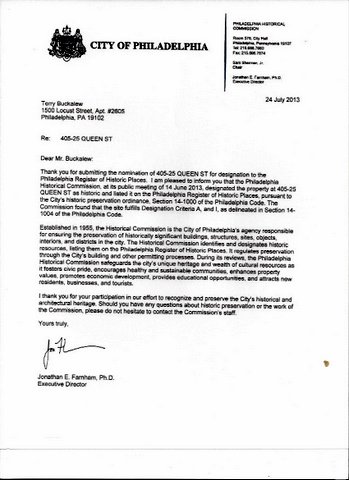
Philadelphia Historical Commission Award Letter Protecting BBG

Posted by Terry Buckalew on October 30, 2014
Posted in: Documents. Leave a comment

Commission Letter


BBG Hx Comm award letter

Posts navigation

← Older Entries
Newer Entries →
  • Recent Posts

    • Three dead as church wall falls on this date, May 1st, in 1841.
    • The ten-month-old Baby Colgate died this date, June 20th, in 1847, and was buried at Bethel Burying Ground.
    • Fifty-eight-year-old Rachel Dawson died this date, May 3rd, in 1839, and was buried at Bethel Burying Ground.
    • Twenty-eight-year-old Robert Swails died on this date, March 31st in 1849, and was buried at Bethel Burying Ground.
    • Forty-year-old Jacob “Jesse” Howard died on this date, January 29th, in 1840, and was buried at Bethel Burying Ground.
  • Archives

    • May 2024
    • June 2023
    • May 2023
    • March 2023
    • January 2023
    • December 2022
    • November 2022
    • October 2022
    • September 2022
    • August 2022
    • May 2022
    • April 2022
    • March 2022
    • February 2022
    • January 2022
    • December 2021
    • November 2021
    • October 2021
    • September 2021
    • August 2021
    • July 2021
    • June 2021
    • May 2021
    • April 2021
    • March 2021
    • February 2021
    • January 2021
    • December 2020
    • November 2020
    • October 2020
    • September 2020
    • August 2020
    • July 2020
    • June 2020
    • May 2020
    • April 2020
    • March 2020
    • February 2020
    • January 2020
    • December 2019
    • November 2019
    • October 2019
    • September 2019
    • August 2019
    • July 2019
    • June 2019
    • May 2019
    • April 2019
    • March 2019
    • February 2019
    • January 2019
    • December 2018
    • November 2018
    • October 2018
    • September 2018
    • August 2018
    • July 2018
    • June 2018
    • May 2018
    • April 2018
    • March 2018
    • February 2018
    • January 2018
    • December 2017
    • November 2017
    • October 2017
    • September 2017
    • August 2017
    • July 2017
    • June 2017
    • May 2017
    • April 2017
    • March 2017
    • February 2017
    • January 2017
    • December 2016
    • November 2016
    • October 2016
    • September 2016
    • August 2016
    • July 2016
    • June 2016
    • May 2016
    • April 2016
    • March 2016
    • February 2016
    • January 2016
    • December 2015
    • November 2015
    • October 2015
    • September 2015
    • August 2015
    • July 2015
    • June 2015
    • May 2015
    • April 2015
    • March 2015
    • February 2015
    • January 2015
    • December 2014
    • November 2014
    • October 2014
  • Categories

    • Archaeology
    • BBG History
    • Bethel Burying Ground Name Directory
    • Bethel Burying Ground Timeline
    • Burial services
    • Diseases
    • Documents
    • Freemasonry
    • Ignatius Beck
    • It's a fact
    • Maps
    • Neighborhood
    • Newspaper Articles
    • On This date
    • Photographs
    • Uncategorized
    • Videos
  • Meta

    • Create account
    • Log in
    • Entries feed
    • Comments feed
    • WordPress.com
Blog at WordPress.com.
Bethel Burying Ground Project
Blog at WordPress.com.
  • Subscribe Subscribed
    • Bethel Burying Ground Project
    • Join 48 other subscribers
    • Already have a WordPress.com account? Log in now.
    • Bethel Burying Ground Project
    • Subscribe Subscribed
    • Sign up
    • Log in
    • Report this content
    • View site in Reader
    • Manage subscriptions
    • Collapse this bar
 

Loading Comments...