Bethel Burying Ground Project

Bethel Burying Ground Project

  • ABOUT THE BETHEL BURYING GROUND PROJECT

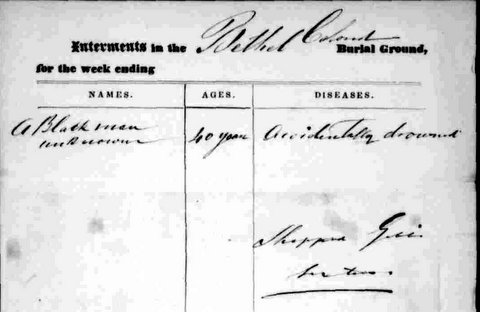
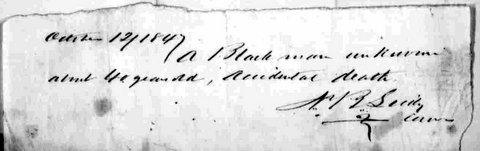
A 40-year-old “Black man unknown” was buried this date, October 12th, in 1847 at Bethel Burying Ground

Posted by Terry Buckalew on October 12, 2015
Posted in: On This date. Tagged: African American burial grounds, African American cemeteries, African American History, archaeology, Bethel Burying Ground, Mother Bethel African Methodist Episcopal Church, Philadelphia, Richard Allen. Leave a comment

A Black man, approximately 40 years old, accidentally drowned and was buried this date, October 12th, in 1847 at Bethel Burying Ground. The process by which a stranger to everyone can evidently be buried at Bethel is unknown. The majority of those with no given name buried at BBG are for the most part infants or babies born dead and have not yet been given a name. The circumstances around this man’s dead suggest suicide in my experience. Yet I have not been able to locate any newspaper account of such an event. Did one of the Church’s beneficial societies learn of his death and agree to bury him? Normally in a case like this he would have been buried in Potter’s Field. Hopefully, his story will not end here and further evidence will surface in the future. 


record-image_ 1


2


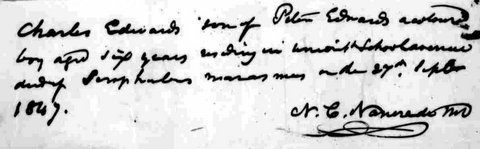
Six-years-old Charles Edwards died this date, September 27th, in 1847 and was buried at Bethel Burying Ground

Posted by Terry Buckalew on September 27, 2015
Posted in: Uncategorized. Leave a comment

Edwards (1)

Charles Edwards, 6 years old, died this date, September 27th, in 1847 of Scrofulous Marasmus (malnutrition) and was buried at Bethel Burying Ground. Charles lived with his parents and sibling near at the intersection of Union Street and School Avenue near 2nd and Spruce Streets in Philadelphia. Charles’ father, Peter, was a day labourer, possibly on the nearby wharves and warehouses. Six-year-old Charles lived with a sibling and his parents in a 9ft. x 9ft. room for which they paid a weekly rent of $0.62 according to the 1847 African American Census.

For more details on the disease that killed Charles please go to http://www.tenement.org/encyclopedia/diseases_marasmus.htm.

Description of the wall around Bethel Burying Ground and its front gate

Posted by Terry Buckalew on September 23, 2015
Posted in: Newspaper Articles. Tagged: African American burial grounds, African American cemeteries, African American History, Bethel Burying Ground, Mother Bethel African Methodist Episcopal Church, Philadelphia, Richard Allen. Leave a comment
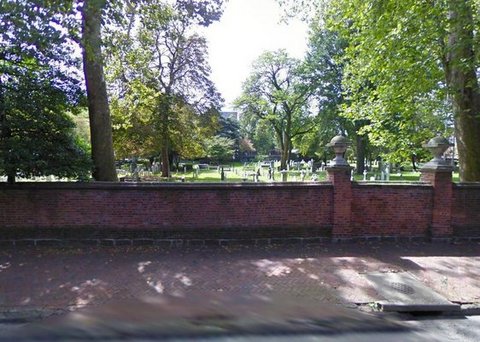
St. Peter's brickwall

The wall surrounding St. Peter’s Cemetery at 313 Pine Street, Philadelphia, PA

“What is now known as Weccacoe Park, in quaint old Southwark, was, a few years ago, the old burial ground of Bethel African Methodist Episcopal Church. It was back in the early years of the century when Bethel Burying Ground was first used, the property having been secured by Richard Allen, The first African Methodist Episcopal bishop. At that time, colored people after death were often treated with but little respect and it was a wish to set apart a place where his people could have the same kind of Christian burial as the white people. Just in what way he got the property is not clear. But having gained possession of that he made it over to Bethel Church, signifying that all who were unable to pay for their dead should be given sufficient ground without cost. A brick wall similar to the one that encloses old Saint Peter was built around the lot and iron gates were erected on the Queen street [sic] front (Emphasis added). As years pass the population of the little grave-yard increased and soon the ground was dotted with tombstones. Before many years, the plot was found to be entirely inadequate and sometimes five bodies were put in a single grave. This led to unfortunate results; for when in succeeding years, the rain beat down upon old Bethel Burying Ground, the water washed the bones of the dead out of the graves and the Board of Health was forced, out of regard for the health of Southwark, to interpose. It has been over 25 years now since any burials have taken place in Bethel, and after the Board of Health issued its mandate the ground was neglected and rapidly went to ruin. The idea of its purchase by the city came through a letter from a lady residing in that neighborhood addressed to the chairman of the sub-committee on small parks. The committee on municipal government indorsed [sic] a recommendation to purchase the plot, and it was in the first batch of small park ordinances passed.”      The Times Sunday (Philadelphia), April 24, 1892, p. 1.

1-St. Peter's front gate 1909

                                            The front gate of St. Peter’s

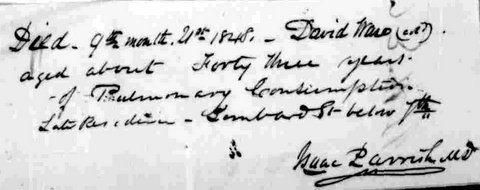
Forty-three-year-old Rev.David Ware died this date, September 21th, in 1848 and was buried at Bethel Burying Ground

Posted by Terry Buckalew on September 21, 2015
Posted in: On This date. Tagged: African American burial grounds, African American cemeteries, African American History, archaeology, Bethel Burying Ground, Mother Bethel African Methodist Episcopal Church, Philadelphia, Richard Allen. Leave a comment

David Ware

The Reverend David Ware, 43, died this date, September 21st in 1848 and was buried at Bethel Burying Ground on the 27th. He was stricken with Tuberculosis six months before his death and bore his illness with “Christian fortitude” according to his obituary.* Rev. Ware was a school teacher, principal, Bethel Church deacon, steward, secretary, trustee and considered “one of the ablest men of his day,” according to African Methodist Episcopal history.** 

Rev. Ware was a teacher and principal of his own private school. In 1847 enrollment at the school was reported to be 56 students from 4 different districts in the County and City of Philadelphia. For many years he was the superintendent of  Bethel’s Sunday School with an enrollment of 300 students and a staff of 24 teachers.*** Before his death he was tasked with creating a high school for Black students. His illness prevented him from fulfilling that assignment. **** 

The Ware family lived in the 600 block of Lombard Street only yards away from Bethel Church. The Philadelphia African-American Census of 1847 reported 6 total members of the family (2 males; 4 females; Under 5 Yrs., 1; Under 15 Years, 1; Under 50 years, 4). A total of five family members could read and write with all the children being educated at Rev. Ware’s school. The four females in the family were employed as a teacher, dressmaker and two were engaged as domestics.  

Sadly, the Ware family suffered the loss of their son and brother, William J. Ware on November 21, 1847. He was nineteen at the time of his death from tuberculosis. The same disease that took his father. It is very likely they are buried next to each other at Bethel Burying Ground.

*Public Ledger, September 23, 1848, p.2. 

** Bethel Gleanings, Rev. Joseph S. Thompson (1881), p. 40. Available at  http://stillfamily.library.temple.edu/bethel-gleanings-page-1; in the same reference (p. vii), Bishop Payne makes note of Rev. Ware “beauty of penmanship” and substantial “detailed entries” as Secretary of Bethel Church for many years. As a layman, Rev. Ware was not considered a minister and Payne points this out as he laments the total lack of literacy among A.M.E. itinerant ministers. It is apparent that Rev. Ware was responsible for the recording and documenting numerous aspects of the Church’s organization during his adult lifetime.  

*** A statistical inquiry into the conditions of the people of colour of the city and districts of Philadelphia, p. 21. Available at http://babel.hathitrust.org/cgi/pt?id=umn.319510023192154;view=1up;seq=3.

**** History of the African Methodist Episcopal Church, Bishop David Alexander Payne, pp. 142 and 177. Available                                                  at http://docsouth.unc.edu/church/payne/payne.html

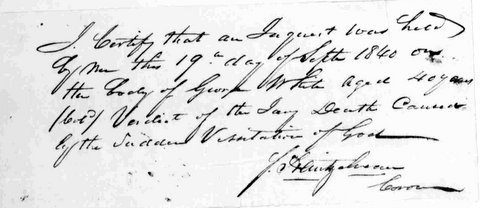
Forty-year-old George White died this date, September 19th, in 1840 and was buried at Bethel Burying Ground

Posted by Terry Buckalew on September 19, 2015
Posted in: On This date. Tagged: African American burial grounds, African American cemeteries, African American History, archaeology, Bethel Burying Ground, Mother Bethel African Methodist Episcopal Church, Philadelphia, Richard Allen. Leave a comment

record-image_S3HT-6S29-9ZD

Forty-year-old George White died this date, September 19th, in 1840 from a “Sudden Visitation of God” and was buried at Bethel Burying Ground. Five days later the Public Ledger newspaper would report that Mr. White collapsed on Shippen Street (now Bainbridge) and died from Consumption (Tuberculosis). *

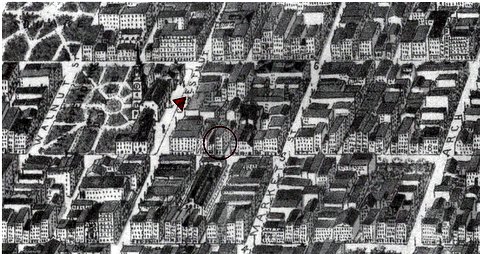
From Federal Census Records and Philadelphia city directories it appears that Mr. White and his family lived at 160 S. 5th Street in the block north of Independence Hall. He was employed as a porter earning approximately $5 a week if he was able to find full-time employment. There is no additional information on his family members at this time.

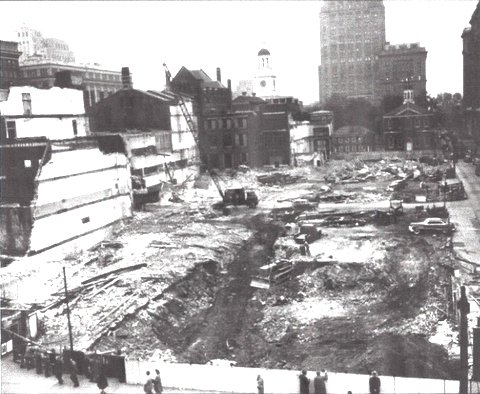
This perspective map shoulds the location of the White’s home (circle) in relationship to Independence Hall (arrow) on Chestnut Street. In the early 1950s the homes on the White’s block were torn down to create the Independence Square Mall. 

Mall (1)

Below is a photo from the Evening Bulletin (Philadelphia) dated November 1, 1951. It shows the complete demolition of the three blocks directly north of Independence Hall (in the background) which included the White’s address. 

Scan mmmm (1)

*Public Ledger, September 21, 1840

THE NEIGHBORHOOD – 1962

Posted by Terry Buckalew on September 14, 2015
Posted in: Neighborhood. Tagged: African American burial grounds, African American cemeteries, African American History, archaeology, Bethel Burying Ground, Mother Bethel African Methodist Episcopal Church, Philadelphia, Richard Allen. Leave a comment

Track a (1)

The Weccacoe Playground that sits atop the Bethel Burying Ground has witnessed the changing ethnic makeup of the surrounding neighborhood in the 20th Century. It has gone from Russian Jews to Italian and to African American in the 1940s, 50s and the early 60s. The above February 20, 1962 Philadelphia Tribune photo illustrates the depth of the African American community in the Southwark community during this period.

Twenty-eight-year-old George Blake was buried this date, September 12th, in 1847 at Bethel Burying Ground

Posted by Terry Buckalew on September 12, 2015
Posted in: On This date. Tagged: African American burial grounds, African American cemeteries, African American History, archaeology, Bethel Burying Ground, Mother Bethel African Methodist Episcopal Church, Philadelphia. Leave a comment

George Blake

On the evening of September 7, 1847, George Blake, 28, was a passenger on the steamboat Portsmouth coming back to Philadelphia from a day excursion trip to Salem, New Jersey on the Delaware Bay. At approximately 10 PM the steamboat collided in the dark with another ship and Mr. Blake was thrown overboard.* His body was not found until the 12th when the City Coroner ruled his death an accidental drowning. Mr. Blake’s brother John ran an ad in the September 11th edition of the Public Ledger newspaper offering a “suitable reward” for the return of the body of his brother. At the time of his death, George was wearing a “black frock coat, green satin vest and dark pantaloons.” John Blake lived no. 44 St. Mary Street in the Cedar Section of the City.**

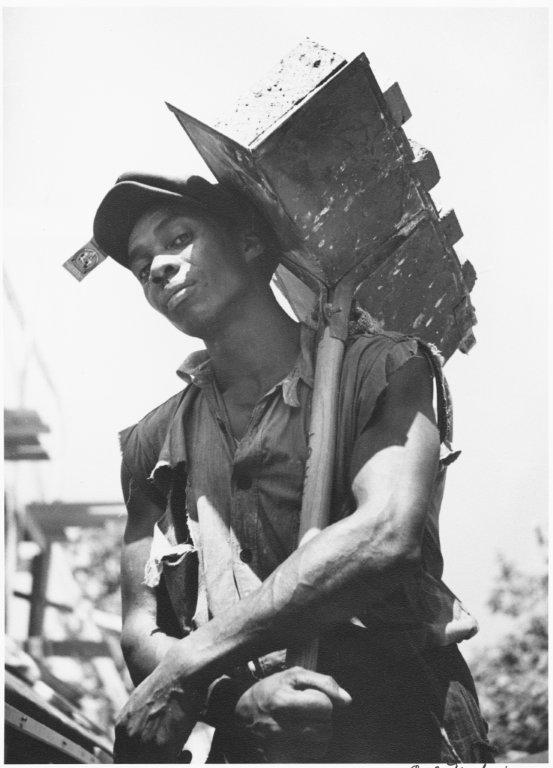
From the 1847 African American Census it appears that George and John were living at the same address and that both worked as hod carriers (brick carrier).

brick carrier

            A young African American hod carrier

*Philadelphia Inquirer, September 11, 1847.

The Rev. Joseph Cox died this date, September 5th, in 1843 and was buried at Bethel Burying Ground.

Posted by Terry Buckalew on September 5, 2015
Posted in: On This date. Tagged: African American burial grounds, African American cemeteries, African American History, archaeology, Bethel Burying Ground, Mother Bethel African Methodist Episcopal Church, Philadelphia, Richard Allen. Leave a comment
Scan

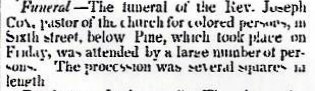
                                                     Public Ledger, 9 September 1843

The Reverend Joseph Cox, 65 years of age, died of an intestinal problem on this date, September 5th, in 1843 and was buried at Bethel Burying Ground. He was pastor of Bethel Church from 1834-1840. Originally a tanner, he became a preacher and then an elder of Bethel AME Church in the 1820s. Bishop Cox was the brother of preacher Rebecca Cox Jackson. His funeral was on September 8th at his late residence on Gaskill Street, a few doors below Fifth. His funeral procession to Bethel Burying Ground was several blocks in length according to The Public Ledger (9 Sept 1843). In all likelihood he was buried next to the body of his son John who died of Tuberculosis at the age of nine in 1832 and was buried at Bethel Burying Ground.

For much more information on Rev. Cox and Rebecca Cox Jackson please see – Gifts of Power: The Writings of Rebecca Jackson, Black Visionary, Shaker by Rebecca Jackson. It is available at Google Books.

Ten-year-old Albert Washington died this date, September 4th, in 1848 and was buried at Bethel Burying Ground

Posted by Terry Buckalew on September 5, 2015
Posted in: On This date. Tagged: African American burial grounds, African American cemeteries, African American History, archaeology, Bethel Burying Ground, Mother Bethel African Methodist Episcopal Church, Philadelphia, Richard Allen. Leave a comment

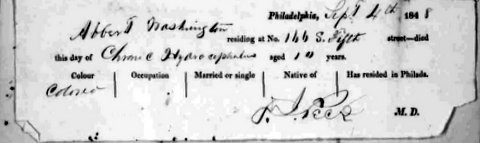
record-image_S3HY-6GBC-N5

Ten-year-old Albert Washington died this date, September 4th, in 1848 of Chronic Hydrocephalus and was buried at Bethel Burying Ground. He was the son of George Washington, a boot black, who lived at 166 S. 5th Street and worked at 75 Chestnut Street (Front and Chestnut Streets). Albert’s mother name is unknown at this time, however, the 1847 African American Census reports that she was employed as a shopkeeper earning about $80 a year. George is reportedly earning about $17 a month. The rent for their room is $92 for the year. Both parents attended religious services.

Revised Historical Timeline for Bethel Burying Ground

Posted by Terry Buckalew on August 28, 2015
Posted in: Bethel Burying Ground Timeline, Documents. Tagged: African American burial grounds, African American cemeteries, African American History, archaeology, Bethel Burying Ground, Mother Bethel African Methodist Episcopal Church, Philadelphia, Richard Allen. Leave a comment

TIMELINE FOR BETHEL BURYING GROUND (BBG)  

(Revised 8/31/2015)
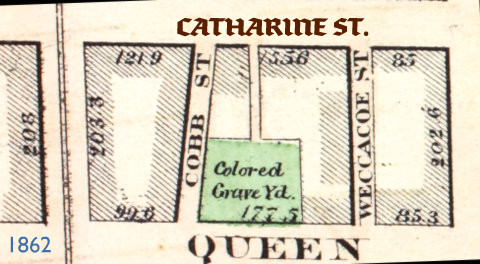
1862 map PP


Prior to March 7, 1810:      In late February or early March of 1810, the trustees of the Ebenezer Methodist Church of Southwark considered the purchase of the Queen Street lot for use as a burial ground. The asking price was $1,700. They instead purchased a lot on Christian Street. (The History of Ebenezer M.E. Church of Southwark, Philadelphia (Philadelphia: Lippincott, 1890, 62).

28 April 1810:                       The parcel of ground bordered by the 400 block of Queen Street to the south, the 400 block of Catharine Street to the north, the 800 block of Leithgow Street (formerly Weccacoe Street) to the east and the 800 block of Lawrence Street (formerly Cobb Street) to the west in the Queen’s Village section of Philadelphia is purchased by Reverend Richard Allen and the Trustees of Mother Bethel African Methodist Episcopal (AME) Church on April 28, 1810 for $1,600.

1819:                                      A letter to The Philadelphia Register by a white man describes a funeral procession and burial at BBG of an unnamed Black man who was employed as a woodsawyer.                                                     The procession was led by his professional society.

“The society walked by the grave, and were followed by many whose dress was comfortable, and whose appearance was neat. When we entered the burial ground of Bethel church, they commenced singing a hymn appropriate to the occasion, which was continued round the grave, and had a very solemn and impressive effect. When it was finished the preacher (a “coloured” man) delivered a discourse. . . . One sentence I particularly remember: “The greatest text is an open sepulcher, and the loudest voice that can be addressed to you will soon be heard on the boards of the coffin. (The Philadelphia Register and National Recorder, vol. 1; Jan to June, 1819, p. 84-85.

1835:                                      BBG is included in the city guide “Picture of Philadelphia: Being a complete guide for strangers.” Map coordinates are given for “Bethel Church-Burial Ground.” (p. 232)

10 Nov 1847:                         The Philadelphia Board of Health notifies Bethel Church officials that the BBG is a public nuisance following complaints by neighbors and an inspection by Board members. “You are hereby notified, that in all future interments made therein each body shall be deposited in the grave six feet in depth, and filled up with earth to a level with the proper surface of the ground; and that nobody shall be kept upon any part of the said grounds, or in any place appertinent and thereto, for a longer period than two hours previous to it being interred as above directed.” Philadelphia Board of Health Minutes for November 10, 1847.

12 May 1848:                        Rev. John Boggs, one of the early legends of the itinerant ranks of AME clergy, is buried at BBG. His funeral was attended by one thousand mourners including 200 clergymen. (PCDC and My Recollections of African M. E. Ministers, or Forty Years’ Experience in the African Methodist Episcopal Church: Electronic Edition. Wayman, A. W., 1821-1895.)

14 Oct 1849:                          Ignatius Beck is buried at BBG; as an enslaved laborer worked on the construction of the U.S. Capitol Building.

1850:                                      Bethel Church burial records “were lost,” according to William Carl Bolivar, “in the church Dissension of 1850.” (The Philadelphia Tribune, 10 Oct 1914)

1 Jan 1869:                            “Sixty years after the purchase of the ground that was long used by Mother Bethel as a burial ground,” the Trustees of Bethel rented the burial ground out on the first of January, 1869 to Barnabas H. Bartol, a sugar refiner, for 10 years at $500 per year; the lot is to be used for the storage of wagons and drays. (The Philadelphia Tribune, 3 December 1921)

City of Philadelphia Deed book JTO 209, 1869 January 1, p. 30 – :

“The African A.M.E. Church of the City of Philadelphia to Barnabas H. Bartol … party of 1st part leases to party of 2nd part of a lot on north side of Queen St. between 4th and 5th….” the same having been used and occupied by the parties of the first part hereto commonly known as the Bethel Church for the purposes of burial”…. provided “that the remains of the dead who are interred in the said lot of ground are to be allowed to remain there undisturbed.”  (Emphasis added)

6 July 1872:                          An article appears in The Christian Recorder by the editor Bishop Benjamin Tucker Tanner calling attention to the shameful condition of “the burial ground of Bethel Church.”  The article exclaimed “. . . is there no more precious dust” than those who are buried there. These men and women, these “heroes and heroines” are responsible for what Mother Bethel is today.

3 August 1872:                     Another article appears in The Christian Recorder calling attention to the disgrace of Bethel trustees who have let the “consecrated grounds” of the church’s “Old Burial Ground” on Queen Street crumble. The plot is in gross disrepair and has been rented out for $500 a month to a company that dumps rubbish, old hogsheads, barrels and lumber over the graves. “There is not a grave stone unbroken and not a grave to be seen – all in confusion and shame.”

6 June 1873:                         In June of 1873, Barlot (the lessee of BBG) sought to be released from his agreement. The Bethel Trustees, led by Theodore Gould, did so on June 6, 1873 for a cash settlement and the erection of a “good fence” around the lot. (Minutes of the Bethel Trustees 1878-1891)

14 Dec 1882:                         Another article in The Christian Reporter states that the “. . . graveyard of Bethel Church, where sleep the dead fathers and mothers of our Connection” is in a condition “not credible to us as a church.”

1 April 1885:                         President of the Board of Trustees for Mother Bethel introduces a motion that a sign be purchased advertising the sale of the Queen Street lot. It is also proposed that an advertisement be place in the “Ledger.” (Minutes of the Bethel Trustees 1878-1891)

5 May 1885:                          “Resolved that the defective retaining wall of the African A.M.E. Church Burying Ground west of 411 Queen Street . . . are on account of their condition, nuisances prejudicial to public health, and as such the owners or agents thereinof have failed to abate the nuisances in the manner hereinafter specified in accordance with the law, and the rules of the Board; viz.” (Philadelphia Board of Health Minutes, 5 May 1885; Nuisance 1521, p. 273)

1 April 1886:                         At a Bethel trustees’ meeting “Brother Cornish” asks his fellow trustees how many lots they desire for the reburial of the dead in the “Queen Burying Ground.” It was also suggested that “a large box or boxes” be purchased for the bones and then interred at Olive Cemetery. There is no evidence that this was ever accomplished. (Minutes of the Bethel Trustees)

12 April 1886:                       At a Bethel Corporation meeting, it is requested by George F. Woodson that the retiring trustees and officers remain after the meeting to discuss the erection of a building on the Queen Street lot. (Minutes of the Bethel Trustees)

10 Oct 1887:                          Two nuisance complaints had been filed against the lack of upkeep on BBG. Bethel Church Trustee Shadd asks what has been done “to keep the Board of Health from the Queen Street lot.” The president of the board reports that a contract was issued to have a new fence erected and that he had obtained a building permit to have a building erected on the lot. (Minutes of the Bethel Trustees)

24 May 1888:                       Philadelphia City Councilman Roberts reports the selection of 5 plots of land to become new city parks. The one that is to be called Weccacoe Park, in the Third Ward, “is now an old colored burying ground.”

1 Mar 1889:                           “Survey notice: Notice is hereby given that the Board of Surveyor has fixed upon Monday, March 2-5, 1889, at 10 a.m. for a hearing of all parties interested in the confirmation of the following plans: a plan of the lines of the Weccacoe Square at the Northeast corner of Queen and Cobb St. in the 3rd Ward. “ (The Philadelphia Inquirer, March 1, 1889, p. 7)

30 March 1889:                   William Carl Bolivar, historian and journalist, reports in the Philadelphia Tribune that there is an offer of $10,000 from the city to the Bethel trustees for the burial ground. He recommends accepting the offer “Since it is apparent that the present officials of Bethel cannot or do not keep the grounds in the condition it should be kept.”

He also reports:

+ The burial ground contains “old, old members of the Church.”

+ “Bishop Allen set apart a place where they (the dead) could have a proper kind               of Christian burial.”

+ “Twenty-five years have passed since the last burial (1864).

16 April 1889:                       “An ordinance to appropriate $10,000 to purchase a plot of ground on Queen Street, to be turned into a square to be known as ‘Weccacoe Park,’ was ordered negatively reported.”  (The Philadelphia Inquirer, April 16, 1889, p. 3)

21 April 1889:                       City of Philadelphia Board of Surveyor has confirmed lines on Weccacoe Square between 4th and 5th on Queen Street. (The Philadelphia Inquirer, April 21, 1889, p. 3)

24 May 1889:                        The Select Council of the City of Philadelphia transfers $10,000 from the Department of Public Safety for the purchase and improvement of Weccacoe Square, to the department of Public Works for the repaving of Queen Street between 4th and 5th streets.

25 Nov 1889:                        “An ordinance to amend an ordinance approved December 24, 1888, entitled ‘an ordinance to make an appropriation to the Department of Public Safety for 1889.’ ”

Section 1. The select and Common Councils of the city of Philadelphia do ordain:

That Item 41, Section 8, of the Ordinance approved December 24, 1888, making an appropriation for 1889 to the Department of Public Safety (Bureau of City Property) , be amended by striking out the words “and improvement” as that the item will read “for the purchase of Weccacoe Square,” ten thousand ($10,000) dollars.

Approved this fourteenth day of November, A.D. 1889, Edwin H. Fitler, Mayor of Philadelphia.”  The Philadelphia Inquirer, Nov 25, 1889, p. 5.

2 Dec 1889:               At a specially called meeting of the Mother Bethel Corporation, President D.W. Parvis states the City of Philadelphia has “ordained” that the BBG be used for a park. In addition, it is necessary for the Corporation to vote to empower the trustees to sell the plot for $10,000 and the money is to be directed to be used for the improvement of the 6th and Lombard Streets properties. The Corporation voted unanimously 20-0 in favor of the sale. (Minutes of the Bethel Trustees)

19 Dec 1889:             The Philadelphia Ledger reports that the trustees of Bethel African Methodist Episcopal Church received the purchase money for Weccacoe Square. The Square is the first plot actually acquired as a result of the “Small Park” movement.

27 Dec 1889:             Sale agreement signed by Mother Bethel trustees selling the BBG for $10,000 to the City of Philadelphia.

5 Feb 1890:               President D.W. Parvis reports on behalf of the Real Estate Committee that the “Queen Street lot” has been sold to the City of Philadelphia for $10,000. In addition, Mr. Parvis reports that board member Charles Jenkins had an interview with Wendell P. Bowman, Esquire. Mr. Bowman “points out” that he had “difficulties” in securing the high amount for the burial ground ($10,000). Mr. Bowman’s fee is $1,250. Trustee Parvis states he would be willing to check out with “other lawyers” to ascertain if the fee is excessive. Pastor Shaffer is in attendance. (Minutes of the Bethel Trustees) (Researcher’s note: Mr. Bowman is a white, Republican powerbroker and lobbyist. He is debatably one of the most influential men, in Philadelphia politics at this time.)

20 Aug 1890:            “Contractor Filbert is getting Weccacoe Square, Queen St. east of Fifth, ready for Promenaders. The site is that of an abandoned burial ground for colored people.” The Philadelphia Inquirer, Aug 20, 1890, p.1.

1890 – 1901:             By all accounts, the condition of the graveyard in 1889 was a rubbish strewn, “hard clay” lot that was used as a trash dump and a space for neighborhood children to play. There were no headstones or other artifacts to indicate that a burial ground existed there, although newspaper accounts indicate it was common knowledge. The lot remained untouched for the next ten years. Even though the Select Council of the City in July of 1896 directed a portion of “the Weccacoe Park to be opened” and awarded a contracted for certain “buildings” to be demolished on the property, it wasn’t until June of 1899 that the city legislature approved the appropriation of $10,000 for the improvement of the property and to repave Queen Street between Fourth and Fifth Streets.[1] A contractor was hired to ready “Weccacoe Square” for “promenaders.” It was reported that the property is the site of “an abandoned burial ground for colored people.”[2]

Arbor Day was observed in the Park in the spring of 1901 with the planting of saplings and again in 1902.[3]

1903-05:                    Weccacoe Square was used as a school/community garden by local sixth and seventh graders during the growing seasons of 1904 and 1905. [4]

Two initial plowings of the lot revealed many layers of ‘broken bricks’ with a bottom surface of “hard clay.” After further nurturing, the Weccacoe garden consisted of 250 single plots 4.5 ft. by 11.5 ft. that were tended by a single student. There were also 18 general plots that were used for instruction and to grow grain. The Weccacoe program engaged 250 students yearly. The immediate effect of engaging the students was that “Gambling and rioting have disappeared from the neighborhood, there have been fewer arrests than before and the college settlement, a block away, reported that ‘never had there been a summer so peaceful.’ ”[5]

Perhaps a longer lasting effect of the movement was the mandatory establishment of an accompanying playground attached to the gardens. The rudimentary playground at Weccacoe took up one third of the entire lot and included softball (there was not enough room for hardball), basketball, ring toss and a punching bag. The average attendance in the playground was a reported average of 100 children a day.[6]

12 March 1912:         Philadelphia Tribune columnist William Carl Bolivar writes a column retelling the history of BBG and Weccacoe Playground. The burial ground “is now used as a public square.”

10 October 1914:      A subsequent Bolivar column:  “The great strides of Bethel in the way of membership forced that body to secure a lot, now a playground, running from Catharine to Queen Streets above Fourth. This was not only for its own members, but for others outside of its fold, and in the plot the remains of scores of old families . . . Unfortunately, the records of Bethel’s Queen Street burial grounds were lost in the church dissension of 1850.”

3 December 1921:    The Philadelphia Tribune article recounts BBG history: On April 28, 1810, Matthew and Hannah Waring sell to Bethel for $1,600 a lot on the north side of Queen Street, between 4th and 5th Streets, in the District of Southwark with a frontage on Queen Street of one hundred and twenty-one feet and two inches, extending in depth northward one hundred and three feet. Lot was part of a larger plot previously owned by James Currie of Richmond Va., a physician.

Sixty years after the purchase of the ground that was long used by Bethel as a burial ground, the Trustees of Bethel rented the burial ground out on the first of January, 1869 to Barnabas H. Barlot, a sugar refiner, for 10 years at $500 per year; the lot to be used for the storage of wagons and drays. In June of 1873, Bartol sought to be released from his agreement. The Bethel Trustees did so on June 6, 1873 for a cash settlement and the erection of a good fence around the lot.

Subsequently, the lot was sold to the city of Philadelphia and is now used as a public square.

1905-1921:                 Now established as one of the nicest parks in the vicinity, it hosted 4th of July celebrations, carnivals, pageants and athletic events through the first couple of decades of the 20th century. [7]

Weccacoe Playground was one of nine city playgrounds under the control of a quasi-governmental agency called the Philadelphia Playground Association that relinquished oversight in 1910 to the Bureau of City Properties which in turn transferred responsibility to the Board of Recreation in 1912. The park system created a valuable amount of political patronage jobs that resulted in a tug of war between city agencies.[8]

14 June 2013:          The Philadelphia Historical Commission votes unanimously to designate the property at 405-25 Queen Street as “historic” and subsequently will list it on the Philadelphia Register of Historic Places.

2 June 2015:             The full board of the Pennsylvania Historical and Museum Commission votes unanimously to approve the application for National Register status and forward it to the National Park Service for their consideration.

[1] Philadelphia Inquirer, 24 June 1889.

2  Ibid, 20 Aug 1890.

3 Ibid, 12 Apr 1901 and 5 Apr 1902.

4 John W. Harshberger, PhD, The Botanists of Philadelphia and Their Work, 1899, p. 252-253. Available at Google Books; The Gardeners’ Chronicle: A Weekly Illustrated Journal of Horticulture and Allied Subjects, vol. v, 3rd series, Jan to June, 1889, London, p. 529. Available at Google Books; also see, Philadelphia Inquirer, 9 June 1912; NYT, 1 Sept 1895;  Stephanie G. Oberle, The Influence of Thomas Meeham. The above photograph was published in Appleton’s Magazine, vol. 5, January-June 1905.

5 The Nature-Study Review, vol. 1, 1905, p.34; Published by the U.S. Bureau of Education and available through Google Books; James Ralph Jewell, Agricultural Education including Nature Study and School Gardens, Dept. of the Interior, Bureau of Education, whole no., 368, bulletin no. 2, 1907, p. 212-217 and available through Google Books; U.S. Dept. of Agriculture, Annual Report of the Office of Experiment Stations for the year ended June 30, 1905, printed 1906, p. 356-7; The Booklovers Magazine (later “Appleton’s Magazine”), vol. 5, Jan-June, 1905, p. 468-478 and available through Google Books; Philadelphia Inquirer articles on the Park’s gardening era include: 25 Feb 1904,  9 Mar 1904, 17 Apr 1904, 24 May 1904, 20 Oct 1904 and 23 Dec 1904.

6 The Booklovers Magazine, p. 473; Annual Report of the Mayor of Philadelphia . . .for the Year ending 31 Dec 1912, vol. 1, 1913, p. 706. Both are available through Google Books. Note: For remarkable photographs of the plot before and after the garden was planted see The Playground, a monthly journal published by The Playground Association of America, no. 15, June 1908, p. 2-6. Available at Google Books.

7 Philadelphia Inquirer, 29 July 1905, 19 June 1910, 29 June 1911, 2 July 1911, 16 June 1912, 7 June 1914, 6 June 1915, 4 June 1916, 27 May 1917 and 5 July 1917; the above photograph is from The Philadelphia Ledger, 1 Feb 1915, p.1.

Posts navigation

← Older Entries
Newer Entries →
  • Recent Posts

    • Three dead as church wall falls on this date, May 1st, in 1841.
    • The ten-month-old Baby Colgate died this date, June 20th, in 1847, and was buried at Bethel Burying Ground.
    • Fifty-eight-year-old Rachel Dawson died this date, May 3rd, in 1839, and was buried at Bethel Burying Ground.
    • Twenty-eight-year-old Robert Swails died on this date, March 31st in 1849, and was buried at Bethel Burying Ground.
    • Forty-year-old Jacob “Jesse” Howard died on this date, January 29th, in 1840, and was buried at Bethel Burying Ground.
  • Archives

    • May 2024
    • June 2023
    • May 2023
    • March 2023
    • January 2023
    • December 2022
    • November 2022
    • October 2022
    • September 2022
    • August 2022
    • May 2022
    • April 2022
    • March 2022
    • February 2022
    • January 2022
    • December 2021
    • November 2021
    • October 2021
    • September 2021
    • August 2021
    • July 2021
    • June 2021
    • May 2021
    • April 2021
    • March 2021
    • February 2021
    • January 2021
    • December 2020
    • November 2020
    • October 2020
    • September 2020
    • August 2020
    • July 2020
    • June 2020
    • May 2020
    • April 2020
    • March 2020
    • February 2020
    • January 2020
    • December 2019
    • November 2019
    • October 2019
    • September 2019
    • August 2019
    • July 2019
    • June 2019
    • May 2019
    • April 2019
    • March 2019
    • February 2019
    • January 2019
    • December 2018
    • November 2018
    • October 2018
    • September 2018
    • August 2018
    • July 2018
    • June 2018
    • May 2018
    • April 2018
    • March 2018
    • February 2018
    • January 2018
    • December 2017
    • November 2017
    • October 2017
    • September 2017
    • August 2017
    • July 2017
    • June 2017
    • May 2017
    • April 2017
    • March 2017
    • February 2017
    • January 2017
    • December 2016
    • November 2016
    • October 2016
    • September 2016
    • August 2016
    • July 2016
    • June 2016
    • May 2016
    • April 2016
    • March 2016
    • February 2016
    • January 2016
    • December 2015
    • November 2015
    • October 2015
    • September 2015
    • August 2015
    • July 2015
    • June 2015
    • May 2015
    • April 2015
    • March 2015
    • February 2015
    • January 2015
    • December 2014
    • November 2014
    • October 2014
  • Categories

    • Archaeology
    • BBG History
    • Bethel Burying Ground Name Directory
    • Bethel Burying Ground Timeline
    • Burial services
    • Diseases
    • Documents
    • Freemasonry
    • Ignatius Beck
    • It's a fact
    • Maps
    • Neighborhood
    • Newspaper Articles
    • On This date
    • Photographs
    • Uncategorized
    • Videos
  • Meta

    • Create account
    • Log in
    • Entries feed
    • Comments feed
    • WordPress.com
Blog at WordPress.com.
Bethel Burying Ground Project
Blog at WordPress.com.
  • Subscribe Subscribed
    • Bethel Burying Ground Project
    • Join 48 other subscribers
    • Already have a WordPress.com account? Log in now.
    • Bethel Burying Ground Project
    • Subscribe Subscribed
    • Sign up
    • Log in
    • Report this content
    • View site in Reader
    • Manage subscriptions
    • Collapse this bar
 

Loading Comments...