Bethel Burying Ground Project

Bethel Burying Ground Project

  • ABOUT THE BETHEL BURYING GROUND PROJECT

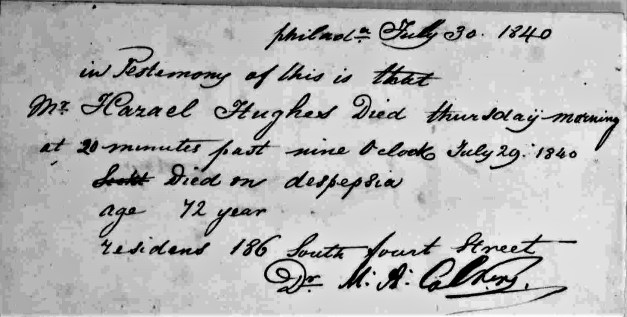
Seventy-two-year-old Hazael Hughes died this date, July 29th, in 1840 and was buried at Bethel Burying Ground.

Posted by Terry Buckalew on July 29, 2018
Posted in: On This date. Tagged: African American burial grounds, African American cemeteries, African American History, African Methodist Episcopal Church, archaeology, Bethel Burying Ground, Mother Bethel, Mother Bethel African Methodist Episcopal Church, Philadelphia, Richard Allen. Leave a comment

HAZAEL HUGHES

Seventy-two-year-old Mr. Hazael Hughes died this date, July 29th, in 1840 at twenty minutes past nine o’clock in the morning. The official cause of death was dyspepsia or indigestion. This is only a symptom, not a cause. An ulcer or stomach cancer could have been the cause of the symptoms. The 1837 Philadelphia African American Census recorded that Mr. and Ms. Hughes were the heads of a family that included four additional members. The Census does not state the relationship or ages of these family members. Ms. Hughes’ first name was not reported.  Mr. Hughes’ first name (Hazael) is taken from the Old Testament. 

Out of the six family members, only one was born in Pennsylvania. The 1848 Philadelphia African American Census reports that Mr. and Ms. Hughes were formally enslaved and were manumitted. In the second half of the 1830s, Mr. Hughes was employed as a clothes dealer and his spouse as a shopkeeper. By the latter part of the 1840s, they worked as a laborer and a laundress, according to the 1848 Census. The Hughes may have been employed at Shedaker’s Dry Good Store, located only yards away from their home. The Hughes family lived in a room at 186 South 4th Street for which they paid $3.33 in 1837. It was double that amount by 1848. The 1837 rent was the equivalent of a week’s take-home pay, increasing to two weeks pay by 1848. Their residence was only a block away from Independence Mall. 
hh17g1

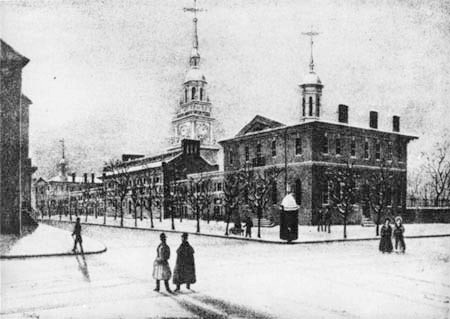
A lithograph depicting Independence Hall in 1840, the year that Mr. Hughes passed away.

This structure supposedly stood for the liberty of all but, in reality, it stood for the rights of white males. Mr. Hughes likely would walk by the Hall on a daily basis and be starkly reminded that he, as a Black man, could not vote in Pennsylvania. In 1838, the Pennsylvania Senate voted 77 to 45 to amend the state’s constitution, officially disenfranchising the Black man. After this time, no African Americans voted in Pennsylvania until after the Civil War. And, only then, at the risk of being murdered or beaten. The Pennsylvania Constitution was not changed until 1873. And women, white or Black, could still not vote.

The reasons given by the politicians for the constitutional amendment were: 

  • Blacks were less than human
  • They were a degraded being
  • They were lawless and idle
  • Blacks filled the jails and the poorhouses
  • To allow Blacks to vote would do irreparable injury to Pennsylvania
  • Giving Black Pennsylvanians the right to vote would attract hordes of lawless Blacks to invade the state.

This action by the state’s politicians emboldened racist groups across the state, resulting in a dramatic increase in organized deadly violence against African American citizens. Two years before Hazael Hughes died, he witnessed one of the most brutal and fierce attacks by white mobs on the Black community with the burning of Pennsylvania Hall, Black churches, and homes. 
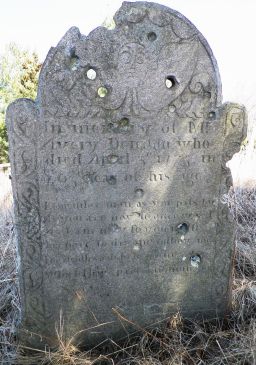
Shot up gravestone

The Hughes family interred their patriarch on a warm summer day with the temperature reaching 85 degrees by 2 o’clock.
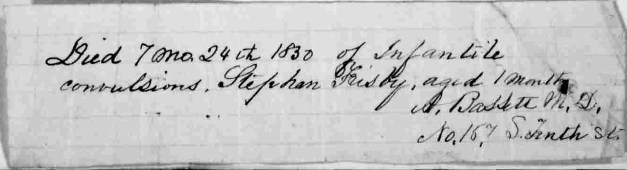


One-month-old Stephan Frisby died this date, July 24th, in 1850 and was buried at Bethel Burying Ground.

Posted by Terry Buckalew on July 24, 2018
Posted in: On This date. Tagged: African American burial grounds, African American cemeteries, African American History, African Methodist Episcopal Church, archaeology, Bethel Burying Ground, Mother Bethel, Mother Bethel African Methodist Episcopal Church, Philadelphia, Richard Allen. Leave a comment

Stephan Frisby

One-month-old Stephan Frisby died this date, July 24th, in 1850 of convulsions and was buried at Bethel Burying Ground. He was the only child of Jeremiah and Ann Frisby, according to the 1850 Federal Census. Mr. Frisby, born in Delaware, was 50 years old at the time of his son’s death. Ms. Frisby was 33 years old and was born in Pennsylvania. Two other women lived at the Frisby home. Caroline D. Garnet, 23-years-old, born in Pennsylvania, and Rachel Harris, 54-years-old and born in Maryland. The Census did not provide any more information on these women.

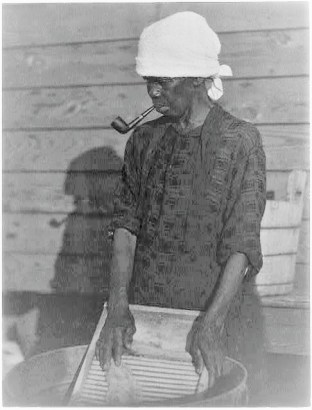
Mr. Frisby was employed as a “carter” or one who transported goods by cart or wagon. Ms. Frisby was employed as a laundress, along with one other woman in the household, according to the 1847 Philadelphia African American Census. 

Washer Woman

The Frisby family lived in one room at 35 Currant Alley, a very narrow thoroughfare that ran from Walnut Street to Chestnut Street and was between 10th and 11th Streets. Historian Roger Lane considered it “one of the worst [streets] in Philadelphia.” Poverty, rat-infested housing, crime, and disease were major problems. Ninety-six Black families with a staggering total of three hundred twenty-one family members lived in the densely packed alley, according to the 1847 Census. The Census also showed that the Currant Alley adults, despite all the obstacles, were solidly working class, having a wide range of laboring and domestic jobs to which African American men and women were restricted.

One-month-old Stephan was buried on a July day beset by “excessive heat.” Ann Frisby would live only to 50-years-old when she died of a stroke on May 18, 1861. At the time of her death, she was an inmate of the Blockley Alms (Poor) House where she was buried.

Jeremiah Frisby lived to 71 years of age and died of a brain hemorrhage on May 19, 1870. He was buried at Lebanon Cemetery. His obituary in the Public Ledger on May 18th contained the following:

A father once so kind we had,

Who dwelt with us on earth,

He now is dead, his smiled no more

Will cheer our home hearth

Dear father is now called away

To a world more bright than this,

To join with angels in their mirth,

And dwell in endless bliss.

I was unable to identify the individuals who had been Mr. Frisby’s child or children. Ann Frisby may have been his second wife and his other children may have been from a first marriage.

IMG_6260

Tent Graves


Seventeen-month-old John W. Harrard died this date, July 20th, in 1848 and was buried at Bethel Burying Ground.

Posted by Terry Buckalew on July 20, 2018
Posted in: On This date. Tagged: African American burial grounds, African American cemeteries, African American History, African Methodist Episcopal Church, archaeology, Bethel Burying Ground, Mother Bethel, Mother Bethel African Methodist Episcopal Church, Philadelphia, Richard Allen. Leave a comment

HARRARD

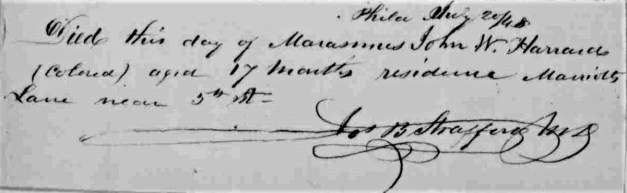
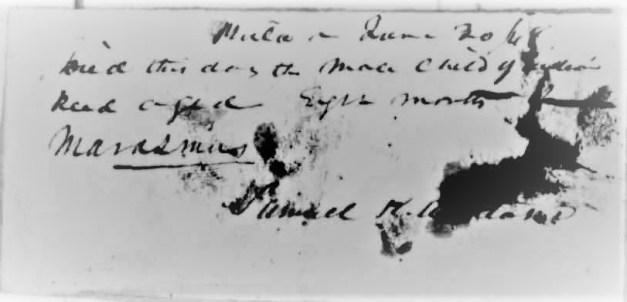
Seventeen-month-old John W. Harrard died this date, July 20th, in 1848 of Marasmus and was buried at Bethel Burying Ground. The child’s parents, Clement (38 y/o) and Comfort (31 y/o), had four other children at the time of their son’s death: Charlotte (12), Clement, Jr. (9), William (6) and Abraham (4). All the children and their father were born in Pennsylvania while their mother was born in Delaware. Sadly, the family would lose another child, George, in 1853 due to convulsions. He was seven months old at the time of his death and was buried at Lebanon Cemetery.

screenshot-1

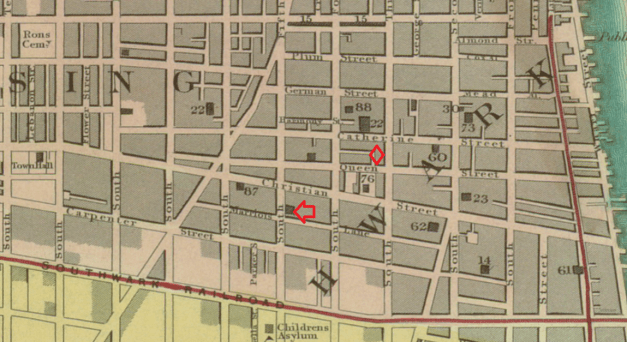
The red arrow on the above map indicates the location of the Harrards’ home. The diamond symbol shows the location of the Bethel Burying Ground. There were lanes, alleys, and courts in the city that had not been dignified with the status of the sorry state of an official Philadelphia street – Marriott’s Lane was one of these. The family lived in one room in a tenement, for which they would pay approximately $2 a month.

1063_2302_1672_2017

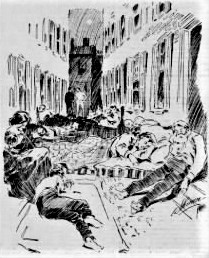
Thirty-five Black families lived on Marriott’s Lane, according to the 1847 Philadelphia African American Census. They lived in rooms that were poorly ventilated boxes, where they froze in the winter and roasted in the summer. During the worst of the heat, the rooms were ovens of stifling feted air. To survive, the families had to sleep outside on the sidewalks and on the dirt or cobblestones of the narrow thoroughfares.  Above is a sketch by a newspaper reporter in the 19th century of a sight he came upon one night in the Harrads’ neighborhood. 

Little John Harrard died of ‘Marasmus,’ a term that stood for a variety of malnutrition, wasting and starvation illnesses in the 19th century. The condition has been characterized as a disease of the “extremely poor.”  Often, the infant or child was being fed too many carbohydrates (cheaper) and little, if any, protein (more expensive). In many cases, the individual simply starved to death for lack of any food.

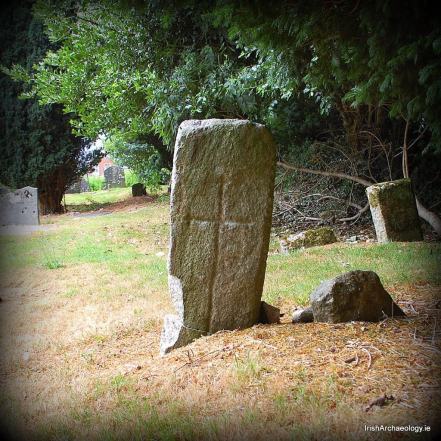
Unnamed tombstone Irish

Seventeen-month-old John W. Harrard was buried on a day where the morning broke clear and warm (65 degrees) and the temperature rose to 86 degrees by 2 o’clock. 
Two-year-old William Wallace died this date, July 11th, in 1844 and was buried at Bethel Burying Ground.

Posted by Terry Buckalew on July 11, 2018
Posted in: On This date. Tagged: African American burial grounds, African American cemeteries, African American History, African Methodist Episcopal Church, archaeology, Bethel Burying Ground, Mother Bethel, Mother Bethel African Methodist Episcopal Church, Philadelphia, Richard Allen. 2 Comments

WALLACE

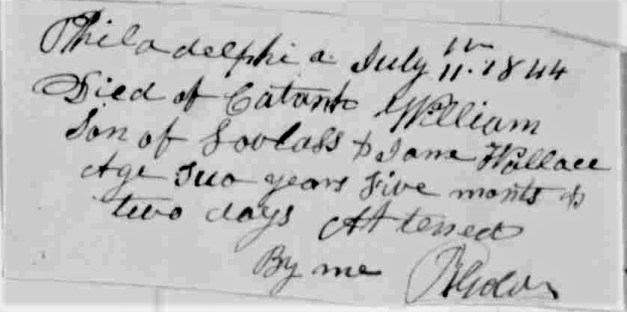
Two-year-old William Wallace died this date, July 11th, in 1844 of Catarrh Fever and was buried at Bethel Burying Ground. Catarrh is an inflammation of the mucous membrane, particularly of the head and throat.

The child’s parents were Jane and Loveless Wallace. Mr. Wallace’s first name is spelled “Lovelis” in city directories. Ms. Wallace was employed as a “day worker” and Mr. Wallace as a “carter” who owned his own wagon. According to the 1847 Philadelphia African American Census, the family appeared to be relatively well off financially. They reported that they owned $2,000 in personal property which would be equivalent to approximately $54,500 in today’s U.S. currency. In addition, Mr. Wallace reported that he earned $450 a year, almost twice the average yearly earnings by a Black man laboring in 1844 Philadelphia.

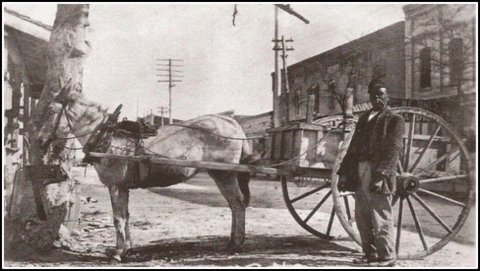
drayman

A carter or drayman drove a horse or mule drawn wagon that was used for the transport of all sorts of goods. Most Black men did not own their own rig and either rented one or worked for a weekly salary with a company. Those that owned their own rig were better off financially.

The Wallace family lived at 195 1/2 Lombard Street which was located between 6th and 7th Streets on Lombard, less than a block away from Bethel AME Church. Their rent was $5 a month for one room that was home to three adults and two children, according to the 1847 Philadelphia African American Census. One of the adults (unidentified) was born enslaved and purchased his or her freedom for $200. 

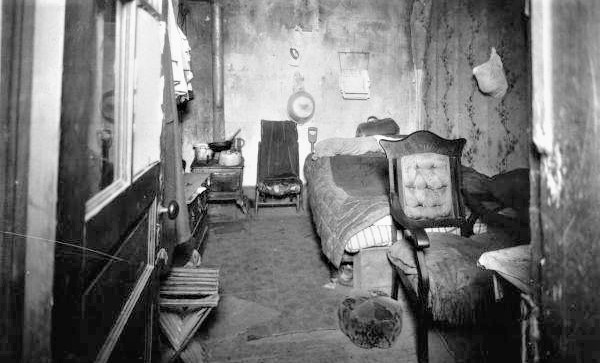
1914 Slum 530 lombard

The above is a 1914 photo of a room in a building near the Wallace family’s residence. The title of the City of Philadelphia photo is “Slum.”


The last mention of Loveless and Jane Wallace in public records is in the 1848 Philadelphia City Directory.  I am unable to locate any records on the family after that date.

Their young son William was buried on an “intolerably hot” day in July. Tragically, the Wallaces lost another son, 6-year-old John, on December 14, 1845, of Tuberculosis. He was interred next to his younger brother at Bethel Burying Ground. 

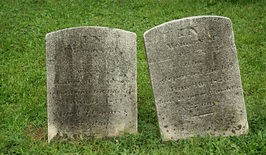
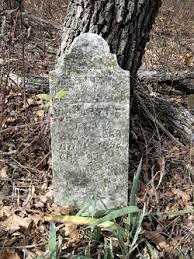
two-old-gravestone-with-grass-in-a-graveyard-picture_csp0817511 (1)

Forty-five-year-old Sidney Stewart died this date, July 7th, in 1853 and was buried at Bethel Burying Ground.

Posted by Terry Buckalew on July 7, 2018
Posted in: On This date. Tagged: African American burial grounds, African American cemeteries, African American History, African Methodist Episcopal Church, archaeology, Bethel Burying Ground, Mother Bethel, Mother Bethel African Methodist Episcopal Church, Philadelphia, Richard Allen. Leave a comment

Sidney Stewart

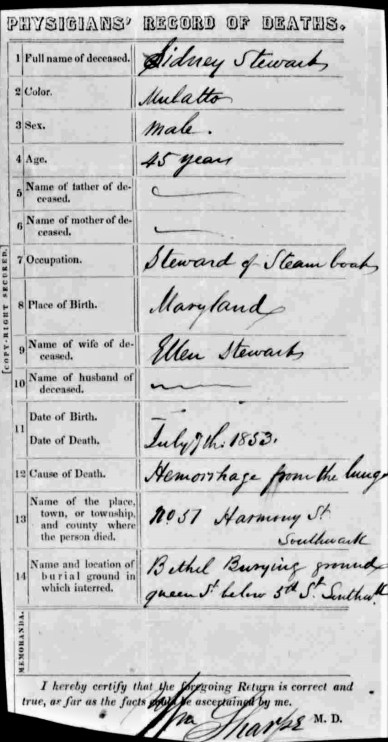
Forty-five-year-old Sidney Stewart* died this date, July 7th, in 1853 due to hemorrhaging of his lungs and was buried at Bethel Burying Ground. At the time of his death, he was employed as a steward on a steamboat that traveled the Delaware River. Below are the Stewart family members as recorded by the 1850 Federal Census three years before Mr. Stewart’s death.

Ellen – (spouse) 35 years old, also referred to as Eleanor.

Mary – 12 years old

Sidney – 10 years old

Ellen – 8 years old

Amelia – 6 years old

Emeline – 4 years old

Fanny – 2 years old

                                                             Isabella – less than a year old. 

The Stewarts had two other children. They had a seven-year-old daughter, Frances, who died on October 5, 1842, of Croup and who was buried at Bethel Burying Ground. Ellen Stewart gave birth to a daughter, Charlotte, on May 25, 1852. Sadly, she died February 4, 1853, of a GI infection and also was buried at Bethel Burying Ground. 

Isabella died in 1867 at the age of eighteen, from complications during childbirth and was buried at Lebanon Cemetery in Philadelphia.

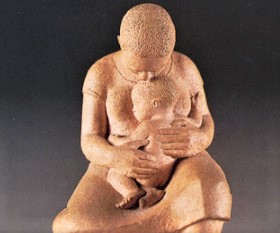
120404084815-catlett-c1-main

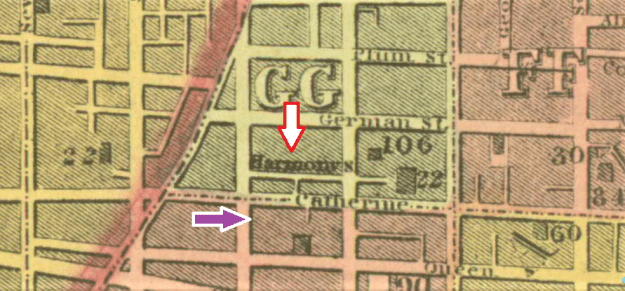
The Stewart family lived at 25 Harmony Street, a short alleyway from Bethel Burying Ground. The purple arrow points to the location of the graveyard and the white arrow shows the location of the Stewart home. The narrow thoroughfare was home to 15 Black families containing 57 members. Some of the families owned their own home, including the Stewarts. The Black men on Harmony Street were employed in a wide variety of occupations including sailmaker, oyster seller, seaman, and drayman. The women of Harmony Street were engaged as laundresses, dressmakers, and homemakers. The Black population of Harmony Street largely was comprised of former slaves and first generation free men and women, according to the 1847 Philadelphia African American Census.

Screenshot 2018-07-05 16.39.44

The white arrow indicates the location of the Stewarts’ home on Harmony Street. The purple arrow is the location of Bethel Burying Ground.

Sidney Stewart was interred on a warm day in July at Bethel Burying Ground next to his daughters, Frances and Charlotte.

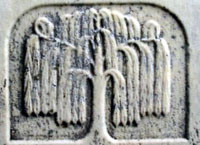
weepingwillow

_____________

*There is one occasion in public records where Mr. Stewart’s first name was spelled ‘Syndey’ and another time where the family name was spelled ‘Steward.’

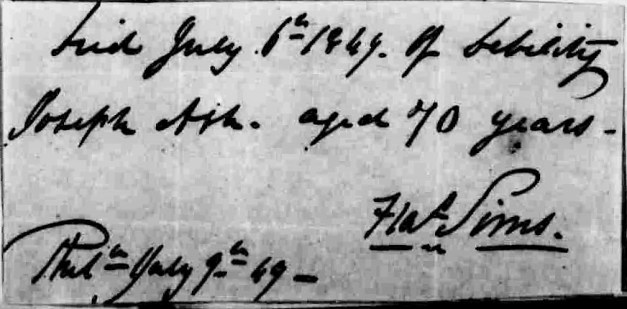
Seventy-year-old Joseph Ash died this date, July 6th, in 1849 and was buried at Bethel Burying Ground.

Posted by Terry Buckalew on July 6, 2018
Posted in: On This date. Tagged: African American burial grounds, African American cemeteries, African American History, African Methodist Episcopal Church, archaeology, Bethel Burying Ground, Mother Bethel, Mother Bethel African Methodist Episcopal Church, Philadelphia, Richard Allen. Leave a comment

ASH

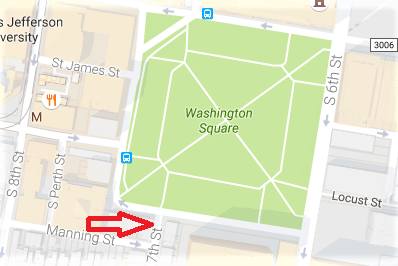
Seventy-year-old Joseph Ash died this date, July 6th, in 1849 of “Debility”* and was buried at Bethel Burying Ground. When Mr. Ash was a younger man, he worked as a porter, according to city directories. At the time of his death, he lived with his adult son, Josuha Ash, and his family at 220 S. 7th Street in center city Philadelphia. It appears the Ash family may have owned this basement unit at this prestigious address across from the southwest corner of Washington Square.

washington-park-map_orig

The value of the property in 2018 would be approximately $38,000. In 2018 dollars, annual taxes would be $475 with a water bill of $15 for the year.

The 1847 Philadelphia African American Census recorded that, in addition to his father, Josuha Ash’s family included his spouse, a male child under the age of five and a female child under the age of fifteen who was employed as a seamstress. 

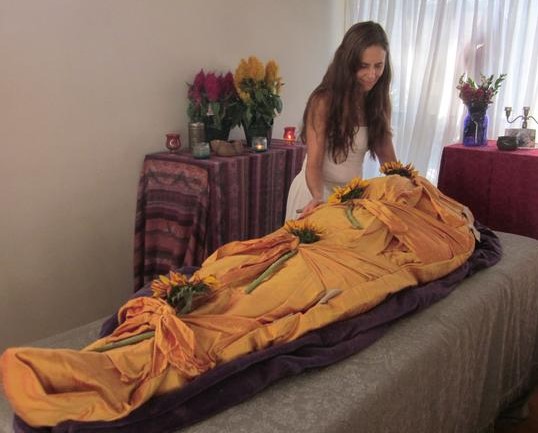
It appears from the 1847 Census that Sarah Ash, Josuha’s spouse, was employed as a “layer out of the dead” – the predecessor to the role of a funeral director or undertaker. She would prepare the body of the deceased for burial. Embalming became an option during the American Civil War, prior to that era the remains had to be interred as soon as possible. The law stated it had to be within the 24 hours after the individual died. A layer out of the death or a ‘shrouder,’ as they sometimes were called, had to be available around the clock. Their duties included washing and dressing the deceased and some shrouders also were able to provide items such as black mourning crape, shrouding sheets and ice to preserve the body in hot weather. Some also acted as the deceased family’s representative with burial ground managers, and the owners of funeral carriages and hearses. 

VAR-_home_funeral_grande

A modern-day shrouder

Mrs. Ash, one of our oldest citizens of color, and a noted Shrouder, departed this life on the 28th ultimo, aged 69 years of age. Mr. Ash was one among the first who joined Bethel church . . . Her death was caused by typhoid fever. Mrs. Ash had a large circle of friends, and was a very thorough-going woman. If our memory serves us correctly, she came forward and partook of the Sacrament in Bethel church the last time we saw here there. We trust we shall meet her in heaven. . . .       “The Christian Recorder,” February 18, 1865

It is likely that Sarah Ash prepared the body of her father-in-law for his interment at Bethel Burying Ground. Joseph Ash was buried on a pleasant day where the temperature only reached an unseasonable 80 degrees. There was no way to predict the devasting hurricane that would hit the city of Philadelphia on the evening of the 14th.

tombstone and tree


A Summer’s Harvest at Bethel Burying Ground

Posted by Terry Buckalew on July 3, 2018
Posted in: Neighborhood. Tagged: African American burial grounds, African American cemeteries, African American History, African Methodist Episcopal Church, AME Zion, archaeology, Bethel Burying Ground, Mother Bethel, Mother Bethel African Methodist Episcopal Church, Philadelphia, Richard Allen. Leave a comment

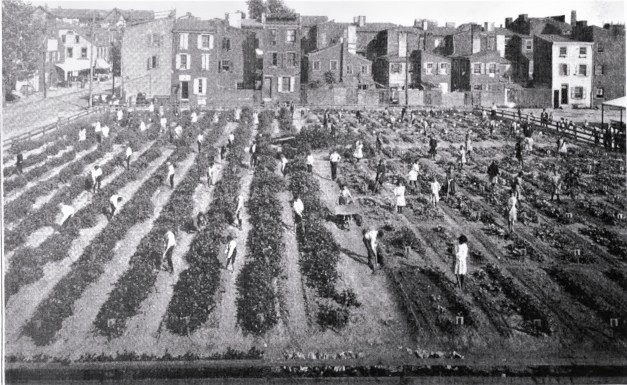
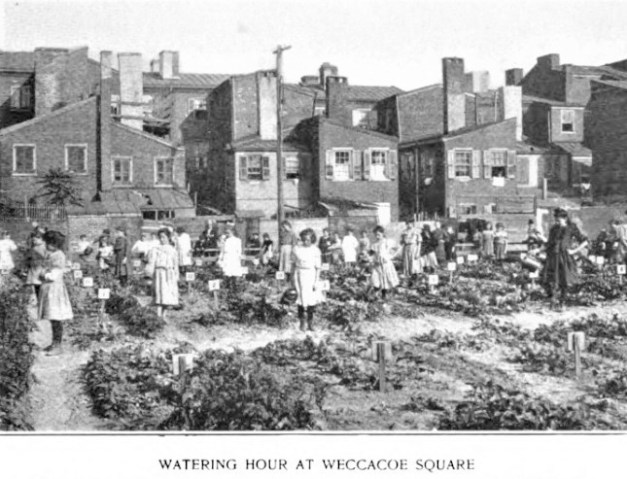
Bethel Burying Ground in the Summer of 1904

Weccacoe Garden 2

 Bethel Burying Ground was the location of the first community garden in the city of Philadelphia. In 1889, Philadelphia’s City Council purchased Bethel Burying Ground from the trustees of Bethel Church A.M.E. with the intention of turning it into a “pocket park” and playground. The more than 5,000 bodies buried at the small cemetery were not removed and the tombstones and surrounding brick walls already had been vandalized and “disfigured,” according to newspaper reports. A.M.E bishop and journalist Benjamin Tucker Tanner condemned the trustees of Bethel Church for the condition of the graveyard and the disrespect it showed to the Church’s founding members.

To the annoyance of the local adults, the boys of the neighborhood played baseball on the flattened cemetery and were responsible for numerous broken windows of nearby homes. From 1889 to 1904, the once-venerated ground also was being used for burning the rubbish of local households and for the dumping of garbage and dead animals. Although the city had allocated the funds for purchasing the land, the City Council had not been forthcoming with the money to develop the now hard clay barren lot into a usable park.

  The city knew the bodies still laid under the hardpan soil. In a national magazine of the time, it was reported that the “impression prevailed” that, at one point, the lot “was sort of a Potter’s Field.” There were several newspaper articles at the time of the sale of the lot to the city describing the grounds as formerly an African American cemetery belonging to Bethel Church A.M.E. for which the church was paid $10,000.

          In early May of 1904, Philadelphia City Council responded to a petition from the Public Education Association to fund two public school gardens. One of which was going to be at Weccacoe Square. Before seeds could be planted, a good deal of work had to be done. The first plowing “turned up bricks, more bricks, and apparently more bricks, but bravely the children picked and piled,” according to a national gardening magazine. The bricks were likely the remains of the brick walls that surrounded the small cemetery. In addition, the children were raking up “old shoes, hats, tin cans, baskets, dead cats…,” all of which were piled up and turned into “a glorious bonfire.” Forty truckloads of fertilizer (animal and human) then were dumped and spread by the children across the graves. Eventually, a low wood fence surrounding the land was erected, paths were dug, and plots laid out in symmetrical rows. The garden was divided into 250 individual plots, each 4 ½ x 11 ½ feet with seeds planted for radishes, small turnips, lettuce, peas, tomatoes, lima beans, carrots, and string beans.

          The garden’s neighbors, mainly Russian Jews who fled the pogroms of Imperial Russia, looked out their windows daily wondering out loud in Yiddish about the undertaking. Others ventured down to lean on the garden fence and reminisce about their farms in the old country. They marveled at the newly built tool shed with its colorfully painted wheelbarrows, and the “symmetrical rows of rakes, hoes, and watering cans hanging against the wall.” Hundreds of people visited the garden, some from other cities, to see the garden. Teachers in the city took a great interest and would bring their classes to see what hard work could achieve.

Bethel Burying Ground was used as a vegetable garden for only one year because of the beginning of construction the following Spring of a playground and park over the graves. 

     Bethel Burying Ground in 1904

ARTICLE PIC


The eight-month-old son of Anna and William Reed died this date, June 30th, in 1848 and was buried at Bethel Burying Ground.

Posted by Terry Buckalew on June 30, 2018
Posted in: On This date. Tagged: African American burial grounds, African American cemeteries, African American History, African Methodist Episcopal Church, archaeology, Bethel Burying Ground, Mother Bethel, Mother Bethel African Methodist Episcopal Church, Philadelphia, Richard Allen. Leave a comment

REED

The eight-month-old son (unnamed) of Anna and William Reed died this date, June 30th, in 1848 of Marasmus* and was buried at Bethel Burying Ground. Mr. Reed (45 y/o), born in Virginia, was employed as a shoemaker at the time of his son’s death. Ms. Reed (34 y/o), born in Maryland, worked as a laundress. Census records show that one of them was born into slavery. 

Reviewing the Philadelphia 1847 African American Census and the 1850 Federal Census, it appears that the Reeds suffered the death of two other of their children and Mr. Reed’s sixty-year-old mother. It is likely that some, if not all, also are buried at Bethel Burying Ground. All the Reed children were born in Pennsylvania.

The family lived at 16 Bonsall Street below 10th in the “Cedar Section” of the city of Philadelphia. The Reed family had one room in a three-story brick tenement for which they paid $3.12 a month in rent. The average wage for a shoemaker would have been $4-$5 a week and half that for a laundress. 

gillam-jazz_large

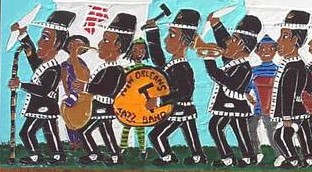
According to census records, Anna and William Reed were members of a temperance organization. It is highly likely that they were members of the Moyamensing Temperance Society. On August 1, 1842, this society mustered its 1,200 members to march in a parade around the city celebrating its liberation from the grip of alcohol and celebrating the anniversary of the end of slavery in the West Indies. It is unknown if Mr. and Ms. Reed were there that day when the 1,200 marchers were met by a white mob twice that size. This violent planned assault was the start of a three-day citywide riot. The Black community saw their homes, churches, an orphanage and meeting halls burned to the ground along with many killed and wounded. What wasn’t destroyed was looted. The sight of so many strong and unified Black citizens scared the hell out of the white population, prompting an Irish woman to demand the mob attack the home of a certain Black family. “There’s [sic] some Negroes living in there, living just like white folk!” 

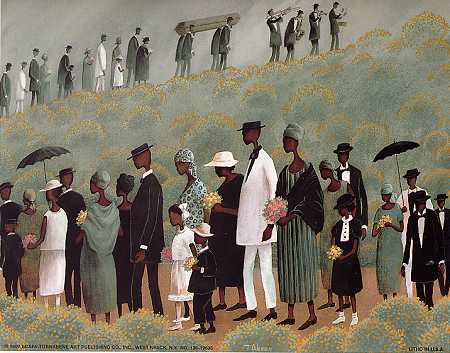
Black funeral

The Reed child was interred at Bethel Burying Ground on a warm June day that was “alternately cloudy and clear” with temperatures reaching into the high 80s.

*****

* The term “Marasmus” stood for a variety of malnutrition, wasting and starvation illnesses. The condition has been characterized as a disease of the “extremely poor.”  Often the infant or child was getting too many carbohydrates (cheaper) and little if any protein (more expensive). In many cases, the individual simply starved to death for lack of any food.

Thirty-eight-year-old Eliza Moore died this date, June 27th, in 1843 and was buried at Bethel Burying Ground.

Posted by Terry Buckalew on June 27, 2018
Posted in: On This date. Tagged: African American burial grounds, African American cemeteries, African American History, African Methodist Episcopal Church, archaeology, Bethel Burying Ground, Mother Bethel, Mother Bethel African Methodist Episcopal Church, Philadelphia, Richard Allen. Leave a comment

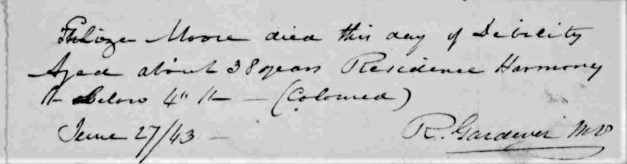
Eliza Moore.jpg

Thirty-eight-year-old Eliza Moore died this date, June 27th, in 1843 of “Debility” and was buried at Bethel Burying Ground. “Debility” is only a symptom, not actually a cause of death. Any illness from cancer to influenza could have caused the physical wasting. There is no census or city directory mention of Ms. Moore. Her death certificate was signed by a physician who was volunteering with the Southern Dispensary, a medical clinic for the poor. 

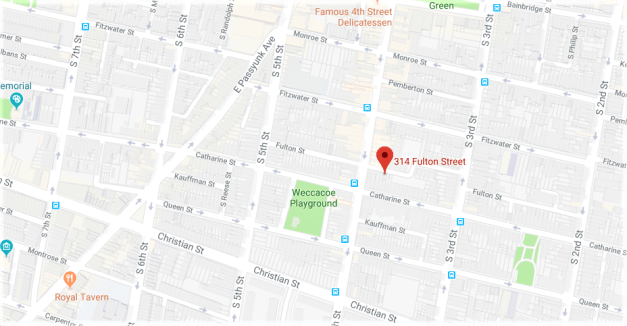
Fulton Street

Ms. Moore lived in the 300 block of Harmony Street, which is now named Fulton Street. The map above shows that she lived only two blocks from Bethel Burying Ground where she was laid to rest. Harmony Street was a narrow crooked thoroughfare filled with working-class Black families and widows. According to the Philadelphia 1847 African American Census, the men’s occupations included sailmaker, oyster seller, and seaman. Women were generally employed as laundresses. Families lived in one room where a 12’x12′ room rented for $2 – $2.50 a month which would be close to a week’s salary.  

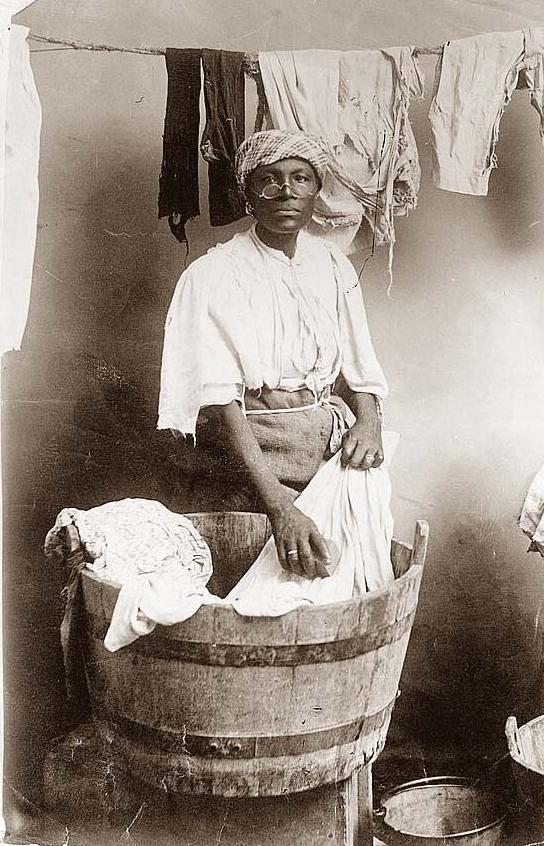
Washing-Clothes

Ms. Moore was one of only eight individuals in her age group that died in Philadelphia in 1843 of “Debility.” By contrast, four hundred forty-eight children died of this diagnosis during the same period. 

Ms. Moore was interred at Bethel Burying Ground on a clear, hot day where the temperature rose to over 100 degrees. 

photomania-f138a208459e611930de56b044426b43


The eighteen-month-old son of Maria Bayles died this date, June 25th, in 1846 and was buried at Bethel Burying Ground.

Posted by Terry Buckalew on June 25, 2018
Posted in: On This date. Tagged: African American burial grounds, African American cemeteries, African American History, African Methodist Episcopal Church, archaeology, Bethel Burying Ground, Mother Bethel, Mother Bethel African Methodist Episcopal Church, Philadelphia, Richard Allen. Leave a comment

BAYLES

The eighteen-month-old son of Maria Bayles died this date, June 25th, in 1846 of Marasmus* and was buried at Bethel Burying Ground. An 1846 Philadelphia African American Census worker contacted Ms. Bayles after her son died. The Census reports that Ms. Bayles was a single woman working as a domestic who lived at 15 Washington Street paying $2 a month for a room which was about what she made for a week’s work. Ms. Bayles reported to the census taker that she attended church services and was a member of a beneficial society that likely assisted her in paying the funeral expenses for her son.

Ms. Bayles lived with her son on Washington Street (now Rodman Street, see the red marker below) which was between 11th and 12th Streets and Lombard and South Streets. 

RODMAN

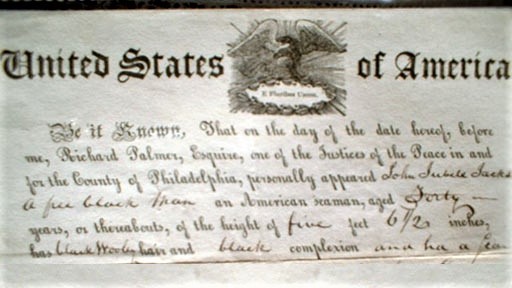
Ms. Bayles was a “free black,” a person of color who was not enslaved. However, no African American in Philadelphia could consider his or her freedom secure as long as somewhere in the United States Blacks were enslaved and slave hunters were on the prowl. It did not matter where free Black citizens lived; they inexorably were linked to the institution of slavery. They could be accused by anyone that they were not who they said they were. The burden of proof would rest on the freeman to immediately produce “Freedom Paper” on demand. The document had to be carried at all times and, if the Black citizens weren’t able to show it, they could be kidnapped by fugitive slave hunters as a result. Ms. Bayles may have carried a document that resembled the following:

Freedom Papers

“Freedom Paper” issued by a Philadelphia Justice of the Peace.

Young negro woman

Maria Bayles interred her son on a day when the weather was reported to be “very pleasant” with the morning being cool and warming into the afternoon. (North American, 2 July 1846.)

*”Marasmus” stood for a variety of malnutrition, wasting and starvation illnesses. The condition has been characterized as a disease of the “extremely poor.”  Often the infant or child was getting too many carbohydrates (cheaper) and little if any protein (more expensive). In many cases, the individual simply starved to death for lack of any food.

Posts navigation

← Older Entries
Newer Entries →
  • Recent Posts

    • Three dead as church wall falls on this date, May 1st, in 1841.
    • The ten-month-old Baby Colgate died this date, June 20th, in 1847, and was buried at Bethel Burying Ground.
    • Fifty-eight-year-old Rachel Dawson died this date, May 3rd, in 1839, and was buried at Bethel Burying Ground.
    • Twenty-eight-year-old Robert Swails died on this date, March 31st in 1849, and was buried at Bethel Burying Ground.
    • Forty-year-old Jacob “Jesse” Howard died on this date, January 29th, in 1840, and was buried at Bethel Burying Ground.
  • Archives

    • May 2024
    • June 2023
    • May 2023
    • March 2023
    • January 2023
    • December 2022
    • November 2022
    • October 2022
    • September 2022
    • August 2022
    • May 2022
    • April 2022
    • March 2022
    • February 2022
    • January 2022
    • December 2021
    • November 2021
    • October 2021
    • September 2021
    • August 2021
    • July 2021
    • June 2021
    • May 2021
    • April 2021
    • March 2021
    • February 2021
    • January 2021
    • December 2020
    • November 2020
    • October 2020
    • September 2020
    • August 2020
    • July 2020
    • June 2020
    • May 2020
    • April 2020
    • March 2020
    • February 2020
    • January 2020
    • December 2019
    • November 2019
    • October 2019
    • September 2019
    • August 2019
    • July 2019
    • June 2019
    • May 2019
    • April 2019
    • March 2019
    • February 2019
    • January 2019
    • December 2018
    • November 2018
    • October 2018
    • September 2018
    • August 2018
    • July 2018
    • June 2018
    • May 2018
    • April 2018
    • March 2018
    • February 2018
    • January 2018
    • December 2017
    • November 2017
    • October 2017
    • September 2017
    • August 2017
    • July 2017
    • June 2017
    • May 2017
    • April 2017
    • March 2017
    • February 2017
    • January 2017
    • December 2016
    • November 2016
    • October 2016
    • September 2016
    • August 2016
    • July 2016
    • June 2016
    • May 2016
    • April 2016
    • March 2016
    • February 2016
    • January 2016
    • December 2015
    • November 2015
    • October 2015
    • September 2015
    • August 2015
    • July 2015
    • June 2015
    • May 2015
    • April 2015
    • March 2015
    • February 2015
    • January 2015
    • December 2014
    • November 2014
    • October 2014
  • Categories

    • Archaeology
    • BBG History
    • Bethel Burying Ground Name Directory
    • Bethel Burying Ground Timeline
    • Burial services
    • Diseases
    • Documents
    • Freemasonry
    • Ignatius Beck
    • It's a fact
    • Maps
    • Neighborhood
    • Newspaper Articles
    • On This date
    • Photographs
    • Uncategorized
    • Videos
  • Meta

    • Create account
    • Log in
    • Entries feed
    • Comments feed
    • WordPress.com
Blog at WordPress.com.
Bethel Burying Ground Project
Blog at WordPress.com.
  • Subscribe Subscribed
    • Bethel Burying Ground Project
    • Join 48 other subscribers
    • Already have a WordPress.com account? Log in now.
    • Bethel Burying Ground Project
    • Subscribe Subscribed
    • Sign up
    • Log in
    • Report this content
    • View site in Reader
    • Manage subscriptions
    • Collapse this bar
 

Loading Comments...