Bethel Burying Ground Project

Bethel Burying Ground Project

  • ABOUT THE BETHEL BURYING GROUND PROJECT

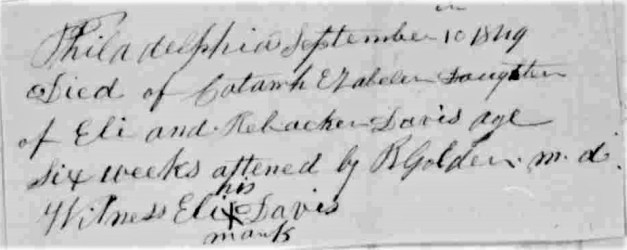
Six-week-old Isabella Davis died this date, September 10th, in 1849 and was buried at Bethel Burying Ground.

Posted by Terry Buckalew on September 10, 2019
Posted in: On This date. Tagged: African American burial grounds, African American cemeteries, African American History, African Methodist Episcopal Church, archaeology, Bethel Burying Ground, Mother Bethel, Mother Bethel African Methodist Episcopal Church, Philadelphia, Richard Allen. Leave a comment

Isabella Davis

Six-week-old Isabella Davis died this date, September 10th, in 1849 from an undiagnosed illness that caused a fever (Catarrh). Eli and Rebecca* Davis were sixty-four and forty-four years of age respectively when the infant died, according to the 1850 U.S. Census. Also in the home were ten-year-old Rebecca and two-year-old Benjamin. Mr. Davis was born in Maryland** and Ms. Davis was born in Pennsylvania as were all the children, according to the 1850 Census.
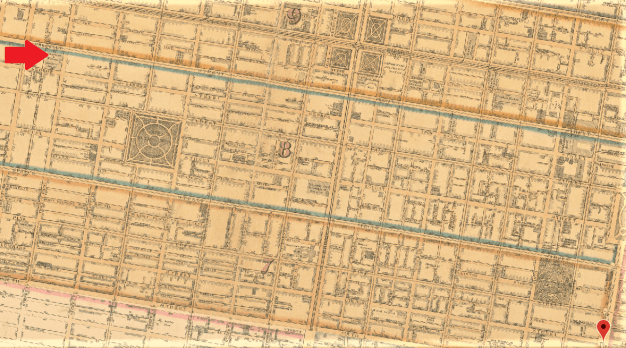
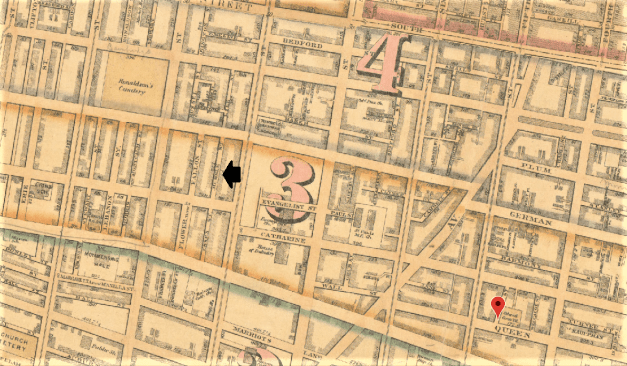
DAVIS MAP

Eli Davis was a self-described “cake dealer” with a shop at 7th and Lombard Streets a block away from Bethel A.M.E. Church. This location is illustrated by the red pin in the lower right-hand corner of the above map. The red arrow in the upper left-hand points to the Davis family home at 17th and George Street (now Samson Street). In the 1850 U.S. Census, Mr. and Ms. Davis valued their property at $2,000 or approximately $66,000 in modern currency. In the 1847 Philadelphia African American Census, it was reported that Mr. Davis earned $6 a week and Ms. Davis earned $.50 a week as a laundress. The census also reports that Mr. Davis was a Freemason.
abababa

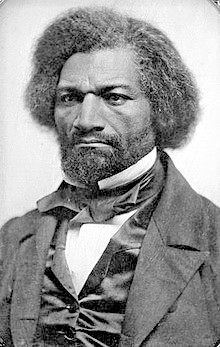
FREDERICK DOUGLASS

The day before six-week-old Isabella Davis died, “a gang” of white men invaded the home of a Black man living near the Davis’ home. He was severely beaten “in an act of wanton wickedness on the part of the assailants,” according to a newspaper report.*** Sadly, this type of violence against African Americans was common, while the white police force literally stood by and watched. Black men and women were hunted in their own communities.

Speaking in Philadelphia the following Spring, Frederick Douglass had this to say about the racist violence in Philadelphia. 

Philadelphia from time to time, the scene of a series of most foul and cruel mobs, waged against the people of color –  and is now justly regarded as one of the most disorderly and insecure cities in the Union. No [Black] man is safe- his life – his property – and all that he holds dear, are in the hands of a mob, which may come upon him at any moment – at midnight or mid-day, and deprive him of all.****

Those buried at Bethel Burying Ground, in addition to living under apartheid conditions, had to fight everyday just to survive.
Small_Gravestone

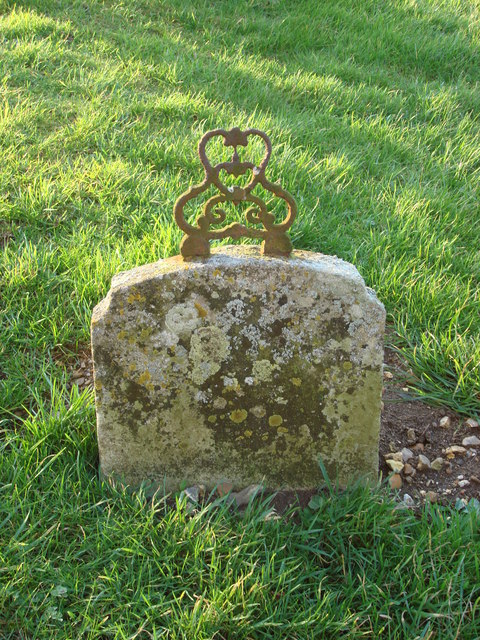
Rebecca and Eli Davis lost their infant daughter on a clear September day with a light northerly wind. The temperature never made it out of the mid-60s. She was buried at Bethel Burying Ground.

Official Border

*It appears that the doctor misspelled Ms. Davis’ first name. The 1850 U.S. Census has her named as “Rebecca,” as does her death certificate.

** On Ms. Davis’ death certificate in August of 1857, Eli Davis’ place of birth was reported as Nantucket, Massachusettes.

***North American, 11 September 1849.

****The North Star, 30 May 1850.

Note: This posting is a revision of one from one year ago. That one has been deleted.


Two-month-old Charles Bulah died this date, September 9th, in 1846 and was buried at Bethel Burying Ground.

Posted by Terry Buckalew on September 9, 2019
Posted in: On This date. Tagged: African American burial grounds, African American cemeteries, African American History, African Methodist Episcopal Church, archaeology, Bethel Burying Ground, Mother Bethel, Mother Bethel African Methodist Episcopal Church, Philadelphia, Richard Allen. Leave a comment

Bulah cert

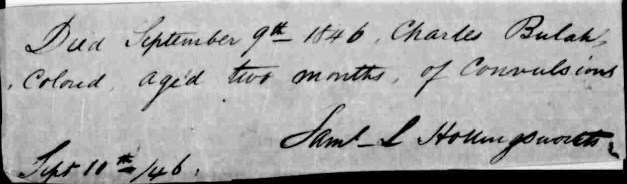
Two-month-old Charles Bulah* died this date, September 9th, in 1846 of Convulsions and was buried at Bethel Burying Ground. After comparing census records and city directories, I believe that the infant’s parents were William and Ann Bulah. Mr. Bulah was thirty-six-years-old at the time of his son’s death while Ms. Bulah was twenty-one-years-old. He was born in New Jersey and she was born in Delaware. The Bulahs also had a five-year-old daughter Elizabeth who was born in Philadelphia, according to the 1850 U.S. Census. 

BULAH MAP

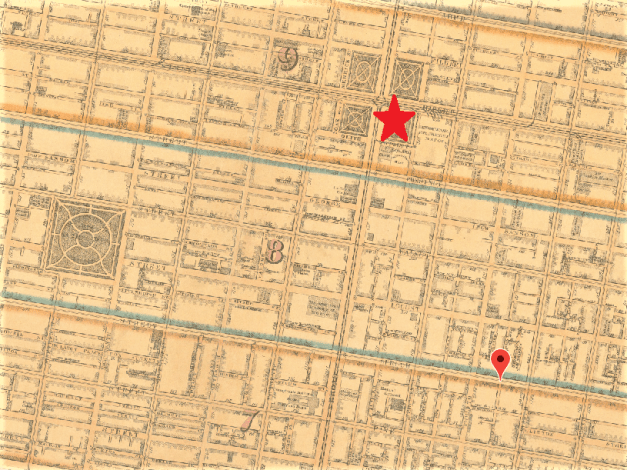
The red pin illustrates the location of the Bulah home on Quince Street. The narrow thoroughfare extended from Lombard Street to Walnut Street, west of 11th Street. The red star illustrates the location of Penn Square, the future location of Philadelphia’s City Hall.

The Bulah family lived in one room at #25 Quince Street for which they paid approximately $4 a month. Working as a coachman, Mr. Bulah would have earned anywhere between $4 and $7 a week. Ms. Bulah worked in the home. She would give birth to another daughter, Mary Ann, in late 1849 or early 1850, according to the federal census.

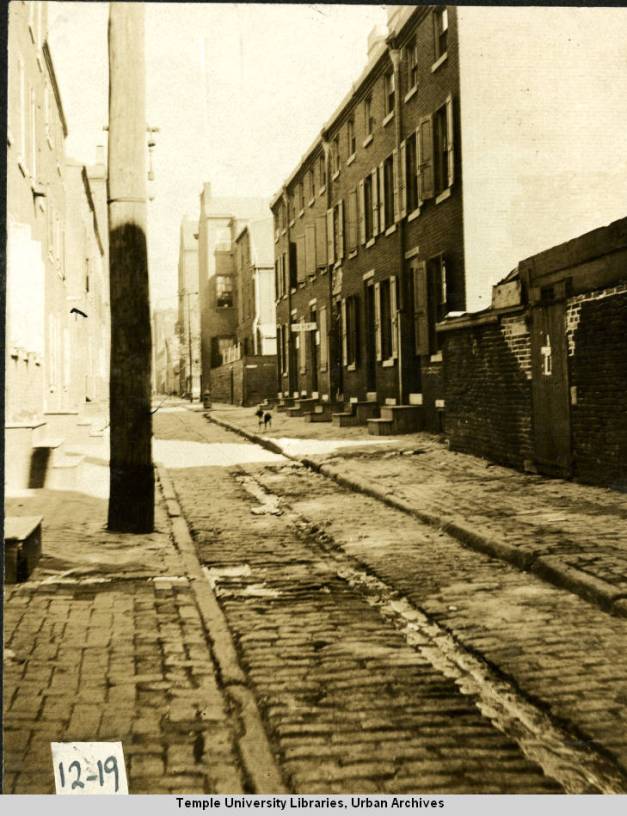
QUINCE STREET 1915

Quince Street in 1915

In the state of  Ohio, on the day that the Bulah infant boy died, the Ohio State Supreme Court upheld the United States Supreme Court decision to allow enslavers to pursue, arrest and return alleged slaves to the state from which they allegedly fled. All this without notifying the local government that had no real authority over the situation. This court decision further set the stage for the draconian 1850 Fugitive Slave Law. 

weepingwillow

Two-month-old Charles Bulah died on a “cool and raw” day.

“. . . a violent gale blew all day, and many of the wharves were even with the water – for 10 years so violent a wind has not been known on the Delaware [River] – it was so rough that the steamboats rocked on it like small vessels.” (North American, 1 October 1849)

This rough weather may be the reason the physician was not able to visit the body and sign the death certificate for two days while the small body lay in the home.

Official Border

*The family name is spelled “Beulah” in the 1850 U.S. Census.

Sixty-year-old Joseph Furrow died this date, September 1st, in 1853 and was buried at Bethel Burying Ground.

Posted by Terry Buckalew on September 1, 2019
Posted in: On This date. Tagged: African American burial grounds, African American cemeteries, African American History, African Methodist Episcopal Church, archaeology, Bethel Burying Ground, Mother Bethel, Mother Bethel African Methodist Episcopal Church, Philadelphia, Richard Allen. Leave a comment

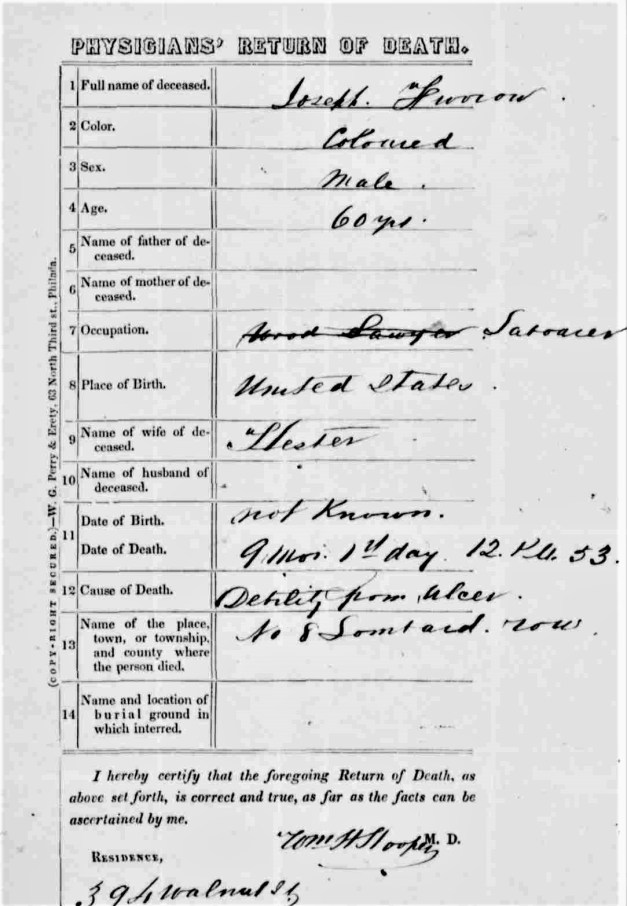
FURROW CET

Sixty-year-old Joseph Furrow* died this date, September 1st, in 1853 of “Debility from Ulcer” and was buried at Bethel Burying Ground. Mr. Furrow was formerly enslaved. His freedom was purchased for $375, according to the 1847 Philadelphia African American Census. In the 1850 U.S. Census, Mr. Furrow reported that he did not know what state in which he was born. The low $375 amount likely reflects that he was a child at the time of his liberation. Mr. Furrow was employed as a huckster and laborer during his life in Philadelphia. 

Mr. Furrow was widowed shortly before his death. In the 1850 Census, his spouse Hester Furrow was alive. However, Mr. Furrow’s death certificate mentions that Ms. Furrow was deceased. She is most likely buried at Bethel Burying Ground but there isn’t a death certificate available for her. In 1850, she was fifty-seven-years-old and was employed as a domestic. Also listed in the family was seven-year-old Cornelia Furrow and four-year-old James Furrow. It appears that they were grandchildren. Tragically, James would die of Tuberculosis in December of 1852 and be buried at Bethel Burying Ground. His parents were reported as Arnold and Pleasant Furrow and they lived at Joseph and Hester’s address. The young couple was not listed with the family in the 1850 Census.**

Thee map

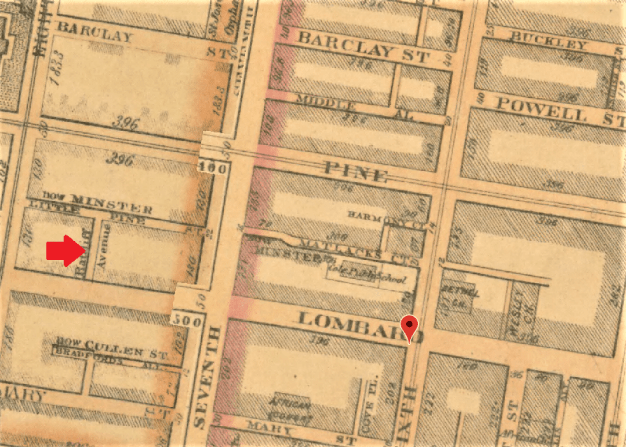
The red pin illustrations the location of Bethel A.M.E. Church and nearby Lombard Row (red arrow), the residence of the Furrow family.

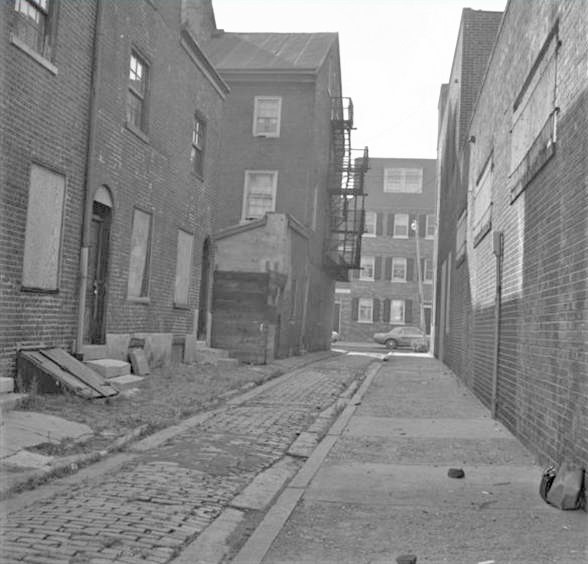
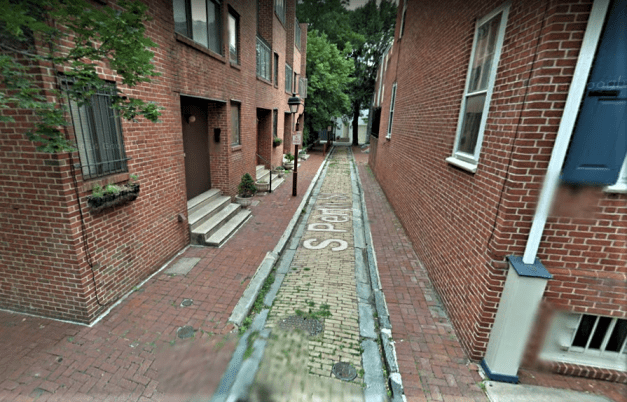
The Furrow family lived in a single room at #8 Lombard Row, a very narrow thoroughfare, located between 7th and 8th Streets off of Lombard Street. The Furrows paid $2.60 a month in rent, according to the 1847 Census. In 1847, there were fourteen Black families living on Lombard Row with a total of sixty-one family members. They were employed as waiters, cooks, laborers, and domestics. Fourteen of the sixty-one were reported to be formerly enslaved.

Orignal Perth Street

Above is an undated photo of Lombard Row (now South Perth Street). Below is a current photo.

South Perch Street

Mr. Furrow died at home on a cloudy overcast day in early September where the temperature rose to 84 degrees in the afternoon. His family interred him at Bethel Burying Ground.

Official Border

*The last name is spelled “Furrah” in the 1850 U.S. Census. The 1847 Philadelphia African American Census, the death certificates, and all the city directories report the spelling as “Furrow.”

**Benjamin Furrow


Current Bethel Burying Ground Name Directory

Posted by Terry Buckalew on August 28, 2019
Posted in: Bethel Burying Ground Name Directory. Tagged: African American burial grounds, African American cemeteries, African American History, African Methodist Episcopal Church, archaeology, Bethel Burying Ground, Mother Bethel, Mother Bethel African Methodist Episcopal Church, Philadelphia, Richard Allen. Leave a comment

The following is an alphabetical directory of some of the African American Philadelphians who were buried at Bethel Burying Ground from 1810 to 1864. Currently, 2,486 individuals have been identified through City of Philadelphia death records and historic newspapers. Research is ongoing to identify the remainder of the 5,000+ estimated to be buried on Queen Street in old Southwark.

Please click on – BBG Name Directory

The six-month-old-son of Mary and Jacob Johnson died this date, August 23rd, in 1844 and was buried at Bethel Burying Ground.

Posted by Terry Buckalew on August 23, 2019
Posted in: On This date. Tagged: African American burial grounds, African American cemeteries, African American History, African Methodist Episcopal Church, archaeology, Bethel Burying Ground, Mother Bethel, Mother Bethel African Methodist Episcopal Church, Philadelphia, Richard Allen. Leave a comment

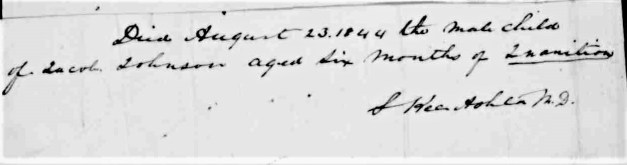
JOHNSON CERTIFICATE

The unnamed six-month-old son of Mary and Jacob Johnson died this date, August 23rd, in 1844 of Inanition and was buried at Bethel Burying Ground. The word ‘inanition’ literally means starvation. Today we might know it as a “failure to thrive.” The child was not able to use the nutrition that he was being fed. This condition may arise from a number of medical conditions, such as diabetes or a thyroid hormone disease. 

Mary Johnson was twenty-four-years-old at the time of her son’s death and was employed as a laundress. Jacob Johnson was twenty-six-years-old and was occupied as a hat dryer.* Both were born in Pennsylvania, according to the 1850 U.S. Census and the 1847 Philadelphia African American Census. The latter census reported that the Johnsons had two other children. They had a boy and girl with the ages ranging with one under 5 years old and the other between 5 and 15 years old. By the time of the 1850 U.S. Census, the Johnsons only reported having a two-year-old daughter named Julia. The Johnsons may well have had other children buried at Bethel Burying Ground.

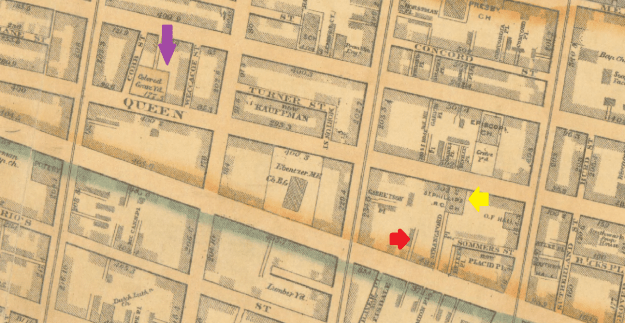
Jacob Johnson Map

The Johnson family lived on Green Street in the Southwark District of the County as indicated by the red arrow. The street was only a block away from the Bethel Burying Ground (purple arrow) where their infant son was interred. The family would have lived in one room for which they would have paid approximately $3 a month. In the 1847 Census, Mr. Johnson reported his income as $7 a week which was above the average wage for a Black man during this period. Ms. Johnson would have earned between $.75 to $1.50 a week as a laundress.

However, the Green Street address in the Spring and Summer of 1844 would put the Johnson family in the wrong place at the wrong time. In May and in August, there were a number of nativist mob assaults on the Irish Catholic population in Philadelphia. They were vicious and deadly with attacks on several Catholic churches. The center of one of these battles was the Church of St. Philip Neri on Queen Street in Southwark. There were days of rolling battles between the mob, police and, finally, the military. The mob at one point fired a cannon at the church. The Johnsons’ home backed up on the church! The yellow arrow on the above map points to the location of the church. There are no reports of anyone in the Johnson family being physically harmed. However, according to city directories, the family quickly moved six blocks to the west in a denser Black community.**

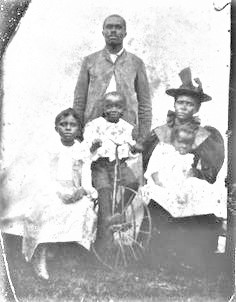
Johnson family

Mary and Jacob Johnson lost their baby boy on a rare chilly day in late August that saw rain in the afternoon. They buried their son at Bethel Burying Ground.

Official Border

*A hat dryer would work in the drying room of a hat manufacturer. The wool for the hat would be cut, stitched, blocked and dipped in a stiffening agent before it was hung by the hat dryer. The acids and other chemicals used in the process, such as mercury, were deadly occupational hazards.

**For more history on the 1844 riots and reading suggestions, please go to –https://en.wikipedia.org/wiki/Philadelphia nativist_riots.

Twenty-five-year-old Elizabeth Brooks died this date, August 20th, in 1849 and was buried at Bethel Burying Ground.

Posted by Terry Buckalew on August 20, 2019
Posted in: On This date. Tagged: African American burial grounds, African American cemeteries, African American History, African Methodist Episcopal Church, archaeology, Bethel Burying Ground, Mother Bethel, Mother Bethel African Methodist Episcopal Church, Philadelphia, Richard Allen. Leave a comment

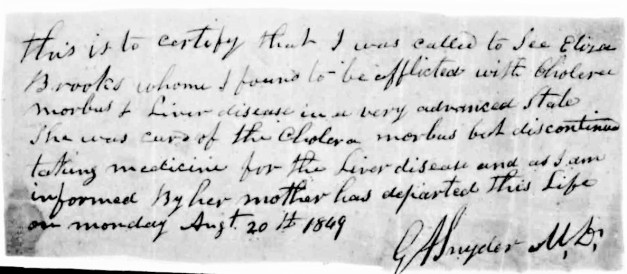
Elizabeth Brooks

The above death certificate states – This is to certify that I was called to see Elizabeth Brooks whom I found to be afflicted with Cholera morbus & Liver disease in a very advanced state. She was cured of the Cholera morbus but discontinued taking medicine for the Liver disease and as I am informed by her mother has departed this Life on Monday Augt. 20th 1849. G.A. Snyder M.D.

Official Border

The person that signed Ms. Brooks’ death certificate was Dr. George A. Snyder, an herb doctor or botanic physician. He was treating Ms. Brooks for Cholera and the resultant liver damage. It was not unusual for the African American community to utilize the service of a “root doctor.” The 1847 Philadelphia African American Census lists ten Black men and women as herb doctors. What is uncommon about Dr. Snyder was that he was a white man. 

According to historian Natalie Lewis, herb doctors also were called conjurers, root doctors, and healers. Black Philadelphia herb doctors owed their origins and knowledge to their African heritage. Again from Ms. Lewis, “Africans, when taken from their homeland some 400 years ago, brought with them more than their words. They also brought their experience working with herbs, and they transmitted their botanical knowledge to their children.” *

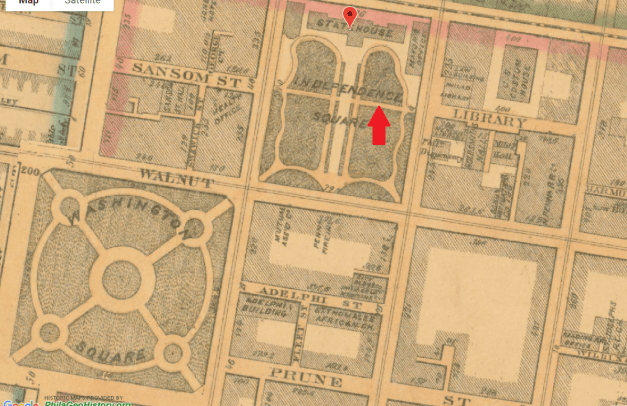
Brooks Map

Sadly, there is no census or city directory information on Ms. Brooks. The red arrow on the map above shows the location of Dr. Snyder’s home and office.  It is safe to assume that Ms. Brooks, and possibly her mother, lived nearby. Dr. Snyder lived on Powell Street which crossed from 5th to 6th Streets before the area became Independence Square. There was a sizable number of Black families residing in the alleys and courts in the area around the State House, now known as Independence Hall (see the red pin on the map). There were numerous hotels, restaurants, and taverns in the area where Blacks worked as waiters and domestics. Could Ms. Brooks and her mother have worked in these professions?

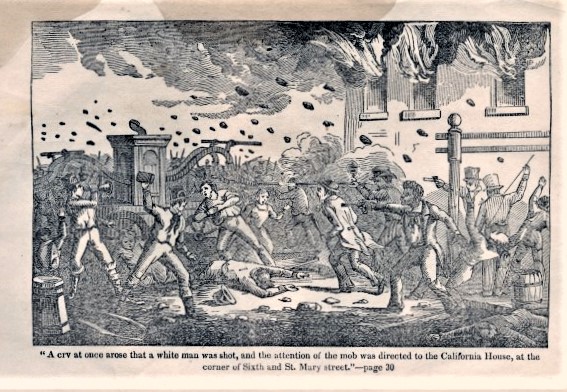
California House

California House Riot of August 1849.

What we do know about Ms. Brooks is that, while she laid on her death bed in the stifling heat of August, the streets of Philadelphia were full of vicious white mobs murdering Black men and women and burning their homes, businesses, and churches. The Klu Klux Klan-like gangs raged for several days and nights unchecked by the police who instead arrested Black men for defending themselves.

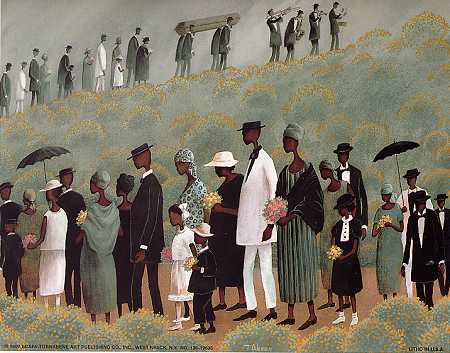
Black funeral

Ms. Brooks died on an August day on which the skies were clear and the temperature reached 82° by late afternoon. Her mother buried her at Bethel Burying Ground. Please say her name – Elizabeth Brooks.

Official Border

*Encyclopedia of Black Studies, Molefi Kete Asante and Ama Mazama, eds., p. 422.  

Forty-six-year-old Sarah Howard died this date, August 15th, in 1851 and was buried at Bethel Burying Ground.

Posted by Terry Buckalew on August 15, 2019
Posted in: On This date. Tagged: African American burial grounds, African American cemeteries, African American History, African Methodist Episcopal Church, archaeology, Bethel Burying Ground, Mother Bethel, Mother Bethel African Methodist Episcopal Church, Philadelphia, Richard Allen. Leave a comment

SARAH HOWARD

Forty-six-year-old Sarah Howard died this date, August 15th, in 1851 of heart disease and was buried at Bethel Burying Ground. A year before her death, the 1850 U.S. Census captured the family’s information. Ms. Howard was married to George Howard, a fifty-six-year-old porter who was born in Maryland. She was not employed outside the home. They had three children: John (14 y/o), Thomas (8 y/o) and Mary T. (6 y/o). All were born in Pennsylvania. Also living with the family was sixty-year-old Hester Hammer and nine-year-old Elizabeth Purver. Both females were born in Pennsylvania as was Sarah Howard.

HOWARD MAP

According to the 1849 Philadelphia City Directory, the Howard family lived across Queen Street from the Bethel Burying Ground (red pin above). The following year, they were living on Morris Street (eventually Montcalm Street). It was located between Christian Street and Fitzwater Street and between 9th and 10th Street. See black arrow above. On Morris Street, the Howards would have paid $3 – $5 a month in rent. That would have been equivalent to a week’s pay for Mr. Howard. 

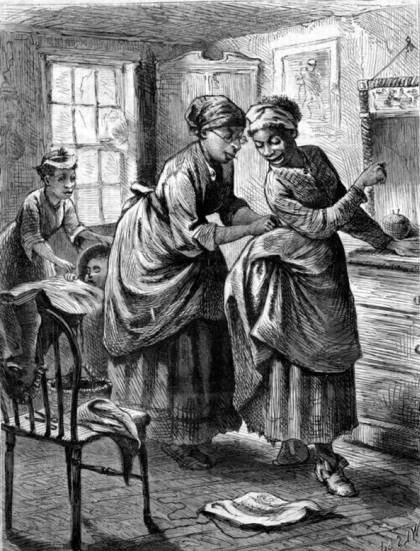
Negro dressmaker

Morris Street was a small neighborhood of Black artisans. The 1847 Census shows a remarkable number of Black dressmakers, seamstresses, tailors, confectionery bakers, Mantua makers*, and Drapers **.

img_6417

Ms. Sarah Howard died on a warm day in August 1851 when the temperature at dawn was 65° and rose to 84° by 3 o’clock in the afternoon. Her family eventually buried her at Bethel Burying Ground.

Official Border

*Mantua: a fashionable woman’s loose gown.

**Draper: a retailer or wholesaler of cloth for clothing.

Thirty-five-year-old Henrietta Anderson died this date, August 10th, in 1852 and was buried at Bethel Burying Ground.

Posted by Terry Buckalew on August 10, 2019
Posted in: On This date. Tagged: African American burial grounds, African American cemeteries, African American History, African Methodist Episcopal Church, archaeology, Bethel Burying Ground, Mother Bethel, Mother Bethel African Methodist Episcopal Church, Philadelphia, Richard Allen. Leave a comment

HENRIETTA ANDERSON

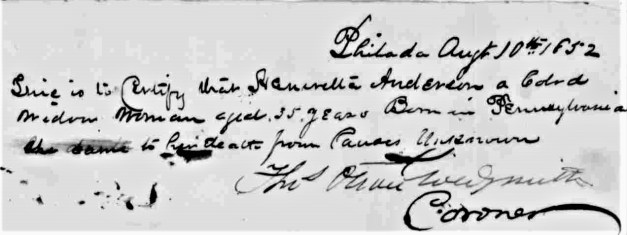
Thirty-five-year-old Henrietta Anderson died this date, August 10th, in 1852 of unknown causes, according to the City Coroner. She was buried at Bethel Burying Ground. 

I believe Ms. Anderson is the “Henrietta Anderson” recorded in the 1850 U.S. Census. The birth dates and birth location are good matches. The 1847 Philadelphia African American Census records her occupation as a domestic worker. In 1850, she was married to John Anderson, a forty-three-year-old chimney sweep. He was born in Pennsylvania, as was Ms. Anderson. The same census (1850) reported additional family members that included eleven-year-old John Anderson who was born in New Jersey, ten-year-old John Bowen who was born in Pennsylvania and an eight-year-old boy simply recorded as “Ballard.” He also was born in Pennsylvania.

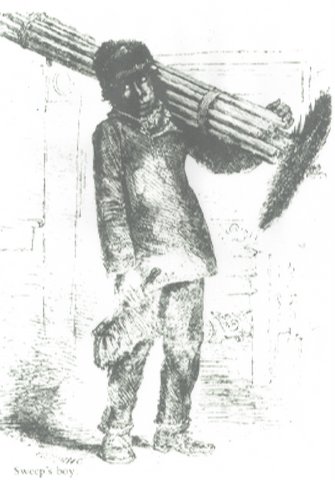
Sweep's Boy

Journeymen chimney sweeps would often obtain small young boys from the workhouse or almshouses as apprentices. Their diminutive size would allow them to fit in chimnies to do the backbreaking scraping and cleaning. The labor exposed the workers to deadly lung diseases and cancers.

Mr. Anderson was alive in early 1850 (census) and dead by his spouse’s death in 1852 when she was reported to be a widow. I am unable to locate a death certificate for Mr. Anderson. The majority of these documents for those buried at Bethel Burying Ground no longer exist. Mr. Anderson is last recorded in the 1851 City Directory.

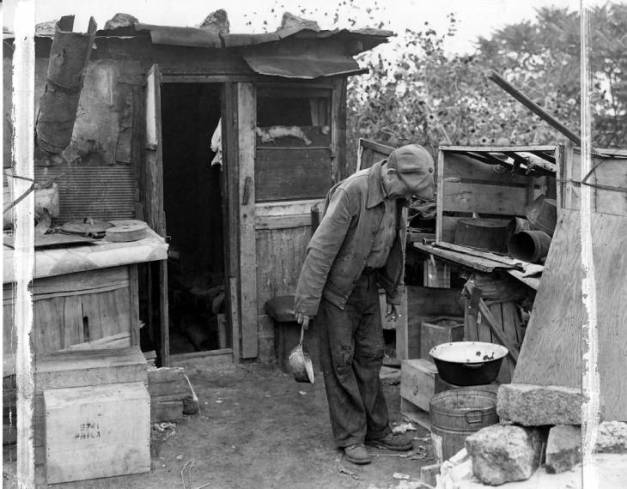
SHED

The Anderson family lived in the rear of #11 St. Mary’s Street only a block from Bethel AME Church. St. Mary’s Street was a rat infected, disease-ridden alley where only the destitute would live because they couldn’t afford anything better. It was often the first address of those migrating to the city – both free and formerly enslaved. The Anderson family of five lived in a shack in the back of #11. Often, these structures were converted horse stalls or pig pens with dirt floors. They paid $0.75 to $1.00 a week in rent. That would be the equivalent of what Ms. Anderson might earn in a week.

No one chose to live like this. 

download

Sankofa


‘Sankofa’ is a word in the Twi language of Ghana that translates to “Go back and get it” and also refers to the Asante proverb “It is not wrong to go back for that which you have forgotten.”

The Sankofa bird appears frequently in traditional Akan art and also has been adopted as an important symbol in an African-American and African Diaspora context to represent the need to reflect on the past to build a successful future.

Official Border

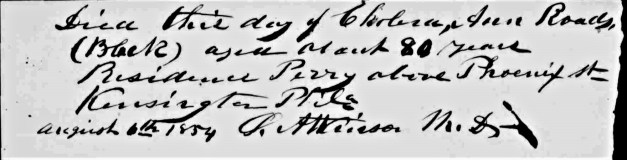
Eighty-year-old Ann Roads died this date, August 6th, in 1854 and was buried at Bethel Burying Ground.

Posted by Terry Buckalew on August 6, 2019
Posted in: On This date. Tagged: African American burial grounds, African American cemeteries, African American History, African Methodist Episcopal Church, archaeology, Bethel Burying Ground, Mother Bethel, Mother Bethel African Methodist Episcopal Church, Philadelphia, Richard Allen. Leave a comment

ANN ROADS

Eighty-year-old Ann Roads died this date, August 6th, in 1854 of Cholera and was buried at Bethel Burying Ground. I could find little specific information on Ms. Roads. I did find two families at the same address with her last name. I also found the last name spelled ‘Rhoades’ and ‘Rhodes.’

Rhoades Map

Ms. Roads and, presumably, her family lived in the northeast corner of Philadelphia County (red pin above) on Perry Street. The Kensington neighborhood did not have a large African American population but there were pockets, such as Perry Street. The men in Ms. Roads’ family worked as brick masons and brickmakers at a local brickyard. The two families were headed by Alexander and Thomas Roads. Their census information can be view at https://lilac.swarthmore.edu/fmi/webd/DigitizedCensusWeb.

To illustrate the remoteness of the Perry Street location, I also have identified Bethel Church (red arrow-3 miles away) and the Bethel Burying Ground (yellow arrow-4 miles away) on the above map. 

The small pocket of African Americans on Perry Street consisted of twelve families with a total of forty-two individuals, according to the 1847 Philadelphia African American Census. They were employed as brickmakers, porters, seamstresses, laundresses, and woodsawyers. Many would worship at nearby Zoar African Methodist Episcopal Church.

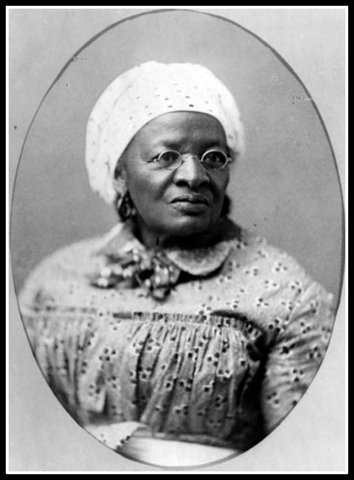
Black Matriarch

The day that Ms. Roads died, there was a “tremendous storm… The lightning was keen and vivid, while the deep rolling thunder seemed to shake the very buildings.” (Daily Pennsylvanian, 7 August 1854). She was laid to rest at Bethel Burying Ground.

Official Border

JULY 1896

Posted by Terry Buckalew on July 25, 2019
Posted in: Bethel Burying Ground Timeline. Tagged: African American burial grounds, African American cemeteries, African American History, African Methodist Episcopal Church, archaeology, Bethel Burying Ground, Mother Bethel, Mother Bethel African Methodist Episcopal Church, Philadelphia, Richard Allen. Leave a comment
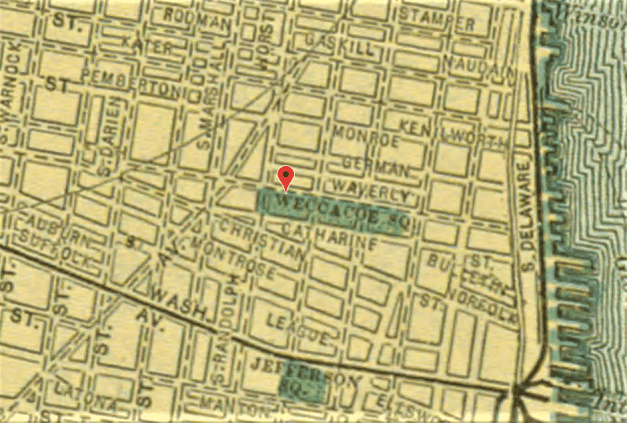
Weccacoe 1903

1903 Philadelphia Street Map

By all published accounts, the condition of the Bethel Burying Ground in 1889 was a rubbish-strewn, “hard clay” lot that was used as a trash dump and a place for neighborhood children to play. There were no headstones or other artifacts to indicate that a burial ground existed there, although newspaper accounts indicate it was common knowledge. The lot remained untouched for the next ten years. Even though the Select Council of the City in July of 1896 directed a portion of “the Weccacoe Park to be opened” and awarded a contracted for certain “buildings” to be demolished on the property, it wasn’t until June of 1899 that the city legislature approved the appropriation of $10,000 for the improvement of the property and to repave Queen Street between Fourth and Fifth Streets. A contractor was hired to ready “Weccacoe Square” for “promenaders.” It was reported that the property is the site of “an abandoned burial ground for colored people.” (Philadelphia Inquirer, August 20, 1890)

Posts navigation

← Older Entries
Newer Entries →
  • Recent Posts

    • Three dead as church wall falls on this date, May 1st, in 1841.
    • The ten-month-old Baby Colgate died this date, June 20th, in 1847, and was buried at Bethel Burying Ground.
    • Fifty-eight-year-old Rachel Dawson died this date, May 3rd, in 1839, and was buried at Bethel Burying Ground.
    • Twenty-eight-year-old Robert Swails died on this date, March 31st in 1849, and was buried at Bethel Burying Ground.
    • Forty-year-old Jacob “Jesse” Howard died on this date, January 29th, in 1840, and was buried at Bethel Burying Ground.
  • Archives

    • May 2024
    • June 2023
    • May 2023
    • March 2023
    • January 2023
    • December 2022
    • November 2022
    • October 2022
    • September 2022
    • August 2022
    • May 2022
    • April 2022
    • March 2022
    • February 2022
    • January 2022
    • December 2021
    • November 2021
    • October 2021
    • September 2021
    • August 2021
    • July 2021
    • June 2021
    • May 2021
    • April 2021
    • March 2021
    • February 2021
    • January 2021
    • December 2020
    • November 2020
    • October 2020
    • September 2020
    • August 2020
    • July 2020
    • June 2020
    • May 2020
    • April 2020
    • March 2020
    • February 2020
    • January 2020
    • December 2019
    • November 2019
    • October 2019
    • September 2019
    • August 2019
    • July 2019
    • June 2019
    • May 2019
    • April 2019
    • March 2019
    • February 2019
    • January 2019
    • December 2018
    • November 2018
    • October 2018
    • September 2018
    • August 2018
    • July 2018
    • June 2018
    • May 2018
    • April 2018
    • March 2018
    • February 2018
    • January 2018
    • December 2017
    • November 2017
    • October 2017
    • September 2017
    • August 2017
    • July 2017
    • June 2017
    • May 2017
    • April 2017
    • March 2017
    • February 2017
    • January 2017
    • December 2016
    • November 2016
    • October 2016
    • September 2016
    • August 2016
    • July 2016
    • June 2016
    • May 2016
    • April 2016
    • March 2016
    • February 2016
    • January 2016
    • December 2015
    • November 2015
    • October 2015
    • September 2015
    • August 2015
    • July 2015
    • June 2015
    • May 2015
    • April 2015
    • March 2015
    • February 2015
    • January 2015
    • December 2014
    • November 2014
    • October 2014
  • Categories

    • Archaeology
    • BBG History
    • Bethel Burying Ground Name Directory
    • Bethel Burying Ground Timeline
    • Burial services
    • Diseases
    • Documents
    • Freemasonry
    • Ignatius Beck
    • It's a fact
    • Maps
    • Neighborhood
    • Newspaper Articles
    • On This date
    • Photographs
    • Uncategorized
    • Videos
  • Meta

    • Create account
    • Log in
    • Entries feed
    • Comments feed
    • WordPress.com
Blog at WordPress.com.
Bethel Burying Ground Project
Blog at WordPress.com.
  • Subscribe Subscribed
    • Bethel Burying Ground Project
    • Join 48 other subscribers
    • Already have a WordPress.com account? Log in now.
    • Bethel Burying Ground Project
    • Subscribe Subscribed
    • Sign up
    • Log in
    • Report this content
    • View site in Reader
    • Manage subscriptions
    • Collapse this bar
 

Loading Comments...