Bethel Burying Ground Project

Bethel Burying Ground Project

  • ABOUT THE BETHEL BURYING GROUND PROJECT

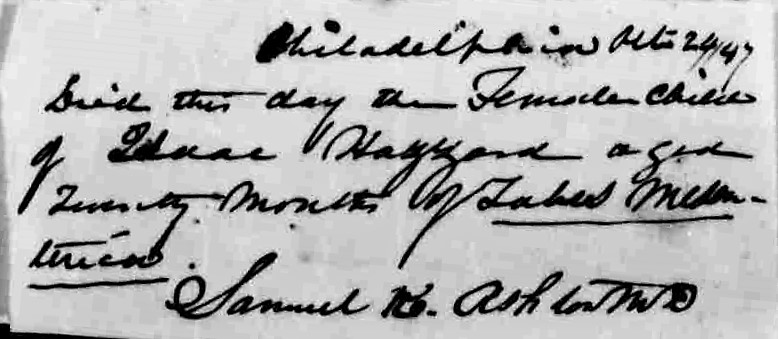
The twenty-month-old daughter of the Hazzard family died this date, October 24th in 1847, and was buried at Bethel Burying Ground.

Posted by Terry Buckalew on October 24, 2017
Posted in: On This date. Tagged: African American burial grounds, African American cemeteries, African American History, African Methodist Episcopal Church, archaeology, Bethel Burying Ground, Mother Bethel, Mother Bethel African Methodist Episcopal Church, Philadelphia, Richard Allen. Leave a comment

hazzard II

The twenty-month-old daughter of Joanna Liveley Hazzard and Isaac Hazzard died on this date, October 24th in 1847, of Tabes Mesenteric and was buried at Bethel Burying Ground. Ms. Hazzard was employed as a day worker and Mr. Hazzard was a seaman who also worked occasionally as a laborer in a Delaware River boatyard where he was paid $5 a week. The family lived in a 10’X 10′ room at 179 South 6th Street within the shadow of Independence Hall. They paid $3.50 a month for rent, according to the 1837 and 1847 Philadelphia African American Censuses.

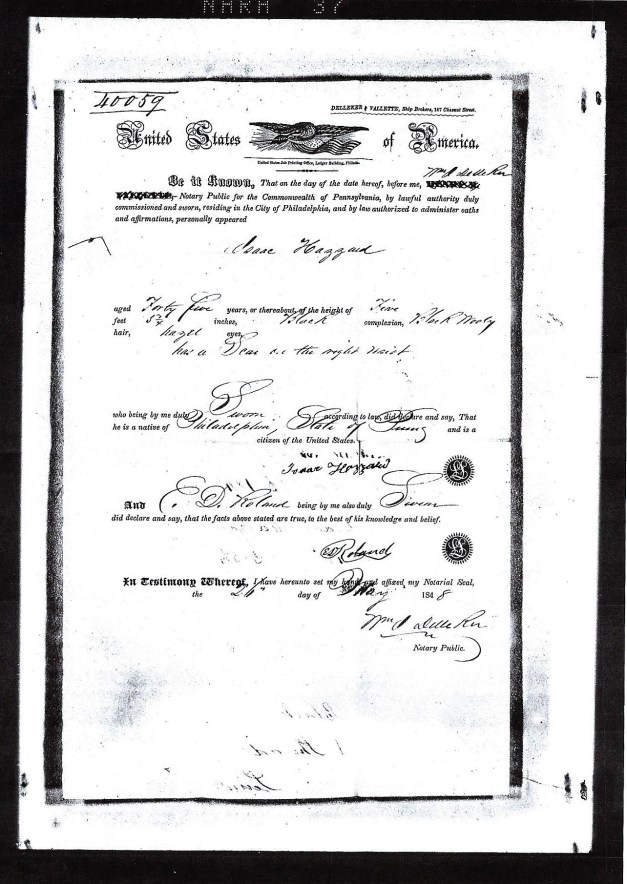
To work as a seaman, Mr. Hazzard would have had to obtain a “Seaman’s Protection Certificate.” These were issued to American seamen during the last part of the 18th century through the first half of the 20th century. These papers provided a description of the sailor and showed American citizenship. All it took to be certified was a witness to attest to the applicant’s identity. Black men were allowed to vouch for other Black men. It has been mentioned that fugitives from enslavement were able to get “freemen papers” this way and exit the country.**

Seamen 2

Mr. Hazzard was 5′ tall with hazel colored eyes, a dark complexion and an identifying scar on his right wrist.

The Hazzard family lived in the block just north of Independence Hall now known as Independence National Park. Below is a photo of how it looks today.

images

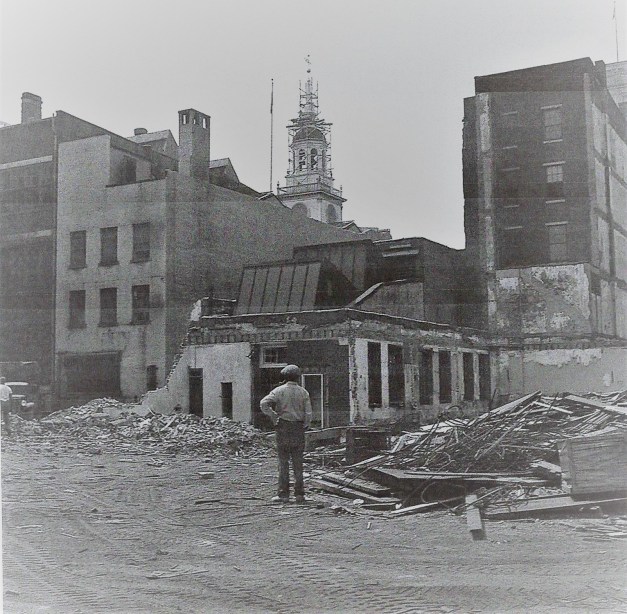
The buildings that had been on the block were torn down beginning in 1949. Below is a photo of the buildings in the Hazzards’ neighborhood being demolished. 

Scan mnb

Demolition on 5th and 6th Streets, Independence Mall. Independence Hall Tower ca. 1950. Philadelphia Free Library.

Official Border
Official Border

*Tabes Mesenterica is a progressive wasting of the intestines marked by anemia, dramatic swelling of the abdomen, diarrhea, fever, and pain.

** For further reading on the history of African American seamen I suggest W. Jeffrey Bolster, Black Jacks: African American Seamen in the Age of Sail.


Thirty-three-year-old Rebecca Conner died this date, October 3rd, in 1853 and was buried at Bethel Burying Ground.

Posted by Terry Buckalew on October 3, 2017
Posted in: On This date. Tagged: African American burial grounds, African American cemeteries, African American History, African Methodist Episcopal Church, archaeology, Mother Bethel, Mother Bethel African Methodist Episcopal Church, Philadelphia, Richard Allen. Leave a comment

REBECCA CONNOR

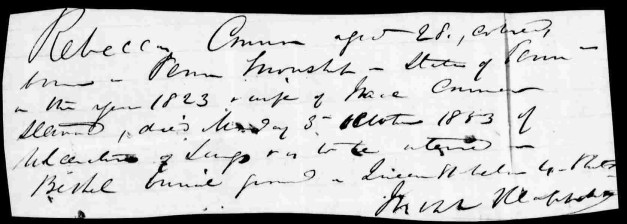
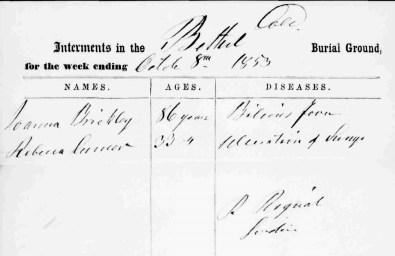
Thirty-three-year-old* Rebecca Conner died this date, October 3rd, 1853 due to “Ulceration of the Lungs” and was buried at Bethel Burying Ground. She left a spouse, Issac (31 y/o) and two children Ellen (6 y/o) and Isaac, Jr. (9 y/o). Ms. Conner was employed as a “days worker” and Mr. Conner as a porter earning $3 a week, according to the 1847 Philadelphia African American Census (PAAC). The children and Mr. Conner were born in Philadelphia while Ms. Conner was born in New Jersey.

The Conner family lived on Bedford Street which was known historically for its grinding poverty, wretched living conditions, disease, and violence. The family lived in one 10’X10′ room for which they paid $2.50 a month. In 1847, the Connor family included a woman “over 50 years old” who was previously enslaved and her kidnapper was paid $160 for her release. (1847 PAAC) She is not recorded as being with the family in the 1850 Federal Census.

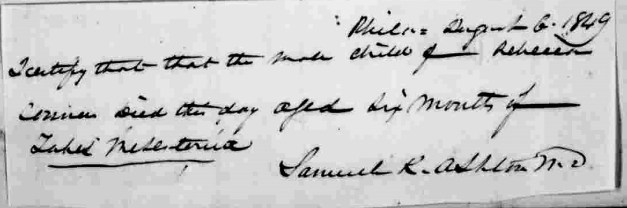
Ms. Conner was buried with her six-month-old son who tragically died on August 6, 1849, of Tuberculosis and was buried at Bethel Burying Ground.

Black funeral

The 1847 PAAC also reports that the Conners belonged to a “beneficial society” that likely assisted Mr. Connor in paying the funeral expenses for Ms. Conner and their infant son. 

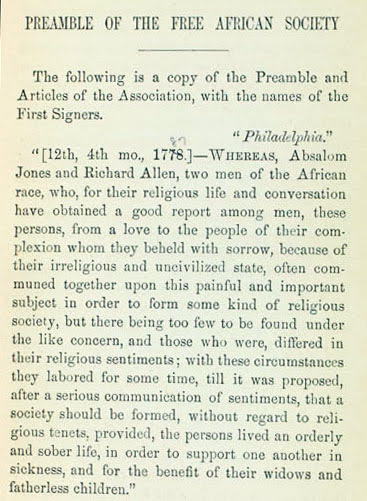
“Beneficial societies were social and economic safety nets for an impoverished community; in Philadelphia the Free African Society established on April 12, 1787, charged members monthly dues in order to create a pool of money from which to draw if women were widowed, a member fell sick, or to provide a Christian burial for a member who died.  This assurance that one would be taken care of by an organization if any misfortune were to befall them was a powerful motivator to convince people to contribute to the Free African Society.”**

African American Philadelphians joined together around their churches, trade groups and philanthropic organizations such as the Black Freemasons to assert their self-reliance and not their dependence on white charities. Rebecca Conner was one of these pioneers.

Free African Society


Further reading on Beneficial Societies: 

  1. Du Bois, W.E.B., “Economic Co-operation among Negro Americans”, http://docsouth.unc.edu/church/dubois07/dubo
  2. is.html#dub92.
  3. Dunbar, Erica Armstrong, A Fragile Freedom.
  4. Nash, Gary B., Forging Freedom.

*The attending physician was in error when he wrote that Ms. Conner’s age was 28 years old. This was corrected on the Board of Health document and her exact age is supported by the 1850 Federal Census.

Brickley and Connor


**http://www.blackpast.org/aah/african-insurance-company-1810-1813.

Three-year-old Ellen Sprigg died this date, September 17th, in 1845 and was buried at Bethel Burying Ground.

Posted by Terry Buckalew on September 17, 2017
Posted in: On This date. Tagged: African American burial grounds, African American cemeteries, African American History, archaeology, Bethel Burying Ground, Mother Bethel, Mother Bethel African Methodist Episcopal Church, Philadelphia, Richard Allen. Leave a comment

SPRIGG

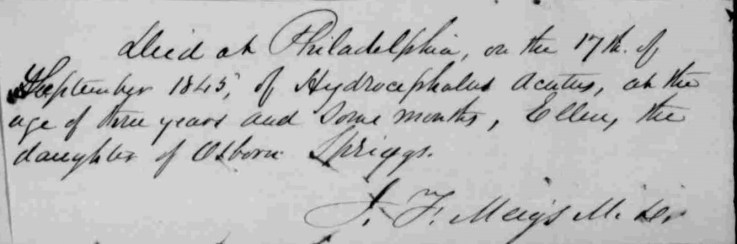
Three-year-old Ellen Sprigg* died this date, September 17th, in 1845 of Hydrocephalus and was buried at Bethel Burying Ground. Osborne (~35) and Rebecca Sprigg (~24) lived at 201 Lombard Street in the rear of the building. It appears that Rebecca was Osborne’s second spouse. On April 30, 1833, Mr. Sprigg married Sarah Matthews at St. James Episcopal Church in Philadelphia. It is very possible that Sarah died in the 1830s, however, I cannot verify that because the vast majority of those death records have been destroyed. 

At the time of their daughter’s death, Mr. Sprigg was employed as a waiter and Ms. Sprigg as a laundress. The entire family lived in one room for which they paid $3.50 a week rent. This is equivalent to approximately $100 in today’s U.S. currency.

The 1850 Federal Census lists the following Sprigg family members: Osborn (40y born in Maryland); Rebecca (29y/Delaware); Mary (11y/PA); William (10y/PA); Margaret (5/PA); Rebecca (3y/PA); James (15y/ PA) who was employed as a barber. The children attended the 6th and Lombard School. Five members of the family could read and three could write, according to the 1847 African American Census. In addition, this Census reports that Mr. Sprigg was a member of a Philadelphia temperance society.

As of 1842, there were ten active Black temperance societies in Philadelphia. Black interest in temperance societies appeared as early as 1788 when the Free African Society refused membership to all drinkers of alcohol. Political and cultural forces solidly linked temperance to the abolition movement and the moral and civil uplifting of African Americans in the United States. By the late 1830s, the temperance movement had come to symbolize solidarity with the enslaved. Mr. Sprigg belonged to a large group of African American Philadelphians who believed that alcohol was used to debilitate and subjugate Blacks and suppress their desire to rebel against white racist society. Two hundred years later, the same accusations would be made against heroin and crack cocaine. 

Riot pic

Mr. Sprigg may have been one of the 1,200 Black men and boys who, on August 1, 1842, marched through the streets of Philadelphia celebrating both their liberation from alcohol and also the anniversary of the British abolishing slavery in England and in their West Indies colonies. In the southern part of the city, the parade was met by a white mob made up mostly of Irish immigrants that numbered at least double that of the Black paraders who were savagely attacked. There was a running battle of clubs, stones, knives, and guns until the Blacks were overrun. Then began one of the worst acts of ethnic cleansing that a northern city had ever witnessed to this point in U.S. history.

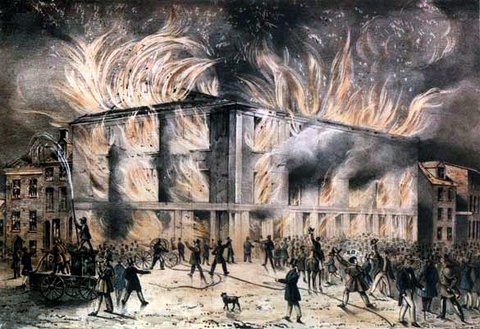
Black paraders were killed and maimed. Countless homes of Black citizens’ homes were broken into, valuables were stolen and furniture destroyed. Many of their homes were burned to the ground.  The Second African Church and the newly built Black temperance hall also were completely destroyed by fire. The Black community began to flee the city in fear of their lives and the lives of their children. The ferries to Camden, New Jersey were jammed with terrified families. However, the docks of the Delaware and Schuylkill Rivers were manned by the Irishmen who attacked the innocent as they waited to escape. Three days of unchecked violence finally prompted the mayor to call out seven militia units to restore order. The courts, the city government, and the press placed the blame for the violence on the Black paraders. They claimed that free Black men provoked the white mob who could do nothing less than react in the way they did. The toll of dead and injured Black citizens has never been accurately assessed.
FIRE

The above illustration is not of the Black temperance hall burned down in 1842. It depicts the burning of another Black-owned hall on May 17, 1838.

For further reading on the Black Temperance Movement and the August riot see:

A Gentleman of Color: The Life of James Forten, J. Winch; Forging Freedom, G. Nash;  Philadelphia Stories, S. Otter; Tasting Freedom, D. Biddle and M. Dubin.

*The family name is also spelled “Spriggs” and “Sprig” in census documents and city directories. In addition, “Osborne” in one occasion is spelled “Osborn.”

The four-month-old Chapman child died this date, September 14th, in 1822 and was buried at Bethel Burying Ground.

Posted by Terry Buckalew on September 14, 2017
Posted in: On This date. Tagged: African American burial grounds, African American cemeteries, African American History, African Methodist Episcopal Church, archaeology, Bethel Burying Ground, Mother Bethel, Mother Bethel African Methodist Episcopal Church, Philadelphia, Richard Allen. Leave a comment

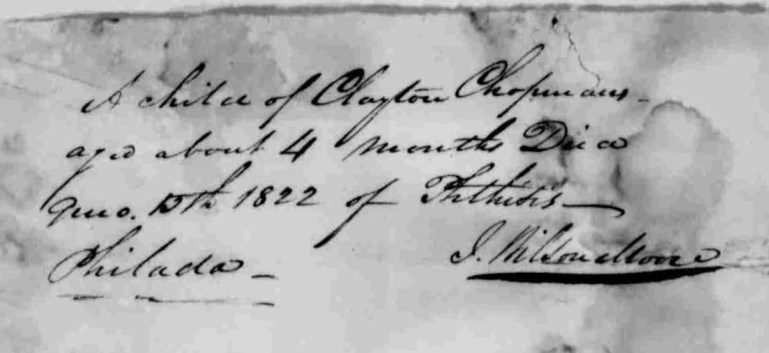
CHAPMAN 4mos obit

The four-month-old child of Clayton and Rossa Medkiff Chapman died this date September 14th in 1822 of Tuberculosis and was buried at Bethel Burying Ground. The Chapmans were married on October 29, 1818, at Old St. George’s Methodist Episcopal Church in Old City Philadelphia. This was the same church where Richard Allen and Absalom Jones staged an exodus in 1787. Not all Black congregates followed the examples of the two community leaders that established Black churches.

Mr. Chapman had a shoemaker workshop in his home at 109 S. 5th Street very near Independence Hall. Ms. Chapman’s employment is not recorded. The newspaper item below shows that Mr. Chapman had at least one indentured apprentice involved in his business.

Screenshot 2017-09-13 09.48.43(2)

June 20, 1827, “Poulson’s American Daily Advertiser.” The Chapmans had moved to 185 Spruce Street by 1827.

“Binding out” poor children by their parents was not restricted to whites. Black parents did try to limit the indenture of their children to when they reached 18 to 20 years old only. Black parents frequently solicited the assistance of the Pennsylvania Abolition Society to rescue a child from violent treatment or from being kidnapped into enslavement. Run away Black indentured servants risked the chance of being picked up by authorities and sold as a slave.* 

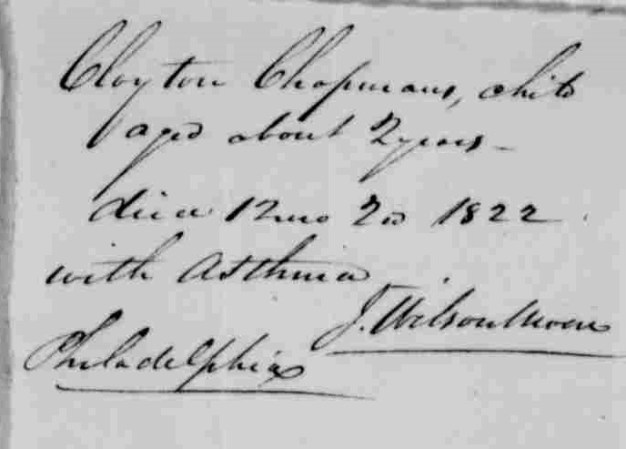
Sadly, the Chapmans lost another child (2y/o) just three months later. The youngster died of complications from Asthma and was buried with his or her sibling at Bethel Burying Ground.

Chapman second obit


*For further reading on Black Philadelphia indentures see Gary B. Nash’s “Forging Freedom,” p. 158-163.

19th Century Healthcare for the Poor

Posted by Terry Buckalew on September 12, 2017
Posted in: BBG History. Tagged: African American burial grounds, African American cemeteries, African American History, African Methodist Episcopal Church, archaeology, Bethel Burying Ground, Mother Bethel, Mother Bethel African Methodist Episcopal Church, Philadelphia, Richard Allen. Leave a comment

The vast majority of those interred at Bethel Burying Ground were poor working class men and women who relied on the free clinics (dispensaries) for their family’s healthcare needs. These clinics were spread across the county and provided office visits and home visits if necessary. Below are links to better understand the system and the physicians who voluntarily provided their services. 

http://philadelphiaencyclopedia.org/archive/dispensaries/

https://southwarkhistory.org/2017/09/treating-the-poor/

Pencak, William. “Free Health Care for the Poor: The Philadelphia Dispensary.” Pennsylvania Magazine of History and Biography 136 (January 2012): 25-52.

Sixty-year-old Alice Ricker died this date, September 7th, in 1849 and was buried at Bethel Burying Ground.

Posted by Terry Buckalew on September 7, 2017
Posted in: On This date. Tagged: African American burial grounds, African American cemeteries, African American History, archaeology, Bethel Burying Ground, Mother Bethel, Mother Bethel African Methodist Episcopal Church, Philadelphia, Richard Allen. Leave a comment

RICKER

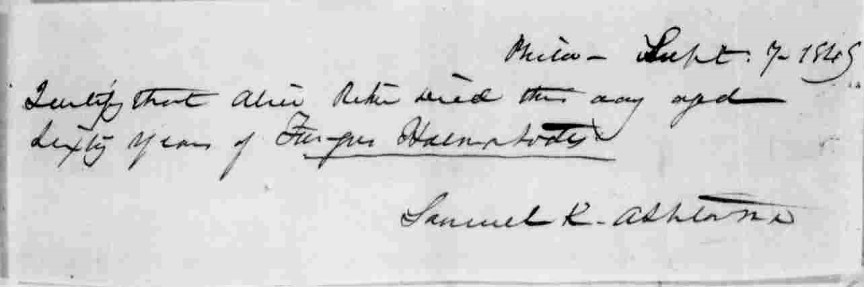
Sixty-year-old Alice Ricker died this date, September 7th, in 1849 of Fungus Haematodes* and was buried at Bethel Burying Ground. As the matriarch of the family, she was employed at the time of her death as a laundress. She lived at #4 Barley Alley above 10th Street in the City with someone who appears to be a married son or daughter (waiter/laundress) and his or her young daughter. They paid a very high $8 a month rent for their home. A typical Black waiter at this time would bring home $4-$5 a week. None of the Ricker family members were native to the state of Pennsylvania, according to the 1847 Philadelphia African American Census.

download

Barley Street was considered a cartway at only 6’10” wide. The 1847 Census reports that, in addition to the Ricker family, there were 56 other African American families living along Barley with a total of 245 individuals. The 1847 Census lists their occupations: 

Cake Baker

Cake Seller

Clothes Dealer

Wood Sawyer

Silversmith

Nurse

Bottler

White Washer

Hog Carrier

Bootmaker

Shoemaker

Waiter

Dressmaker

Laundress

Laborer

Janitor

Coal Hauler

Cook

Seaman

Barber

Shirtmaker

Porter

Coachman

Seamstress

 Man’s greatness consists in his ability to do and the proper application of his                                                           powers to things needed to be done.                                                                                                                                                              Frederick Douglass

The thirteen-month-old daughter of the Scotts died this date, September 2nd, in 1846 and was buried at Bethel Burying Ground.

Posted by Terry Buckalew on September 2, 2017
Posted in: On This date. Tagged: African American burial grounds, African American cemeteries, African American History, African Methodist Episcopal Church, archaeology, Bethel Burying Ground, Mother Bethel, Mother Bethel African Methodist Episcopal Church, Philadelphia, Richard Allen. Leave a comment

SCOTT

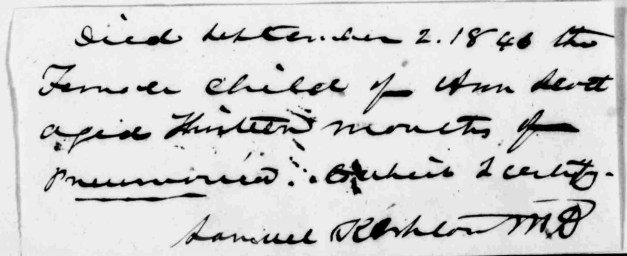
The thirteen-month-old daughter of Ann and Emanuel Scott died this date, September 2nd, in 1846 of Pneumonia and was buried at Bethel Burying Ground. Ann (20 y/o) worked making doormats and Emanuel (22 y/o) worked as a laborer on the Delaware River wharves. According to the 1847 Philadelphia African American Census, it appears that, at the time of their unnamed daughter’s death, they also had a three-year-old son. 

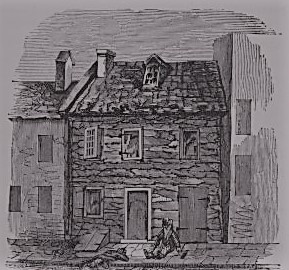
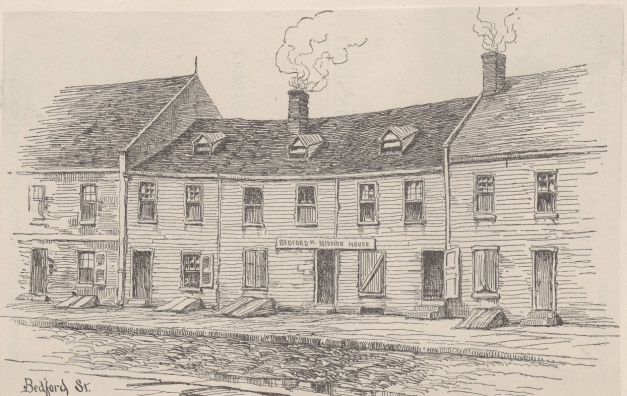
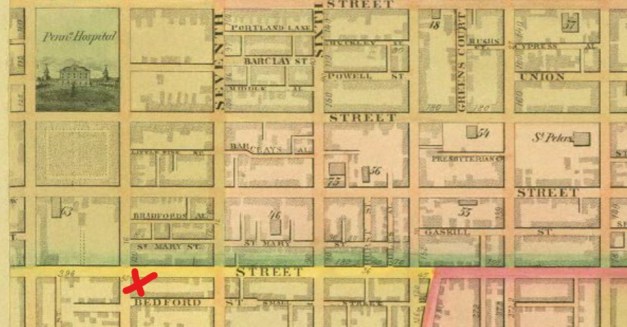
New York city had its “Five Points” and Philadelphia had Bedford Street. With its next door neighbor, St. Mary’s Street, it was renowned for its abject poverty, prostitution, gambling, and its streets covered with garbage and animal waste. It’s where an African American man lay dead for over two days before his corpse was removed from the gutter. The desperately poor were housed in old buildings, overcrowded, with no ventilation or running water and cellars that were more akin to cesspools. The rear yards previously were horse stables converted into dwellings scarcely fit to shelter the original tenants. Viral and bacterial epidemics would roar through the neighborhood taking the lives of its residents. Here the Scotts lived at 112 Bedford Street in a one 10’x10′ room for which they paid 75¢ a week. Mr. Scott reported in the 1847 Census that he earned $3.50 a week laboring. The Census does not record Ms. Scott’s income. 

Bedford store front

The sketches above and below are depictions of Bedford Street several years after the Scott child died.

Bedford Street 1854

Ann Scott was born in Delaware and Emanuel in Virginia. They are typical of families with members buried at Bethel Burying Ground. They were hard working, industrious and family oriented. This young couple sent their oldest child to school to learn how to read and write, something the parents could not do. Despite their very limited finances, their dead child was not going to be buried in a potter’s field to lie forever, nameless and forgotten.


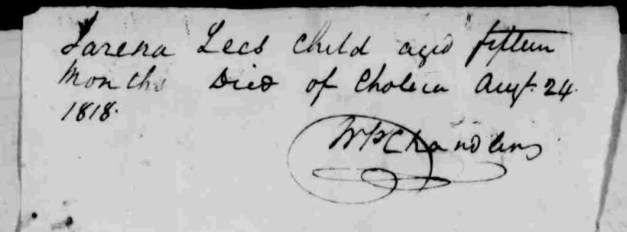
The fifteen-month-old child of African Methodist Episcopal preacher Jarena Lee died this date, August 24th, in 1818 and was buried at Bethel Burying Ground.

Posted by Terry Buckalew on August 24, 2017
Posted in: On This date. Tagged: African American burial grounds, African American cemeteries, African American History, archaeology, Bethel Burying Ground, Mother Bethel, Mother Bethel African Methodist Episcopal Church, Philadelphia, Richard Allen. 1 Comment

Jerena Lee (Child)

The fifteen-month-old son of African Methodist Episcopal preacher Jarena Lee died this date, August 24th, in 1818 of Cholera and was buried at Bethel Burying Ground. The child’s father, Rev. Joseph Lee, an African Methodist Episcopal minister, also died in 1818. Existing records do not indicate if his death occurred before or after the child mentioned above. The Lees had another son James who reached maturity. *

religiousexperi00leegoog_0006

Preacher Lee at sixty years of age in 1844.

Mrs. Lee was an early feminist, abolitionist, equal rights advocate, author and a determined champion for women in the ministry. She rose up from servitude to become the first female preacher in the largest African American denomination of the era. She was born to free Black parents in Cape May, New Jersey on February 11, 1783. Her family name has not be recorded. At the young age of seven years, she was sent away by her parents to the Sharp family, sixty miles away, to work as a “servant maid.” According to her Journal, her adolescence was marked by episodes of severe depression and suicidal thoughts that would continue into her adulthood. 

religiousexperi00leegoog_0007

Ms. Lee’s Journal is published in full at https://archive.org/details/religiousexperi00leegoog

Mrs. Lee initially published her autobiography in 1839 and updated it in 1849. It is a chronicle of her long spiritual journey. Historian Erica Armstrong Dunbar observed that “The writings of African American women, both elite and ordinary, demonstrate the difficulties of racism, sexism, motherhood, and familial obligations during the nineteenth century.” The male-dominated Bethel church congregation did not initially approve of a female preacher. However, when they saw the outpouring of support, they deferred to Bishop Richard Allen’s decision to give her access to the pulpit. Many men and women of both races traveled long distances to hear Mrs. Lee sermonize and conduct prayer meetings.***

Jarena Lee died February 5, 1864, at the age of eighty-one, impoverished and having to rely on others to keep alive. A social worker interviewed her several weeks before she died and reported ” . . . she endeavored to support herself for as long as she could (washerwoman) but in her last days depended upon the contributions of others, this was so distasteful to her that a short time before her death she remarked, ‘she wished she was done with begging’.” Her occupation listed on her death certificate was recorded as “Missionary.”*** During her lifetime, she preached up and down the Atlantic seaboard, often in slaveholding states, fulfilling her life’s mission while enduring many emotional and physical trials. She lamented in the 1849 edition of her autobiography that there was a wall between the white community and her “which was higher than I could possibly see over.” 


*Frederick Knight (January 2017). “The Many Names for Jarena Lee,” Pennsylvania Magazine of History & Biography. 141 (1): 59-68. ISSN 0031-4587.

**Erica Armstrong Dunbar, A Fragile Freedom: African American Women and Emancipation in the Antebellum City, p. 97, 111-119.

*** Knight, p. 63.


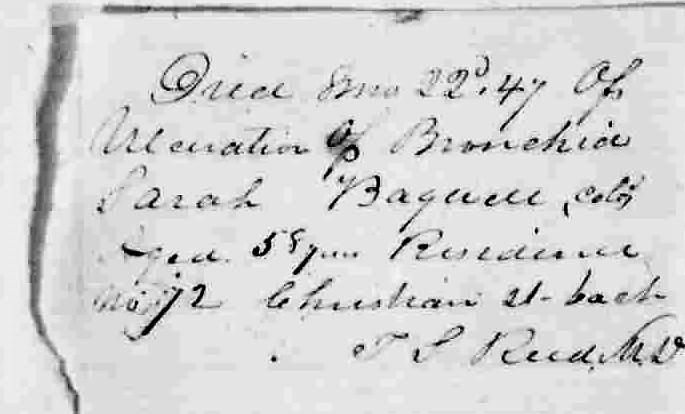
Fifty-eight-year-old Sarah Bagwell died this date, August 22nd, in 1847 and was buried at Bethel Burying Ground.

Posted by Terry Buckalew on August 22, 2017
Posted in: On This date. Tagged: African American burial grounds, African American cemeteries, African American History, African Methodist Episcopal Church, archaeology, Bethel Burying Ground, Mother Bethel, Mother Bethel African Methodist Episcopal Church, Philadelphia, Richard Allen. Leave a comment

Sarah Bagwell 2

Fifty-eight-year-old Sarah Bagwell died this date, August 22nd, in 1847 of an Ulcerated Bronchid and was buried at Bethel Burying Ground. She developed an abscess that eventually became a complete hole in her trachea.The medical literature of the era lists Tuberculosis and Cancer as the main causes. Ms. Bagwell worked as a laundress and lived with her husband Edward, a bricklayer, at 72 Christian Street in South Philadelphia. With the change in street numbering the house would now be recognized as being situated in the 200 block of Christian Street.  The attending physician reported that they lived in the rear of the  Christian Street structure.

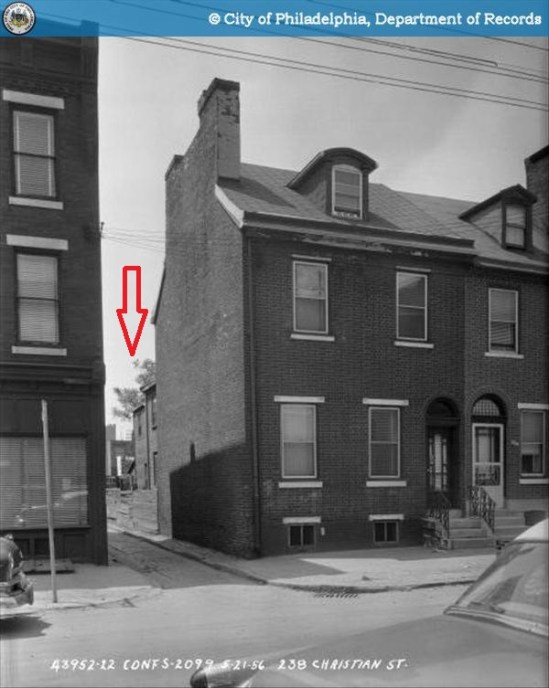
MediaStream

Above is a photo from the 1960s and shows a building in the 200 block of Christian Street erected many years after the Bagwells lived nearby. However, what it does depict is the rear living quarters often rented to African Americans because of the low rents. It appears that the Bagwells may have owned this small piece of property valued at $1,000, according to the 1838 Philadelphia African American Census. That amount equates to approximately $28,140 in 2017 U.S. currency.

The 1838 Census also revealed that the Bagwells had three sons and a daughter. The only name to be found in the census records is “Richard” who also was employed as a bricklayer. The 1847 Philadelphia African American Census reports that Richard Bagwell and his spouse were also financially doing well, owning their home on Davis Court valued at $2,000 ($56,280).  

Although the Bagwell family appears to have been somewhat financially secure for African Americans in 19th Century Philadelphia, they still had to be on the alert for the Irish and Nativist white gangs that prowled their streets. In particular, two gangs that seemed to be the most active in the Bagwells neighborhood were the “Wildcats” and the “Rats.” When these gangs weren’t out trying to kill and maim each other, they preyed on the African Americans of the Southwark and Moyamensing Districts.*

Dozens of gangs terrorized the unpoliced streets of the City with fearsome names, such as, American Guards; Bleeders; Blood Tubs; Bouncers; Bulldogs; Deathfetchers; Flayers; Fly-By-Nights; Garroters; Gumballs; Killers; Lancers; Molly Maguires; Nighthawks; Schuylkill Rangers; Skinners; Smashers; Spitfires; The Forty Thieves; Tormentors; Turks; Vampyres and Wreckers.**

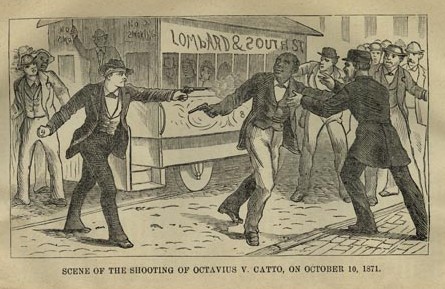
It was notorious political boss William “Bull” McMullen’s gang of racist cutthroats, the “Killers,” that assassinated African American educator and civil rights activist Octavius V. Catto on the afternoon of October 10, 1871, as he went to vote. The murderers were arrested but never convicted.***

Catto

*Public Ledger, May 28, 1845.

**https://www.phillyhistory.org/blog/index.php/2016/02/the-gangs-of-philadelphia/

***Harry C. Silcox, Philadelphia Politics from the Bottom Up.


Six-month-old baby boy Conner died this date, August 6th, and was buried at Bethel Burying Ground.

Posted by Terry Buckalew on August 6, 2017
Posted in: Uncategorized. Leave a comment

BABY CONNOR 2

The six-month-old son of Rebecca and Isaac Conner died this date, August 6th, in 1849 of Tabes Mesenterica* and was buried at Bethel Burying Ground. His first name was not recorded. Isaac (25y/o) worked as a drayman or longshoreman on the Delaware River docks. Rebecca (22 y/o) worked as a day worker. At the time of their son’s death, the Conners had two other small children, Issac, Jr. (3 y/o) and Ellen (1 y/o). Isaac and the children were all born in Pennsylvania. Rebecca was born in New Jersey. The family lived in one 10′x10′ room in Bedford Street for which they paid $2.50 a month, according to the 1847 Philadelphia African American Census.

Tragically, Ms. Conner died on August 3, 1853, of lung disease and was buried with her infant son at Bethel Burying Ground.

—————————————————————————————————————————————–

The ghettoization of African Americans in the city forced the poorest white and Black families to live on streets like Bedford with its notoriously crowded dwellings which were little more than pigsties. Piles of garbage lay in the street, clogging the gutters with black water that was covered with foul-smelling vegetation. Bedford was a plague spot with fever-ridden pest houses. This is where Rebecca and Isaac were forced to raise their family. In addition to these conditions was the ever-present deadly threat from white gangs that roamed the street. Two weeks before the death of the Connor baby, the “Killers,” a white Irish gang of thugs, attacked an African American boy walking on Bedford Street, slicing him up with straight razors. He was eventually taken to Pennsylvania Hospital.**

InkedBEDFORD STREET_LI

X marks the location of Bedford Street. A 19th Century Philadelphia physician, a Health Department official, dramatically stated that “No city should ever have more than one Bedford Street.”


*Tabes Mesenterica is a progressive wasting of the intestines marked by anemia, dramatic swelling of the abdomen, diarrhea, fever, and pain. 

**Philadelphia Inquirer, 23 July 1849, p.1.

For further reading concerning the history of Bedford Street see “The Philadelphia Negro,” W.E.B. DuBois; “The Peoples of Philadelphia,” Alan F. Davis and Mark H. Haller; “Philadelphia Politics From the Bottom Up,” Harry C. Silcox.

Posts navigation

← Older Entries
Newer Entries →
  • Recent Posts

    • Three dead as church wall falls on this date, May 1st, in 1841.
    • The ten-month-old Baby Colgate died this date, June 20th, in 1847, and was buried at Bethel Burying Ground.
    • Fifty-eight-year-old Rachel Dawson died this date, May 3rd, in 1839, and was buried at Bethel Burying Ground.
    • Twenty-eight-year-old Robert Swails died on this date, March 31st in 1849, and was buried at Bethel Burying Ground.
    • Forty-year-old Jacob “Jesse” Howard died on this date, January 29th, in 1840, and was buried at Bethel Burying Ground.
  • Archives

    • May 2024
    • June 2023
    • May 2023
    • March 2023
    • January 2023
    • December 2022
    • November 2022
    • October 2022
    • September 2022
    • August 2022
    • May 2022
    • April 2022
    • March 2022
    • February 2022
    • January 2022
    • December 2021
    • November 2021
    • October 2021
    • September 2021
    • August 2021
    • July 2021
    • June 2021
    • May 2021
    • April 2021
    • March 2021
    • February 2021
    • January 2021
    • December 2020
    • November 2020
    • October 2020
    • September 2020
    • August 2020
    • July 2020
    • June 2020
    • May 2020
    • April 2020
    • March 2020
    • February 2020
    • January 2020
    • December 2019
    • November 2019
    • October 2019
    • September 2019
    • August 2019
    • July 2019
    • June 2019
    • May 2019
    • April 2019
    • March 2019
    • February 2019
    • January 2019
    • December 2018
    • November 2018
    • October 2018
    • September 2018
    • August 2018
    • July 2018
    • June 2018
    • May 2018
    • April 2018
    • March 2018
    • February 2018
    • January 2018
    • December 2017
    • November 2017
    • October 2017
    • September 2017
    • August 2017
    • July 2017
    • June 2017
    • May 2017
    • April 2017
    • March 2017
    • February 2017
    • January 2017
    • December 2016
    • November 2016
    • October 2016
    • September 2016
    • August 2016
    • July 2016
    • June 2016
    • May 2016
    • April 2016
    • March 2016
    • February 2016
    • January 2016
    • December 2015
    • November 2015
    • October 2015
    • September 2015
    • August 2015
    • July 2015
    • June 2015
    • May 2015
    • April 2015
    • March 2015
    • February 2015
    • January 2015
    • December 2014
    • November 2014
    • October 2014
  • Categories

    • Archaeology
    • BBG History
    • Bethel Burying Ground Name Directory
    • Bethel Burying Ground Timeline
    • Burial services
    • Diseases
    • Documents
    • Freemasonry
    • Ignatius Beck
    • It's a fact
    • Maps
    • Neighborhood
    • Newspaper Articles
    • On This date
    • Photographs
    • Uncategorized
    • Videos
  • Meta

    • Create account
    • Log in
    • Entries feed
    • Comments feed
    • WordPress.com
Blog at WordPress.com.
Bethel Burying Ground Project
Blog at WordPress.com.
  • Subscribe Subscribed
    • Bethel Burying Ground Project
    • Join 48 other subscribers
    • Already have a WordPress.com account? Log in now.
    • Bethel Burying Ground Project
    • Subscribe Subscribed
    • Sign up
    • Log in
    • Report this content
    • View site in Reader
    • Manage subscriptions
    • Collapse this bar
 

Loading Comments...