Bethel Burying Ground Project

Bethel Burying Ground Project

  • ABOUT THE BETHEL BURYING GROUND PROJECT

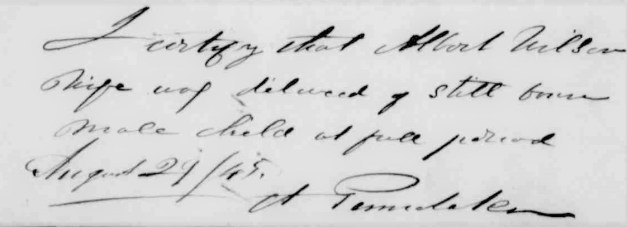
Frances Wilson gave birth to a stillborn male child on this date, August 29th, in 1845 and the child was buried at Bethel Burying Ground.

Posted by Terry Buckalew on August 29, 2018
Posted in: On This date. Tagged: African American burial grounds, African American cemeteries, African American History, African Methodist Episcopal Church, archaeology, Bethel Burying Ground, Mother Bethel, Mother Bethel African Methodist Episcopal Church, Philadelphia, Richard Allen. Leave a comment

WILSON

Frances Wilson delivered a stillborn male child on August 29th in 1845. The child subsequently was buried at Bethel Burying Ground (BBG). Tragically, Ms. Wilson delivered a stillborn female child on July 14, 1843, who also was buried at BBG and, on New Year’s Eve in 1848, she lost a three-day-old son who was interred at BBG as well. All the babies would have been buried in the same grave.

In 1845, Frances was twenty years old and married to Albert Wilson, age unknown. They had three children, Iram (5), Albert (3), and George (1). In 1847, Frances would give birth to another son, Charles, according to the 1850 Federal Census. 
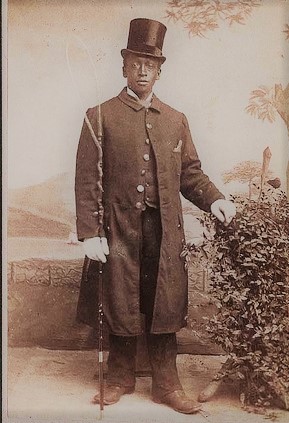
AA Coachman

Albert Wilson was employed as a coachman, according to a city directory. It is unknown if he was a public driver, similar to a taxi cab driver of today, or if he worked for a single family. Mr. Wilson disappears from public records in 1849. His spouse, Frances, is listed as the head of the family in the 1850 Federal Census. There is no death certificate for Mr. Wilson in the existing records. He may be buried with his children at Bethel Burying Ground. There is, however, an item in a local paper in 1847 that suggests that Mr. Wilson lost his coachman job and was looking for a career that offered more opportunities. The address and age in the advertisement match Mr. Wilson’s.

SITUATION WANTED

A SITUATION, by a young man of color, 25 years of age, in a Gentlemen’s office, as waiter, or tender, or about a store. He writes a fair hand, as is willing to make himself useful. The best city recommendation given for character and capacity. Apply No. 14 Buckley Street. (“Public Ledger,” 19 Oct 1847)

It appears that the Wilson’s owned their home at 14 Buckley Street. It was sold in 1855. I was unable to find any additional records on the family. The Wilsons buried their stillborn son on a clear day in August that only reached a high of 68 degrees.
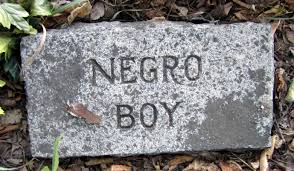
Negro boy tombstone


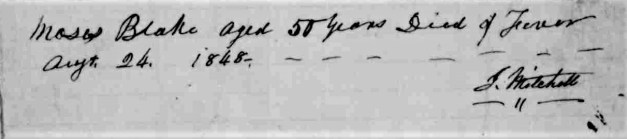
Fifty-year-old Moses Blake died this date, August 24th, in 1848 and was buried at Bethel Burying Ground.

Posted by Terry Buckalew on August 24, 2018
Posted in: On This date. Tagged: African American burial grounds, African American cemeteries, African American History, African Methodist Episcopal Church, archaeology, Bethel Burying Ground, Mother Bethel, Mother Bethel African Methodist Episcopal Church, Philadelphia, Richard Allen. Leave a comment

Moses Blake

Fifty-year-old Moses Blake died this date, August 24th, in 1848 of “Fever” and was buried at Bethel Burying Ground. Mr. Blake, along with his unnamed spouse, was born enslaved. One had their freedom purchased for $25 and the other was manumitted by his or her enslaver, Richard Baker of Maryland. The 1847 African American Census also reports that the Blakes had three children between the ages of five and fifteen. They attended church services regularly and belonged to at least one beneficial society. 

The Blake family lived on Bedford Street, a narrow block long thoroughfare that was where many white Philadelphians believed the devil lived. White and Black men and women were seen “unhesitatingly” mixing and even were rumored to be legally married to each other. Blacks saw Bedford Street as a slum where corpses laid unburied for days, waiting to be picked up and dropped off at the city’s Potter’s Field. Consequently, the neighborhood was a target for church missions, schools, and soup kitchens, not only because of the local desperately poor but also for the presence of gambling dens, houses of prostitution and speakeasies. Violence and disease were constant visitors.

No one chose to live on Bedford Street but that was all they could afford and was likely close to Mr. Blake’s workplace. The 10’x10′ room the Blake family resided in cost them $2.50 a month. Mr. Blake worked as a laborer and Ms. Blake was occupied as a laundress/day worker. Two of the children attended the Bedford Street Mission School.

BEDFORD

Bedford Street, now Kater Street, was home to sixty-three African American families according to the 1847 Philadelphia African American Census.

Ms. Blake and her children buried their spouse and father on a clear day in August with the temperature rising to only seventy-eight degrees.

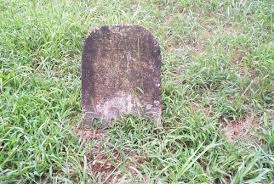
old tombstone


Forty-nine-year-old Sarah Darrah died this date, August 23rd, in 1850 and was buried at Bethel Burying Ground.

Posted by Terry Buckalew on August 23, 2018
Posted in: On This date. Tagged: African American burial grounds, African American cemeteries, African American History, African Methodist Episcopal Church, archaeology, Bethel Burying Ground, Mother Bethel, Mother Bethel African Methodist Episcopal Church, Philadelphia, Richard Allen. Leave a comment

SARAH DARRAH

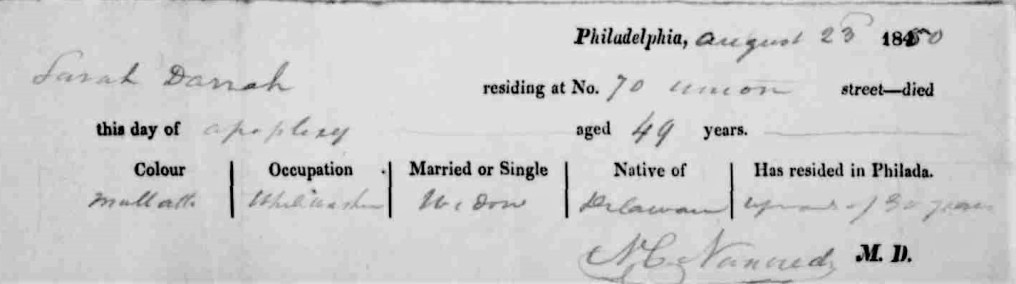
Forty-nine-year-old Sarah Darrah died this date, August 23rd, in 1850 of Apoplexy (stroke) and was buried at Bethel Burying Ground. She lived with an older woman who was crippled from strokes and relied on Ms. Darrah as a caregiver, according to the 1847 Philadelphia African American Census. Ms. Darrah was born in Delaware and earned a living as a laundress in 1847 and a “whitewasher” or house painter at the time of her death in 1850. She had lived in Philadelphia for approximately thirty years.

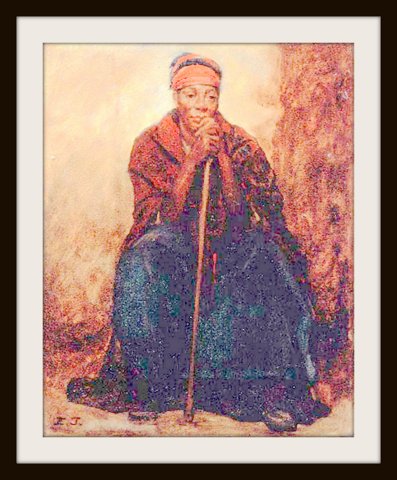
By Eastman Johnson (1)

Ms. Darrah was a widow. Census records identify her deceased spouse as Tilghman Darrah who worked as a porter. The 1840 Federal Census reports that they had a daughter who was between 5-10 years of age. There are no city death records available for either individual. One or both may have been buried at Bethel Burying Ground.

Three Bear Park

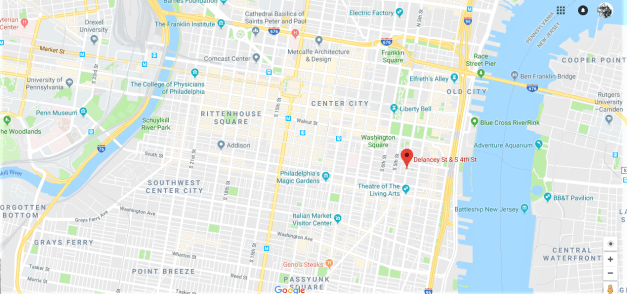
Ms. Darrah lived in a single small room at 70 Union Street, now Delancy Street, with her roommate for which they paid $1.25 a month. The physically disabled woman, for whom Ms. Darrah was caring, was receiving public aid that included some firewood in the winter and a small amount of groceries, according to the 1847 census. 

Ms. Darrah was a long time member of Bethel AME Church and belonged to a beneficial society that may have paid her burial expenses.  She was interred on a clear August day where the temperature reached a high of seventy-eight degrees by 3 p.m.

deplapidated


Ten-month-old Deanna Smith died this date, August 13th, in 1836 and was buried at Bethel Burying Ground.

Posted by Terry Buckalew on August 13, 2018
Posted in: On This date. Tagged: African American burial grounds, African American cemeteries, African American History, African Methodist Episcopal Church, archaeology, Bethel Burying Ground, Mother Bethel, Mother Bethel African Methodist Episcopal Church, Philadelphia, Richard Allen. Leave a comment

Deanna Smith

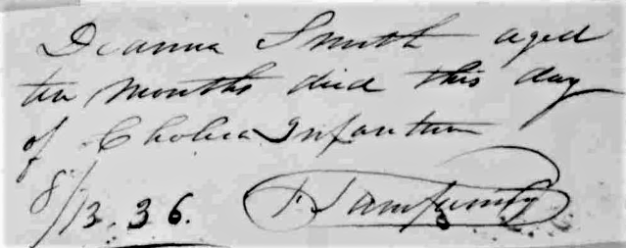
Ten-month-old Deanna Smith died this date, August 13th, in 1836 of Cholera Infantum and was buried at Bethel Burying Ground. She was a victim of a bacterial disease that, although its symptoms mirrored adult Asiatic Cholera, was of an entirely different etiology. 

Cholera I.

1833

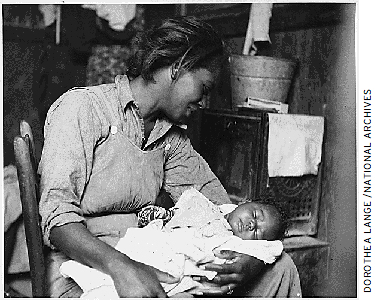
Little Deanna would have come down with a fever closely followed by vomiting, constant diarrhea, eventual convulsions, severe dehydration, rapid emaciation and finally death from one to four days after the initial onset. Physicians would have little to offer their patients. Not all babies that came down with the disease died from it. However, given how young this child was, it was inevitable. Today, a simple course of antibiotics and Pedialyte would be all that is needed to restore the infant to health.

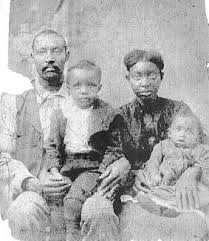
The identification of the child’s family is problematical. The slim evidence available points to George Smith being Deanna Smith’s father. The 1837 Philadelphia African American Census did not record the mother’s name. He worked as a laborer while his spouse was employed as a day worker. There appears to have been at least one other child in the family in addition to Deanna. The severity of the family’s poverty was evident in the census report that states they only had $10 in personal property. They lived in one room on the 700 block of Shippen Street, now Bainbridge Street. For this, they paid $3.16 a month in rent. 

Family Black

In July of 1835, the Smiths would have been in the path of a marauding white mob numbering over a thousand. They attacked Black men, women, and children as they sacked and burned homes and churches only a couple blocks from the Smith’s home. There was a group of 50-60 African Americans who were armed and who attacked the mob guerilla style throughout the days and nights, as the police looked on and did nothing to protect Black citizens. 

ednext_XV_2_patterson_img03

Deanna’s mother may have been one of the many Black women who struggled to gather up their children and escape the mob. Some hid in pitch black cellars, while others left the city taking the ferry to Camden, New Jersey. 

The Smith family buried their daughter on a relatively cool day in August where the temperature reached only 73 degrees by 3 o’clock in the afternoon.

nh-portsmouth-cemetery-76

Deanna was one of 212 children in Philadelphia that died of Cholera Infantum in 1836.


The twenty-two-month-old son of Elias and Marsha Collins died this date, August 10th, in 1848 and was buried at Bethel Burying Ground.

Posted by Terry Buckalew on August 10, 2018
Posted in: On This date. Tagged: African American burial grounds, African American cemeteries, African American History, African Methodist Episcopal Church, archaeology, Bethel Burying Ground, Mother Bethel, Mother Bethel African Methodist Episcopal Church, Philadelphia, Richard Allen. Leave a comment

ELIAS COLLINS

The twenty-two-month-old son of Elias and Marsha Collins died August 10th in 1848 of Tabes Mesenteria and was buried at Bethel Burying Ground. The infant’s name was not recorded. The cause of death was a disease of children which was caused by drinking milk from cows infected with a certain form of bacteria. The disease painfully destroys the lining of the stomach and results in rapid weight loss and death. With pasteurization, it is no longer a major problem. 

The unnamed toddler was the only child of Elias (36 years) and Marsha (22 years) Collins, according to the 1847 Philadelphia African American Census. The couple had a 50-year-old woman, Caster Dumfries, residing with them. All were born in Virginia, according to the 1850 Federal Census. Ms. Dunfries may have been Ms. Collins’ mother.

Elias Collins was employed as a laborer and Marsha Collins as a laundress. The three adults and the baby lived in an 11’x11′ room on White’s Court for which they paid $1.67 a month.

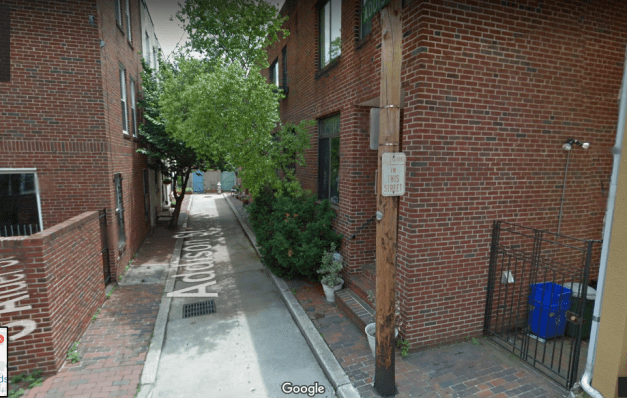
White's court

The above photo is how White’s Court (renamed Addison) looks like currently. On this narrow alley, near 10th and Lombard Streets, the Collins’ were one of 25 families totaling 92 residents. They labored at jobs such as shoemaker, tailor, dressmaker, laundress, and waiter. Around the corner was the Shiloh Baptist Infant School that provided daycare for the families. It is likely that Baby Collins was enrolled there before his death.

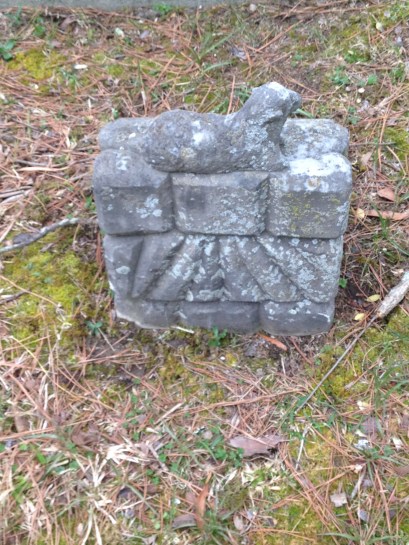
Lamb

In Philadelphia, the Collins’ son was one of forty-six children who died of Tabes Mesenteria in 1848, according to official Board of Health records.

Seventy-four-year-old Ann Fletcher died this date, August 8th, in 1849 and was buried at Bethel Burying Ground.

Posted by Terry Buckalew on August 8, 2018
Posted in: On This date. Tagged: African American burial grounds, African American cemeteries, African American History, African Methodist Episcopal Church, archaeology, Mother Bethel, Mother Bethel African Methodist Episcopal Church, Philadelphia, Richard Allen. Leave a comment

FLETCHER

Seventy-four-year-old Ann Fletcher died this date, August 8th, in 1849, of Dysentery and was buried at Bethel Burying Ground. She resided with another elderly woman at #6 Little Pine Street in one room for which they paid $5 a month rent. Neither woman was born in Pennsylvania. According to the 1847 Philadelphia African American Census, Ms. Fletcher was working as a laundress.

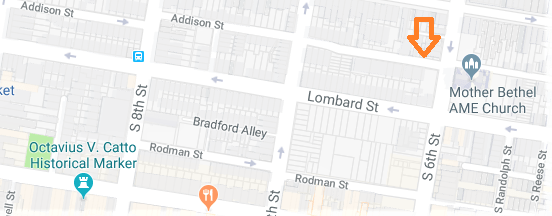
Little Pine Street was literally in the shadow of Bethel African Methodist Episcopal Church at 6th and Lombard Streets. The street is now named “Addison Street.”

Little Pine

The red arrow indicates the approximate residence of Ms. Fletcher.


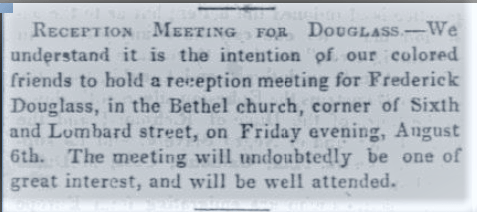
Douglass and Fletcher

Pennsylvania Freeman, 5 August 1847

As a member of the Bethel Church congregation, Ms. Fletcher was witness to many seminal events in the Church’s history, such as the visit of the former slave and abolitionist Frederick Douglass. She may have been one of the thousand mourners who attended the funeral of her longtime pastor, the Rev. John Boggs. If her health was good enough, she may have joined the long procession to Bethel Burying Ground to inter the beloved minister in May of 1848. Shortly before her death, Ms. Fletcher may have witnessed the funeral of Bishop Morris Brown, who was the successor to the AME Church founder Richard Allen. She may have been able to look out her window on May 14, 1849 and see a large number of mourners in front of the Church where the elders were lowering Bishop Brown’s coffin into the vault where Bishop Allen’s remains also were situated. It was an end of an era.

Ms. Fletcher would make her own journey to Bethel Burying Ground two months later.

Mt. Zion Cemetery

Bethel surrounded by her foes,

But not yet in despair;

Christ heard her supplicating cries,

The God of Bethel heard. 

                                                                                 Richard Allen

Sixty-year-old Diana Crosby died this date, August 7th, in 1849 and was buried at Bethel Burying Ground.

Posted by Terry Buckalew on August 7, 2018
Posted in: On This date. Tagged: African American burial grounds, African American cemeteries, African American History, African Methodist Episcopal Church, archaeology, Bethel Burying Ground, Mother Bethel, Mother Bethel African Methodist Episcopal Church, Philadelphia, Richard Allen. Leave a comment


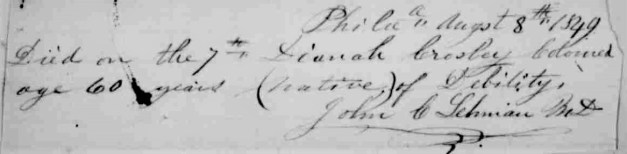
Diana Crosby.jpg

Sixty-year-old Diana Crosby died this date, August 7, in 1849 of “Debility”* and was buried at Bethel Burying Ground. Alternative spellings of her names have included “Dianah” and “Crosbey.” She lived alone at 100 Gaskill Street in a 12’x12′ room for which she paid $1.75 a month, according to the 1847 Philadelphia African American Census. Ms. Crosby received public aid in the form of firewood for her stove.

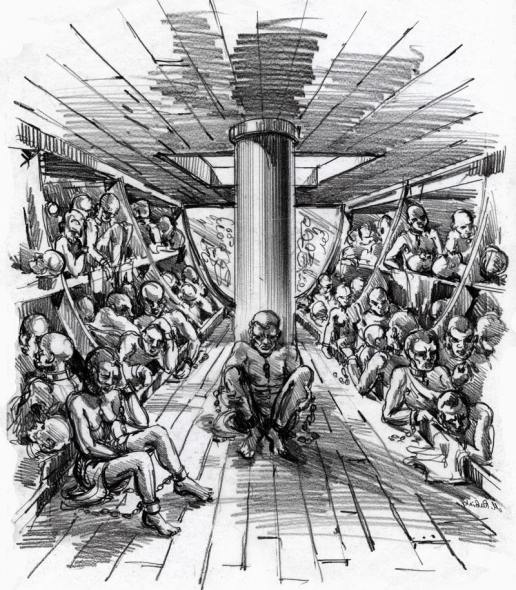
Ms. Crosby was born enslaved to parents that, most likely, were kidnapped from West Africa. They would have been placed on a slave ship headed to the Caribbean, where they would be forced to labor in the sugar cane fields before they were shipped to ports in the United States.

interior-slave-ship

Diana Crosby’s parents first had to survive the murderous Middle Passage before arriving in the Caribbean.

Although Ms. Crosby’s death certificate states that she was a native Philadelphian, there is other evidence to place that statement in doubt. In 1836, she told a census taker for the 1837 Philadelphia African American Census that she was born in Maryland, not Pennsylvania. In the 1847 Census, she reported that her freedom was purchased, although she could not remember the price.

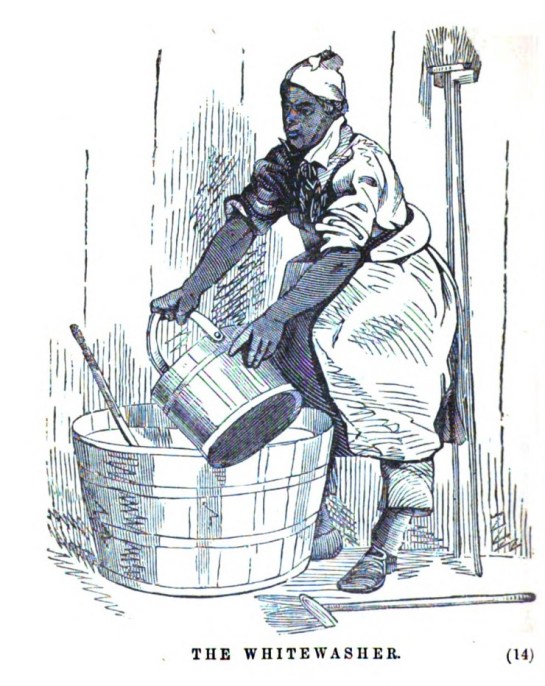
Ms. Crosby was a widow (1836) and was self-employed as a “whitewasher” or house painter, according to the 1837 Census. There were eighty African Americans reported as whitewashers. Most of them were men, but there also were a good many women employed in the trade.

whitewasher

A PHILADELPHIA WHITEWASHER

Ms. Crosby worshipped at Bethel A.M.E. and, as of 1836, she belonged to three beneficial societies that, undoubtedly, eventually assisted with her burial costs.

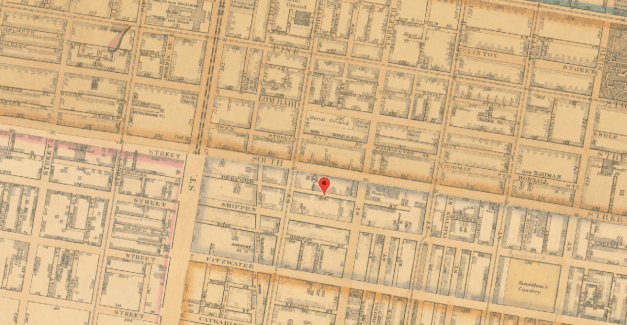
Gaskill Street was only an eight foot wide narrow cartway that often was clogged with garbage and ashes from stoves and fireplaces. Heavy rains and overflowing cesspools would flood the basements which would then filter down to the water level and contaminate the drinking water at the local hand pump, causing illness and often death. Ms. Crosby’s address would have been located on Gaskill between 4th and 5th Streets and Lombard and South Streets. The name of the street is now “Naudain.”

GASKILL STREET

The red arrow indicates the approximate location of Ms. Crosby’s home.

The night before Ms. Crosby died, the city was hit by a “tremendous storm” with thunder that “seemed to shake every building.” However, the next day dawned with the temperature at a pleasant 72 degrees, reaching only 74 degrees at noon with a slight northerly breeze.

unnamed


  • The term “Debility” usually meant dramatic weight loss from cancer or some other illness.


Slough of Contempt

Posted by Terry Buckalew on August 3, 2018
Posted in: Bethel Burying Ground Name Directory, Newspaper Articles, On This date. Tagged: African American burial grounds, African American cemeteries, African American History, African Methodist Episcopal Church, archaeology, Bethel Burying Ground, Mother Bethel, Mother Bethel African Methodist Episcopal Church, Philadelphia, Richard Allen. Leave a comment
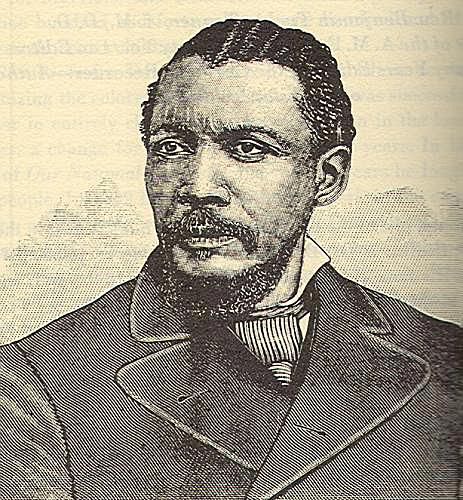
tanner_benjamin_0-5895bd3f3df78caebca68e0d

Bishop Benjamin Tucker Tanner

One hundred forty-six years ago, Bishop Benjamin Tucker Tanner, Bishop of the African Methodist Episcopal Church and the editor of the Christian Record, called out the leadership of Bethel A.M.E. Church over the mismanagement of the Bethel Burying Ground. The trustees of the church had rented the graveyard to a local factory to be used as a storage yard for its wagons and barrels. This newspaper was the official organ of the AME Church.

The Christian Recorder
Date: August 3, 1872

More than a fortnight ago, we called attention to the miserable and most disgraceful condition of this consecrated ground; and then promised more “next week.” We now fulfill our promise, if not in regard to time, certainly in regard to the matter itself.

As we said then, it cannot be possible that Bethel church knows the condition of these grounds. If she did, we feel sure that she would rise up in her might, and right the wrong, by putting away the disgrace. Her disgrace! It is nothing less. Is not the son disgraced who refuses to pay the funeral expenses of his mother? Is he not disgraced if he gives her not decent interment? And would he not be doubly disgraced, if he were to barter away for pelf, the family burial ground; and at the same time, be too mean to remove the bones of his dead ancestry? All the Christian world would give a most hearty affirmative to each and all these interrogatories.
It is almost precisely thus with the few men who led Bethel into this affair of bartering away Old the (sic) Burial Ground. In that ground, lay the dead fathers and mothers of our Israel, and their children of this generation have made traffic of their bones. For the paltry sum of five hundred dollars a year, they have disgraced themselves, disgraced the Church; we might say, disgraced the race.
Visit that ground today, perfumed with the sweet odors of the dead, and which ought to be perfumed with sweetest flowers, and what do you see? A most shameful spectacle-old hogshead, and barrels and lumber of every conceivable shape. Not a gravestone unbroken, not a grave to be seen-all is confusion and shame.

Who led Bethel-the first to recommend it we mean, into this Slough of Contempt, we know not; we possibly may know by the time we write our next article. Whoever he is, he ought to be made do forty days penance and wear the deepest sackcloth. In the meantime, we invite the friends to take a walk down to the ground, on Queen St. between Fourth and Fifth, and view it for themselves.
In our next edition, we hope to give the names of some of the venerable dead there interred with a little more comment.

The stillborn son of James Phillips was delivered this date, August 2nd, in 1846 and was buried at Bethel Burying Ground.

Posted by Terry Buckalew on August 2, 2018
Posted in: On This date. Tagged: African American burial grounds, African American cemeteries, African American History, African Methodist Episcopal Church, AME Zion, archaeology, Bethel Burying Ground, Mother Bethel, Mother Bethel African Methodist Episcopal Church, Philadelphia, Richard Allen. Leave a comment

JAMES PHILLIPS

The stillborn son of James Phillips died this date, August 2nd, in 1846 and was buried at Bethel Burying Ground. The name of the mother is unknown to us. There is no mention of James and his family in the 1850 Federal Census within Philadelphia. It was this Census that began recording the names of family members in addition to the male head of the family. 

The 1847 Philadelphia African American Census records the family as having a child under the age of five years. All the members of the family were born in Pennsylvania. The Phillips’ were extremely poor. Mr. Phillips was a day worker picking up laboring jobs, reportedly earning only $2 a week. Ms. Phillips was unemployed.

The 1847 Census reports the family lived in a room the size of a closet (6’x6′) in a tenement on Perry Street for which they paid $.50 a week. The family admitted to owning only $10 in personal property. 

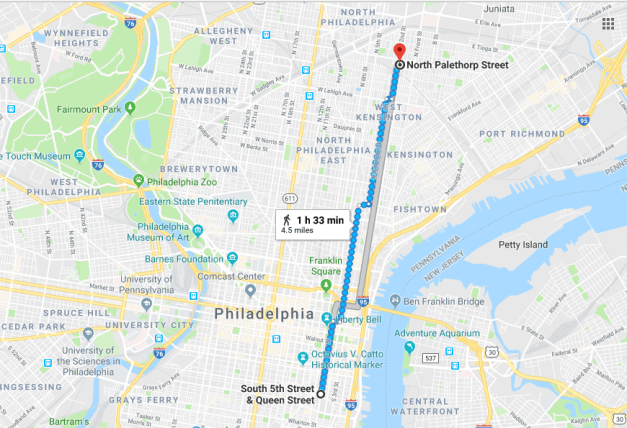
Fishtown map

Unlike most of the individuals buried at Bethel Burying Ground, the Phillips family did not reside nearby. The above map illustrates the almost five miles that the family traveled to bury their son. The family lived on Perry Street, now named Palethorp Street.

James Phillips and his family were in a war zone during May of 1844. The so-called “Nativist Riots” saw thousands of Irish Protestants and Catholics take up arms against one another and Perry Street was squarely in the middle of it. Five thousand soldiers were called out to quell the violence that included burning a Catholic church and school to the ground along with numerous homes. Officially, thirteen civilians and two soldiers were killed. Scores, if not hundreds, were injured. Pity the poor African Americans who found themselves facing this ferocious mob. The city did not tally the Black citizens who were killed and injured.

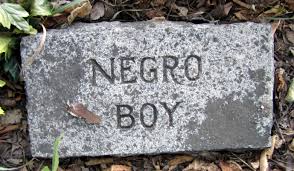
Negro boy tombstone

The Phillips’ son was interred at Bethel Burying Ground on a clear warm day that followed a day of showers and fog.


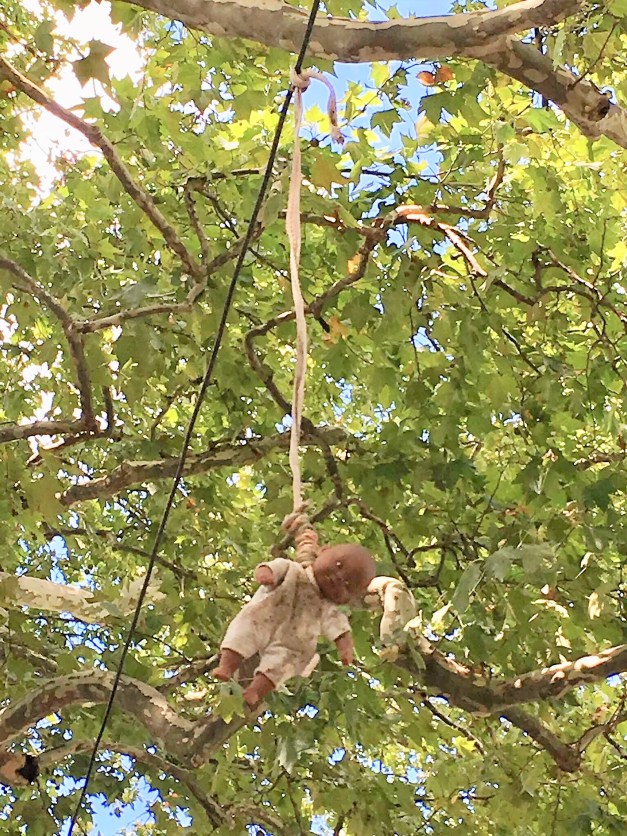
Lynched Black Doll

Posted by Terry Buckalew on August 2, 2018
Posted in: Uncategorized. Leave a comment

August 2, 2018

This morning a Black doll was found hanging from a tree at the Bethel Burying Ground in the 400 block of Queen Street in Philadelphia, PA. The mayor is calling this a hate crime and it is being investigated by the police. The area is covered by video cameras and, hopefully, they will prove to be helpful. Please check the local media for updates.

file-37

There are approximately 1,000 African American infants under the age of 12 months interred at Bethel Burying Ground.

Posts navigation

← Older Entries
Newer Entries →
  • Recent Posts

    • Three dead as church wall falls on this date, May 1st, in 1841.
    • The ten-month-old Baby Colgate died this date, June 20th, in 1847, and was buried at Bethel Burying Ground.
    • Fifty-eight-year-old Rachel Dawson died this date, May 3rd, in 1839, and was buried at Bethel Burying Ground.
    • Twenty-eight-year-old Robert Swails died on this date, March 31st in 1849, and was buried at Bethel Burying Ground.
    • Forty-year-old Jacob “Jesse” Howard died on this date, January 29th, in 1840, and was buried at Bethel Burying Ground.
  • Archives

    • May 2024
    • June 2023
    • May 2023
    • March 2023
    • January 2023
    • December 2022
    • November 2022
    • October 2022
    • September 2022
    • August 2022
    • May 2022
    • April 2022
    • March 2022
    • February 2022
    • January 2022
    • December 2021
    • November 2021
    • October 2021
    • September 2021
    • August 2021
    • July 2021
    • June 2021
    • May 2021
    • April 2021
    • March 2021
    • February 2021
    • January 2021
    • December 2020
    • November 2020
    • October 2020
    • September 2020
    • August 2020
    • July 2020
    • June 2020
    • May 2020
    • April 2020
    • March 2020
    • February 2020
    • January 2020
    • December 2019
    • November 2019
    • October 2019
    • September 2019
    • August 2019
    • July 2019
    • June 2019
    • May 2019
    • April 2019
    • March 2019
    • February 2019
    • January 2019
    • December 2018
    • November 2018
    • October 2018
    • September 2018
    • August 2018
    • July 2018
    • June 2018
    • May 2018
    • April 2018
    • March 2018
    • February 2018
    • January 2018
    • December 2017
    • November 2017
    • October 2017
    • September 2017
    • August 2017
    • July 2017
    • June 2017
    • May 2017
    • April 2017
    • March 2017
    • February 2017
    • January 2017
    • December 2016
    • November 2016
    • October 2016
    • September 2016
    • August 2016
    • July 2016
    • June 2016
    • May 2016
    • April 2016
    • March 2016
    • February 2016
    • January 2016
    • December 2015
    • November 2015
    • October 2015
    • September 2015
    • August 2015
    • July 2015
    • June 2015
    • May 2015
    • April 2015
    • March 2015
    • February 2015
    • January 2015
    • December 2014
    • November 2014
    • October 2014
  • Categories

    • Archaeology
    • BBG History
    • Bethel Burying Ground Name Directory
    • Bethel Burying Ground Timeline
    • Burial services
    • Diseases
    • Documents
    • Freemasonry
    • Ignatius Beck
    • It's a fact
    • Maps
    • Neighborhood
    • Newspaper Articles
    • On This date
    • Photographs
    • Uncategorized
    • Videos
  • Meta

    • Create account
    • Log in
    • Entries feed
    • Comments feed
    • WordPress.com
Blog at WordPress.com.
Bethel Burying Ground Project
Blog at WordPress.com.
  • Subscribe Subscribed
    • Bethel Burying Ground Project
    • Join 48 other subscribers
    • Already have a WordPress.com account? Log in now.
    • Bethel Burying Ground Project
    • Subscribe Subscribed
    • Sign up
    • Log in
    • Report this content
    • View site in Reader
    • Manage subscriptions
    • Collapse this bar
 

Loading Comments...