Bethel Burying Ground Project

Bethel Burying Ground Project

  • ABOUT THE BETHEL BURYING GROUND PROJECT

Twenty-three-year-old Lewis Peters died this date, July 21st, in 1854 and was buried at Bethel Burying Ground.

Posted by Terry Buckalew on July 21, 2019
Posted in: Uncategorized. Leave a comment

Lewis Peters

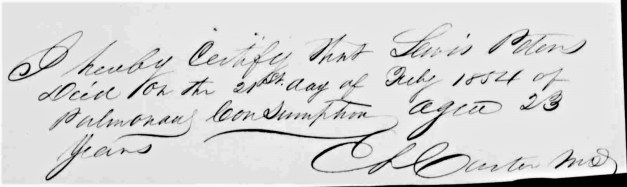
Twenty-three-year-old Lewis Peters died this date, July 21th, in 1854 of Tuberculosis and was buried at Bethel Burying Ground. Information about his occupation is allusive but he may have been employed as a porter at one time, according to the 1847 Philadelphia African American Census. He was the member of a family led by Rachel Peters and Sarah Boggs. They were sixty-one-years-old and sixty-four-years-old respectively at the time of Mr. Peters’ death. Both were born in Maryland and may have been sisters.

The 1850 U.S. Census lists the remaining members of the family as Mary A. Peters, twenty-six-years-old years old, and Rebecca Peters, twenty-five-years old. Both were born in Maryland and the ages listed above were as of 1850. Also in the family was John Boggs, twenty-one-years old in 1850, who was employed as a waiter. 

The 1847 Census mentions that one of the family members formerly was enslaved and bought his or her freedom for $100 but it does not identify which person it was. It also reports that two women were laundresses. Also, the family regularly attended religious services and belonged to a beneficial society. 
Emeline 1

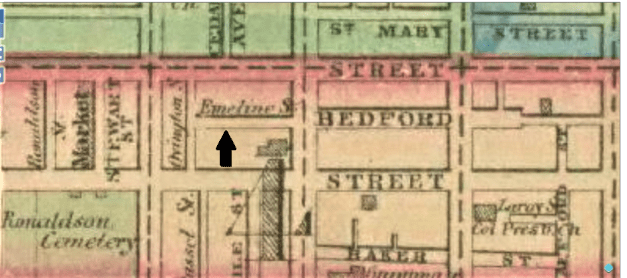
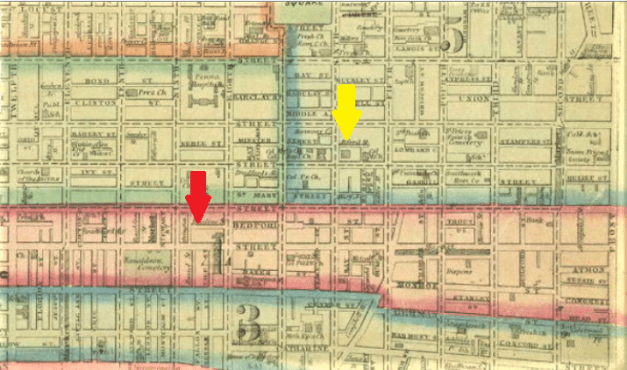
The Peters/Boggs family lived in a tenement on a small alley thoroughfare in the Southwark District of the County. The black arrow indicates the location of #10 Emeline Street.
Emeline #2

The family residence (red arrow) is shown in location to Bethel AME Church at 6th and Lombard Streets (yellow arrow).

Census records in 1847 show that there were only thirteen Black families, including the Peters/Boggs family, who lived on the small Emeline Street. These families included forty-three-members with the adults employed as dressmaker, waiter, seaman, basketmaker, seamstress, midwife, porter, and woodsawyer. Rents ranged from to $2.00 to $5.00 a month. Salaries for the men would have ranged from $2.00 to $5.00 a week. The women would have earned between $.75 to $1.50 a week.
Head of a Negro

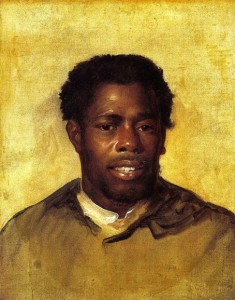
Twenty-three-year-old Lewis Peters died on a day in July when the temperature reached a high of a “torrid” 96 degrees. His family laid him to rest at Bethel Burying Ground.

Official Border

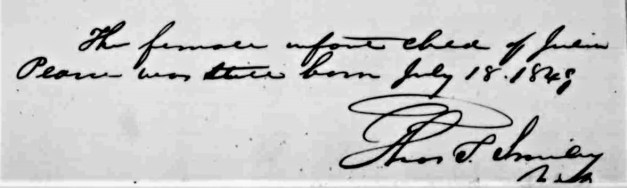
The stillborn daughter of Julia Pearce was delivered this date, July 18th, in 1849 and was buried at Bethel Burying Ground.
Posted by Terry Buckalew on July 18, 2019
Posted in: On This date. Tagged: African American burial grounds, African American cemeteries, African American History, African Methodist Episcopal Church, archaeology, Bethel Burying Ground, Mother Bethel, Mother Bethel African Methodist Episcopal Church, Philadelphia, Richard Allen. Leave a comment


.Stillborn Pearce

The stillborn daughter of Julia Pearce was delivered this date, July 18th, in 1849 and was buried at Bethel Burying Ground. 
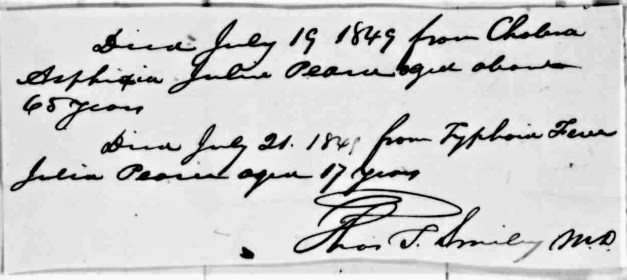
Dr. Thomas T. Smiley had his medical office on the northwest corner of 10th and Lombard Streets. Nearby lived a family of three generations of Black women. This family included Julia Pearce, 65 years old, her daughter, Hannah Pearce, thirty-two-years-old and Julia Pearce, the daughter of Hannah was seventeen-years-old. Young Julia lost her daughter in stillbirth with Dr. Smiley signing the death certificate. (See above)*

Sadly, the next day Dr. Smiley would sign the death certificate of the matriarch of the family who would pass away from Typhoid Fever.

Dr. Smiley was not done yet with the Pearce family. Tragically, two days later on the 21st, he would sign the death certificate of seventeen-year-old Julia Pearce who would die from Cholera. She was one of 148 Philadelphians to succumb to a vicious Cholera epidemic that week. 

Both women would be buried with the new stillborn baby at Bethel Burying Ground. (See below)
Julia and Julia

The 1847 Philadelphia African American Census shows a “Julie Ann Pierce” as the head of a family of three females residing on Lombard Street. This would have been the eldest of the three women. Her occupation was reported as “nurse.” One other woman was reported as being “at service” working as a live-in domestic. Only two of the women were born in Pennsylvania. 

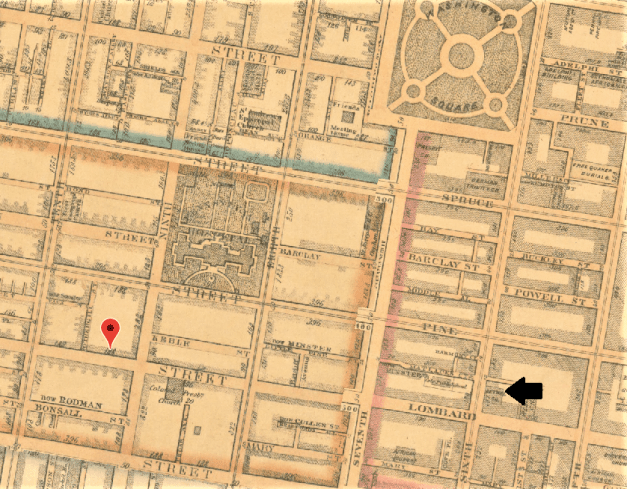
Pearce Map

The red pin represents the approximate location of the Pearce family home. The black arrow illustrates the location of Bethel A.M.E. Church where the women attended services.

The three women lived in one room at 363 Lombard Street in the 900 block of Lombard. Their rent for this tenement space was $2.25 a month, according to the 1847 Census. This amount would have been close to two weeks’ earnings for one of the working women. 

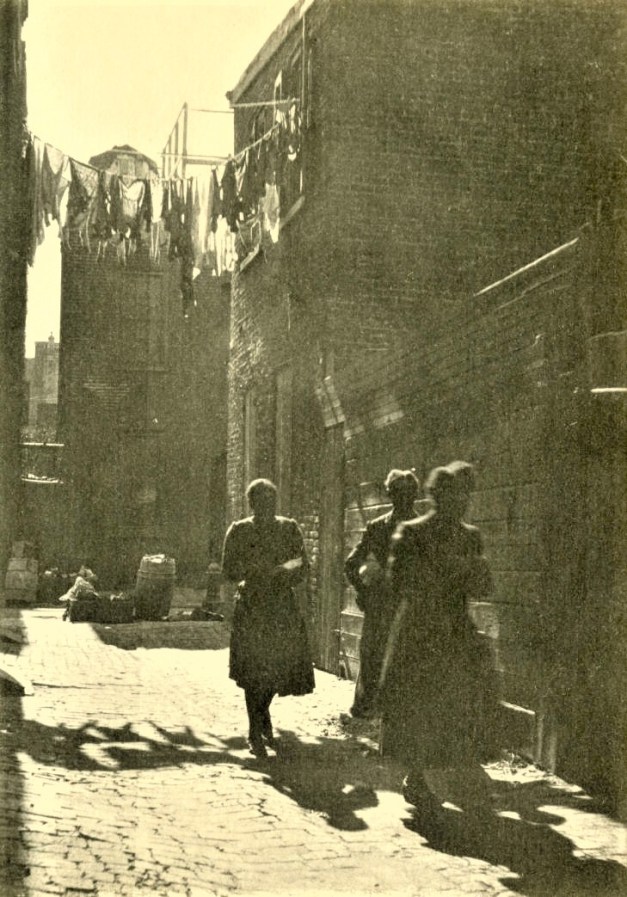
Three woman on Lombard street

Three Women on Lombard Street, circa 1900-1905. Temple University’s Urban Archives.

The stillborn baby and the two adult women died between July 18th and the 21st in 1849 and were buried at Bethel Burying Ground. A heatwave had just broken and the days were clear and moderate with temperatures ranging from morning lows in the low 70s to highs in the low 80s in the afternoon.
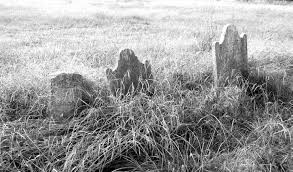
3 tombstones

The survivor of that tragic week for the Pearce family was Harriet Pearce. She buried her mother, daughter and granddaughter all within several days. According to her death certificate, Ms. Pearce lived until she was fifty-four years old working as a housekeeper. Still living on Lombard Street, she died of an “abdominal abscess” (ulcer?) in August 1869 and was buried at Lebanon Cemetery. 

Official Border

*The ages of the Pearce women were gathered from the death certificates and the 1850 U.S. Census which recorded Harriet Pearson’s age. 

Five-month-old Julia Harper died this day, July 15th, in 1847 and was buried at Bethel Burying Ground.
Posted by Terry Buckalew on July 15, 2019
Posted in: On This date. Tagged: African American burial grounds, African American cemeteries, African American History, African Methodist Episcopal Church, archaeology, Bethel Burying Ground, Mother Bethel, Mother Bethel African Methodist Episcopal Church, Philadelphia, Richard Allen. Leave a comment

JULIA HARPER

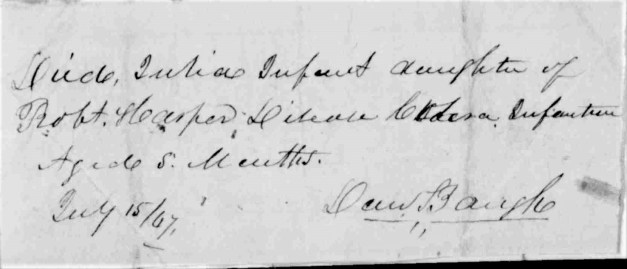
Five-month-old Julia Harper died this date, July 15th, in 1847 of Cholera and was buried at Bethel Burying Ground. She was the daughter of Robert and Dorcas Harper. He was twenty-five years old at the time of his child’s death; she was twenty-years-old. Both were born in Delaware. Julia was their only child. However, Ms. Harper would give birth to a son, Simon, in 1849, according to the 1850 U.S. Census. 
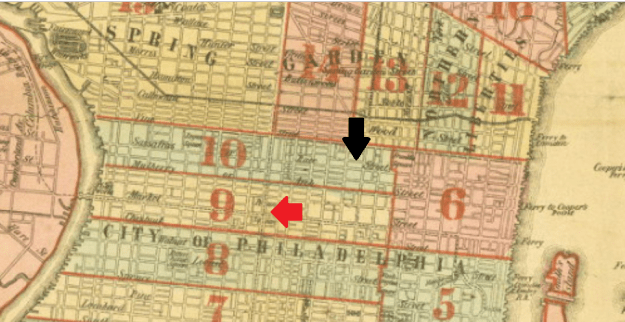
RACE STREET MAP

The black arrow indicates the location of the Harpers’ residence on the 900 block of Race Street. The location is now in the Chinatown section of the city. The red arrow indicates the location of what was “Penn Square” at the time – the future home of Philadelphia City Hall.

In 1847, it appears that the Robert and Dorcas Harper family lived with or next door to the George Harper family on Race Street. Robert and George may have been brothers or cousins. According to the 1847 Philadelphia African American Census, the rent for 340 Race Street was a hefty $6 a month. Robert worked as a laborer and George was employed as a stevedore and his unnamed spouse worked as a laundress. 

Small_Gravestone

Little Julia Harper was one of the 443 children in Philadelphia that died of Cholera in 1847. She died on a “temperate and pleasant” day in July with the temperature rising to 82° and was buried at Bethel Burying Ground.

Official Border

EPILOGUE

Thirty years before the death of little Julia Harper, Race Street looked very different. Black children were being sold as indentured servants. A young Black man was up for sale as “a good Carriage driver” and “an excellent hand on a Farm.”

SERVANTS FOR SALE

Poulson’s American Daily, 10 January 1818.

The two girls and the young man listed above were not enslaved for life, as in the historical sense. They were enslaved as indentured servants. Slavery of a different kind. Frequently, white immigrants would offer themselves and their family members as indentured servants in order to pay the cost of their passage across the Atlantic. This would not be the system that Blacks would be forced into. 

Excellent reading on the Philadelphia Black indentured servant is in “A Fragile Freedom” by Erica Armstrong Dunbar. She focuses on Black women and girls forced into servitude. Also, the book “Freedom By Degrees” by Gary B. Nash and Jean R. Soderlund offers an excellent overview of the topic.

Official Border

Thirty-five-year-old William Todd died this date, July 13th, in 1849 and was buried at Bethel Burying Ground.
Posted by Terry Buckalew on July 13, 2019
Posted in: On This date. Tagged: African American burial grounds, African American cemeteries, African American History, African Methodist Episcopal Church, archaeology, Bethel Burying Ground, Mother Bethel, Mother Bethel African Methodist Episcopal Church, Philadelphia. Leave a comment

WILLIAM TODD

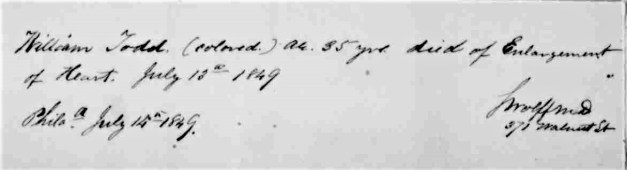
Thirty-five-year-old William Todd died this date, July 13th, in 1849 of an enlarged heart and was buried at Bethel Burying Ground. Mr. Todd was a successful coachman, earning $6.50 a week which was above the average income for Black men, according to the 1847 Philadelphia African American Census. He was married to Henrietta Todd who was thirty-four-years-old at the time of Mr. Todd’s death. Ms. Todd was born in Maryland and was the mother of four children at the time of her spouse’s death, all born in Pennsylvania. The children were John (12 y/o), Martha (8 y/o), William (4 y/o) and Daniel (2 y/o). The children attended the David Ware School and the Raspberry Alley School. 
It appears that Ms. Todd was pregnant at the time of her husband’s death as she gave birth to a daughter who she named Sarah the following year. This information was gathered from the 1850 U.S. Census which lists a fifth child at the age of one-year-old.

In 1847, Ms. Todd reported she worked as a domestic. In 1850, she reported that she was not employed outside the home.

In the 1850 Census, Ms. Todd reported that she and her family were residing with a young Black couple, Thomas and Margaret Pusey. He was employed as a laborer.

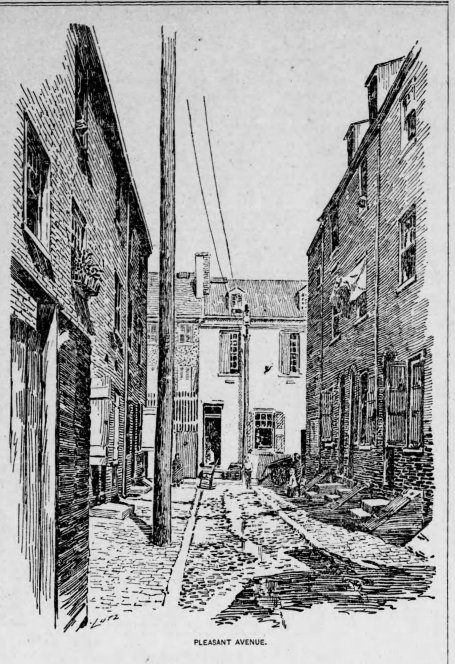
PLEASANT AVE

In 1847, the Todd family lived in one or two rooms at #8 Pleasant Avenue for which they paid a hefty rent of $7.50 a month. Pleasant Avenue (above) was a dead-end alley that ran north/south between Lombard Street and Minister Streets and between 7th and 8th Streets in center city Philadelphia. This street rarely appeared on a city street map. The ghettoization of African Americans in the city forced the poorest Black families to live on streets like Pleasant, with notoriously crowded dwellings where diseases were spread quickly. Missing from the above illustration are the piles of garbage and animal waste lying in the street, clogging the gutters with black water that was home to numerous deadly diseases. The city government would pay contractors to clean these alleys, but it rarely occurred.

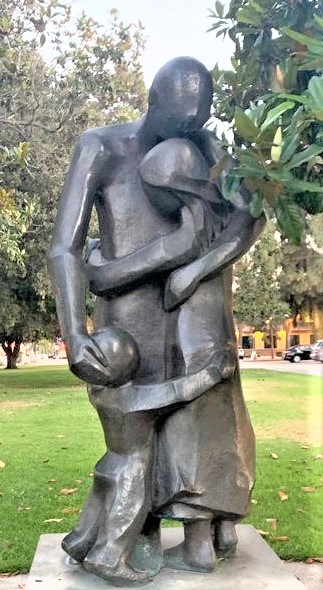
STATUE

“Me Too” Sculpturer, Natalie Krol

William Todd died on a day where the temperature rose to an unfathomable 96°. The sunrise temperature the next morning was only 82°. This was after a week-long heat wave. The weather may have played a part in Mr. Todd’s death. He was quickly buried at Bethel Burying Ground.
Henrietta Todd lived until she was sixty-years-old, dying in 1875 of Bright’s Disease. She was buried at Olive Cemetery. 

Official Border

The six-month-old son of Frances and Francis Ludnun died this date, July 9th, in 1848 and was buried at Bethel Burying Ground.

Posted by Terry Buckalew on July 9, 2019
Posted in: On This date. Tagged: African American burial grounds, African American cemeteries, African American History, African Methodist Episcopal Church, archaeology, Bethel Burying Ground, Mother Bethel, Mother Bethel African Methodist Episcopal Church, Philadelphia, Richard Allen. Leave a comment

LEDNUN

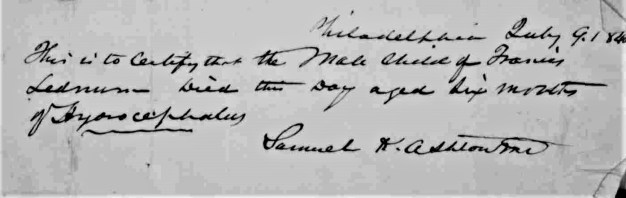
The six-month-old son of Frances and Francis Ludnun* died this date, July 9th, in 1848 of Hydrocephalus and was buried at Bethel Burying Ground. Ms. Ludnun was thirty-one-years-old at the time of her son’s death; Mr. Ludnun was thirty-six-years-old. She was born in Philadelphia while he was born in Delaware, according to the 1850 U.S. Census. At the time of the baby’s death, there were three other Ludnun children: Daniel (15 y/o), Charles (13 y/o), and Anne (3 y/o). All of the children were born in Philadelphia. 
WHEAT STREET

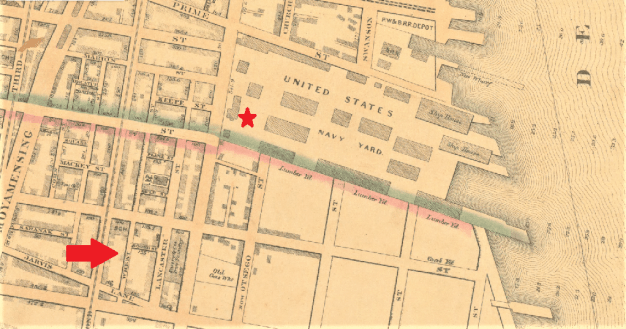
The red arrow indicates the approximate location of the Ludnun family’s home on Wheat Street. The red star marks the Philadelphia Navy Yard.

The Ludnun family lived in a 10’x10′ room on Wheat Street in the far southeastern part of the county, very close to the Philadelphia Navy Yard. For this, they paid $.50 a week in rent. Mr. Ludnun reported in the 1847 Census that he earned $4 a week as a laborer, likely at the Navy Yard. Ms. Ludnun worked in the home.

In August of 1844, the neighborhood near the Navy Yard was raked by white mob violence. A gang raided the Navy Yard and stole two cannons with the goal of destroying Catholic churches in the neighborhood (Southwark). The city’s newspapers did not report the violence to the local Black community that more than likely happened.

3 tombstone

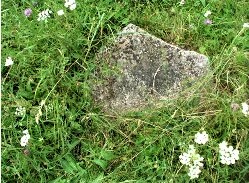
The six-month-old son of Frances and Francis Ludnun died on an overcast day in July that saw intermittent showers. The temperature only rose to 70 degrees.

Official Border

*In addition to the spelling of the family name as “Ludnun,” I have also seen it spelled “Lednum,” “Ludnam,” and “Lednun.”


Four-year-old Maria Britton died this date, July 8th, in 1847 and was buried at Bethel Burying Ground.
Posted by Terry Buckalew on July 8, 2019
Posted in: On This date. Tagged: African American burial grounds, African American cemeteries, African American History, African Methodist Episcopal Church, archaeology, Bethel Burying Ground, Mother Bethel, Mother Bethel African Methodist Episcopal Church, Philadelphia, Richard Allen. Leave a comment

BRINTEN

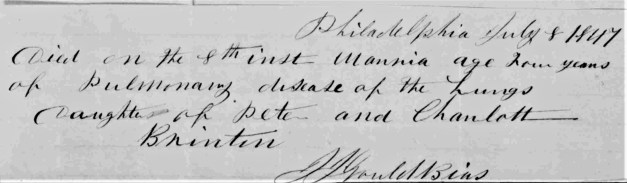
Four-year-old Maria Britton* died this date, July 8th, in 1847 of lung disease and was buried at Bethel Burying Ground. She was the daughter of Charlotte and Peter Britton. Ms. Britton was twenty-two-years-old at the time of her daughter’s death. Mr. Britton was thirty-two-years-old. Ms. Britton was born in Maryland, while Mr. Britton was born in Cape Verde Islands, according to the 1847 Philadelphia African American Census. In addition to young Maria, the Brittons had a two-year-old son, Robert, and had a daughter Emma who was born two years later in 1849. Both children were born in Pennsylvania, according to the 1850 U.S. Census. In both censuses (1847 & 1850), Mr. Britton reported his occupation as “seaman.” Ms. Britton was employed as “days worker” in the 1847 Census.
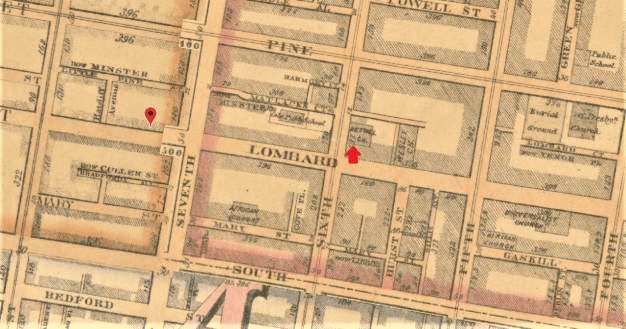
227 lombard

The red pin indicates the approximate location of the Brittons’ residence at 227 Lombard Street. The red arrow indicates the location of Bethel A.M.E. Church where they worshiped. The family paid $1.50 a month for a 10’X10′ room. Mr. Britton likely was paid $4-$5 a month as a seaman. Ms. Britton possibly would earn $0.50-$1.00 a week.

CARBO VERDE

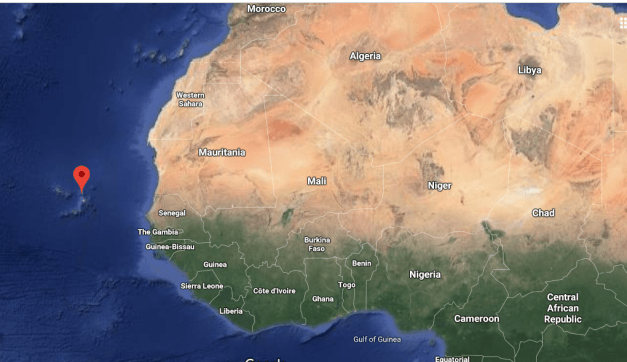
Peter Britton reported to census takers that he was born in the Cape Verde Islands, now know as Carbo Verde. The red pin indicates the country’s location off the west coast of Africa.

“The Cape Verde islands are situated 350 miles off the West Coast of Senegal . . . The islands were first settled by the Portuguese in the mid 15th century, they were uninhabited at the time. The Portuguese wanted to set up plantations, modeled on what they had done in the Algarve region of Portugal, so they brought West African slaves to the Cape Verde islands to cultivate the land, but because of this arid climate, they weren’t very successful at it. But nonetheless, the large African population intermingled with the fewer numbers of Portuguese, to create a completely new culture and society—Cape Verdean Creole.”

Cape Verdeans came on whaling vessels to the United States as early as the late 1700s. 

“The Cape Verde islands were a stopping off point for the whaling industry. Vessels, mainly from New Bedford, Massachusetts, would make regular stops at the Cape Verde islands for supplies and for salt. When whaling went into decline in the latter 19th century, the whaling captains were having trouble finding crew for their ships. They tended to hire a diverse group anyway, but young Yankee seamen were no longer interested in serving. So when they would stop at the Cape Verde islands, the young men of the islands, who were so eager to find any means of survival, that they just seized the opportunity to work on these whaling vessels.”

(Marilyn Halter at https://afropop.org/articles/cape-verdean-american-story-with-marilyn-halte)

Official Border

Moss covered tombstone

Four-year-old Mary Britton died on a day that was alternately cloudy and clear with the temperature rising to 88°. Her parents buried her at Bethel Burying Ground.
Official Border

*Although the attending physician spelled the family’s last name ‘Brinten,’ it is most commonly spelled ‘Britton’ in census records. I also have seen it spelled ‘Briton.’ The attending physician, Dr. J.J.G. Bias, was a Black man who was instrumental to the establishment of a strong Black community in 19th century Philadelphia.  

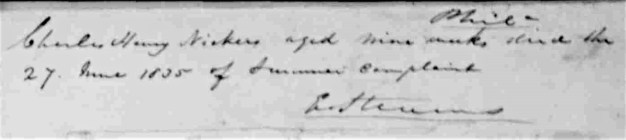
Nine-week-old Charles Henry Nickers died this date, June 27th, in 1835 and was buried at Bethel Burying Ground.
Posted by Terry Buckalew on June 28, 2019
Posted in: On This date, Uncategorized. Tagged: African American burial grounds, African American cemeteries, African American History, African Methodist Episcopal Church, archaeology, Mother Bethel, Mother Bethel African Methodist Episcopal Church, Philadelphia, Richard Allen. Leave a comment

Nickers

Only nine weeks old, Charles Henry Nickers died this date, June 27th, in 1835 of “Summer Complaint” and was buried at Bethel Burying Ground. It is likely that the child’s father was Samuel Knickers and that the attending physician misspelled the child’s last name. There is very little information on the family. Mr. Knickers did reply to the 1837 Philadelphia African American Census but that is the sole mention in available documents. There are no mentions in city directories.
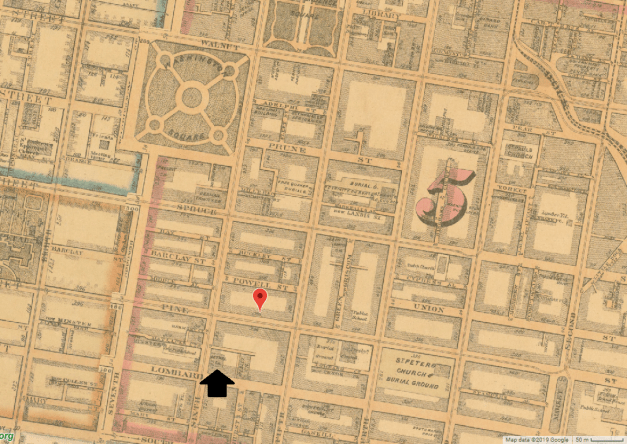
Mr. Knickers lived with his spouse (unnamed) in a room at 165 Pine Street between 5th and 6th Streets. At that time, they had no children. They paid high rent at $6 a month. Mr. Knickers was employed as a brickmaker, likely making $4-$5 a week. There was no employment listed for Ms. Knickers. 

Knickers map 2

The red pin indicates the approximate location of the Knickers’ residence on Pine Street. The black arrow points to the location of Bethel African Methodist Episcopal Church, just around the corner.

A year before the Knickers lost their son, their neighborhood erupted into violence. Black churches and homes were burnt to the ground along with meeting halls and a tavern. Thousands of whites, bent on genocide, murdered and beat Black men and women. This went on for three days and nights without relief from the police. Black families fled the city, crossing the Delaware River to New Jersey. 

Shortly after their son died, there was another attack on the Black community by white terrorists. Mr. and Ms. Knickers may have had enough and decided to leave “the most racist city in the North.”

old tombstone

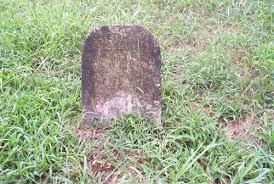
The Knickers buried their infant son on a warm day in late June in 1835 at Bethel Burying Ground.

Official Border

*”Summer Complaint” was an illness thought to be brought on by impure or spoiled milk. The infant would usually die from dehydration because of constant diarrhea. 

Thirty-two-year-old Caroline Anderson died this date, June 24th, in 1853 and was buried at Bethel Burying Ground.

Posted by Terry Buckalew on June 24, 2019
Posted in: On This date. Tagged: African American burial grounds, African American cemeteries, African American History, African Methodist Episcopal Church, archaeology, Bethel Burying Ground, Mother Bethel, Mother Bethel African Methodist Episcopal Church, Philadelphia, Richard Allen. Leave a comment

CAROLINE ANDERSON

Thirty-two-year-old Caroline Anderson died this date, June 24th, in 1853 of Consumption of the Bowel. (The death certificate identifies her year of birth incorrectly. She was 32 years old at her death and was born in 1822.) This bacterial disease created ulceration and perforation in the victim’s intestines, making nourishment impossible to reach the body. The 1850 U.S. Census shows that Ms. Anderson was born in Delaware. There was no occupation reported.

Her spouse Isaac Anderson was born in Maryland and was thirty-seven years old at the time of Ms. Anderson’s death. He reported his occupation as “laborer” in the 1850 Census. It appears the Andersons did not have children.

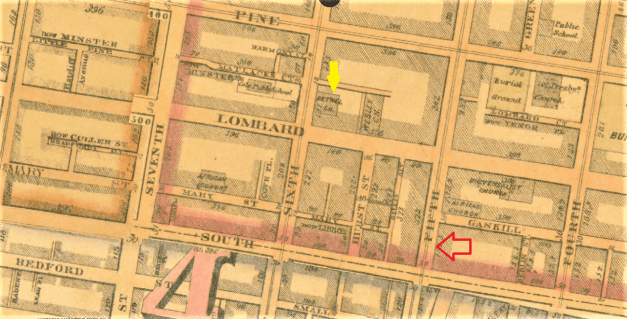
Anderson map

The red arrow indicates the location of the Andersons’ residence on Fifth Street just north of South Street. The yellow arrow indicates the close proximity of Bethel African Methodist Episcopal Church. The couple would have lived in one small room for which they would pay $3-$5 a month in rent. Mr. Anderson would have been fortunate to make that amount in a week. 

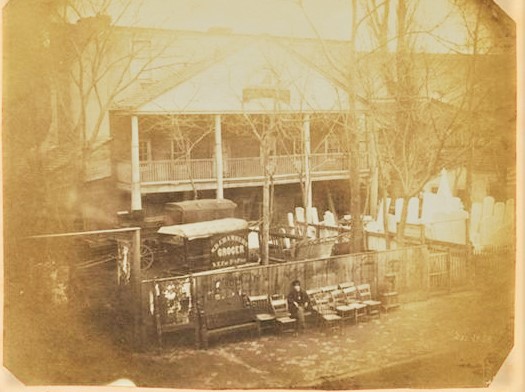
Hurst mansion

The above photo was taken just five years after Ms. Anderson’s death in 1853. It depicts the old Hurst mansion that was built in 1776. It was located two blocks from the Andersons’ home. The building was a tenement by 1853 and the yard was used for storage of wagons, lumber, and headstones from the adjacent marble yard. (Library Company of Philadelphia)

Ms. Anderson died on a day where the temperature reached 82°. For the four days previous, the temperature soared to 95°– 96°. The night before her death, a “fine shower” brought some relief. For someone not able to hold fluid down, her suffering is hard to comprehend. 

Official Border

Ten-year-old Alexander Murrell died this date, June 18th, in 1851 and was buried at Bethel Burying Ground.
Posted by Terry Buckalew on June 18, 2019
Posted in: On This date. Tagged: African American burial grounds, African American cemeteries, African American History, African Methodist Episcopal Church, archaeology, Bethel Burying Ground, Mother Bethel, Mother Bethel African Methodist Episcopal Church, Philadelphia, Richard Allen. Leave a comment

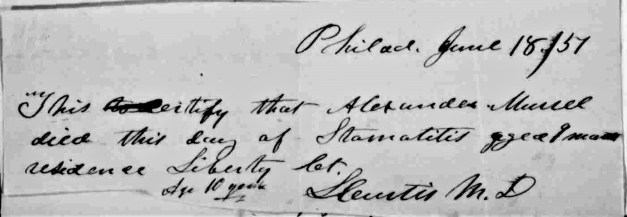
MURRELL DEATH CERT

Ten-year-old Alexander Murrell died this date, June 18th, in 1851 of Stomatitis and was buried at Bethel Burying Ground. Stomatitis is a condition that causes painful swelling and sores in the mouth.  Causes for this include injury, infection, allergies, and malnutrition. The victim usually dies from Septicemia. 
The child’s father was David Murrell. His mother’s name has not been mentioned in any of the available documents. Mr. Murrell was employed as a waiter earning $2.50 a week. Ms. Murrell worked as a wash woman earning $.50 a week, according to the 1847 Philadelphia African American Census. One of the adults was previously enslaved and manumitted by their enslaver. Ten-year-old Alexander was their only child at the time of his death.

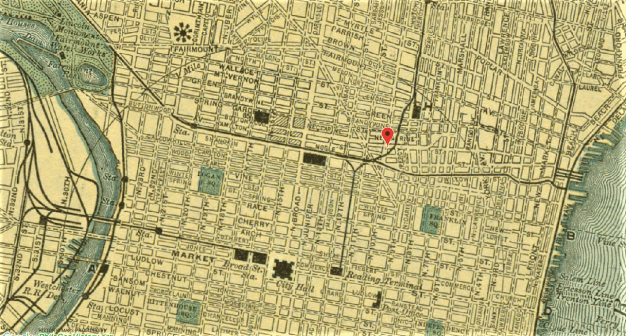
Liberty Court Map 1

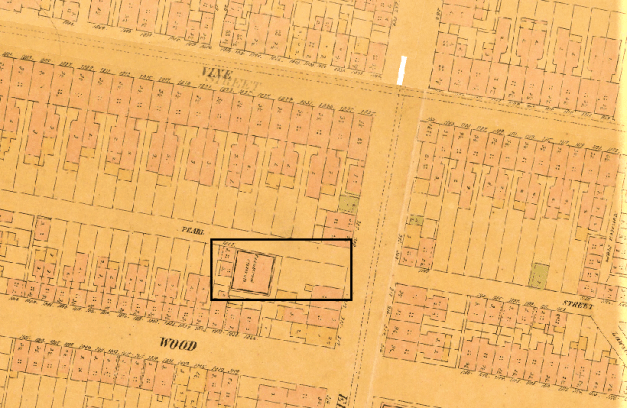
The red pin above illustrates the location of the Murrell family’s residence in Liberty Court in the Spring Garden District in the northern part of the City (before county consolidation in 1855).


Liberty Court Map 2

The box outlines the location of Liberty Court that ran from 10th Street below Vine Street.

Liberty Court was an “African American enclave.” It was a small courtyard community of “band-box” houses squeezed in behind the larger residences that faced the street. “Liberty Court had been erected over a portion of the property along Tenth Street, owned by the First African Baptist Church (FABC), between 1810 and 1822.” A 1985 archeological project revealed the skeletal remains of five African Americans that were missed when the FABC moved its cemetery in 1822. Liberty Court eventually was demolished during the construction of the Vine Street Expressway extension in the late 1980s.*

This “enclave” was home to extremely poor Black families who were paying $0.75-$1.00 a week for one room. Looking at the results of the 1847 Census, there were 18 families with a total of 86 family members living in Liberty Court. The vast majority of the males worked as porters when they could get the work. The women were employed in their usual jobs of domestic and laundress.  Many families received public assistance in the form of firewood in the winter. In addition, there was a higher than normal percentage of formerly enslaved men and women. Interestingly, I could not find any of the Liberty Court residents recorded in the 1850 U.S. Census.

weepingwillow

The Murrells buried their son at Bethel Burying Ground on a clear warm day in June.

Official Border*John L. Cotter, et. al, The Buried Past: An Archeological History of Philadelphia, p. 301-303.


Thirty-four-year-old Daniel Johnson died this date, June 15th, in 1854 and was buried at Bethel Burying Ground.

Posted by Terry Buckalew on June 15, 2019
Posted in: On This date. Tagged: African American burial grounds, African American cemeteries, African American History, African Methodist Episcopal Church, archaeology, Bethel Burying Ground, Mother Bethel, Mother Bethel African Methodist Episcopal Church, Philadelphia, Richard Allen. Leave a comment

Daniel Johnson (colored)

Thirty-four-year-old Daniel Johnson died this date, June 15th, in 1854 of Tuberculosis and was buried at Bethel Burying Ground. Mr. Johnson was employed as a porter until the onset of his illness. He was married to Anna Johnson, who was thirty-two-years-old at the time of her spouse’s death. There was no occupation reported for her. Both were born in Delaware, according to the 1850 U.S. Census. It appears they did not have children. Below is the family’s entry from the 1850 Census which includes two others residing in the same room with the Johnsons.

Daniel Johnson census

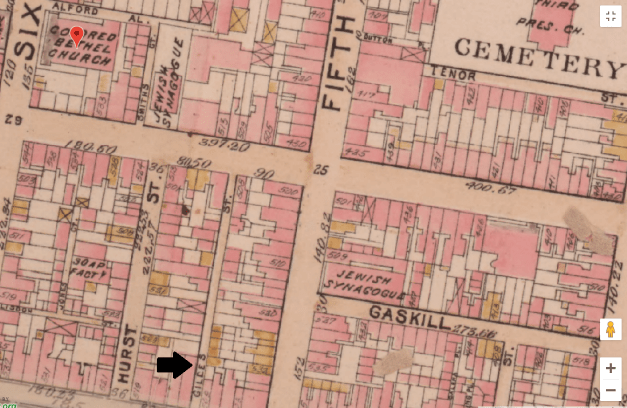
It was common for families to share a room to defray the cost of the rent, although there may have been a family connection. The 1852 Philadelphia City Directory has the Johnson couple residing at #23 Gilles’ Alley. 

Gillis' Map

The black arrow indicates the location of Gilles’ Alley. The red pin illustrates the close proximity of Bethel AME Church.

Gilles’ Alley was a narrow thoroughfare lined with wretched tenements.  It was cobblestoned and without sewer connections. The overflowing outhouses were often used by the homeless for shelter. “It is safe to say not one house in the alley could pass an inspection without being condemned as prejudiced to health.”* In 1847, it was home to forty Black families totaling almost one hundred members. They were working as cake bakers, stevedores, seamen, cooks, shoemakers, domestics, and painters. 

negro couple

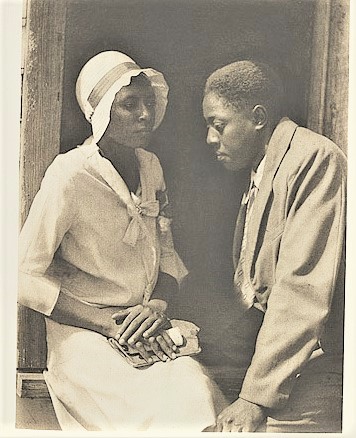
The Johnsons regularly attended religious services and were members of a beneficial society, according to the 1847 Census. 

Anna Johnson buried her husband at Bethel Burying Ground on a clear June day where the temperature rose to 65 degrees by noon. Although it is not possible to be definitive, there is some evidence that Anna Johnson may have lived until June of 1893 when she died at 71 years old of heart disease and was buried at Lebanon Cemetery.

Official Border

*W.E.B. DuBois, Philadelphia Negro, p. 307.


Posts navigation

← Older Entries
Newer Entries →
  • Recent Posts

    • Three dead as church wall falls on this date, May 1st, in 1841.
    • The ten-month-old Baby Colgate died this date, June 20th, in 1847, and was buried at Bethel Burying Ground.
    • Fifty-eight-year-old Rachel Dawson died this date, May 3rd, in 1839, and was buried at Bethel Burying Ground.
    • Twenty-eight-year-old Robert Swails died on this date, March 31st in 1849, and was buried at Bethel Burying Ground.
    • Forty-year-old Jacob “Jesse” Howard died on this date, January 29th, in 1840, and was buried at Bethel Burying Ground.
  • Archives

    • May 2024
    • June 2023
    • May 2023
    • March 2023
    • January 2023
    • December 2022
    • November 2022
    • October 2022
    • September 2022
    • August 2022
    • May 2022
    • April 2022
    • March 2022
    • February 2022
    • January 2022
    • December 2021
    • November 2021
    • October 2021
    • September 2021
    • August 2021
    • July 2021
    • June 2021
    • May 2021
    • April 2021
    • March 2021
    • February 2021
    • January 2021
    • December 2020
    • November 2020
    • October 2020
    • September 2020
    • August 2020
    • July 2020
    • June 2020
    • May 2020
    • April 2020
    • March 2020
    • February 2020
    • January 2020
    • December 2019
    • November 2019
    • October 2019
    • September 2019
    • August 2019
    • July 2019
    • June 2019
    • May 2019
    • April 2019
    • March 2019
    • February 2019
    • January 2019
    • December 2018
    • November 2018
    • October 2018
    • September 2018
    • August 2018
    • July 2018
    • June 2018
    • May 2018
    • April 2018
    • March 2018
    • February 2018
    • January 2018
    • December 2017
    • November 2017
    • October 2017
    • September 2017
    • August 2017
    • July 2017
    • June 2017
    • May 2017
    • April 2017
    • March 2017
    • February 2017
    • January 2017
    • December 2016
    • November 2016
    • October 2016
    • September 2016
    • August 2016
    • July 2016
    • June 2016
    • May 2016
    • April 2016
    • March 2016
    • February 2016
    • January 2016
    • December 2015
    • November 2015
    • October 2015
    • September 2015
    • August 2015
    • July 2015
    • June 2015
    • May 2015
    • April 2015
    • March 2015
    • February 2015
    • January 2015
    • December 2014
    • November 2014
    • October 2014
  • Categories

    • Archaeology
    • BBG History
    • Bethel Burying Ground Name Directory
    • Bethel Burying Ground Timeline
    • Burial services
    • Diseases
    • Documents
    • Freemasonry
    • Ignatius Beck
    • It's a fact
    • Maps
    • Neighborhood
    • Newspaper Articles
    • On This date
    • Photographs
    • Uncategorized
    • Videos
  • Meta

    • Create account
    • Log in
    • Entries feed
    • Comments feed
    • WordPress.com
Blog at WordPress.com.
Bethel Burying Ground Project
Blog at WordPress.com.
  • Subscribe Subscribed
    • Bethel Burying Ground Project
    • Join 48 other subscribers
    • Already have a WordPress.com account? Log in now.
    • Bethel Burying Ground Project
    • Subscribe Subscribed
    • Sign up
    • Log in
    • Report this content
    • View site in Reader
    • Manage subscriptions
    • Collapse this bar
 

Loading Comments...