Bethel Burying Ground Project

Bethel Burying Ground Project

  • ABOUT THE BETHEL BURYING GROUND PROJECT

Fifty-five-year-old Jacob Garver died this date, February 17th, in 1854 and was buried at Bethel Burying Ground.

Posted by Terry Buckalew on February 17, 2020
Posted in: On This date. Tagged: African American burial grounds, African American cemeteries, African American History, African Methodist Episcopal Church, AME Zion, archaeology, Bethel Burying Ground, Mother Bethel, Mother Bethel African Methodist Episcopal Church, Philadelphia, Richard Allen. Leave a comment

JACOB GARVER

Fifty-five-year-old Jacob Garver died this date, February 17th in 1854 of “Debility” and was buried at Bethel Burying Ground. The death certificate states that he was a “native” of  Lancaster, Pennsylvania. However, the 1850 U.S. Census reports that he was born in Maryland. In addition to Mr. Garver, the family included forty-five-year-old Maria Garver and seventy-year-old Hannah Jones who were both born in Maryland and nine-year-old Anna M. Garver who was born in Philadelphia.

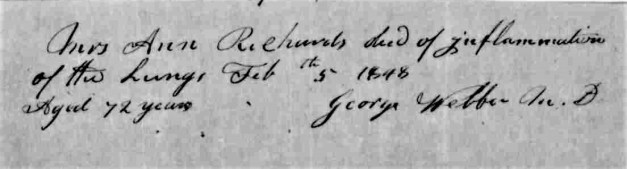
Hannah Jones, who most likely was the mother of Maria Garver, died in April of 1853 and was buried at Lebanon Cemetery. Her death certificate is below. The family lived in a room at #2 Currant Alley for which they paid approximately $3 a month. The 1850 Census reports Mr. Garver’s occupation as a whitewasher for which he may have made $3 a week when he had the work. 

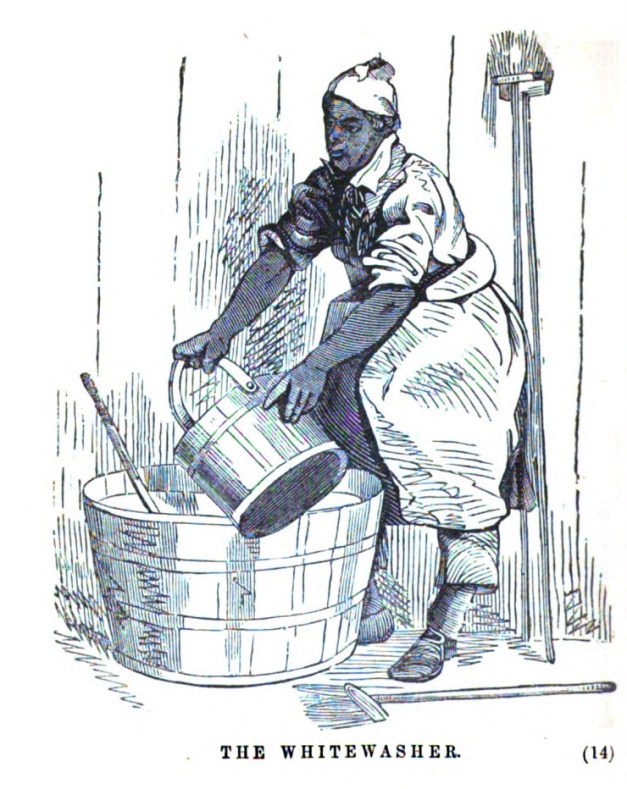
whitewasher

Mr. Garver was employed as a whitewasher or house painter as we know it today. He would have painted fences, stables, house walls, and ceilings. The whitewash/paint that he would have used contained a high content of lead. It was not uncommon for these men and women to suffer brain damage and to experience an early death.

Ninety-six Black families lived in the densely packed Currant Alley. The thoroughfare had a staggering total of three hundred twenty-one Black family members, according to the 1847 Census. The Census also showed that the adults living on Currant Alley were solidly working class, having a wide range of laboring and domestic jobs to which African American men and women were restricted. 

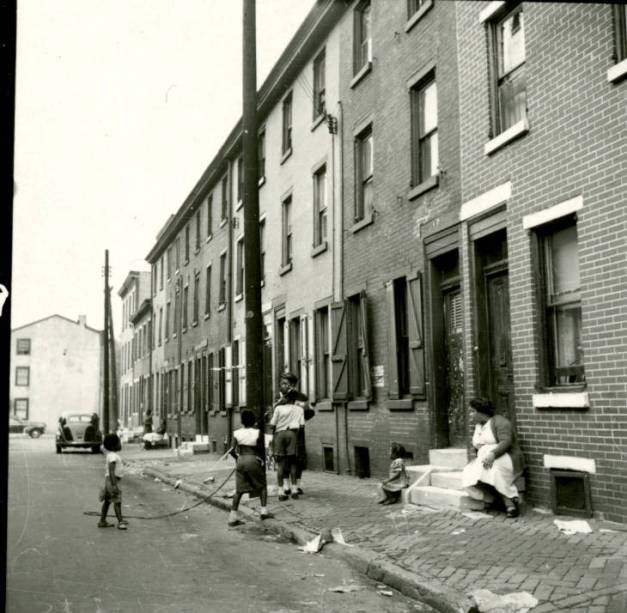
Warnock Street

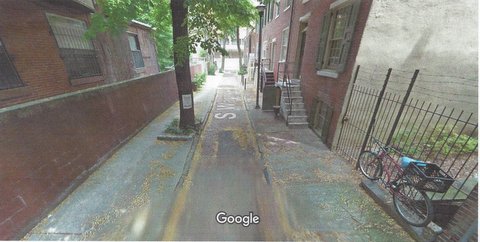
Mr. Garver lived with his family in Currant Alley, now Warnock Street, located between Locust & Spruce Streets and between 10th & 11th Streets. The photo above shows Warnock Street in 1926. Below is a photo of what Warnock Street currently looks like.

warnock

Mr. Garver died on a cold day in mid-February and was buried at Bethel Burying Ground. Several days later, a major snowstorm hit the east coast.

Official Border


Seventy-two-year-old Ann Richards died this date, February 5th, in 1848 and was buried at Bethel Burying Ground.

Posted by Terry Buckalew on February 5, 2020
Posted in: On This date. Tagged: African American burial grounds, African American cemeteries, African American History, African Methodist Episcopal Church, archaeology, Bethel Burying Ground, Mother Bethel, Mother Bethel African Methodist Episcopal Church, Philadelphia, Richard Allen. Leave a comment

ANN RICHARDS

Seventy-two-year-old Ann Richards died this date, February 5th, in 1848 of Inflammation of the Lungs and was buried at Bethel Burying Ground. According to census records and city directories, Ms. Richards was a single woman. The death certificate identifies her as ‘Mrs.,’ which likely means she was a widow. The 1847 Philadelphia African American Census reports that she resided alone at #8 Gray’s Alley in a 9’x9′ room for which she paid $2.33 a month. She was self-employed as a laundress for which she may have made from $0.75-$1.00 a week when she was able to get the work. Ms. Richards reported that she was not born in Pennsylvania and that she could read. She belonged to a beneficial society and attended Bethel A.M.E. at 6th and Lombard Streets.

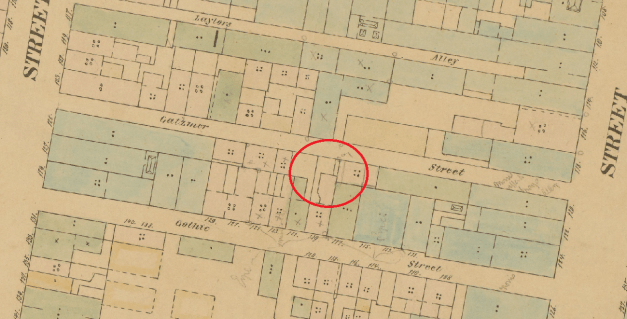
Gray's Alley

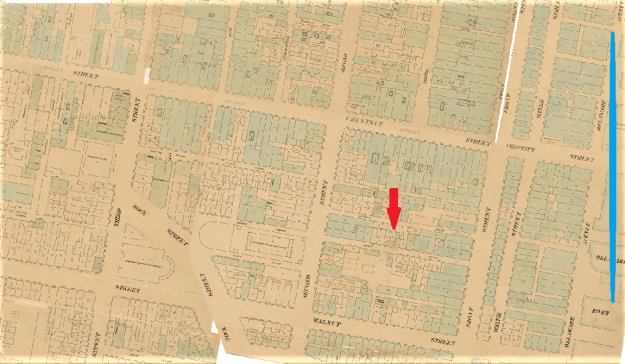
The red circle in the above map illustrates the location of Mrs. Richards’ home at #8 Gray’s Alley. The red arrow in the map below shows the location of the address in relation to the Delaware River (blue line). In the mid-1850s, Gray’s Alley was renamed Gatzmer Alley.

Gray's Alley 2

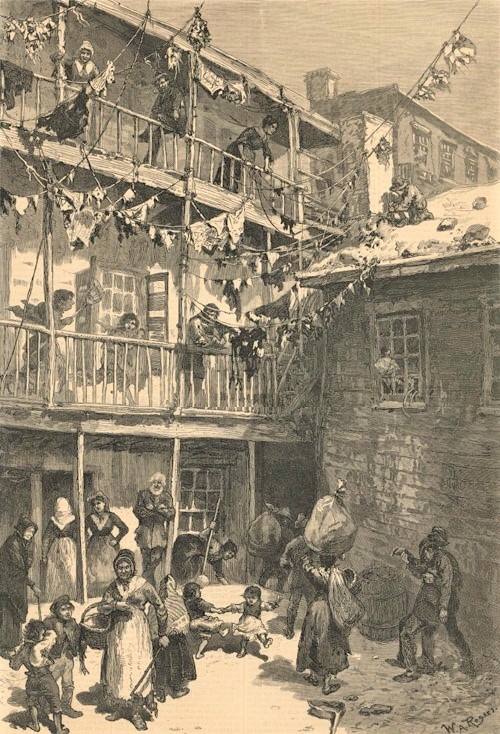
There were two large tenements in Gray’s Alley that contained all the African Africans on the block, according to the 1847 Philadelphia African American Census. The two buildings contained sixty-eight Black men, women, and children. The men in Gray’s Alley worked as laborers and porters, likely on the nearby wharves loading and unloading ships. The women were self-employed as wash women and domestics. There was one woman who listed her occupation as a “cake and pie maker.” She may have sold her baked goods at the nearby outdoor market, just around the corner.

Rear of tenement 6 (2)

Tenement Life

Ms. Richards died on a day in early February where it snowed 2 1/2 inches “but most of it melted on reaching the ground.” She was buried at Bethel Burying Ground.

Official Border

Note: The death certificate for Ms. Richards was signed by “George Webber, M.D.” However, the city directories listed him as a botanical and herb physician. He resided very close to Ms. Richard’s home.

Seventy-four-year-old Jane Ginn died this date, January 25th, in 1849 and was buried at Bethel Burying Ground.

Posted by Terry Buckalew on January 25, 2020
Posted in: On This date. Tagged: African American burial grounds, African American cemeteries, African American History, African Methodist Episcopal Church, archaeology, Bethel Burying Ground, Mother Bethel, Mother Bethel African Methodist Episcopal Church, Philadelphia, Richard Allen. Leave a comment

GINN

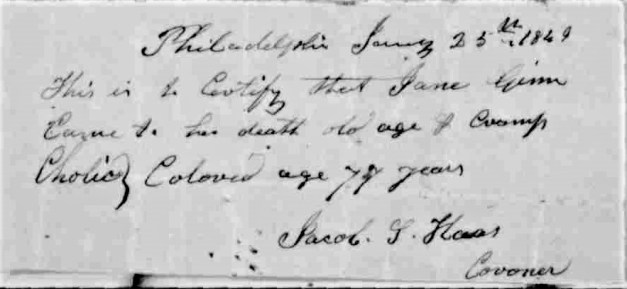
Seventy-four-year-old Jane Ginn died this date, January 25th, in 1849 of “Cramp Cholic” and was buried at Bethel Burying Ground. Mr. Jacob S. Haas was not a physician. He was a Whig Party hack that was given the political patronage job of coroner for which he was completely unqualified. Haas was a liquor supplier and a  victualler, which was traditionally a person who supplies food, beverages and other provisions for the crew of a vessel at sea.  He was relieved later in the year of his coroner job because of supposed ill-health. (1)
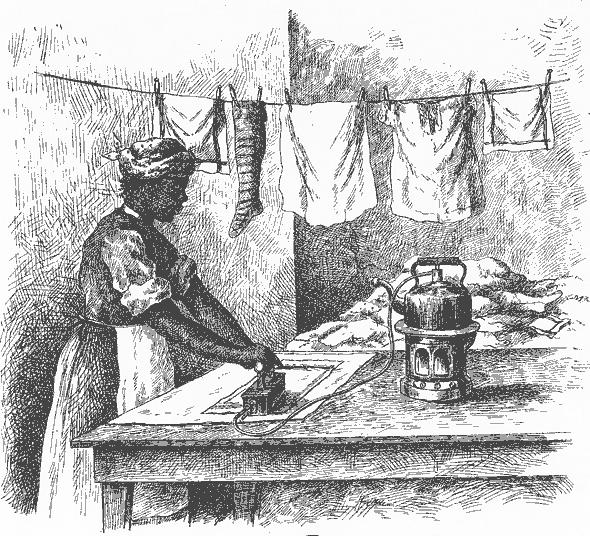
Laundress - ironing

According to the 1847 Philadelphia African American Census, Ms. Ginn was self-employed as a laundress who also did ironing. The highly acclaimed historian of African American History, Carter Woodson observed, “Without a doubt, many a Negro family in the free states would have been reduced to utter destitution had it not been for the labor of the mother as a washwoman.”(1) In the year that Ms. Ginn died, there were 4,249 Black women employed in Philadelphia. Out of that number, there were 1,970 who reported to census takers that they earned a living by taking in washing and/or ironing. (2)

 The 1847 Census shows that Ms. Ginn was a single woman, likely a widow (3), and resided with a woman who was over 50 years of age. The census taker reported that this woman was “intemperate.” The two women received some sort of public aid, like firewood. Ms. Ginn attended church services, probably Bethel A.M.E., and was a member of a beneficial society that, presumably, paid for her funeral expenses. 
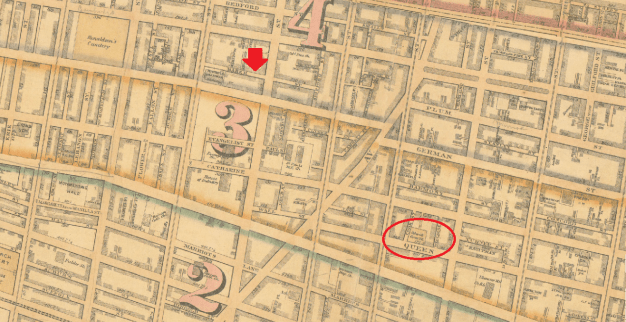
Baker Street

The red arrow on the above map illustrates the location of Ms. Ginn’s home on Baker Street, now known as Pemberton Street. The red circle indicates the location of the Bethel Burying Ground.

 Ms. Ginn resided on Baker Street in South Philadelphia. She lived in a shack, that probably had been a horse stable or pigpen, located behind a shanty that faced Baker Street – hell on earth. This two-block long thoroughfare was cogged with “mud and filth” and was the epicenter in the county for deadly contagious diseases and deaths from poisonous alcohol. The numbers are absolutely stunning. In October of 1847, nine deaths were reported from alcohol, exposure, and neglect. In addition, there were six deaths from Typhus and Typhoid Fever. Incredibly, for the first ten months in 1847, there were a total of 132 deaths on Baker Street, including 68 children on this two-block hell hole. No one chooses to live like this. (4)

In November of 1847, the Philadelphia Board of Health started moving people out of their homes on Baker Street and boarding up the structures. They left the sick people in their homes because they didn’t want them to contaminant others. It was inconceivable that they left two Black women in their shanty who were suffering from fever but had “a fair prospect of recovery.” Could that have been Ms. Ginn and her roommate? (5)
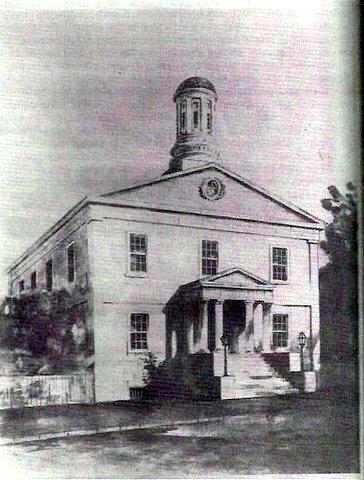
Moyamensin Hall

Moyamensing Hall where Nelson Barrington ran for protection.

In 1846, Ms. Ginn may have been one of the one hundred “wretched creatures,” mostly Black women, avenging a Black woman who was a victim of horrible spousal abuse. Nelson Barrington, a Black man, sold his wife and baby to a fugitive slave catcher from Delaware. The mother and child were put into Moyamensing jail, awaiting a hearing. A group of enraged Black women attacked Barrington in his home on Baker Street, very near Ms. Ginn’s home. They attacked with stones and other weapons with the intent of killing him. Barrington escaped and ran to a local municipal building, Moyamensing Hall, where the constables protected him. The crowd surrounded the Hall for a day until they were dispersed. They were no further newspaper accounts of the abuse victim. (6)

Jane Ginn died on a clear, warm winter day in late January where the temperature at sunrise was 42° and rose to 58° by late afternoon. Ms. Ginn was buried at Bethel Burying Ground.

Official Border

NOTES

(1) John S. Haas . . . Philadelphia Inquirer, 25 June 1849, p. 1.
(2) The Negro Wage Earner by Lorenzo Garner and Carter Woodson, p. 4.
(3) Deaths on Baker Street . . . Public Ledger, 8 Nov 1847, p.2.
(4) Ibid.
(5) Ibid.
(6) 100 Black women . . . Sun, 25 April 1846, p. 2.

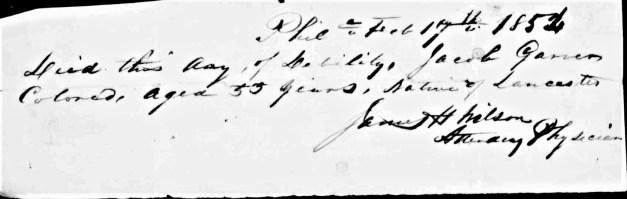
James Champion, an original trustee of Bethel AME Church, died in December of 1818 and was buried at Bethel Burying Ground in January of 1819.

Posted by Terry Buckalew on January 16, 2020
Posted in: On This date. Tagged: African American burial grounds, African American cemeteries, African American History, African Methodist Episcopal Church, archaeology, Bethel Burying Ground, Mother Bethel, Mother Bethel African Methodist Episcopal Church, Philadelphia, Richard Allen. Leave a comment

James Champion 2

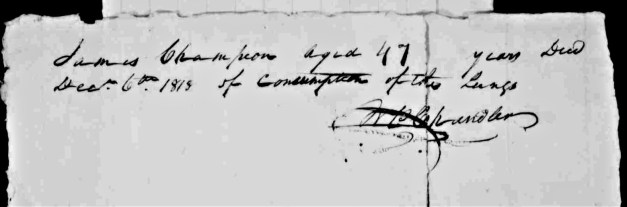
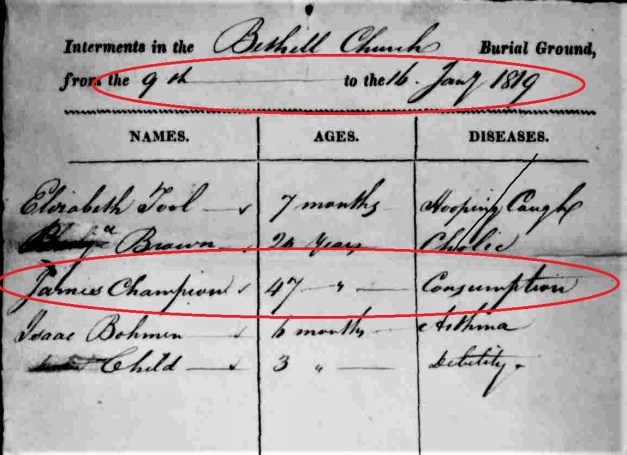
Forty-seven-year-old James Champion died on December 6th, in 1818, of Tuberculosis and eventually was buried at Bethel Burying Ground in early January of 1819. The reason for this delay was a long stretch of below-freezing temperatures that completely froze over the Delaware River, according to newspaper accounts. (1)

JAMES CHAMPION 1

Large cemeteries usually had vaults where they stored bodies in situations like this. Bethel did not have a vault. It was possible to rent space in a vault in a nearby cemetery. It was also a possibility that he was temporarily buried “between the walls” which meant a corpse was buried underneath the floor of the church. (2) But whatever the situation, Mr. Champion’s remains were removed and interred at Bethel Burying Ground in early January of 1819, as described by the above document.

BARCLAY

The red arrow illustrates the location of Mr. Champion’s home at 12 Elizabeth Street, later called Barclay Street. The red circle illustrates the close proximity of Bethel AME Church.

Tragically, there is little personal information available on Mr. Champion or his family. Philadelphia city directories record his occupation as “carter” until 1813 when he is listed as a “master chimney sweep.” A carter is an operator of a wagon or cart that transports goods. Elizabeth Street was the location of several large businesses, including the cordial distillery of J. Dickerson and the chocolate manufactory of Frederick Shonnard. Mr. Champion could have been employed at either one of these. 

James Champion was an original trustee of Bethel Church along with its founder, the Rev. Richard Allen. Champion was an early Allenite or devoted follower of Allen. To give an example of Mr. Champion’s status in the church, we only have to look at an event on December 19th in 1805. A beloved Bethel congregate and an old member of St. George’s Methodist Church, Charles Boston, died and was buried on this date. There was a large funeral at Bethel where the white Methodist clergy followed the coffin in the procession to Mr. Boston’s grave. The only ones allowed to lead the coffin were Rev. Richard Allen, Rev. Absalom Jones, and James Champion! (1)

Screenshot (40)

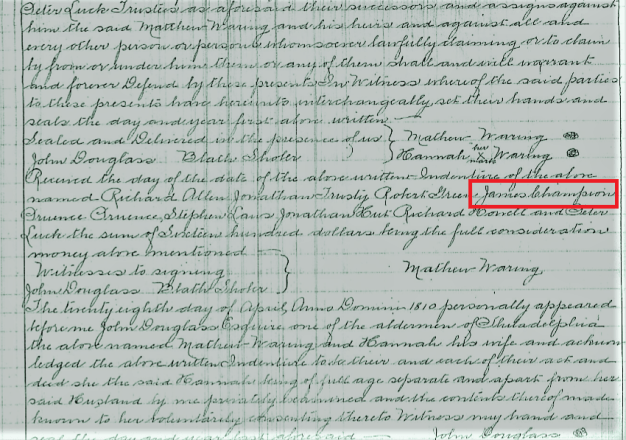
James Champion was one of the Bethel Church trustees that signed (by power of attorney) the sale agreement for the land that would become the Bethel Burying Ground in April of 1810.

In the same year as his death, while he was suffering from Tuberculosis, Mr. Champion finished a hymn book of 314 hymns for his church with Rev. Allen and Daniel Coker. (2)

Official Border


(1) A Journal of the Travels of William Colbert . . . (1790-1833). 

(2) The quadrennial address of the bishops of the African Methodist Episcopal Church, p. 16.

Eighty-three-year-old Abraham Hall died this date, January 8th, in 1841 and was buried at Bethel Burying Ground.

Posted by Terry Buckalew on January 8, 2020
Posted in: On This date. Tagged: African American burial grounds, African American cemeteries, African American History, African Methodist Episcopal Church, archaeology, Bethel Burying Ground, Mother Bethel, Mother Bethel African Methodist Episcopal Church, Philadelphia, Richard Allen. Leave a comment

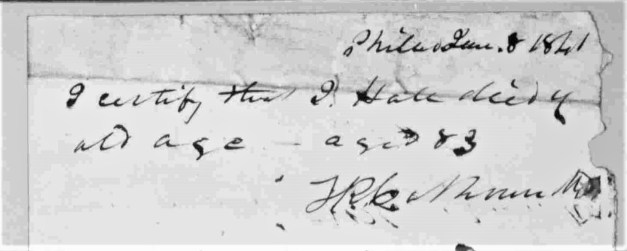
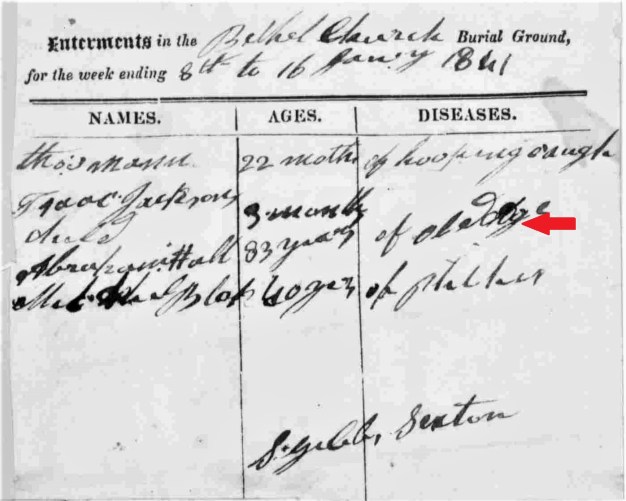
Eighty-three-year-old Abraham Hall died this date, January 8th, in 1841 of “old age” and was buried at Bethel Burying Ground.

ABRAHAM HALL (B)

ABRAHAM HALL (A)

“S. Gibbs” was Shepherd Gibbs, Bethel AME Church’s sexton and cemetery manager.

According to the 1837 Philadelphia African American Census, Mr. Hall worked as a laborer. His spouse worked in the home. There were seven total individuals in the household and all were not native to Pennsylvania. Mr. Hall reported that he was formerly enslaved and that he bought his freedom for two hundred fifty dollars. He also purchased the freedom of his son for fifty-dollars. 

Screenshot (37)

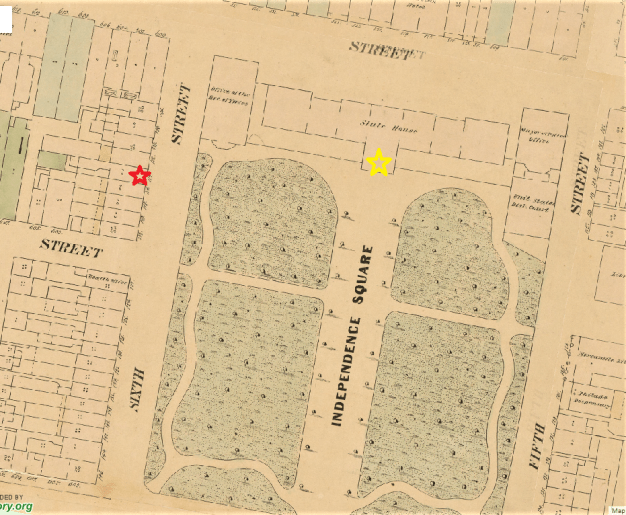
The red star illustrates the location of Mr. Hall’s home. The yellow star indicates the local of the State House, now known as Independence Hall.

The Hall family of seven lived in one room at 114 South 6th Street, across the street from what we now know as Independence Hall. For this, they paid $5 a month in rent, according to the 1837 Census. 

I was unable to identify the Hall family in the 1850 U.S. Census. It is a possibility that the family members were some of the thousands of African Americans to flee the city after the barbaric white mob attacks of 1842. It is estimated that the Black population of Philadelphia decreased by 23.5% after 1842. (1)
Mr. Hall died on a mild day in January where the temperature was warm enough for the thawing to continue on the frozen Delaware and Schuylkill rivers.  


Official Border

(1) A Statistical Inquiry into the Condition of the People of Colour of the City & Districts of Philadelphia, p. 7. Available at – 

https://babel.hathitrust.org/cgi/pt?id=hvd.32044010681914&view=1up&seq=7

The sixteen-month-old daughter of Isaac and Mary Beckett died this date, January 3rd, in 1848 and was buried at Bethel Burying Ground.

Posted by Terry Buckalew on January 3, 2020
Posted in: On This date. Tagged: African American burial grounds, African American History, African Methodist Episcopal Church, archaeology, Bethel Burying Ground, Mother Bethel, Mother Bethel African Methodist Episcopal Church, Philadelphia, Richard Allen. Leave a comment

Unspecified Beckett

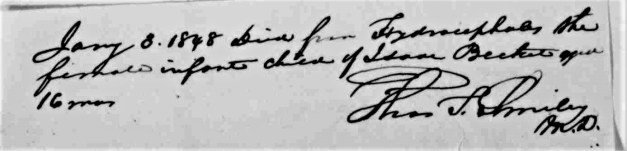
The sixteen-month-old daughter of Mary and Isaac Beckett* died this date, January 3rd, in 1848 of Hydrocephalus** and was buried at Bethel Burying Ground. Tragically, the little girl would not be alone for long. 

Mary Beckett was approximately twenty-seven-years-old at the time of her daughter’s death. She was employed as a domestic and had been born in Pennsylvania. She was dying of Tuberculosis. Isaac Beckett was twenty-eight-years-old and employed as a porter. He was born in Delaware, according to the census. However, his death certificate states that he was born in Maryland.***

There was another adult in the family, Ann Armstrong, forty-seven-years-old, born in Pennsylvania, who was employed as a “white washer” or house painter. She may have been Mary Beckett’s mother. All of this information is from the 1847 Philadelphia African American Census and the 1850 U.S. Census.

Baby Beckett had two siblings Julia, seven-years-old, and Isaac, Jr., four-years-old. Both were born in Pennsylvania, according to the 1850 U.S. Census. Sadly, the Becketts lost a three-month-old daughter to “fever” on June 19, 1848. She was buried at Bethel Burying Ground with her sister.

I. Beckett

237 lombard street

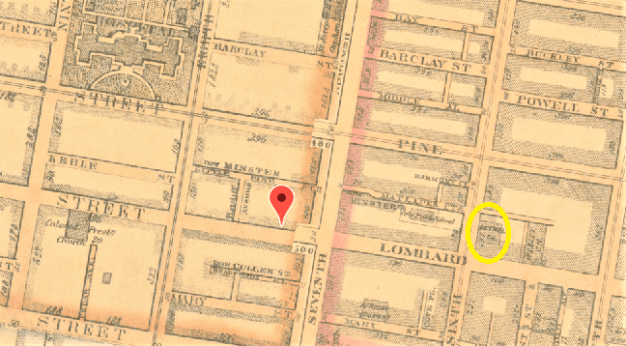
The red pin illustrates the location of the Beckett’s home. The yellow circle illustrates the location of Bethel AME Church a block away.

In 1847 six members of the Beckett family lived in a 9’x9′ room without running water or sanitation. The room was one of eight in a house in the 700 block of Lombard Street north side. The eight families in the tenement consisted of twenty-two African American men, women, and children. The adults were employed as an oyster house worker, waiter, seaman, seamstress, laundress, domestic worker, whitewasher, and porter. There were several who reported that they were formerly enslaved, according to the 1847 Census. The children attended the Raspberry Alley School.

The Becketts lost their baby daughter on a clear day in January where the mercury gradually rose from 34° to 50°. The winds were light and variable. She was buried at Bethel Burying Ground.

Official Border

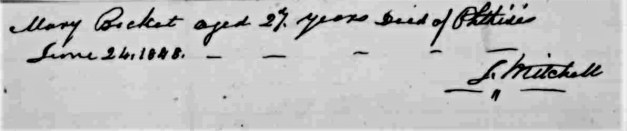
Tragically, Mary Beckett would die six months after the death of her sixteen-month-old daughter and five days after the death of her three-month-old baby on June 24, 1848, of Tuberculosis. She was buried with her daughters at Bethel Burying Ground.

Mary Beckett.jpg

Official Border

*The family name is spelled “Becket” on some documents. I have chosen the more common spelling.

**Hydrocephalus is an abnormal increase in the amount of cerebrospinal fluid that circulates in the brain. This puts increased pressure on the brain that produces an enlarged head and may lead to brain damage. The condition is associated with spina bifida, viruses, bacteria, and funguses. (A Biohistory of 19th-Century Afro-Americans, Lesley M. Rankin-Hill)

***Isaac Beckett died on August 28, 1866, at seventy-three-years-old.

On this date January 1st, in 1869, Bethel Burying Ground was leased as a freight storage yard.

Posted by Terry Buckalew on January 1, 2020
Posted in: On This date. Tagged: African American burial grounds, African American cemeteries, African American History, African Methodist Episcopal Church, archaeology, Bethel Burying Ground, Mother Bethel, Mother Bethel African Methodist Episcopal Church, Philadelphia, Richard Allen. Leave a comment

Barnabas H. Barol

Barnabas Henry Bartol was an engineer, inventor, and investor. He built a family empire that included real estate, foundries, utilities, and sugar refining. He would invent and/or build the huge machinery needed to run some of these businesses. Bartol would eventually become a major stockholder in these empires and reap the large financial benefits. 

In 1869, Philadelphia had over a dozen sugar refineries. It was one of the largest businesses in Philadelphia through the centuries. The factories were large and required a great deal of storage space for freight wagons, hogsheads (large barrels), lumber and the vast amount of trash produced by such industry. (See below image showing one of these enormous factories in Philadelphia.)

Sugar Refinery

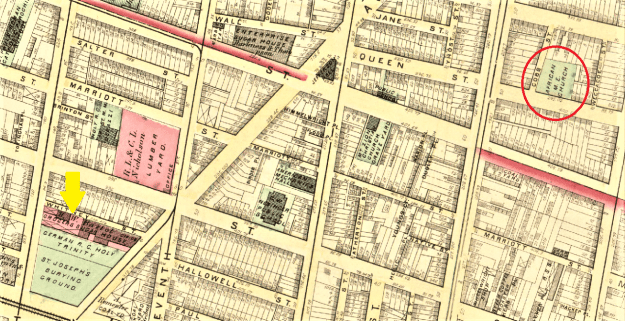
In 1869 Bartol was the head of the Grocers’ Sugar House (refinery) at 7th Street and Passyunk Avenue, three or four blocks from the Bethel Burying Ground.

Map Grocers' Sugar House and BBG

The yellow arrow (lower left) indicates the location of the Grocers’ Sugar House. The red circle illustrates the location of the Bethel Burying Ground.

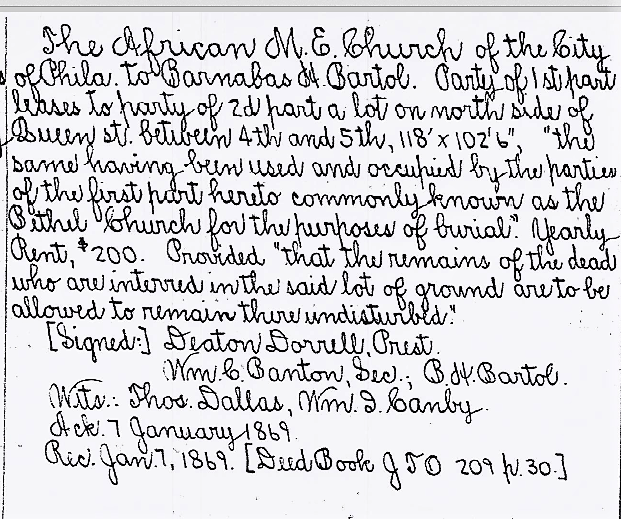
On January 1, 1869, Bartol signed a lease (below) to use Bethel Burying Ground for a storage yard for a rent of $200 a year. It was acknowledged by Bethel Church that the property was formerly a cemetery and that the human remains were still under the hard clay surface. There wasn’t a tombstone standing.

Screenshot (36)

There was a well-known dark side to the sugar industry in its reliance on enslaved laborers who cut and crushed the sugar cane in the West Indies and the southern United States. With the south being defeated in the American Civil War and the British ending slavery in their Caribbean colonies, the focus turned to Cuba. Slavery in Cuba was not ended until 1886. The Philadelphia newspapers frequently wrote about the situation only ninety miles off the coast of Florida. (1)

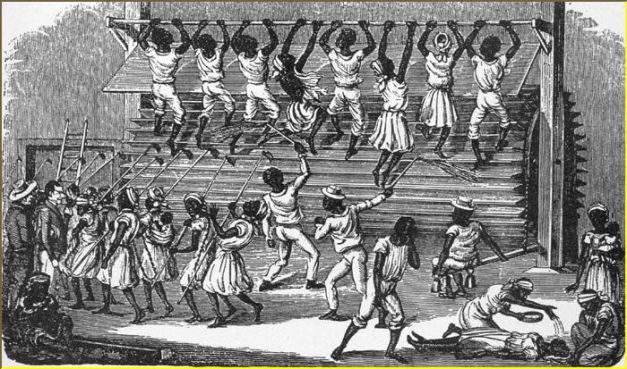
Bartol made numerous trips to Cuba to inspect the sugar cane operations on the island. He saw the crushing toil of the 20 hour days during the harvest season without ever a day off. He stood next to the machinery that often mangled the bodies of the enslaved men, women and children. We know that he saw the beatings, whippings that flayed off the skin of the victims. (2)

Slave cuba

Barnabus Bartol’s spouse, Emma, conscientiously kept a journal on her trips to Cuba with her husband. She wrote that slavery was a “curse,” however “The slaves belong to an inferior race and must yield to the superior intellect of the Caucasian races.” (2)

In August 1872, AME Bishop Benjamin Tucker Tanner wrote in The Christian Recorder calling attention to the disgrace of the Bethel Church trustees who have let the “consecrated grounds” of the church’s “Old Burial Ground” on Queen Street crumble. He laments that the plot is in disrepair and is being used as a dump for rubbish, old hogsheads, barrels, and lumber. “There is not a gravestone unbroken and not a grave to be seen – all in confusion and shame.”

For an unexplained reason, the trustees of Bethel Church and Barnabas Bartol in June of 1873, agreed to terminate the lease for the cemetery plot. Bartol agreed to erect a “good fence” around the grounds on his departure. (Minutes of the Bethel Trustees, 1878-1891).

Official Border

(1) 7 May 1867, Philadelphia Inquirer; 30 Oct 1868, Evening Press; 12 Nov 1868, Telegram; 1 Dec 1868, Press; 21 Dec 1868, Philadelphia Inquirer; 2 March 1869, Philadelphia Inquirer.

(2) Recollections of a Traveller by Emma J. Barlot; (3) p. 73. The entire book is available online at https://www.hathitrust.org/

Official Border

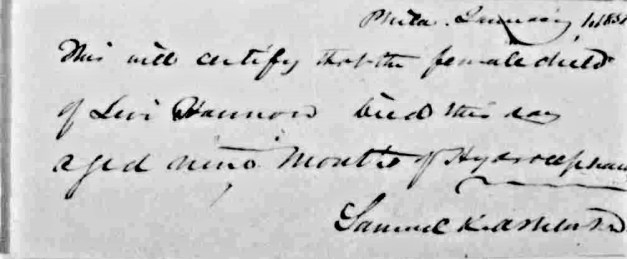
The nine-month-old daughter of Levi and Harriet Harman died this date, January 1st, in 1851 and was buried at Bethel Burying Ground.

Posted by Terry Buckalew on January 1, 2020
Posted in: On This date. Tagged: African American burial grounds, African American cemeteries, African American History, African Methodist Episcopal Church, archaeology, Bethel Burying Ground, Mother Bethel, Mother Bethel African Methodist Episcopal Church, Philadelphia, Richard Allen. Leave a comment

HARMAN

The nine-month-old daughter of Levi and Harriet Harman died this date, January 1st in 1851 of Hydrocephalus and was buried at Bethel Burying Ground. Mr. Harman was fifty-one-years-old and worked as a stevedore. Ms. Harman was twenty-nine-years-old and was employed as a laundress. Both were born in Delaware, according to the 1850 U.S. Census. That Census also shows the family included: William Harman who was thirteen-years-old and Elizabeth Harman who was ten-years-old. Both children were born in Pennsylvania. The 1847 Philadelphia African American Census shows that there was another young male (unnamed) in the family who was employed as a seaman. He is not recorded in the household by the 1850 U.S. Census.

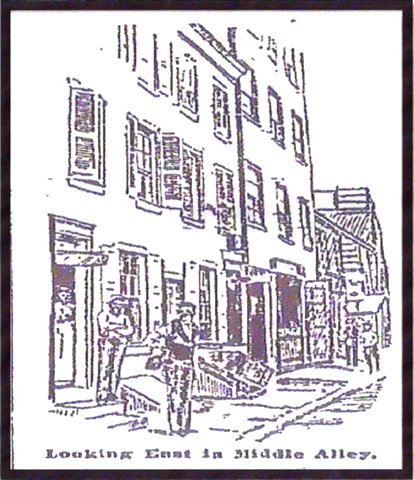
middle-alley-1

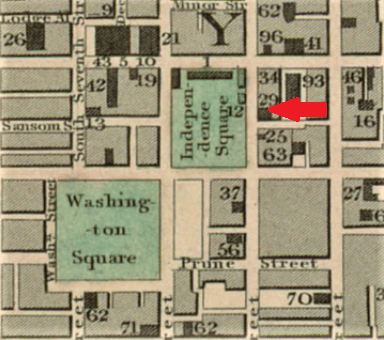
The six members of the Harman family lived in an 11’x 11′ shed in the rear of #19 Middle Alley for which they paid $2.25 a month in rent. Mr. Harman earned $6 a week, according to the 1847 Census. Middle Alley ran from 6th to 7th Streets between Spruce and Pine Streets. It is now called Panama Street. Middle Alley had a long history of violence, brothels, speakeasies and crushing poverty. In addition to dealing with all these elements in their everyday lives, the Harmans, as well as all Black Philadelphians, now had to live in fear of the newly emboldened fugitive slave catchers – savage kidnappers for profit. 

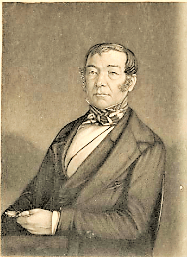
Edward D. Ingraham portrait

Edward D. Ingraham, the Philadelphia Commissioner of the Fugitive Slave Law: “a ten-dollar slave catching judge.”

By 1850 the southern enslavers had won over enough northern politicians to pass the 1850 Fugitive Slave Act. The law required liberated, formerly enslaved Black men, women, and children to be returned to their enslavers, even if they were in a free state. The act also made the federal government responsible for finding, trying and returning escaped Blacks.

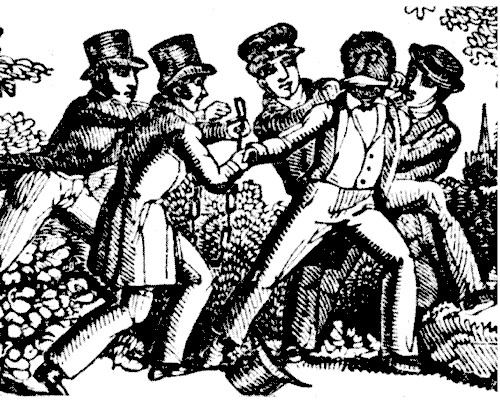
fugitiveslaveact-fathertheo.wordpress.com-1

It didn’t matter to the kidnappers if the African American was a real fugitive or not. As long as they were Black and the judge cooperated, it was often a fait accompli.

Each major city in the north had a federally appointed commission/judge to conduct a hearing to decide the validity of the kidnappers’ claim that the African American was a fugitive. It was not a coveted job by most attorneys. However, there was one in Philadelphia who appeared to be born for the job. Edward D. Ingraham, Esq. was a racist, known for dismissing outright the evidence presented by the Black man or woman’s lawyer. Ingraham took delight in his “indecent haste” in railroading victims while handing the notorious kidnapper George F. Alberti whatever he needed. The Commissioner exhibited “. . . zeal in the business of making it [Fugitive Slave Law] agreeable for the South” and appeared to be ” . . . much endeared to slave-catchers.” There even was an implication that Ingraham was taking bribes from the slave-catchers – “a ten-dollar slave catching judge.” 

All the poor of Philadelphia, regardless of race, suffered from the same crushing effects. Clearly, some more than others. However, only one group of Philadelphia’s citizens could be pounced upon, anywhere and at any time, and dragged in chains to hell. 

Harriet and Levi Harman lost their baby daughter on a day where the sunrise temperature was a cold 18°. Late afternoon it rose to 33° with two inches of snow on the ground from the previous day.

Official Border

NOTES

  • “indecent haste” . . . Trenton Star Gazette, 25 December 1850, p. 1.
  • “zeal in the business” . . . Philadelphia: a history of the city and its people, a record of 225 years. v.2, p. 349, E.P. Oberholzer.
  • “much endeared” . . . Miscellaneous writings on Slavery, p. 598, William Jay.
  • “George F. Alberti” . . . The Underground Railroad: a record of facts, p. 557, William Still.
  • “ten-dollar judge” . . . ibid., p. 598.

December 18, 1787 – “Defending the Potter’s Field”

Posted by Terry Buckalew on December 18, 2019
Posted in: Archaeology, BBG History, Bethel Burying Ground Timeline, Burial services, Documents, On This date. Tagged: African American burial grounds, African American cemeteries, African American History, African Methodist Episcopal Church, archaeology, Bethel Burying Ground, Mother Bethel, Mother Bethel African Methodist Episcopal Church, Philadelphia, Richard Allen. Leave a comment

In the 18th century, Philadelphia African Americans were buried in unmarked trenches and pits in what we now know as Washington Square at Sixth and Walnut Streets in the city. The Free African Society led by courageous Black citizens attempted to have the city government protect the graves from body snatchers and vandals. They refused so the Black community took the duty of defending the ancestors in “Congo Square” upon themselves.

Shippen letter scan

Phase 1B Archeological Investigations of the Mother Bethel Burying Ground, 1810 -Circa 1864, page 2.2 (Mooney & Morrell 2013). page 2.2.

Shippen's Theater

The red arrow illustrates the location of Dr. Shippen’s morgue and teaching classroom to nearby Washington Square and the Potter’s Field.

Mr. Lamont B. Steptoe is a poet who took it upon himself “for five years to sit among the trees and unmarked graves [of Washington Square/Congo Square] and allow this place to speak” to him. As a result, we have a beautiful book of poetry and self-reflection. The below is from Mr. Steptoe’s 2012 Mediations in “Congo Square” by Whirlwind Press which he founded.

Congo Square poetry

There were some Black men who armed themselves with guns to defend their ancestors. There are others who use just as powerful words to protect them.


download

Sankola

Official Border

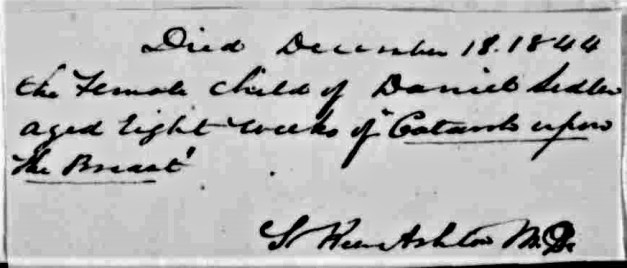
The eight-week-old daughter of Daniel Sedler died this date, December 18th in 1844 and was buried at Bethel Burying Ground.

Posted by Terry Buckalew on December 18, 2019
Posted in: Uncategorized. Leave a comment

SEDLER

The eight-week-old daughter of Daniel Sedler died this date, December 18th in 1844 of “Catarrh upon the breast” and was buried at Bethel Burying Ground. The child likely died of either pneumonia and/or bronchitis. ‘Catarrh’ simply means congestion.

The 1847 Philadelphia African American Census shows a ‘Daniel Sadller’ living at #75 Carpenter Street in the Southwark District of the County of Philadelphia. There were three males and one female in the family. One was under the age of five and three were between the ages of 15 and 49 years of age. Their rent for their room on Carpenter Street was $4 a month. Mr. Sedler earned $4 a week, according to the 1847 Census.

Screenshot (30)

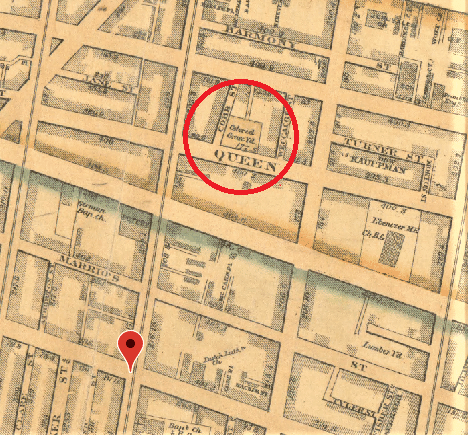
The red pin indicates the approximate location of the Sedler home on Carpenter Street. The Bethel Burying Ground is circled in red.

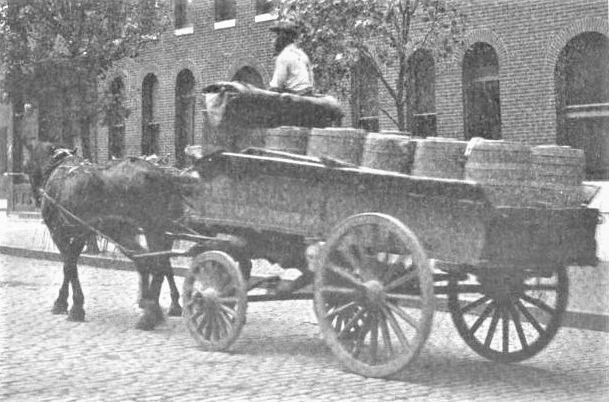
Mr. Sadler was employed as a “sink cleaner.” This was a person who also was called a “night soil man” who had the job of scooping out cesspools (sinks) full of human waste. They worked at night and would empty their slop buckets into barrels on a horse-drawn cart that then would be dumped. The city government attempted to regulate where the waste was dumped but it would often be unloaded in vacant lots or in a nearby creek or river. Tragically, some men would dump the waste in storm drains where the fecal matter would leach into the soil and contaminate the neighborhood water wells and cause epidemics of Cholera and other diseases. 

Night soil cart

Night-soil men were at high risk for disease. A simple cut or scrape could easily become infected with any of a dozen different diseases including worms. Also, they were easy prey for thugs that roamed the streets in the middle of the night. 

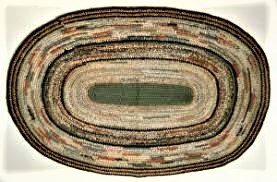
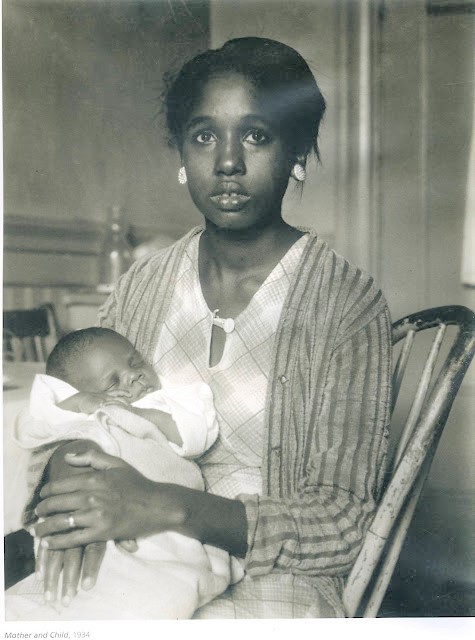
After the 1847 Census, the Sedler family disappears from census and city directory documents. The Census does tell us that Ms. Sedler’s occupation was listed as “carpet rags.”The first group of these women would scavage trash dumps for any clothing that was thrown out. The parts of the garment that could be salvaged were cut out, washed and sold. Larger quantities of these rags would be sold by the pound to sweatshops where the second group of women would take the fabric and braid it to make rugs like the one in the below photograph.

download

Official Border

Life in Photographs by Dorothea Lange from the 1920s to the 1950s.

The Sedler infant daughter died on a day where “The weather was partly clear, having a great appearance of snow, which did not take place.” She was buried at Bethel Burying Ground.

Official Border

Posts navigation

← Older Entries
Newer Entries →
  • Recent Posts

    • Three dead as church wall falls on this date, May 1st, in 1841.
    • The ten-month-old Baby Colgate died this date, June 20th, in 1847, and was buried at Bethel Burying Ground.
    • Fifty-eight-year-old Rachel Dawson died this date, May 3rd, in 1839, and was buried at Bethel Burying Ground.
    • Twenty-eight-year-old Robert Swails died on this date, March 31st in 1849, and was buried at Bethel Burying Ground.
    • Forty-year-old Jacob “Jesse” Howard died on this date, January 29th, in 1840, and was buried at Bethel Burying Ground.
  • Archives

    • May 2024
    • June 2023
    • May 2023
    • March 2023
    • January 2023
    • December 2022
    • November 2022
    • October 2022
    • September 2022
    • August 2022
    • May 2022
    • April 2022
    • March 2022
    • February 2022
    • January 2022
    • December 2021
    • November 2021
    • October 2021
    • September 2021
    • August 2021
    • July 2021
    • June 2021
    • May 2021
    • April 2021
    • March 2021
    • February 2021
    • January 2021
    • December 2020
    • November 2020
    • October 2020
    • September 2020
    • August 2020
    • July 2020
    • June 2020
    • May 2020
    • April 2020
    • March 2020
    • February 2020
    • January 2020
    • December 2019
    • November 2019
    • October 2019
    • September 2019
    • August 2019
    • July 2019
    • June 2019
    • May 2019
    • April 2019
    • March 2019
    • February 2019
    • January 2019
    • December 2018
    • November 2018
    • October 2018
    • September 2018
    • August 2018
    • July 2018
    • June 2018
    • May 2018
    • April 2018
    • March 2018
    • February 2018
    • January 2018
    • December 2017
    • November 2017
    • October 2017
    • September 2017
    • August 2017
    • July 2017
    • June 2017
    • May 2017
    • April 2017
    • March 2017
    • February 2017
    • January 2017
    • December 2016
    • November 2016
    • October 2016
    • September 2016
    • August 2016
    • July 2016
    • June 2016
    • May 2016
    • April 2016
    • March 2016
    • February 2016
    • January 2016
    • December 2015
    • November 2015
    • October 2015
    • September 2015
    • August 2015
    • July 2015
    • June 2015
    • May 2015
    • April 2015
    • March 2015
    • February 2015
    • January 2015
    • December 2014
    • November 2014
    • October 2014
  • Categories

    • Archaeology
    • BBG History
    • Bethel Burying Ground Name Directory
    • Bethel Burying Ground Timeline
    • Burial services
    • Diseases
    • Documents
    • Freemasonry
    • Ignatius Beck
    • It's a fact
    • Maps
    • Neighborhood
    • Newspaper Articles
    • On This date
    • Photographs
    • Uncategorized
    • Videos
  • Meta

    • Create account
    • Log in
    • Entries feed
    • Comments feed
    • WordPress.com
Blog at WordPress.com.
Bethel Burying Ground Project
Blog at WordPress.com.
  • Subscribe Subscribed
    • Bethel Burying Ground Project
    • Join 48 other subscribers
    • Already have a WordPress.com account? Log in now.
    • Bethel Burying Ground Project
    • Subscribe Subscribed
    • Sign up
    • Log in
    • Report this content
    • View site in Reader
    • Manage subscriptions
    • Collapse this bar
 

Loading Comments...