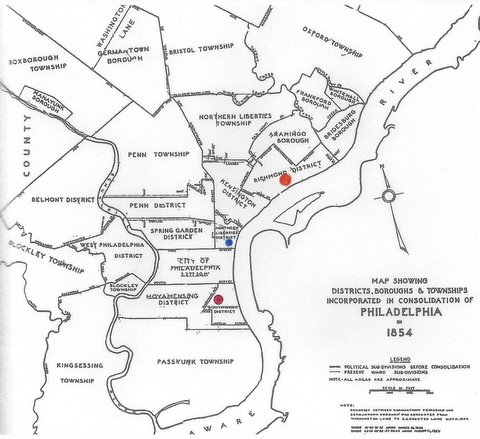
The six-month-old son of Thomas and Francis Wilkins died this date, November 5th, in 1848 of Bronchitis and was buried at Bethel Burying Ground. Unfortunately, I have not been able to locate any additional information on the Wilkins family. What is interesting from a historical standpoint is that the family lived in the Port Richmond district in the County of Philadelphia which was several miles away from Bethel Burying Ground. There was a closer AME church with a graveyard (Union AME) in the far eastern part of the Fairmount district. Perhaps there was another family member (another child?) buried at BBG and the parents wanted to keep them together. Another possibility is that a Bethel Church beneficial society offered burial assistance.
On This date
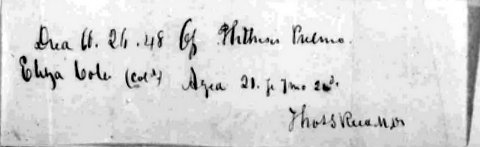
All deaths are tragic. Some more so than others. Twenty-one-year-old Elizabeth Cole died this date, October 21th, in 1848 of Tuberculosis and was buried at Bethel Burying Ground. Ms. Cole appears to have been the female head of her family with her mother deceased or away and her father a seaman and also absent from home for long spells. Census records show that Ms. Cole cared for 3 siblings while occupied as a day worker. Two of the smaller children were attending the Shiloh Infant School. The Cole family lived at 41 Currant Alley where they rented a room for $28 a year. The Cole family attended religious services, presumably Bethel Church (now Mother Bethel).
Currant Alley ran from Walnut Street to Spruce Street between 10th and 11th streets in the Ward 7 of the City.
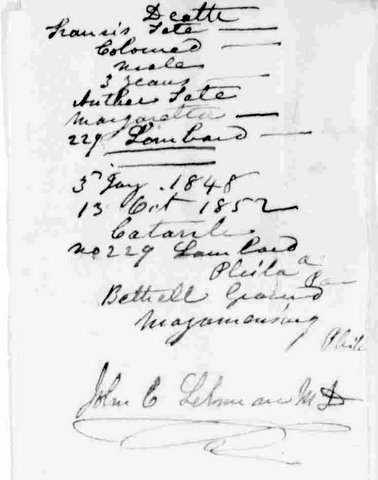
Three-year-old Francis Tate died this date, October 16th, in 1852 from a fever of unknown origin. He was the son of Arthur and Margareta Tate who lived with their four other children in a room located in a 3-story brick building in the 900 block of Lombard Street near Bethel Church (now Mother Bethel). Their rent was $1.75 a month. Arthur was employed as a porter and Margareta was a day worker according to the 1847 African American Census. It appears from the Census that Francis attended the nearby Lombard Infant School. One of the parents was formerly enslaved and gained their freedom through manumission.

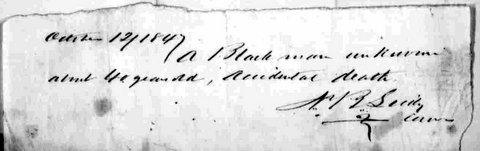
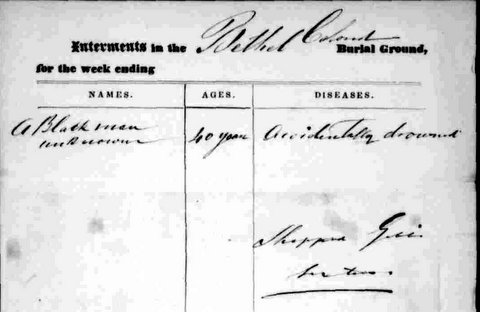
A Black man, approximately 40 years old, accidentally drowned and was buried this date, October 12th, in 1847 at Bethel Burying Ground. The process by which a stranger to everyone can evidently be buried at Bethel is unknown. The majority of those with no given name buried at BBG are for the most part infants or babies born dead and have not yet been given a name. The circumstances around this man’s dead suggest suicide in my experience. Yet I have not been able to locate any newspaper account of such an event. Did one of the Church’s beneficial societies learn of his death and agree to bury him? Normally in a case like this he would have been buried in Potter’s Field. Hopefully, his story will not end here and further evidence will surface in the future.
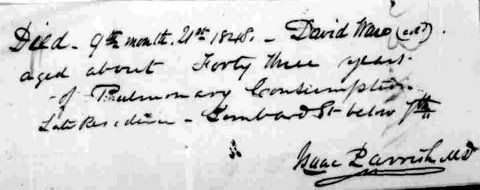
The Reverend David Ware, 43, died this date, September 21st in 1848 and was buried at Bethel Burying Ground on the 27th. He was stricken with Tuberculosis six months before his death and bore his illness with “Christian fortitude” according to his obituary.* Rev. Ware was a school teacher, principal, Bethel Church deacon, steward, secretary, trustee and considered “one of the ablest men of his day,” according to African Methodist Episcopal history.**
Rev. Ware was a teacher and principal of his own private school. In 1847 enrollment at the school was reported to be 56 students from 4 different districts in the County and City of Philadelphia. For many years he was the superintendent of Bethel’s Sunday School with an enrollment of 300 students and a staff of 24 teachers.*** Before his death he was tasked with creating a high school for Black students. His illness prevented him from fulfilling that assignment. ****
The Ware family lived in the 600 block of Lombard Street only yards away from Bethel Church. The Philadelphia African-American Census of 1847 reported 6 total members of the family (2 males; 4 females; Under 5 Yrs., 1; Under 15 Years, 1; Under 50 years, 4). A total of five family members could read and write with all the children being educated at Rev. Ware’s school. The four females in the family were employed as a teacher, dressmaker and two were engaged as domestics.
Sadly, the Ware family suffered the loss of their son and brother, William J. Ware on November 21, 1847. He was nineteen at the time of his death from tuberculosis. The same disease that took his father. It is very likely they are buried next to each other at Bethel Burying Ground.
*Public Ledger, September 23, 1848, p.2.
** Bethel Gleanings, Rev. Joseph S. Thompson (1881), p. 40. Available at http://stillfamily.library.temple.edu/bethel-gleanings-page-1; in the same reference (p. vii), Bishop Payne makes note of Rev. Ware “beauty of penmanship” and substantial “detailed entries” as Secretary of Bethel Church for many years. As a layman, Rev. Ware was not considered a minister and Payne points this out as he laments the total lack of literacy among A.M.E. itinerant ministers. It is apparent that Rev. Ware was responsible for the recording and documenting numerous aspects of the Church’s organization during his adult lifetime.
*** A statistical inquiry into the conditions of the people of colour of the city and districts of Philadelphia, p. 21. Available at http://babel.hathitrust.org/cgi/pt?id=umn.319510023192154;view=1up;seq=3.
**** History of the African Methodist Episcopal Church, Bishop David Alexander Payne, pp. 142 and 177. Available at http://docsouth.unc.edu/church/payne/payne.html
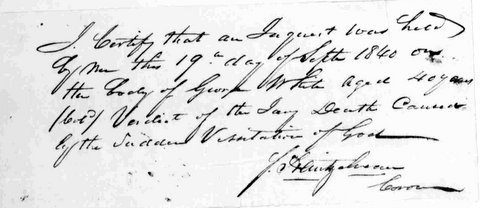
Forty-year-old George White died this date, September 19th, in 1840 from a “Sudden Visitation of God” and was buried at Bethel Burying Ground. Five days later the Public Ledger newspaper would report that Mr. White collapsed on Shippen Street (now Bainbridge) and died from Consumption (Tuberculosis). *
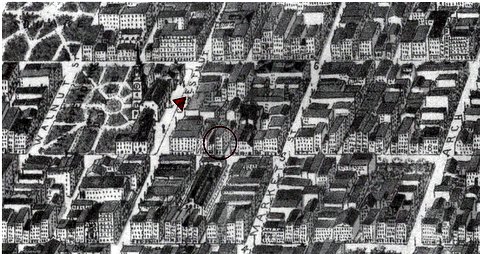
From Federal Census Records and Philadelphia city directories it appears that Mr. White and his family lived at 160 S. 5th Street in the block north of Independence Hall. He was employed as a porter earning approximately $5 a week if he was able to find full-time employment. There is no additional information on his family members at this time.
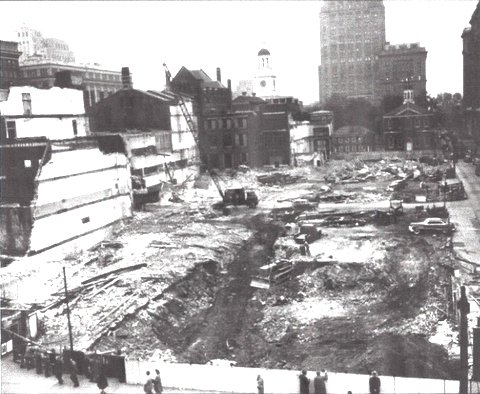
This perspective map shoulds the location of the White’s home (circle) in relationship to Independence Hall (arrow) on Chestnut Street. In the early 1950s the homes on the White’s block were torn down to create the Independence Square Mall.
Below is a photo from the Evening Bulletin (Philadelphia) dated November 1, 1951. It shows the complete demolition of the three blocks directly north of Independence Hall (in the background) which included the White’s address.
*Public Ledger, September 21, 1840
On the evening of September 7, 1847, George Blake, 28, was a passenger on the steamboat Portsmouth coming back to Philadelphia from a day excursion trip to Salem, New Jersey on the Delaware Bay. At approximately 10 PM the steamboat collided in the dark with another ship and Mr. Blake was thrown overboard.* His body was not found until the 12th when the City Coroner ruled his death an accidental drowning. Mr. Blake’s brother John ran an ad in the September 11th edition of the Public Ledger newspaper offering a “suitable reward” for the return of the body of his brother. At the time of his death, George was wearing a “black frock coat, green satin vest and dark pantaloons.” John Blake lived no. 44 St. Mary Street in the Cedar Section of the City.**
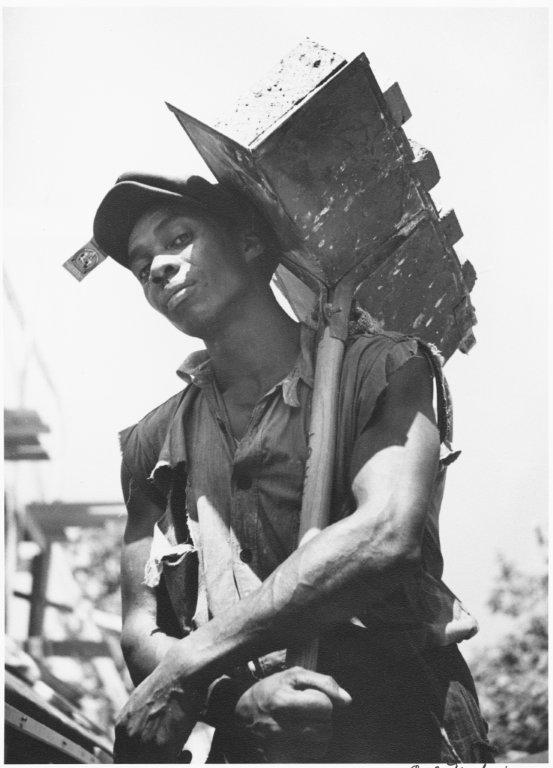
From the 1847 African American Census it appears that George and John were living at the same address and that both worked as hod carriers (brick carrier).
*Philadelphia Inquirer, September 11, 1847.
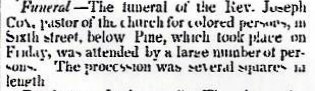
The Reverend Joseph Cox, 65 years of age, died of an intestinal problem on this date, September 5th, in 1843 and was buried at Bethel Burying Ground. He was pastor of Bethel Church from 1834-1840. Originally a tanner, he became a preacher and then an elder of Bethel AME Church in the 1820s. Bishop Cox was the brother of preacher Rebecca Cox Jackson. His funeral was on September 8th at his late residence on Gaskill Street, a few doors below Fifth. His funeral procession to Bethel Burying Ground was several blocks in length according to The Public Ledger (9 Sept 1843). In all likelihood he was buried next to the body of his son John who died of Tuberculosis at the age of nine in 1832 and was buried at Bethel Burying Ground.
For much more information on Rev. Cox and Rebecca Cox Jackson please see – Gifts of Power: The Writings of Rebecca Jackson, Black Visionary, Shaker by Rebecca Jackson. It is available at Google Books.
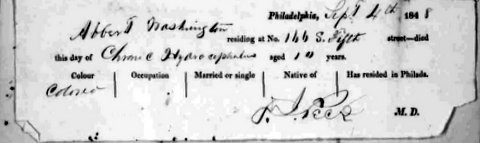
Ten-year-old Albert Washington died this date, September 4th, in 1848 of Chronic Hydrocephalus and was buried at Bethel Burying Ground. He was the son of George Washington, a boot black, who lived at 166 S. 5th Street and worked at 75 Chestnut Street (Front and Chestnut Streets). Albert’s mother name is unknown at this time, however, the 1847 African American Census reports that she was employed as a shopkeeper earning about $80 a year. George is reportedly earning about $17 a month. The rent for their room is $92 for the year. Both parents attended religious services.
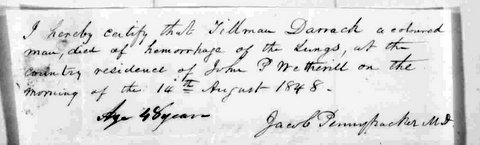
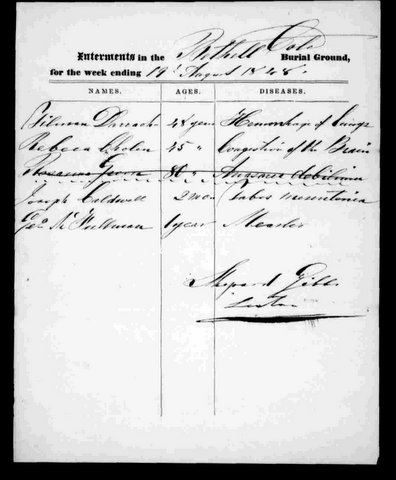
Tilman* Darrach, 48 years old, died this date, August 14th, in 1848 due to “Hemorrhage of the Lungs” and was buried at Bethel Burying Ground. I could find no other information on Mr. Darrach. Interestingly, he died at the country home of wealthy Quaker industrialist John P. Wetherill near Phoenixville in Delaware County, Pennsylvania. The Wetherill home in the city was on 13th Street between Cherry and Arch Streets. It may be that Mr. Darrach was employed by the Wetherills and suffering from a terminal illness was allowed to spend his last days outside the polluted city. Hopefully, further research will uncover more details.
*I have chosen to go with the spelling of the first name as it appears on the Cemetery Return written by the Bethel Church sexton. See below –
** Free Quakers