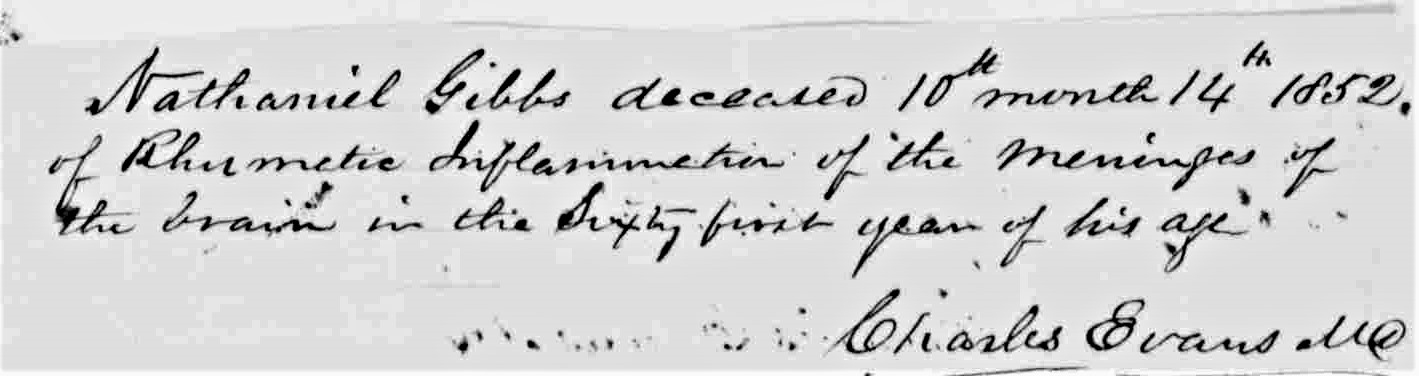
Sixty-one-year-old Nathaniel Gibbs died this date, October 14th, in 1852, of a “Rheumatic Inflammation of the Meninges of the Brain,” in short, Rhematic Fever. Acute RF is a disease that, in addition to the brain, can severely affect the heart, joints, and skin. Without antibiotics, RF is most deadly in the young and the elderly.
The 1847 Philadelphia African American Census shows Mr. Gibbs and his spouse, who I believe was Ann Gibbs, were both born of enslaved mothers in Maryland. Only one gained his or her freedom, presumably by being bought by the other for $250. That sum would be approximately $7,000 in modern currency.
The family suffered a devastating monetary loss when Dyott Bank collapsed. The Gibbs lost $500 which equates to approximately $16,700 in modern currency. The 1847 Census reported five Black families losing life savings with the same Bank.
Mr. Gibbs was employed as a waiter earning $12 a month, $400 in modern currency, according to the Census, while Ms. Gibbs was self-employed as a washer woman earning approximately $1 a week. The family was paying $9 in rent for their room on Lombard Street.
There was an unidentified teenage female living with the Gibbs. The census taker in 1847 commented that the Gibbs were keeping the girl “from the streets.” She did not attend school and likely assisted Ms. Gibbs with her works. All three attended church services, according to the Census. The girl was born in Pennsylvania.
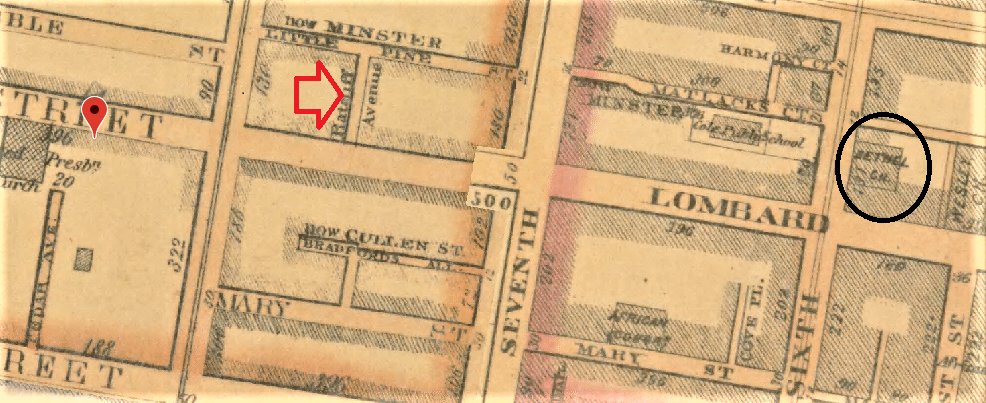
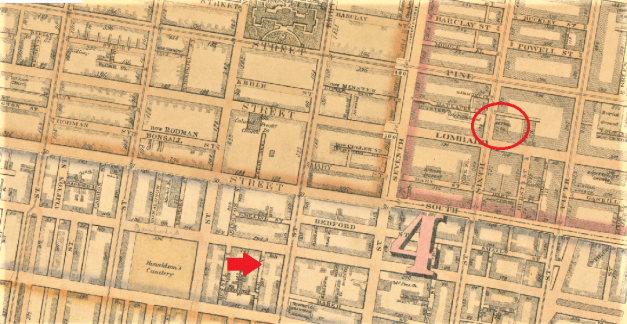
The red pin illustrates where the Gibbs’ family lived at 235-238 Lombard Street. The black circle indicates the location and proximity of Bethel A.M.E. Church. The red arrow indicates the location of Turner’s Alley (later Ratcliff St.).
Tragically, on July 7th in 1849 Ms. Gibbs died of Cholera and was buried at Bethel Burying Ground. Both Mr. and Ms. Gibbs belonged to beneficial societies that likely assisted with their burial costs. The 1850 U.S. Census shows Mr. Gibbs moved to a tenement in Turner’s Court, near his old address. He was still employed as a waiter. (See above map)
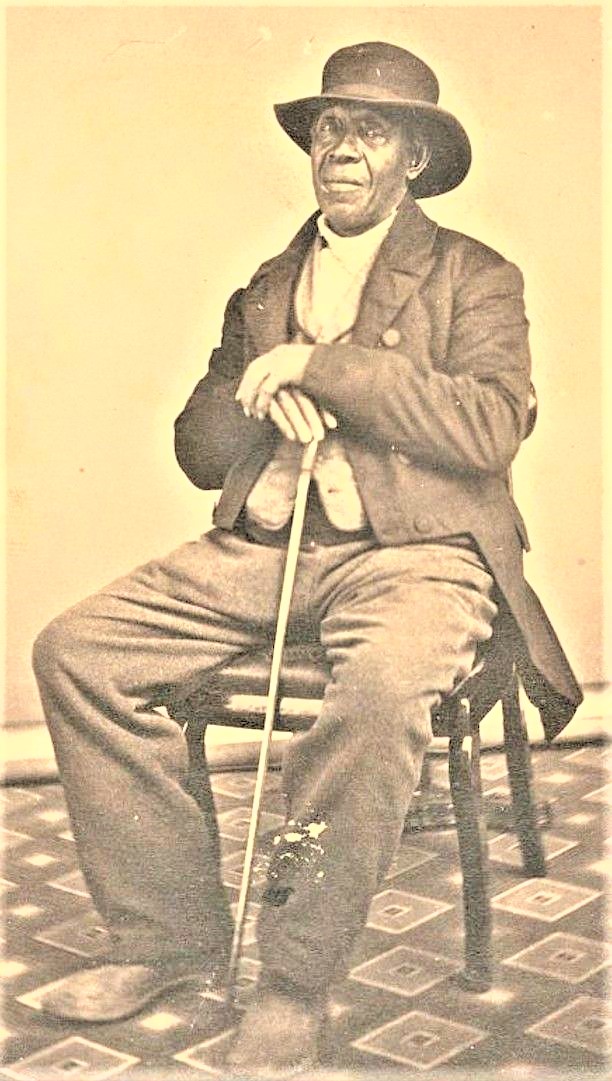
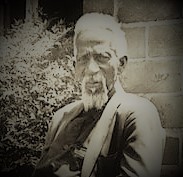
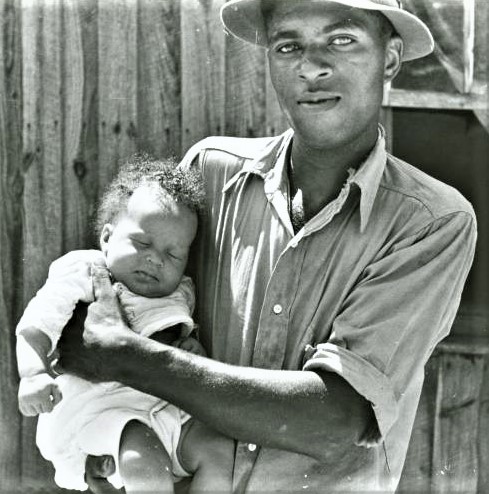
Undated photo of 19th Century African American man (Library of Congress)
Mr. Gibbs died on a fair weather day in mid-October and was buried by friends at Bethel Burying Ground.
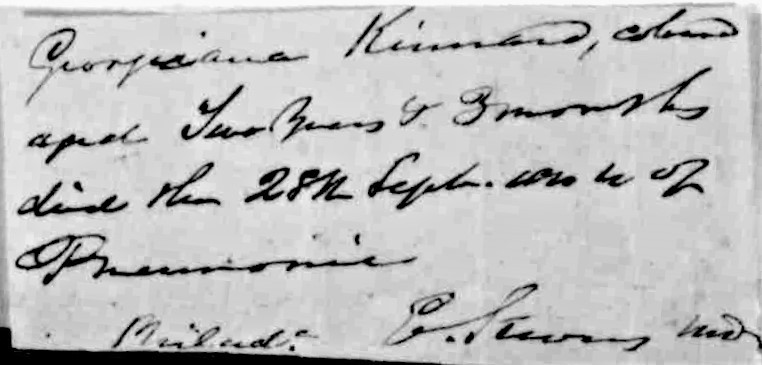
Two-year-old Georgiana Kinnard died this date, September 28th, in 1844 of Pneumonia and was buried at Bethel Burying Ground. After surveying census records, I am convinced that Georgiana’s parents were Elizabeth and Cyrus Kinnard. Ms. Kinnard was thirty-years-old at the time of her daughter’s death and he was thirty-four-years old. Mr. Kinnard was born in Maryland while Ms. Kinnard was born in Delaware. They had two other children: Matilda, who was six-years-old, and Rebecca, who was a year old. It appears that Ms. Kinnard was pregnant with her son Cyrus, Jr. (1)
THE RUNAWAY
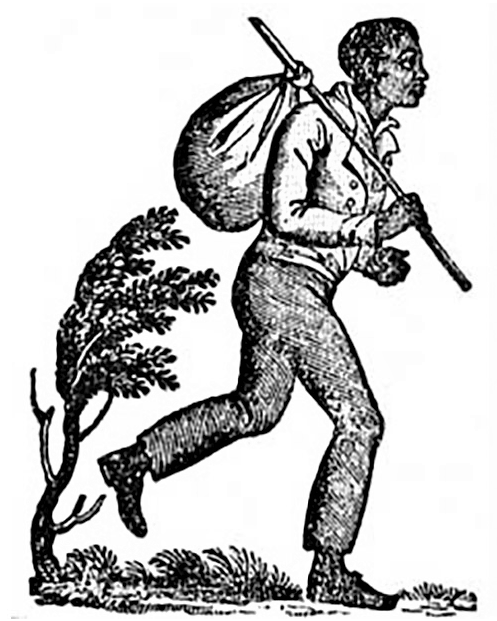
In the 1847 Philadelphia African American Census, Mr. Kinnard reported that he was born to an enslaved mother. He also stated that he was not manumitted nor did he buy his freedom, which leaves the probability that Mr. Kinnard was a succesful passenger on the Underground Railroad! He was employed as a waiter and, in 1847, reported his earnings as only $15 a month. Ms. Kinnard was self-employed as a washerwoman which she did while pregnant and caring for children at home.
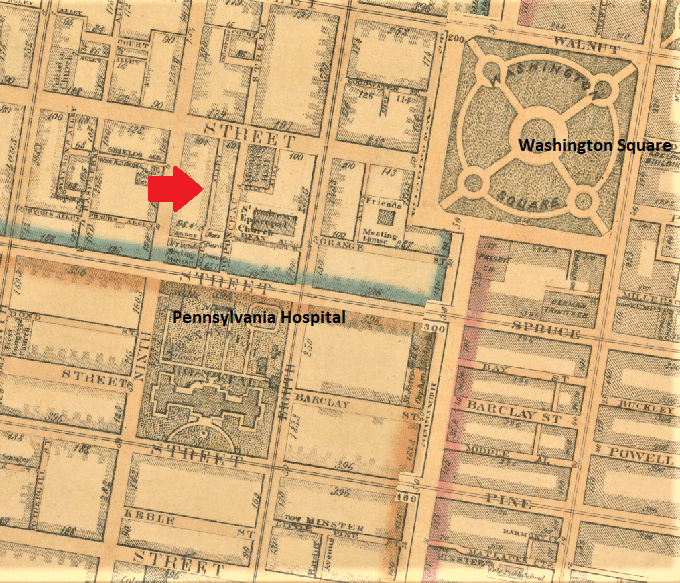
The red arrow indicates the location of the Kinnard home at #18 Acorn Alley, located near the Pennsylvania Hospital and Washington Square.
Two-year-old Georgiana lived with her parents and siblings in one room at #18 Acorn Alley for which they paid $1.50 a month, which is a clear sign of poverty along with Mr. Kinnard’s low income. The modern currency equivalent for $1.50 is approximately $50.00. The Census reports the family had $75 in personal property or $2,500 in modern currency. This would include furniture, tools, and clothes.
Georgiana was one of 211 children who died from Pneumonia between 1846 and 1847, according to the Philadelphia Board of Health records. The treatment for her illness was bloodletting. She would have been cut by the doctor and several spoonfuls of blood would have been taken from her little arms on a regular basis. The more conservative physician might just apply leeches to draw the blood out. Bloodletting is the withdrawal of blood based on an ancient system of medicine in which fluids were regarded as “humours” that had to remain in proper balance to maintain health.
The child’s parents may have gone to Powel’s Apothecary at the corner to buy a liquid “elixir” that usually contained opiates and alcohol that did not help cure the condition. The family also may have contacted an African American herbalist to use traditional medical methods. There were ten Black herbalists in the community, according to the 1847 Census.
Georgiana died on a Saturday in late September that saw a storm of heavy rain and damaging wind. She was buried, with dignity, at Bethel Burying Ground.
(1) By the 1850 Federal Census the Kinnards also had James H. (4 y/o), Mary L. (2 y/o), and July A. (4 months old). All the children were born in Philadelphia.
Mary Ann Robinson died this date, September 22nd, in 1842 of Tuberculosis (Phthisis) and was buried at Bethel Burying Ground. Ms. Robinson was a widow without known living family members, so Dr. Van Dyke was not sure of her age which was approximately thirty-years-old.
According to the 1838 Philadelphia African American Census, Ms. Robinson was widowed at least four years before her death. If her husband was buried at Bethel Burying Ground, there is no surviving record of that event. She was self-employed as a washerwoman, living in a 10′ x 10′ room in Freytag’s Alley. The alley was located near the corner of 5th and Bainbridge Streets in the Southwark section of the county. Ms. Robinson paid $3 a month in rent which equates to approximately $100 in modern currency. The 1838 Census also reports that she had $175 in “personal property” which equates to approximately $5,850. This may have included cash saved in her benefical society account at her church, Bethel A.M.E. It likely helped cover the cost of her funeral and burial.
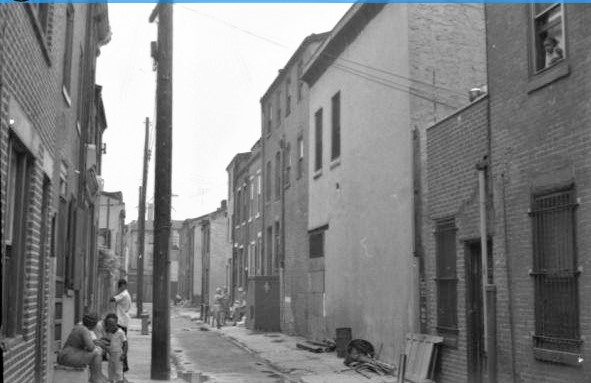
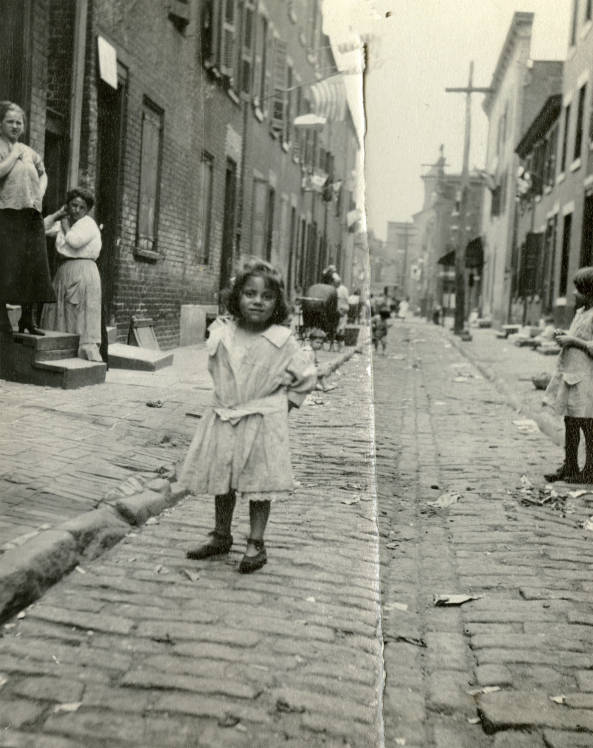
Reese Street (formerly Fraytag’s Alley) 1964 (City of Philadelphia Archives)
Ms. Robinson would have gone to Mr. Charles Rizer’s Apothecary on the southwest corner of 5th and Shippen Streets for any medicine to ease her pain. For peppermint candy or lozenges for her throat, all she needed to do was go across the street to Brooks Candy Store on the southeast corner of the intersection. It appears to have been a very popular establishment!
Current view of Reese Street (formerly Freytag’s Alley)
According to Philadelphia Board of Health records between 1841-1842, Ms. Robinson was one of the one thousand five hundred eighty-three Philadelphians to die of Tuberculosis. Ms. Robinson died on a day in September where the dawn arrived with the city coated in a “heavy frost” and the temperature remained in the teens all day. She was buried by friends, with dignity, at Bethel Burying Ground.
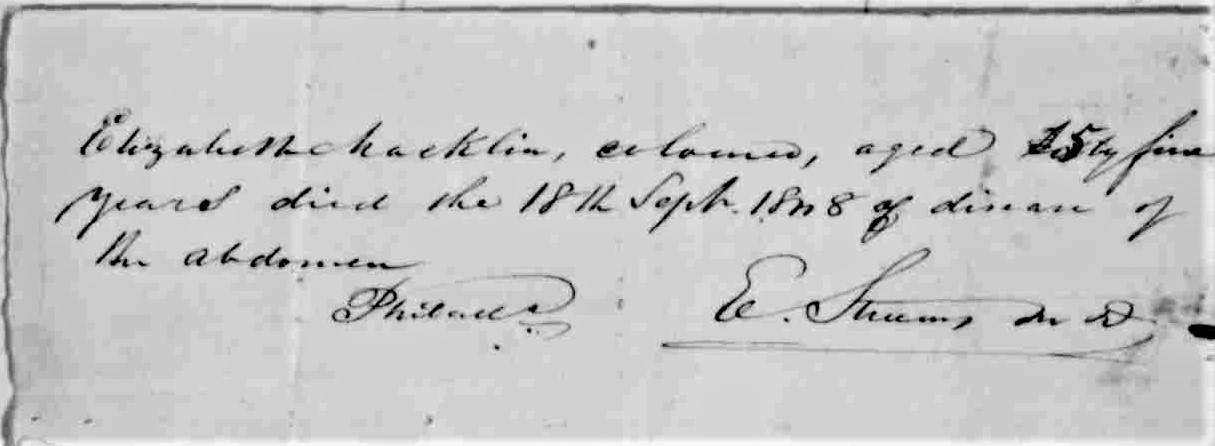
Fifty-five-year-old Elizabeth Macklin died this date, September 18th, in 1848 of an abdominal disease and was buried at Bethel Burying Ground. Ms. Macklin was married to Moses Macklin who would die two months later in November at sixty-one-years-old of a viral disease, likely pneumonia or influenza. Elizabeth and Moses were interred together at Bethel Burying Ground.
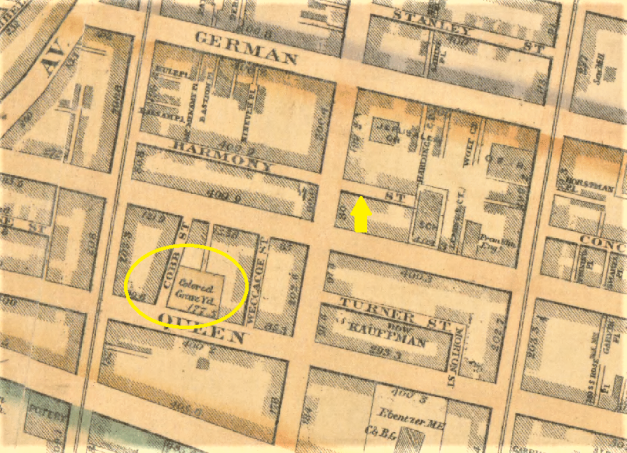
The yellow arrow illustrates the location of the Macklins’ home in the 300 block of Harmony Street. The Bethel Burying Ground is nearby, as illustrated by the yellow circle. The Macklin family owned their home, according to the 1847 Census. The value of the home in modern currency is approximately $22,250.
“By 1847, the majority of black Philadelphia women were washerwoman and domestic servants, numbering 2,085 of a total population of 4,249.” (2)
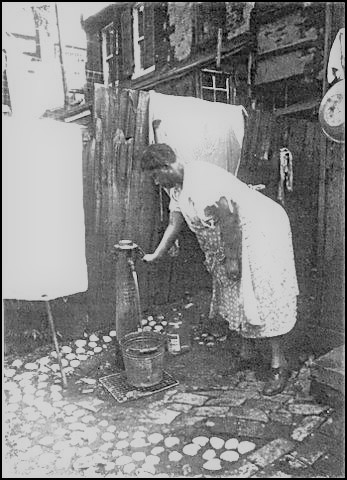
Elizabeth Macklin was a self-employed washerwoman. It was backbreaking work that had to be done in the sub-freezing winter and the heat and humidity of a Philadelphia summer day. She also would be expected to labor when pregnant, take care of children, shop for groceries, and cook. Ms. Macklin’s work week may have looked like the following:
Monday: Deliver clean laundry to clients from the previous week. Gather dirty laundry from clients, look for new clients, and shop for work supplies.
Tuesday and Wednesday: Gather buckets of water from the spigot or hydrant outside and carry them upstairs, making multiple trips, gather firewood to boil water while soaking, washing and wringing out clothes and bed sheets. She would have to carry the heavy wet items outside to hang on clotheslines. On freezing and rainy days, she would have to hang them inside.
Thursday and Friday: Iron for hours until completed. Deliver clean laundry. Repeat Tuesday and Wednesday.
Saturday: Iron all day “finishing late at night or early the next morning” (3)
Depending on how many clients she had, and if there were any helpers, Ms. Macklin would make anywhere from $0.50 to $2.00 for her week of labor.
Ms. Macklin died on a clear day in September where the temperature rose to sixty-eight degrees in the afternoon. She was buried, with dignity, at Bethel Burying Ground by her adult children and with financial assistance from a beneficial society at Bethel A.M.E. Church, according to census records.
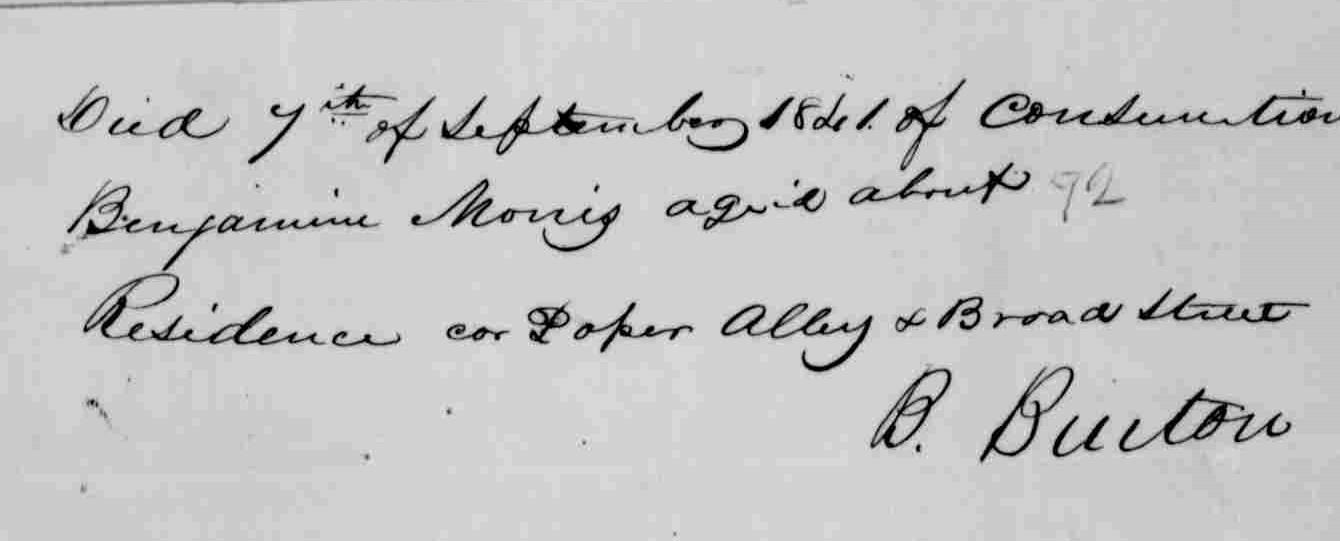
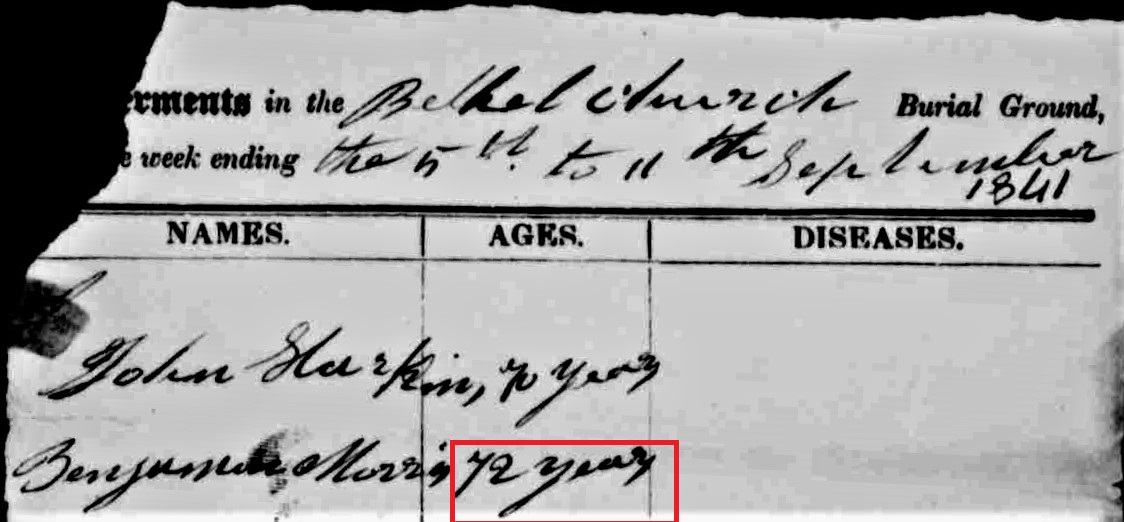
Seventy-two-year-old Benjamin Morris died this date, September 7th, in 1841 of Tuberculosis (Consumption) and was buried at Bethel Burying Ground. The document above shows Mr. Morris’s age as nintey-two which is incorrect. The below document filled out by the manager of the cemetery shows his correct age as seventy-two. This is also backed up by census records.
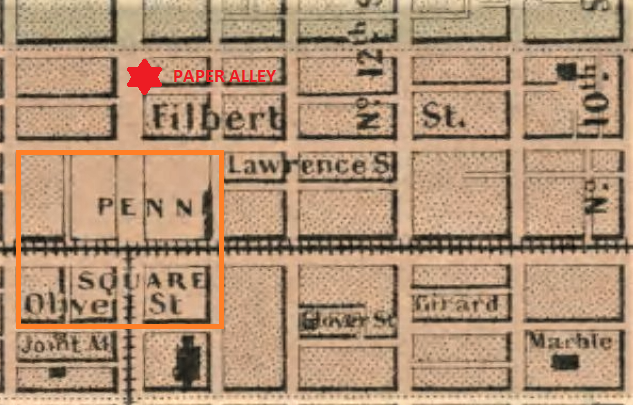
Mr. Morris was employed as a blacksmith and may have worked at McGavett’s Foundry which was next to his home at the corner of Broad Street and Paper Alley in center city Philadelphia. Mr. Morris owned his home, according to the 1838 Philadelphia African American Census. It was a small house with only three rooms and valued at $1,100 in 1838. That would be approximately $34,500 in modern currency. Mr. Morris had $125 in personal property or approximately $4,000 in modern currency.
The red star indicates the location of Mr. Morris’ home at the corner of Broad Street and Paper Alley. The orange square is the location of Penn Square, now the location of Philadelphia City Hall in center city.
Mr. Morris was born to an enslaved mother in approximately 1769. It is not known what colony they lived in at the time. It could have been Pennsylvania. It is recorded in the 1838 Census that he gained his freedom by manumission when $250 was paid to his enslaver. Given the small amount, he may have been a child when this occurred.
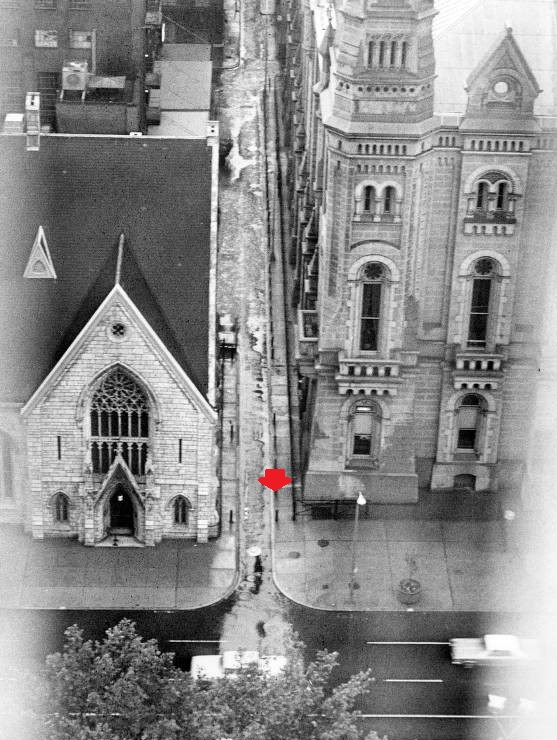
This is a 1961 photo from the Temple University Collection that shows Cuthbert Street, formerly Paper Alley. The red arrow indicates the former location of Mr. Morris’ home. On the right is the Philadelphia Masonic Temple and opposite that is the Arch Street Methodist Church.
Mr. Morris died on a early September day that saw a violent hail storm sweep the city damaging homes, trees, and gardens. He was buried, with dignity, at Bethel Burying Ground.
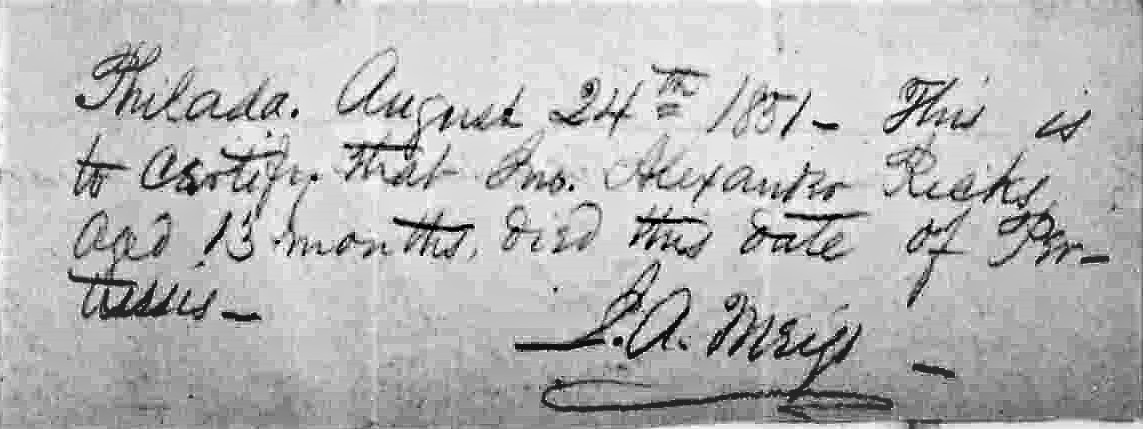
One-year-old John Alexander Ricks died this day, August 24th, in 1851 of Pertussis and was buried at Bethel Burying Ground. The disease, which is also called Whooping Cough, is a highly contagious bacterial disease. Children with this disease develop a “100-day cough” that racks their bodies with pain and can lead to broken ribs, pneumonia, seizures, inflammation of the brain, and death. Today, children receive vaccines that successfully prevent the disease.
Alexander Ricks’ parents were Sarah and Charles Ricks. Ms. Ricks was twenty-nine-years-old at the time of her son’s death. Mr. Ricks was thirty-five-years-old and he had been born in Maryland. She was born in Delaware, according to the 1850 U.S. Census. They had two other children: William was seven-years-old and Charles was five-years-old. Both were born in Pennsylvania.
Mr. Ricks was formerly enslaved in Maryland. He reported to the census taker of the 1847 Philadelphia African Census that he was neither manumitted nor had he paid for his freedom. It appears he was a passenger on the Underground Railroad.
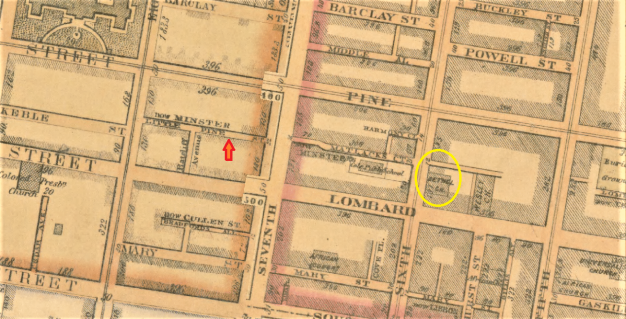
The Ricks’ family lived at #8 Little Pine Street, as illustrated by the red arrow. They lived only a block away from Bethel A.M.E. Church, as indicated by the yellow circle.
The family lived in one room at #8 Little Pine Street for which they paid $11 a month. That amount is several dollars above average. Mr. Ricks was employed as a coachman and may have owned his own horse and cab. The high rent may have included rent of a stable in the rear of the property. The 1847 Census also reports the family owned $150 in personal property, which may have included the horse and cab. In modern currency that amount equates to approximately $5,000. On a busy week, Mr. Ricks would have earned between $5-$8. Ms. Ricks labored as a laundress and may have earned $1 a week if business was good.
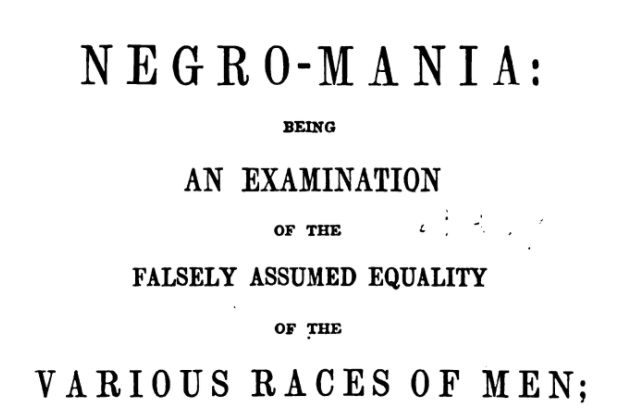
According to the 1847 Census, either Mr. or Ms. Ricks could read and write. But even without that skill, they would have been aware of the most popular book in 1851 Philadelphia. “Negro-Mania” by John Campbell stated that it was God’s will that the Black man was subservient to the white man. The book contained many supporting statements from white businessmen, politicians, jurists, and clergy. They readily led their names to the book’s thesis that the “Colored Race” would never be the “mental, political, or social equal of the white man” And all of the “sickly sentimentalism” and “maudling philosophy” of the abolitionists would not change what God decreed. The African race was created to service the white race.
Frederick Douglass’s comment on race relations in Philadelphia two years before the book was published – “No (Black) man is safe – his life – his property – and all that he holds dear, are in the hands of the mob, which may come upon him at any moment – at midnight or mid-day and deprive him of his all.” (1) These were the streets that the Ricks family had to walk everyday to go to work, market or church.
Between 1850 and 1851, two-hundred thirty-five Philadelphia children died of Whooping Cough. One-year-old John Alexander died on a hot and humid day in late August where the temperature rose to 85 degrees. He was buried, with dignity, by his parents at Bethel Burying Ground.
Eight-year-old Mary Jane Ridgeway died this date, August 20th, in 1851 of “typhoid fever with perforation of the intestines” and was buried at Bethel Burying Ground. Typhoid on its own may not have led to her death, however, perforation and subsequent abdominal bleeding cause a deadly bloodstream infection (sepsis). Mary Jane would have suffered terribly from nausea, vomiting blood, and severe abdominal pain.
Her parents could only watch and provide very little relief. They were Margaret and Peter Ridgeway. Ms. Ridgeway was 30 years old at the time of their daughter’s death as was Mr. Ridgeway. He was born in Delaware and she in Pennsylvania. They had two other children: Elizabeth, 10 years old, and John, who was six years old. Both children were born in Pennsylvania, according to the 1850 U.S. Census.
Mr. Ridgeway was employed as a “seaman,” according to the 1850 Census. It is unknown if he was a “blue water” sailor, also known as a deep-water sailor, which would mean long stretches away from home. Or he may have been employed on the Delaware River on the coastal ferries to New Jersey and Delaware, which would give him more time at home. Either one was seasonal and would mean unemployment during the winter months. There was no occupation reported for Ms. Ridgeway.
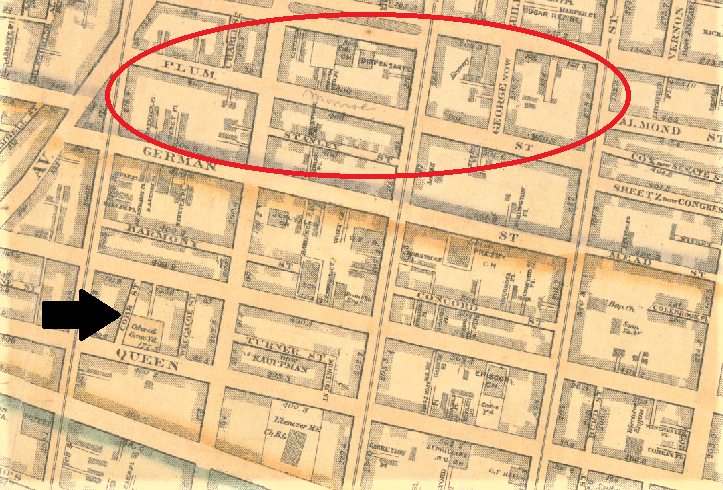
The red circle illustrates the location of Plum Street where the Ridgeway family lived. The black arrow indicates the location and proximity of the Bethel Burying Ground.
Plum Street was described by a journalist of the era as a “small dark alley”and “long known as the most concentrated street of white prostitution in the city” and “a center of low-life in the city.” (1) The center of this mayhem was Dandy Hall. In a large three-story house at the eastern end of Plum Street, there was a saloon, a dance hall, and a brothel in one structure. On any given night, the drunken chaos from the building spilled out onto the street and created an extremely violent environment. That was never truer when on Christmas Eve in 1846 Dandy Hall came under attack by the “Home Squadron,” a group of hardcore murderers from the Killers gang. Blood ran in the street as throats were slashed and skulls crushed as constables tried to stop the destruction.(1)
It appears that the owner of Dandy Hall was not paying protection money and/or not buying his liquor from the bosses of the Killers which was the Moyamensing volunteer fire company. There was a number of failed arson attempts on the building in the following years. The Moyamensing gang succeeded in burning it to the ground in May of 1849.(3)
Such was life on Plum Street for the Ridgeway family.
Between 1850 and 1851 eighty-three children are reported to have died of Typhoid Fever, according to Philadelphia Board of Health records. Eight-year-old Mary Jane Ridgeway died on a late August day where the temperature rose to only 65 degrees. She was buried, with dignity, by her parents at Bethel Burying Ground.
(1) Maria Carlisle, “Disorderly City, Disorderly Women: Prostitution in Ante-Bellum Philadelphia,” Philadelphia Magazine of History and Biography, Vol. 110, No.4 (Oct., 1986), pp. 549-568. Sun (newspaper), 29 Dec 1846, p. 3.
The unnamed seven-month-old son of Mary and Richard Hubert died this date, August 4th, in 1851 of Cholera and was buried at Bethel Burying Ground. Ms. Hubert was thirty-four-years-old at the time of her son’s death while Mr. Hubert was thirty-six-years-old. Both were born in Delaware, according to the 1850 United States Census. The family also included nine-year-old Maria and two-year-old Stephan. Both were born in Pennsylvania.
Mr. Hubert worked as a laborer earning $4-$5 a week. Ms. Hubert was a house cleaner, according to the 1847 Philadelphia African American Census. However, the census taker noted that Ms. Huber was “weakly” and “not able to work regularly.” The family lived at #15 Lisle Street in the Moyamensing District. The narrow thoroughfare was home to more than two dozen Black families. The men and women were employed as waiters, porters, seamstresses, carpenters, laundresses, sailmakers, and tailoresses (female tailors). The Black children in the neighborhood attended the St. Mary’s Street School or the Lombard Street School. The Huberts paid $8-$10 a month in rent.
The red arrow indicates the location of the Huberts’ home on Lisle Street which ran from Fitzwater to Bainbridge Street west of 8th Street. The red circle illustrates the location and proximity of Bethel A.M.E. Church at 6th and Lombard Streets.
The early 1850s in Philadelphia was a fearful time for white people. Every week it seems there was an insurrection by enslaved Black men and women in the slave states such as Alabama and Virginia. There also was a bloody insurrection in Cuba. Hundreds of Blacks were attacking plantations and murdering their enslavers. The southerners blamed the abolitionists for filling the minds of the Blacks with ideas such as equality and liberty. The most famous African American abolitionist was Frederick Douglass. He had visited Philadelphia many times and made numerous friends. But in July of 1852, a month before the Hubert baby died, he decided it was too dangerous to come to Philadelphia. Douglass wrote a friend that he was about to travel from his home in Rochester, New York to Cincinnati, Ohio. He had made this trip before and normally he would stop in Philadelphia. He wrote his friend that he felt sure that this time he would be attacked on the street by white mobs. Douglass also shared with his friend that the potential violence in the city was at a fever pitch, fueled by the “American Demon” – racism. (1)
The above is a 1920 photo of Mildred Street (formerly Lisle). Temple University Digital Collection.
The baby son of Mary and John Hubert died on a day in early August where the temperature only rose to 74 degrees with light showers falling in the afternoon. He was buried, with dignity, at Bethel Burying Ground.
(1) Philip S. Foner, “The Battle To End Discrimination Against Negroes On Philadelphia Streetcars,” Pennsylvania History, vol. 40, no. 3, July 1973, p.266.
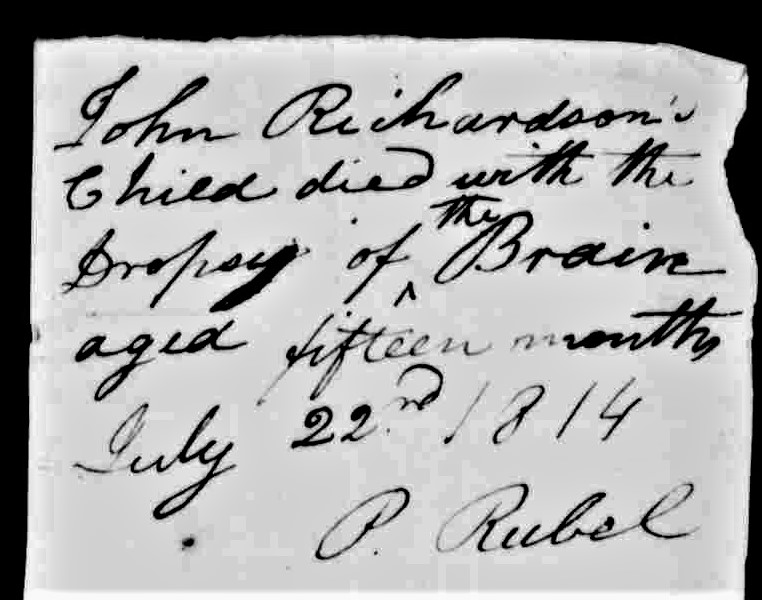
On July 22nd in 1814, John Richardson lost a fifteen-month-old child, gender and name unknown. He or she died from swelling of the brain caused by an unknown disease. Conditions such as kidney disease, heart disease, and Meningitis were common causes for the brain to swell in size. Philadelphia Board of Health Records reveal that the Richardson child was one of seventy-seven children to die with that diagnosis between 1813 and 1814.
According to the 1814 Philadelphia City Directory, Mr. Richardson was employed as a “woodsawyer.” He likely worked in one of the city lumberyards, such as Buntings & Watson’s lumber yard that was located only several blocks away from his home at Shippen Street near 7th in the Moyamensing District of the County. (1)
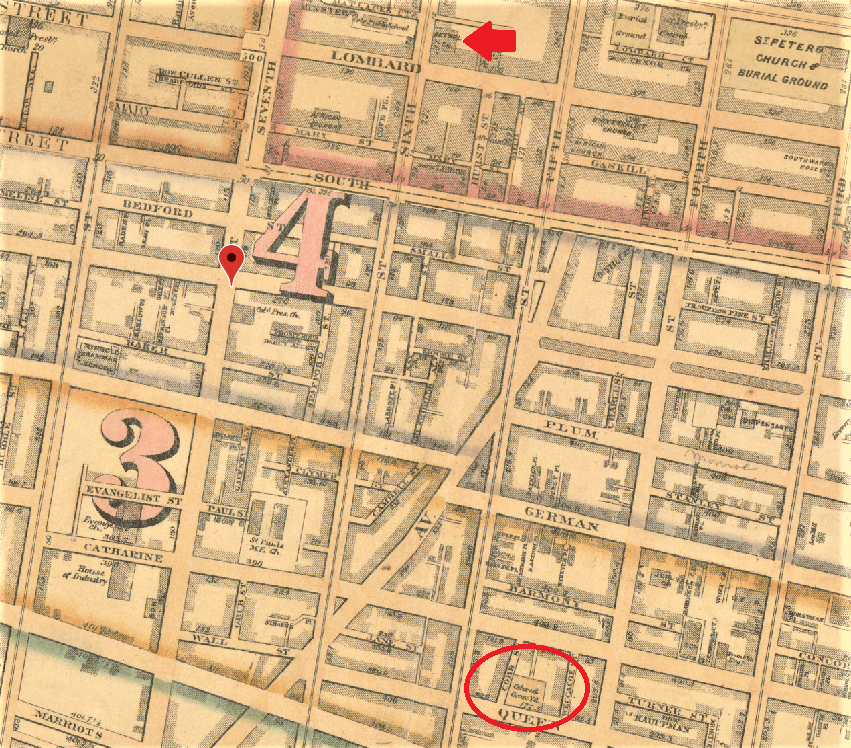
The red pin indicates the location of the Richardson home on Shippen Street (now Bainbridge) near south 7th Street. The red arrow points to the location of Bethel A.M.E. Church and the red circle illustrates the location and proximity of the Bethel Burying Ground. No street maps exist of the Moyamensing District in 1814. This is a much later map.
Given the early (1814) date of the child’s death, the mother’s name is not known. History tells us that she was likely self-employed as a laundress or seamstress. Geographically, they lived on the fringe of the county’s population. Only several years earlier, the neighborhood was a pasture.
In 1813, African Americans in Philadelphia were put on official notice that the white citizens and their political representatives wanted apartheid to be the law of the land. At the urging of the mayor and other Philadelphia politicians, the state senate took up bills that if passed would have made it legal to force all free Black men and women to be registered and carry documents on their person to prove it. It also was proposed that no more Blacks be allowed to enter the city and that the existing residents be taxed to pay for the cost of caring for indigent Blacks. The white officials estimated that there were over 4,000 fugitives from southern slave states.(2)
The Quakers no longer had any political influence in Philadelphia. The political group that succeeded them wanted the city turned into a slave state that would control every aspect of African American lives.
From the little we know about John Richardson, he lived the life of most Black men in early 19th Century Philadelphia. He was a husband, father, laborer, and likely a Christian who worshipped at Rev. Richard Allen’s Bethel African Methodist Episcopal Church at 6th and Lombard Streets. This made him a very likely candidate for a member of the “Black Warriors.”
Amid all of that was happening with the proposed racist legislation, the War of 1812 with the British was in full fury. The English fleet was sailing north up the eastern seaboard taking coastal cities one after the other. It appeared that Philadelphia was next. In late August of 1814, the U.S. Army Engineers urgently needed to build a fortification up on the west bank of the Schuylkill River in an area known as Grays Ferry. From there, the cannons of the army would have a clear shot at the large ships of the British navy as they sailed up the river.
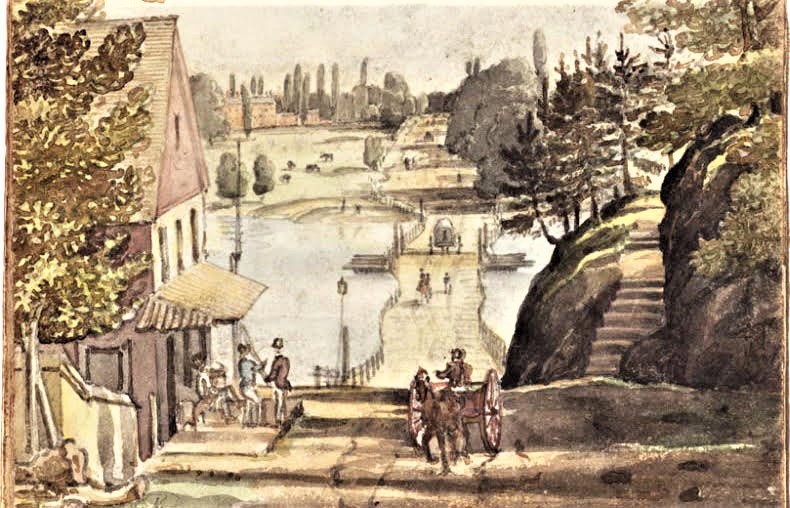
This is an illustration of the west bank of the Schuylkill River at Grays Ferry. From this vantage point, the American cannons could fire down at the British ships. The city appears in the far background.
The Army started using white men as laborers, but that became a problem when it became apparent the majority were not fit enough to handle the heat and humidity. Military officers approached Reverends Richard Allen and Absalom Jones to rally the Black community to help with the construction project. Over a thousand Black men answered the call and gathered at the State House Yard, now known as Independence Mall. From there, they marched to Grays Ferry and worked without stopping for two days straight until the job was accomplished. African American historian Martin R. Delany called these men the “Black Warriors” of Philadelphia. Was Mr. John Richardson one of the “Warriors?” Very likely.
The Richardson baby succumbed to his or her illness in late July and was buried with dignity at Bethel Burying Ground.
(1) I have been able to track Mr. Richardson through city directories up to 1822. The family moved to German Street sometime between 1817 and 1818. German Street is now Fitzgerald Street.
(2) Edward R. Turner, The Negroe in Pennsylvania (1911), p. 229-230.
(3) Martin R. Delany, The Condition, Elevation, Emigration and Destiny of the Colored People of the United States, p. 75.
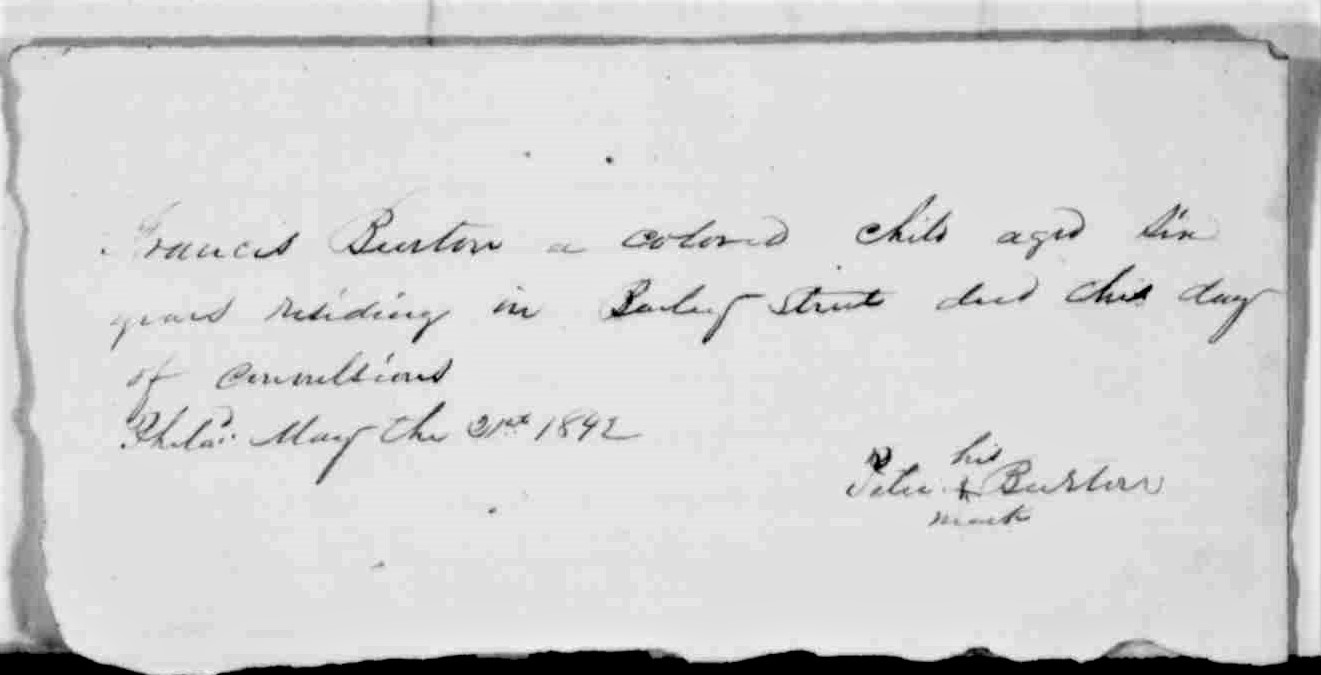
Six-year-old Francis Burton died this date, May 21st, in 1842 of “convulsions.” According to 1842 Philadelphia Board of Health records, Scarlet Fever was killing hundreds of the city’s children and may have been the cause of the child’s death. Francis had three siblings at the time of his death. They included Mary who was eight-years-old, Charles who was four-years-old and Peter, Jr. who was the youngest at two-years-old. The younger children attended the 6th and Lombard School, while the older children were enrolled at Miss Amelia Bogle’s private school, according to the 1847 Philadelphia African American Census.
The parents of this brood were Mary Burton, thirty-two-years-old, who was a self-employed laundress, and Peter Burton, forty-two-years-old, who was employed as a porter. He was born in Delaware and Ms. Burton was born in New Jersey. All of Francis’s siblings were born in Pennsylvania, according to the 1850 U.S. Census.
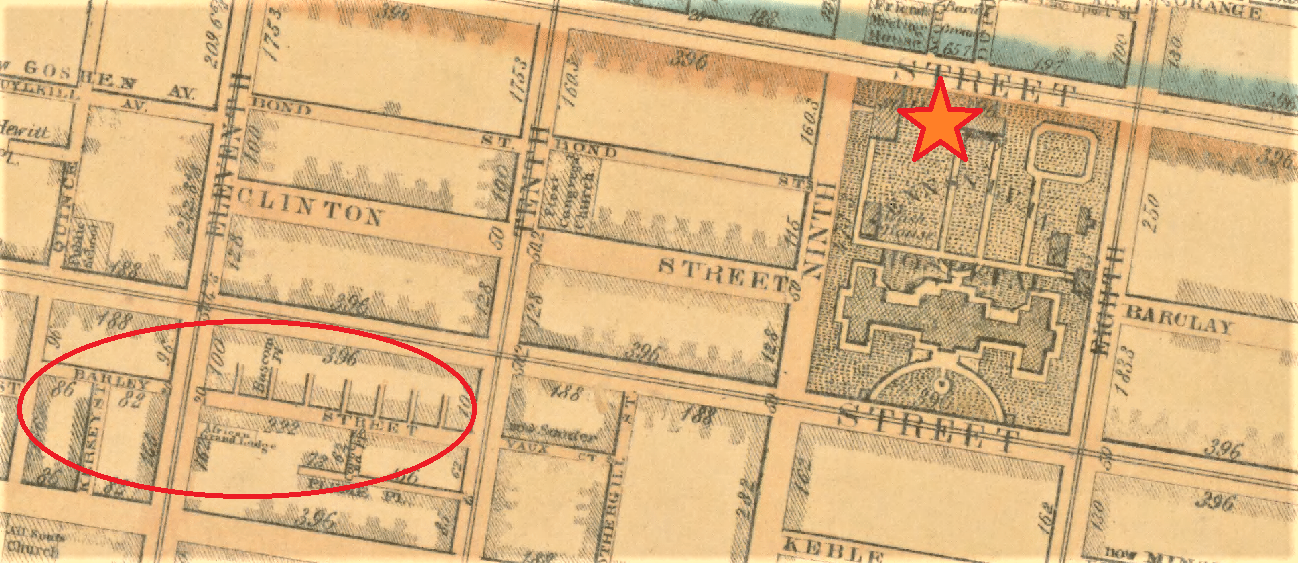
The Burtons lived at #18 Barley Street which is circled on the map above. The red star illustrates Pennsylvania Hospital and its proximity to Barley Street.
The Burtons owned their home on Barley Street. It was between 10th and 11th Streets, just south of Pine Street. According to the 1847 Census, the Burtons were close to paying off their mortgage. Barley Street was a narrow two block long thoroughfare that in 1846 was home to fifty-eight Black families with an amazing total of two hundred twenty-four men, women, and children. They were packed into three-and four-story tenements where they shared outhouses and one or two water pumps. The women worked as laundresses, seamstresses, and cooks. The majority of the men worked as waiters, barbers and porters.
On the morning of August 1, 1842, only a few months after young Francis’s death, a memorial parade was held by over 1,000 members of the Black Young Men’s Vigliant Association on Philadelphia’s Lombard Street between Fifth and Eighth streets in commemoration of the eighth anniversary of the end of slavery in the British West Indies. As the marchers approached Bethel A.M.E. Church at 6th and Lombard Streets, they were attacked by thousands of racist Irish-American thugs. A three-day rolling riot by a white mob attacked African Americans and burned Black homes, churches, and meeting halls.
It appears the Burton family was not physically harmed by the mob. Their home was two or three blocks outside the area of destruction. The next time they may not have been so fortunate.
Six-year-old Francis Burton died on a pleasant day in May after a violent nor’eastern washed through the city the night before. He was buried, with dignity, by his parents at Bethel Burying Ground.










 Bethel Burying Ground Project