Bethel Burying Ground Project

Bethel Burying Ground Project

  • ABOUT THE BETHEL BURYING GROUND PROJECT

Twenty-five-year-old Henry Proctor died this date, October 26th, in 1847 and was buried at Bethel Burying Ground.

Posted by Terry Buckalew on October 26, 2020
Posted in: On This date. Tagged: a, African American burial grounds, African American cemeteries, African American History, African Methodist Episcopal Church, archaeology, Mother Bethel African Methodist Episcopal Church, Philadelphia, Richard Allen. 1 Comment

Twenty-five-year-old Henry Proctor died this date, October 26th, in 1847 of “Fever” and was buried at Bethel Burying Ground. It appears that Dr. John Mitchell took little time seeking out Mr. Proctor’s cause of death. In reviewing Philadelphia Board of Health records for 1847, it appears that the citizens were being plagued by a serious outbreak of Scarlet Fever. Mr. Proctor may have succumbed to this bacterial disease that is usually seen in children. He may have contracted it from a child in his family.

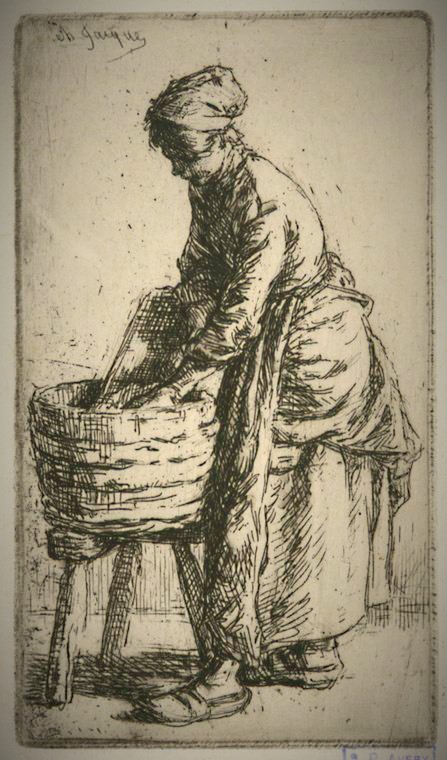
According to the 1847 Philadelphia African American Census, Mr. Proctor lived in Stevens’ Court with two children and four adult women. Three of the women served as “in-service” domestics and may have been staying at their employer’s home during the week. Mr. Proctor worked as a laborer earning $6 a week. The woman who stayed at home with the children was also employed as a laundress who also did ironing! For every dozen shirts finished, she would have made upwards of 10 cents. Everyone in the family was born in Pennsylvania.
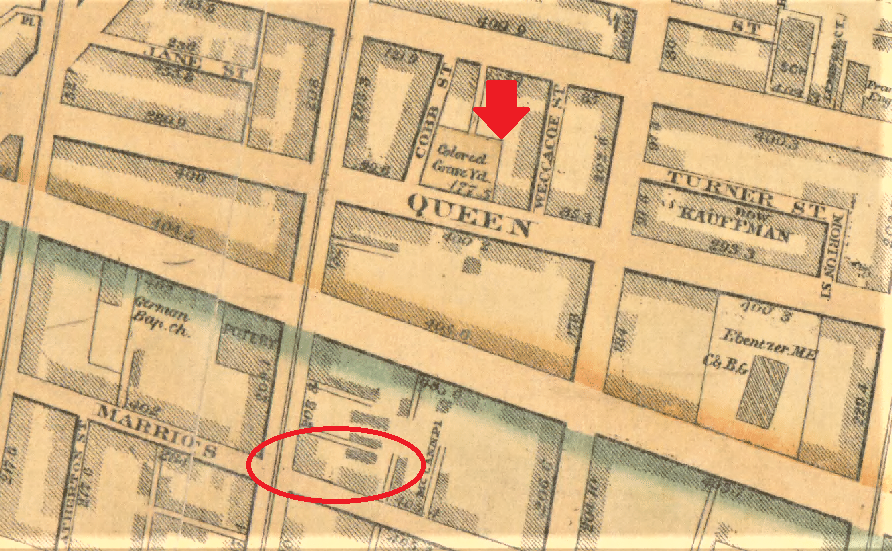
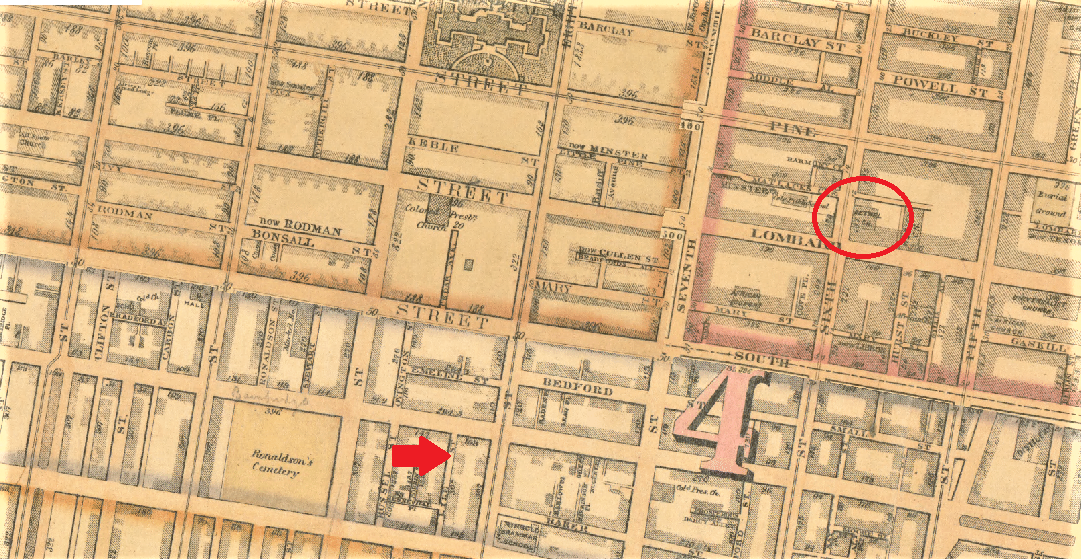
The red circle in the above map indicates the location of Stevens’ Court which was located in the rear of 917 South 5th Street in south Philadelphia. The red arrow illustrates the location of the Bethel Burying Ground and its proximity to the Proctors’ home.

The Proctor family likely lived in two rooms for which they paid $2.50 a month, according to the 1847 Census. At the time of Mr. Proctor’s death, Stevens’ Court was home to 16 Black families with a total of 86 members. All of the women in these families worked as laundresses while the men worked as laborers. There were two men who reported their occupation as “seaman.”
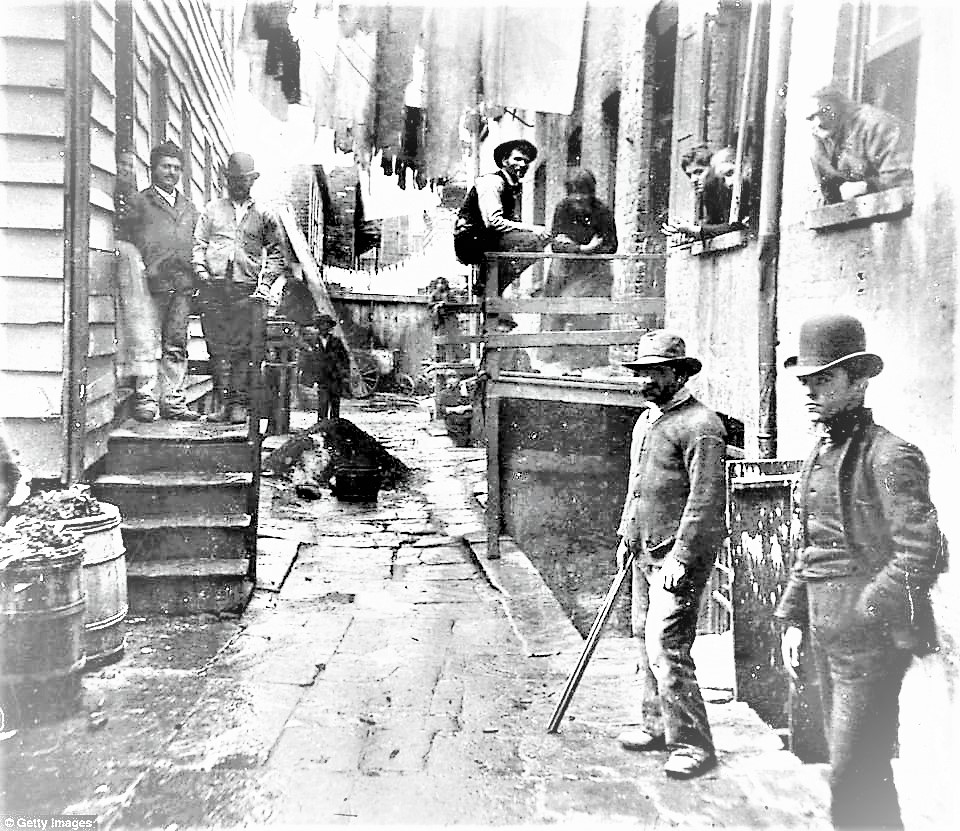
Nineteenth century street gang

Old Philadelphia was traditionally a mob town. Generations of white citizens daily roamed the city’s streets looking to beat down anyone of a different race, religion, or political party. The police force was small and afraid of the gangs. For many years, the policemen refused to wear their uniforms for fear of being identified and assaulted by gang members. The citizenry would not be surprised to hear that federal troops had to be used to quell a riot initiated by a white mob.

The residents of Stevens’ Court lived in a very dangerous neighborhood for African Americans. Blacks were denied access to public transportation which forced many to live near their place of employment. Some locations were worst then others. In this case, Stevens’ Court was only several blocks away from the home of the Moyamensing Hose Company (aka “The Rowdy Boys of Moyamensing”) and the “Killers” – their murderous enforcers. Their sole goal was to rid Philadelphia of Blacks and Protestants. To this end, no form of violence was ruled out. Guns, knives, clubs, cobblestones, and arson were all utilized. (1)
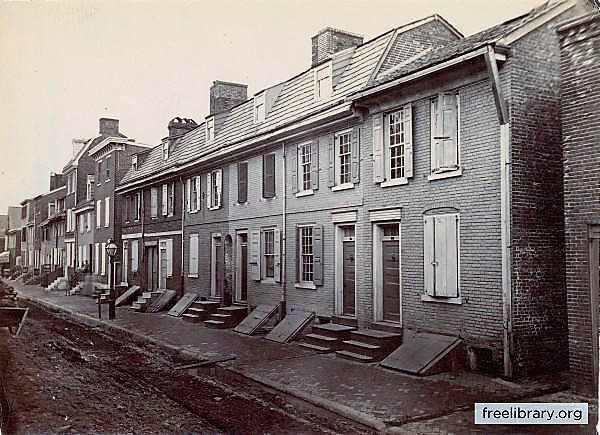
Wood frame rowhouses similar to those on “Red Row.”

Many in Stevens’ Court likely remember the destruction of “Red Row” and feared the same might happen to them. In July of 1835, a Black man stabbed a white man with whom he was fighting on South 2nd Street. Also a Black man working as a butler assaulted his employer. The white gangs in the city used these incidents to mount rampages through the African American neighborhoods. “Red Row” was a block long row of nine wood frame houses located on Christian Street between 8th and 9th Streets. All were occupied by Black families. The origin of the term “Red Row” isn’t clear. It has been used as a disparaging term for a small community of African Americans or a neighborhood of poor whites.

On the night of July 27, 1835, a mob of 1,500 white men and boys broke into and destroyed the homes of Black families on Red Row. Most of the African American adults were able to grab their children and escape through their back doors into the alleys and backyards of their neighbors. However “several men were concealed in a chimney in one of these houses, a torch was applied to burn them out, and the house was quickly in flames.” All the houses on the row were destroyed by fire. All the furniture was destroyed and the families’ valuables and food were stolen. A Black women who had given birth four days before was able to successfully escape with her newborn. She had no where to go and hid in the grass of a vacant lot. (2)

A group of armed Black men were eventually able to engage in a running gun battle which killed and wounded approximately ten white men, according to newspaper reports. But the torture, beatings, and arson were accomplished. The Black men and women of Stevens’ Court lived with the memory of the savagery that could occur any minute of any day to them.
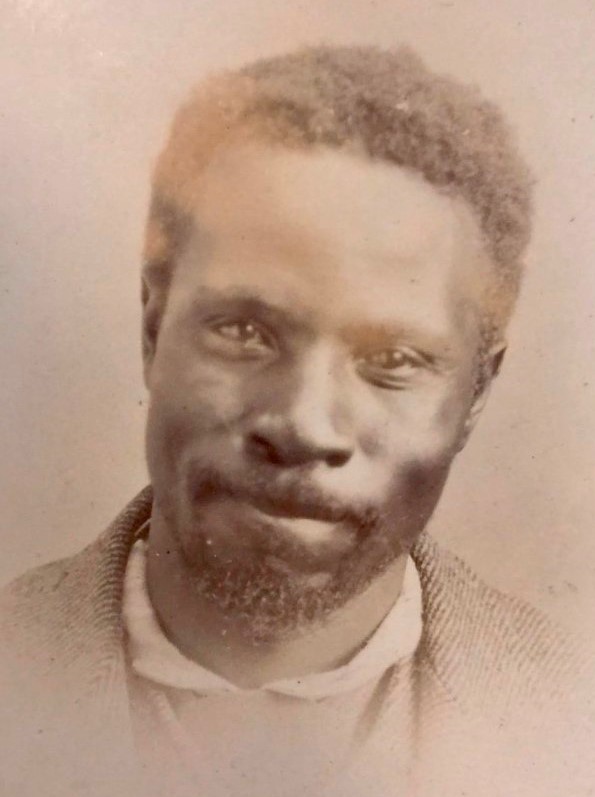
Mr. Proctor died on a day in late October in 1847 and was buried by his family, with dignity, at Bethel Burying Ground.

(1) Harry C. Silcox, Philadelphia Politics from the Bottom Up: The life of Irishman William McMullen, 1824-1901.

(2) Philadelphia Inquirer, 28 July 1835, p. 2.
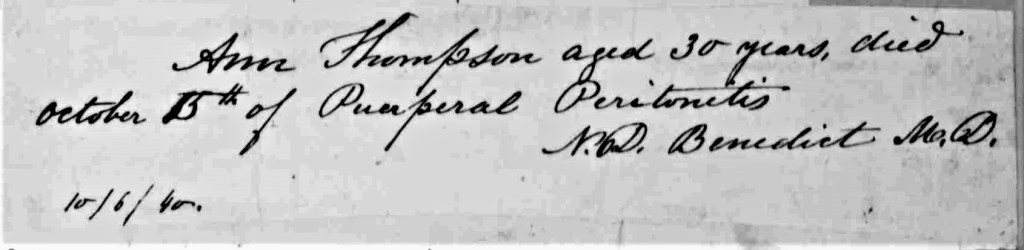
Thirty-year-old Ann Thompson died this date, October 5th, in 1840 and was buried at Bethel Burying Ground.

Posted by Terry Buckalew on October 5, 2020
Posted in: On This date. Tagged: African American burial grounds, African American cemeteries, African American History, Bethel Burying Ground, Mother Bethel, Mother Bethel African Methodist Episcopal Church, Philadelphia, Richard Allen. Leave a comment

Thirty-year-old Ann Thompson died this date, October 5th, in 1840 of Puerperal Peritonitis and was buried at Bethel Burying Ground. She was another victim of physicians and midwives not sterilizing their instruments and not washing their hands and, subsequently, infecting the genital area and uterus of a woman after she gives birth. It appears from Board of Health records that Ms. Thompson’s child lived.

Puerperal Peritonitis or “bed fever” was a quick, agonizing and devastating disease. It affected women within the first three days of giving birth and death occured only days later from sepsis or “blood poisoning.”

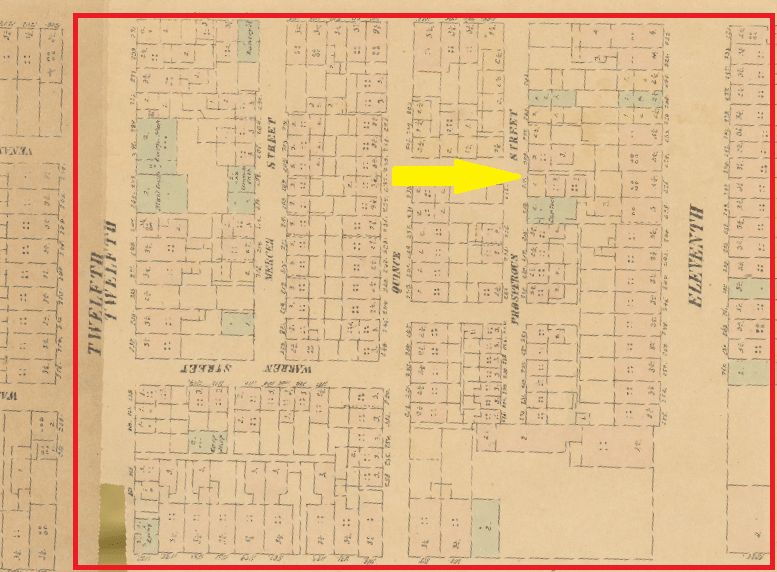
The yellow arrow indicates the approximate location of Ms. Thompson’s home on Prosperous Alley between 11th and 12th Streets and Locust and Spruce Streets. Prosperous Alley was in the middle of a cluster of streets, alleys, and dead end courts that mainly housed Black families. The majority of men worked as waiters and shoemakers, while the women were employed as laundresses and dressmakers. There were a significant number of widows and single women in the alley, according to city directories. The area was five blocks west of Bethel A.M.E. Church.

There is enough evidence from the 1838 Register of Trades of Colored People to suggest that Ms. Thompson’s spouse was Thomas Thompson. His occupation was listed as “Shoemaker.” The 1840 U.S. Census shows Ann and Thomas were already the parents of three girls, all under the age of ten. There were two other older adults listed at the same address who very well may have been Ann’s or Thomas’ parents.

The 1840 Philadelphia that Ms. Thompson left with her death was the most racist city in the north. African American men recently had lost the right to vote in Pennsylvania and street assaults on Black men and women were increasing. Just before Ms. Thompson’s death, the celebrated abolitionist Lucretia Mott, a white woman, was warned by the mayor of Philadelphia that she had been seen walking with Black people on the city’s streets and that her activity was inciting a “certain element” and should stop. She didn’t stop but in the end that “certain element” really didn’t need any incentive to continue their genocidal assault on the Black race.

Ms. Thompson died on a warm day in early October and was buried by her family at Bethel Burying Ground. I wasn’t able to find any further records on Mr. Thompson or the children.

Eighty-year-old Grace Johnson died this date, September 26th, in 1847 and was buried at Bethel Burying Ground.

Posted by Terry Buckalew on September 26, 2020
Posted in: On This date. Tagged: African American burial grounds, African American cemeteries, African American History, African Methodist Episcopal Church, Bethel Burying Ground, Mother Bethel African Methodist Episcopal Church, Philadelphia. Leave a comment

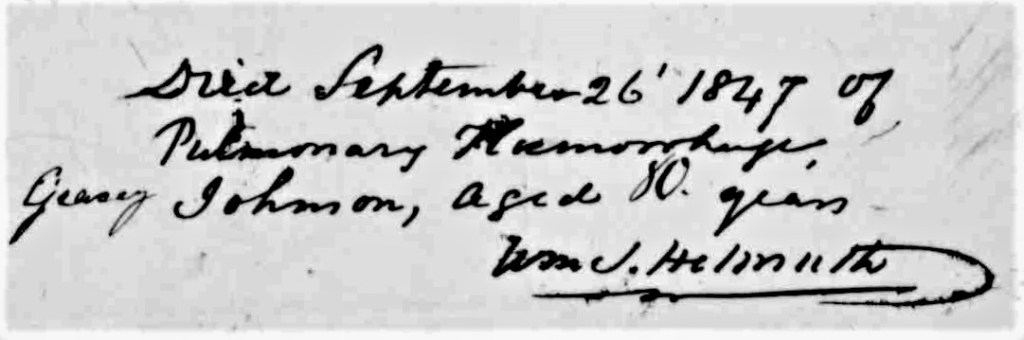
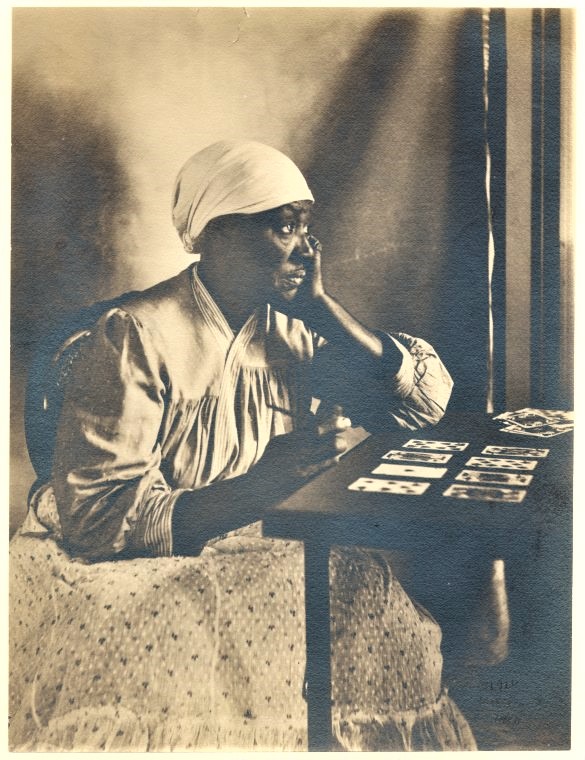
Eighty-year-old Grace Johnson died this date, September 26th, in 1847 of a Pulmonary Hemorrhage and was buried at Bethel Burying Ground. Documents also record her first name as “Gracey” and “Gracie.” Several months before Ms. Johnson died she reported her occupation as a domestic “at service” to the 1847 African American Census. She was one of 194 women in the Census who reported this as their occupation. (1)

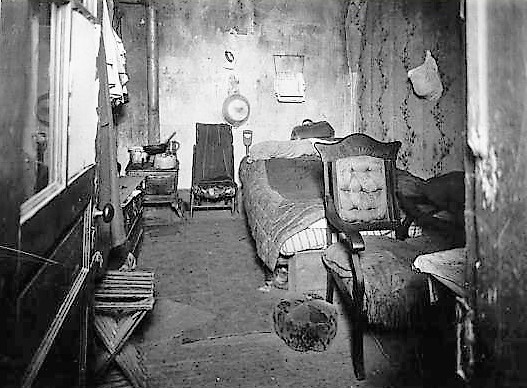
Ms. Johnson was single and lived alone in a 7′ x 7′ room at #8 Fothergill Street for which she paid $1.25 a month. In the 1837 African American Census, she reported that she was a widow. She’s listed as a widow in city directories as early as 1824.

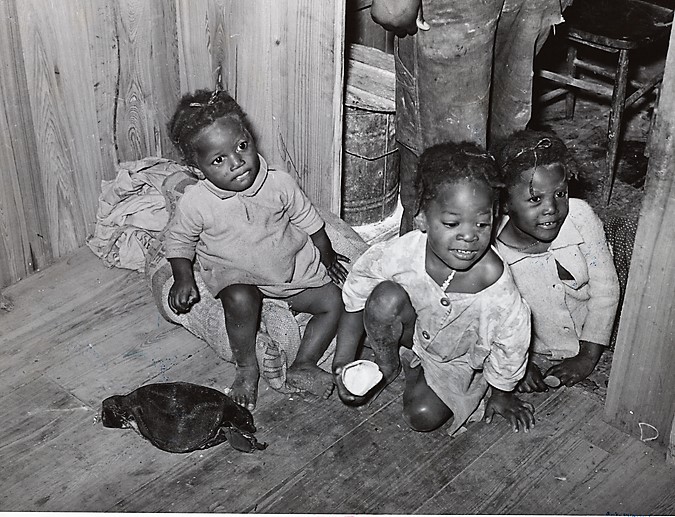
The room in the above photo is larger than the 7’x7′ room in which Ms. Johnson resided.
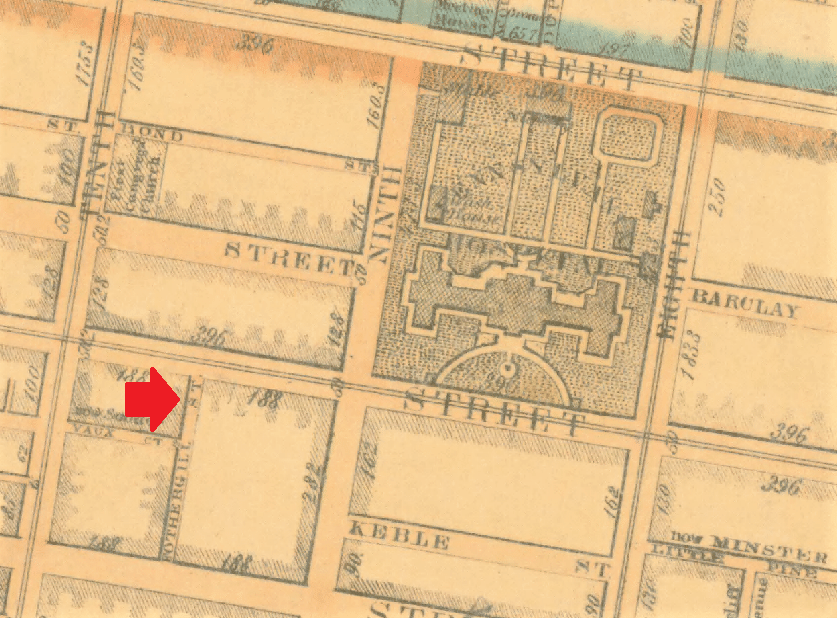
The red arrow on the above map illustrates the approximate location of Ms. Johnson’s home at #8 Fothergill Street and its proximity to Pennsylvania Hospital less than a block away.

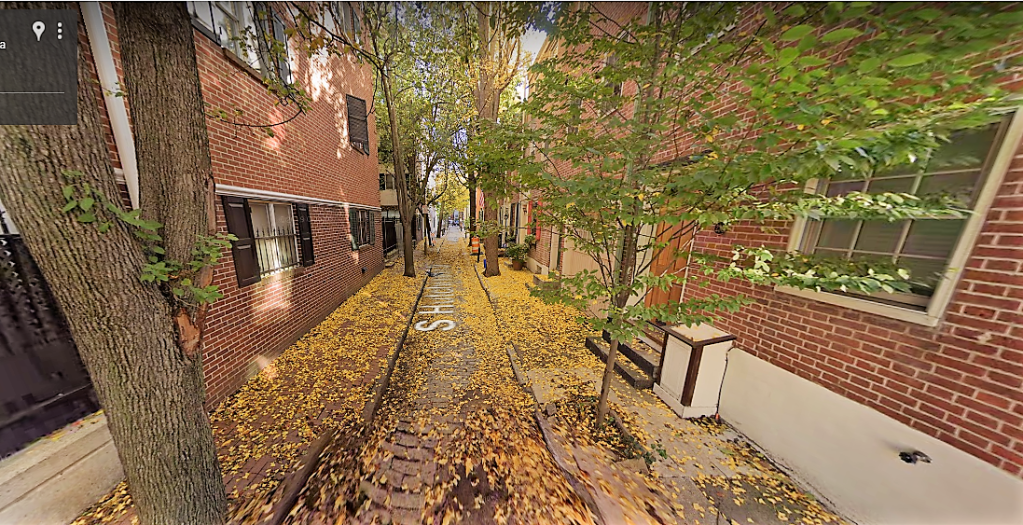
Fothergill Street was more like a narrow alley than a proper thoroughfare. It often would have been blocked by garbage, trash, and piles of ash from stoves and fireplaces. In the winter, ice and snow would have made it impassable. In 1897, the name of the street was changed to Hutchinson.


Hutchinson Street as it currently appears.

Ms. Johnson was born enslaved in 1767. It wasn’t recorded what colony her parents lived in, but it wasn’t Pennsylvania, according to the 1847 Philadelphia African American Census. She choose not to be specific to the census taker about how she was freed.

“In Service” (Digital Collection of the NY Public Library)

Ms. Johnson lived through decades of race riots, white gangs, daily street violence, and epidemics of Cholera, Yellow Fever, Malaria, Typhoid, Typhus and Tuberculosis. She richly deserved a dignified burial where she could rest in peace. She found that on a cloudy late September day that saw intermittent light showers. Ms. Johnson was buried at Bethel Burying Ground.

(1) Philadelphia Negro by W.E.B. DuBois, p. 454.

Five-year-old David Ware died this date, September 19th, in 1843 and was buried at Bethel Burying Ground.

Posted by Terry Buckalew on September 19, 2020
Posted in: On This date. Tagged: African American burial grounds, African American cemeteries, African American History, African Methodist Episcopal Church, archaeology, Bethel Burying Ground, Mother Bethel, Mother Bethel African Methodist Episcopal Church, Philadelphia. Leave a comment

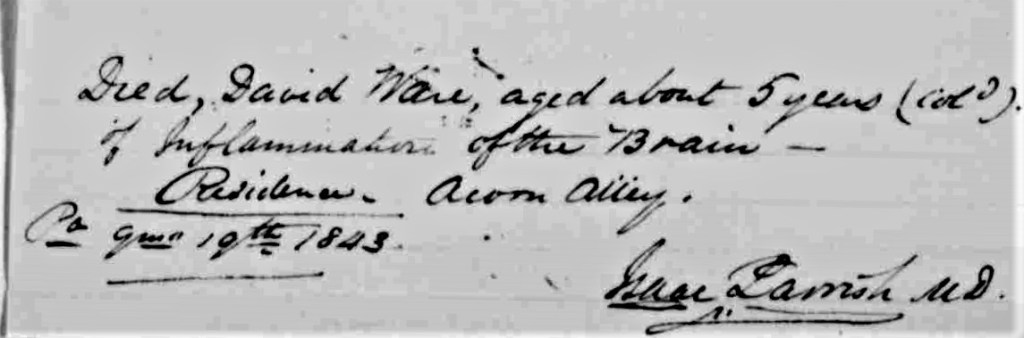
Five-year-old David Ware died this date, September 19th, in 1843 of a brain inflammation and was buried at Bethel Burying Ground. There are several diseases that can cause the inflammation. At David’s age, it could have been measles or mumps.

According to the 1850 U.S. Census, young David lived at #8 Acorn Alley with the following three single women: Eliza Ware, 33-years-old, who was born in Delaware; Sarah Ware, 29-years-old, who was born in New Jersey; Ann Ware, 21-years-old, who was born in Delaware. It is not clear which woman was David’s mother, if any of the three. None of the women was recorded as a widow.

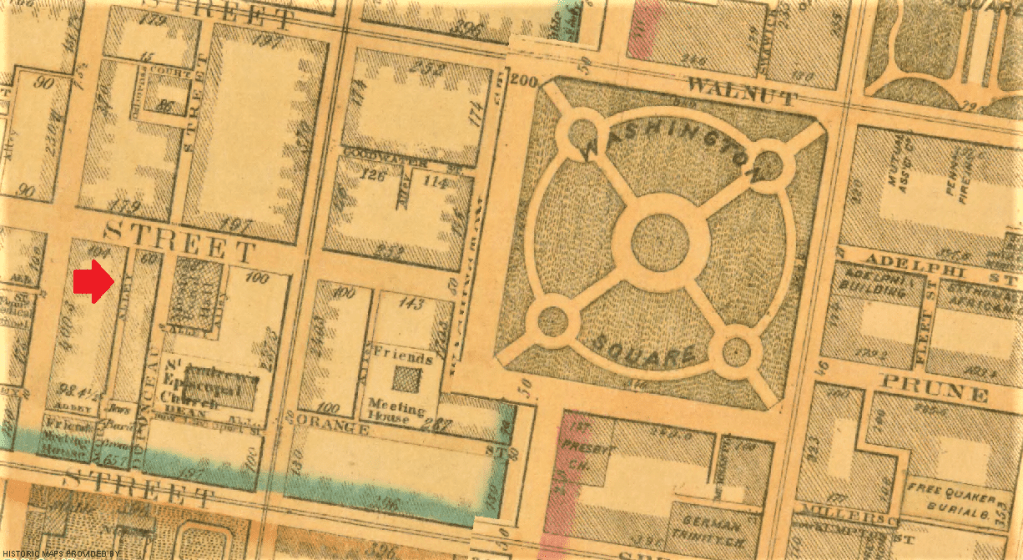
The red arrow on the above map indicates the location of #8 Acorn Alley and the proximity of Washington Square only two blocks away.

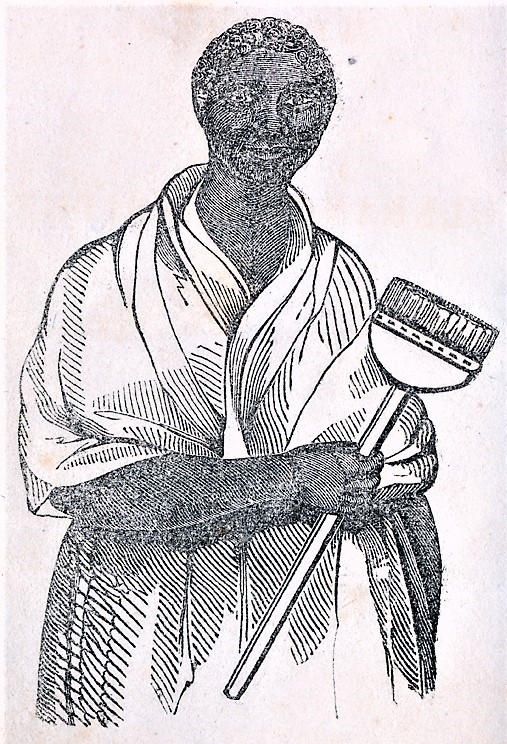
The Ware women were employed as laundresses and whitewashers. Whitewashers were house painters. Colored wash (paint) was very costly and only used in wealthy homes. Whitewash was a mixture of water and quicklime and inexpensive to make.

In a profession where the majority of whitewashers were male, there also was a significant number of women. In the image above, you can see it was a physically demanding occupation by the size of her forearm. (1)

The 1847 African American Census recorded the Ware family paid $4.50 a month for their room/s which is much higher than average. This sum equates to approximately $158 a month in modern currency. It also is reported that the family owned property in New Jersey worth $500 or approximately $17,560 in modern currency.

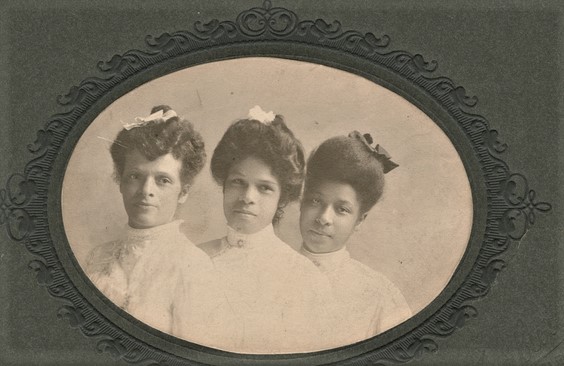
Eliza, Sarah and Ann Ware were educated. All could read and write. They belonged to beneficial societies and attended church services at Bethel A.M.E., according to census records. (Photo is from the Digital Collection of the NY Public Library.)

Young David Ware died on a clear hot day in September of 1843 and was buried, with dignity, at Bethel Burying Ground.

(1) We Are Your Sisters: Black Woman in the Nineteenth Century, edited by Dorothy Sterling, p. 90.

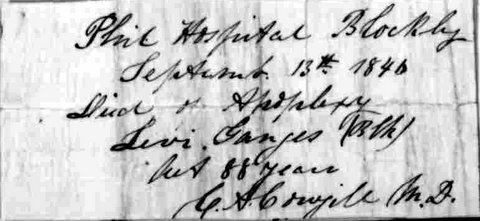
Eighty-eight-year-old Levi Ganges, died on September 13th, in 1848 and was buried at Bethel Burying Ground.

Posted by Terry Buckalew on September 13, 2020
Posted in: On This date. Tagged: African American burial grounds, African American cemeteries, African American History, African Methodist Episcopal Church, archaeology, Bethel Burying Ground, Mother Bethel, Mother Bethel African Methodist Episcopal Church, Philadelphia, Richard Allen. Leave a comment

Someone’s speaking in Ba-kongo another answers a question asked in English with a phase of Wolof 

Someone is telling a joke in Mandingo a young man – salt water African – becrys his fate in Swahili (1)

Official Border

Eighty-eight-year-old Levi Ganges died on September 13th, in 1846 from the complications of a stroke and was buried at Bethel Burying Ground. He was born ‘Lahy,’ son of Malcauba, an African tribal chief. At approximately forty-years-old, he was kidnapped and placed on a slave ship destined for the sugar cane plantations of the Caribbean. 

Mr. Ganges was one of the 135 enslaved Africans rescued in 1800 by the U.S.S. Ganges, an American naval ship.

Mr. Michael Kearney has diligently researched the history of this incident and the genealogy of the Ganges family. For his authoritative account, please go to https://thegangesfamilies.com/

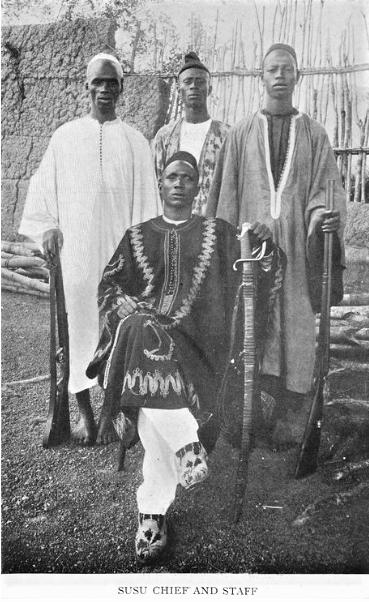
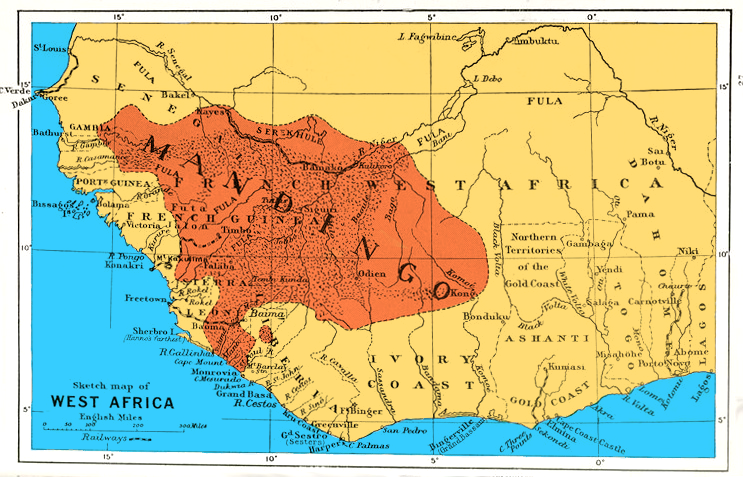
Mr. Ganges was a member of the Susu people, also spelled Soso, a West African ethnic group, one of the Mandé peoples (Mandingo), living primarily in Guinea and Northwestern Sierra Leone. (The photo below is from the New York Library Digital Collection,)

Susu Chief and Staff

MandingoMap-1906_with_color

1906 map of the African west coast showing the home of the Mande people. 

Official Border

Screenshot (32)

The Pennsylvania Abolition Society volunteered to take over the care of Black men and women of Africa. The Society put into place a program where the new citizens would be indentured for a number of years. They would be clothed, housed, and taught a trade. Levy/Lahy Ganges was indentured for four years to Enos Eldridge, a farmer in Darby County, Delaware County, to be taught the fundamentals of agriculture.

In September of 1839, it became known to the lawyers arguing for the freedom of the Africans rescued from the slave ship Amistad that Mr. Ganges spoke their language and could be valuable as a translator. He traveled to Hartford, Connecticut to meet with his fellow countrymen. The pertinent documents concerning this meeting are on Mr. Kearney’s website. 

My research is focusing on Mr. Ganges life between the end of his indenture and his translation work with the Africans of the Amistad.

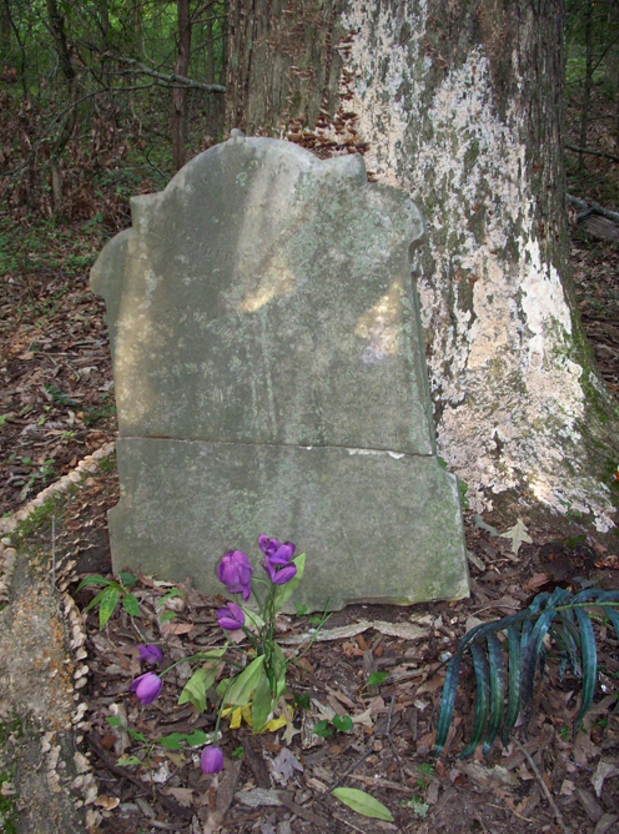
Tombstone Spring flower

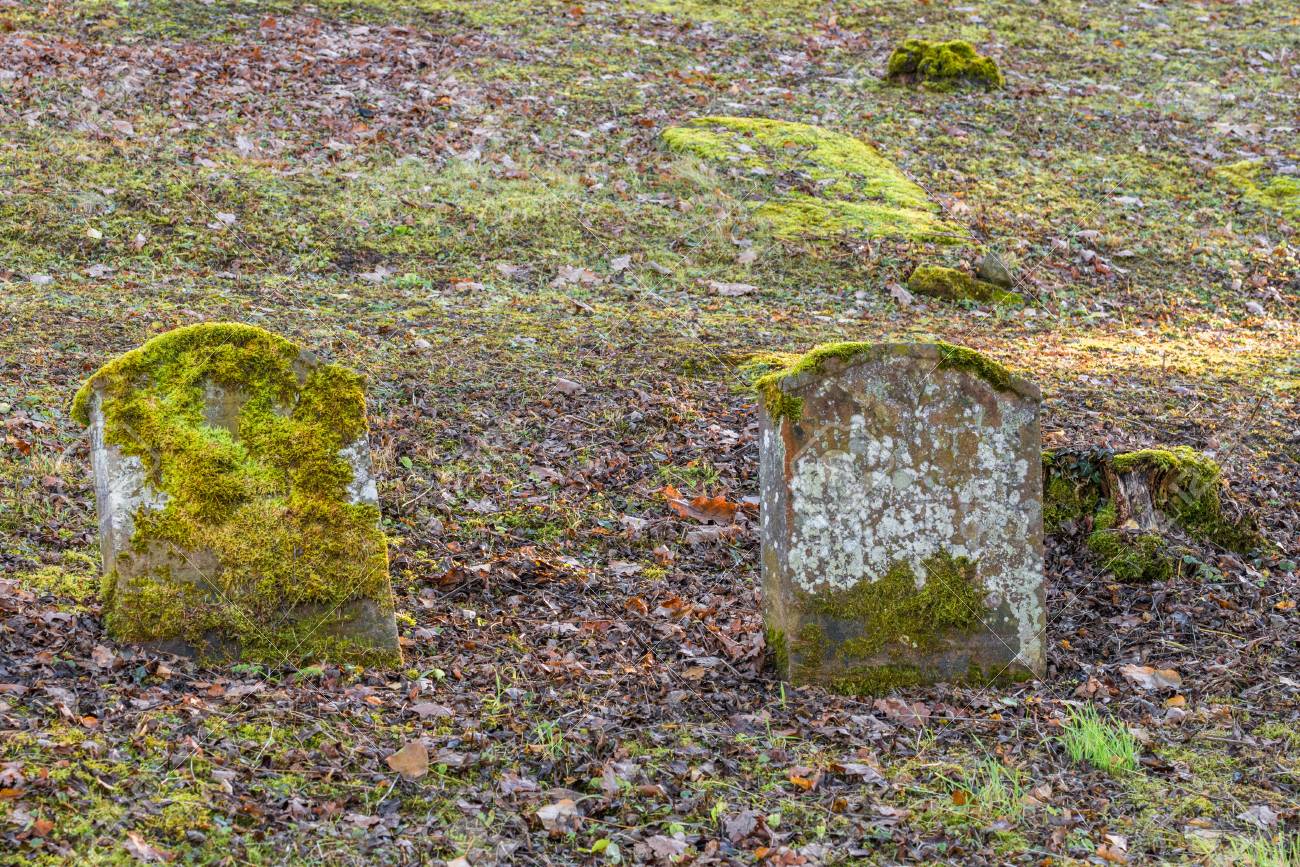
Lahy, son of Malcauba, died on a cool and clear September day where the temperature only rose to sixty-six degrees by late afternoon. There was a total eclipse of the moon on the evening that he passed away. He was buried, with dignity, at Bethel Burying Ground.

Official Border

(1) Meditations in Congo Square by Lamont B. Steptoe, p, 32. (Camden, NJ: Whirlwind Press.
(2) https://en.wikipedia.org/wiki/Susu_people

Eighty-nine-year-old Hannah Richards died this date, September 9th, in 1852 and was buried at Bethel Burying Ground.

Posted by Terry Buckalew on September 9, 2020
Posted in: On This date. Tagged: African American burial grounds, African American cemeteries, African American History, African Methodist Episcopal Church, AME Zion, archaeology, Bethel Burying Ground, Mother Bethel African Methodist Episcopal Church, Philadelphia, Richard Allen. Leave a comment

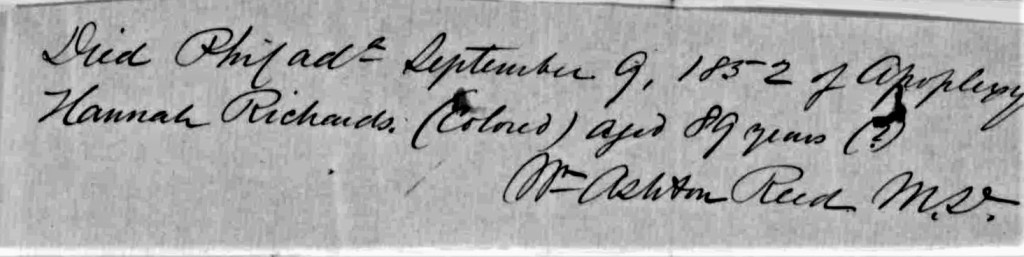
Eighty-nine-year-old Hannah Richards died this day, September 9th, in 1852 of Apoplexy (stroke) and was buried at Bethel Burying Ground. Ms. Richards had been a widow since at least 1837 when she reported that fact to the census taker. At that point in time, she was the head of a family of ten. They ranged from three small children to seven adults. Three were not native to Pennsylvania and one was, who gained his or her freedom through manumission, was formerly enslaved. The 1840 City Directory lists Ms. Richards’ occupation as “washerwoman.” During this period, the family lived on Tammany Street below 3rd Street in the West Kensington section of the county.

By 1847, Ms. Richards resided at a house that she owned at Vernon Street above 10th Street in the Spring Garden section of the county. The red pin on the map below indicates the Richards’ home. The red arrow illustrates the location of Bethel A.M.E. where she reportedly worshiped. African Americans were not allowed on public transportation, so she walked approximately two miles to Bethel. As she grew older, she may have chosen to attend services at Zoar A.M.E. which was only six blocks away from her home at 4th and Brown Streets.

The 1847 African American Census also reveals that Ms. Richards resided at this time with three other adults – a male and two females in a four room house. The male labored as a porter, earning $5 a week. One of the women is employed as a washwoman, earning $3 a week. Only one is native to Pennsylvania. Two were born enslaved and one of the two’s freedom was purchased for $150. The family had a mortgage payment of $450 a year. They had $1,200 equity in the property. Their water bill was $5 a year and they paid $15 a year for taxes. (1)

The Vernon Street neighborhood was predominately white and dotted with carpenters’ shops. A block away was a large chemical factory where many of the local men were employed.

A 1953 photo of a child on Vernon Street (now Reno). (Temple U. Digital Library Collection)

Ms. Richards was born in 1763, likely in Maryland or Virginia. She had seen many burial grounds for Blacks in her lifetime, including slave graveyards, potter’s fields, and small churchyards. However, she had never seen anything like Bethel Burying Ground. Owned by Blacks for Blacks, it was a place of reverence and dignity where generations could be buried together and honored. The creation of such a publicly recognized sacred space would also have served as a powerful symbol, reinforcing the notion that people of African descent were by that time no longer strangers in the city, but rather a permanent part of Philadelphia’s social and historical fabric.

Hannah Richards died on a day in early September 1852 and was buried by her family, with dignity, at Bethel Burying Ground.

(1) In modern currency the equivalents are $450 = $14,218; $1,200 = $37,917; $5 = $158; $15 = $474

Forty-five-year-old Mary Stewart died this date, August 15th, in 1849, and was buried at Bethel Burying Ground.

Posted by Terry Buckalew on August 15, 2020
Posted in: On This date. Tagged: African American burial grounds, African American cemeteries, African American History, African Methodist Episcopal Church, archaeology, Bethel Burying Ground, Mother Bethel, Mother Bethel African Methodist Episcopal Church, Philadelphia, Richard Allen. Leave a comment

MARY STEWART

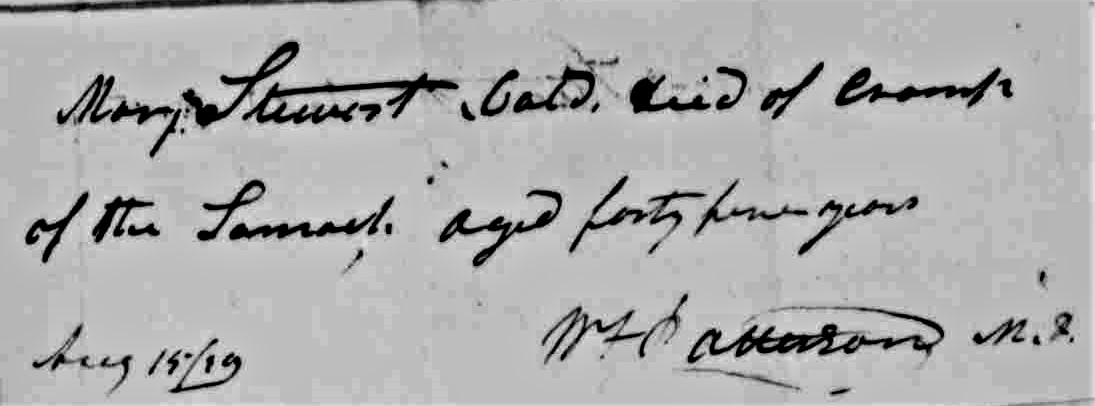
Forty-five-year-old Mary Stewart died this date, August 15th in 1849, due to “Cramps of the Stomach” and was buried at Bethel Burying Ground. In 1847 she told the census taker that her spouse worked irregularly as a laborer, earning $3.50 a week, when he was able. He was not named. Ms. Stewart was employed as a domestic. In the 1847 Philadelphia African American Census, Ms. Stewart sadly reported that she had to sell “some of her things to procure the means to bury a child.” She added that “at the same time her son sold some of his things to bury his wife.” Either Mr. or Ms. Stewart had formerly been enslaved and gained their liberation through manumission.  The family was struggling just to stay alive.

green

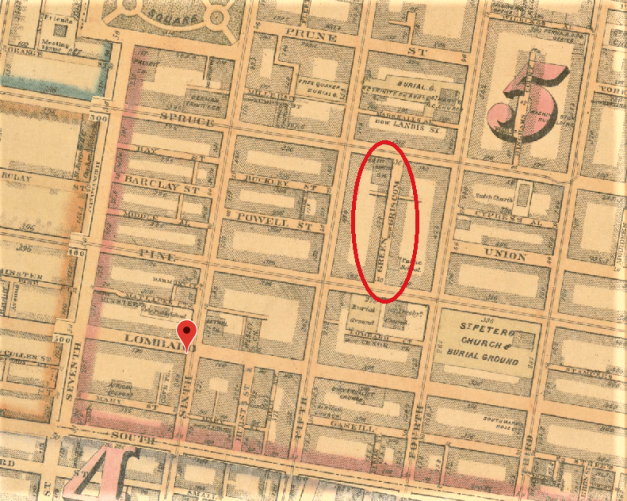
Green Street is enclosed in the red circle. The red pin illustrates the location and proximity of the Bethel A.M.E. Church.

Ms. Stewart and her family lived in a room at #19 Green Street for which they paid $3 a month and reported having only $15 in personal property. In modern currency, their rent equates to approximately $100 monthly and their property equates to approximately $500. Green Street was a block-long thoroughfare, packed with forty-seven Black families with a total of almost one-hundred-fifty men, women and children. 

South side of Spruce Street 1859

The above photo is of 4th and Spruce Streets, right around the corner from the residents of Green Street. It was taken circa 1859. These are some of the homes that the Black women of Green Street would work in as domestics, cooks, and wash women. (Free Library of Philadelphia Digital Collection)

Mary Stewart died on an August day where the temperature rose to 82° and saw a brief shower at 11am. The rest of the day was clear and fair. She was buried by her family, with dignity, at Bethel Burying Ground.

Official Border


Twenty-five-year-old Alexander G. Hopkins died this date, August 9th, in 1842, and was buried at Bethel Burying Ground.

Posted by Terry Buckalew on August 9, 2020
Posted in: Uncategorized. Leave a comment

Alexander Hopkins

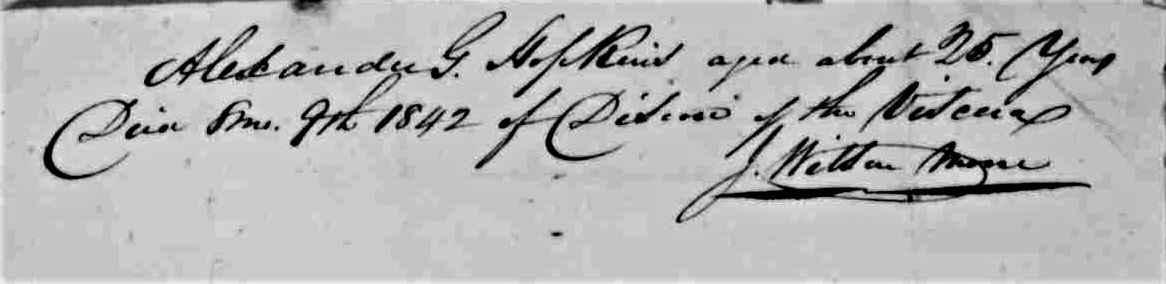
Twenty-five-year-old Alexander G. Hopkins died this date, August 9th, in 1842 of “Disease of the Visceral” and was buried at Bethel Burying Ground. The extremely vague and unspecific cause of death is suspicious. Was Mr. Hopkins a victim of white mob violence during the three-day assault on the Black community known as the Lombard Street Riots from August 1st through August 3rd in 1842? Did the young man succumb to his wounds?

According to the 1840 U.S. Census, Mr. Hopkins had a spouse, however, her name was not reported. The 1842 Philadelphia City Directory identified his occupation as a porter. The young couple lived at #5 Lisle Street in the upper portion of the Moyamensing District.  The narrow thoroughfare was home to Black men and women who were employed as waiters, porters, seamstresses, carpenters, laundresses, sailmakers, and tailoresses (female tailors).  The Black children in the neighborhood attended the St. Mary’s Street School or the Lombard Street School.

Lisle Street

The red arrow above illustrates the location of the Hopkins’ residence on Lisle Street. The red circle shows the location and proximity of the Bethel A.M.E. Church at Sixth and Locust Streets.

mildred

Mildred Street (formerly Lisle Street) in 1920. By this time, the neighborhood was a mix of Jewish and Italian Americans. (Temple University Digital Collection)

The week before Mr. Hopkins died, Mr. Charles Black, an African American man, was dragged down the stairs from the second floor in his home on Lombard Street and beaten almost to death in front of his young son. Supposedly, Mr. Black survived his wounds. However, his name is absent from future city directories. (1)

weathered-tombstones

Mr. Hopkins died on a partly clear day where the temperature rose to 79 degrees by late afternoon. He was buried by his family, with dignity, at Bethel Burying Ground.

Official Border

(1) The Liberator, 9 September 1842.

Eleven-year-old John Holly died on August 3rd, in 1848, and was buried at Bethel Burying Ground.

Posted by Terry Buckalew on August 3, 2020
Posted in: On This date. Tagged: African American burial grounds, African American cemeteries, African American History, African Methodist Episcopal Church, archaeology, Bethel Burying Ground, Mother Bethel, Mother Bethel African Methodist Episcopal Church, Philadelphia, Richard Allen. Leave a comment

John Holly

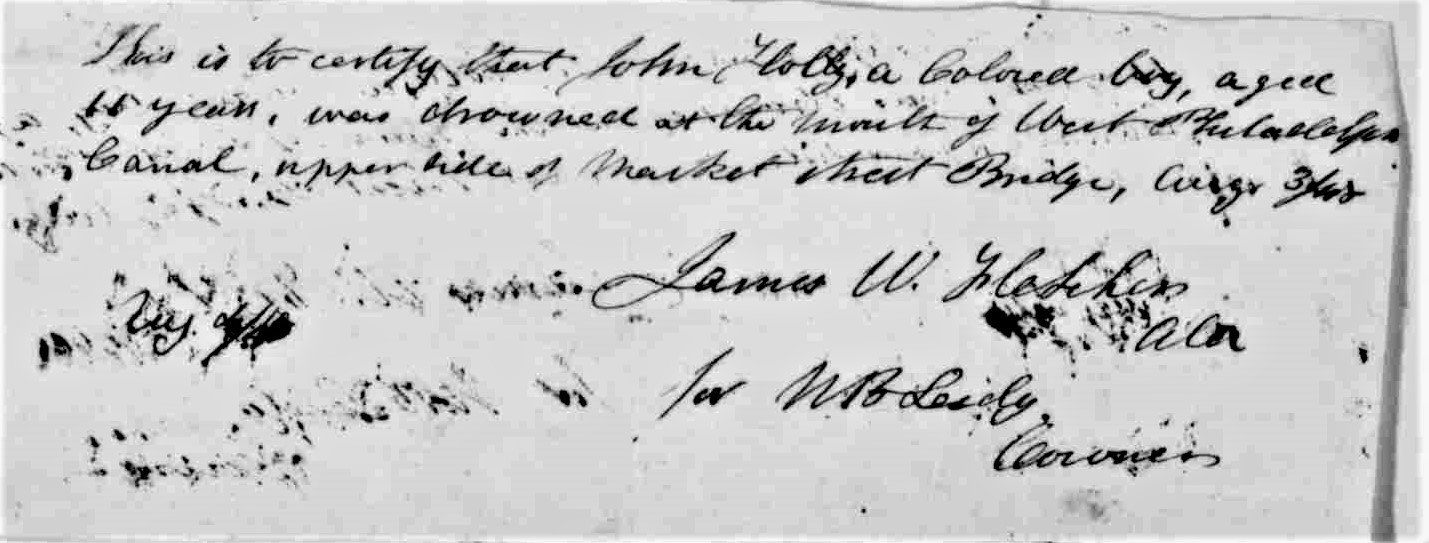
Eleven-year-old John Holly died on August 3rd in 1848 from drowning and was buried at Bethel Burying Ground. John was fishing with friends on the West Philadelphia Canal, near the north side of the Market Street Bridge, when he fell into the Schuylkill River and drown, according to the City Coroner. His body was recovered almost immediately. 

North_American_1848-08-05

North American, 5 August 1848

Screenshot (12)

The red pin indicates the approximate location of the Holly residence on Pearl Street above 12th Street. The red arrow shows the location where young John was fishing when he drowned.

John Holly’s parents were Ann and Aaron Holly. Ms. Holly was forty-one-year-old at the time of her son’s death and Mr. Holly was forty-seven. She was born in Delaware and he was born in Pennsylvania. They had a daughter Harriet, who was thirteen-years-old at the time of her brother’s death and who was also born in Pennsylvania, according to the 1850 U.S. Census. 

Aaron Holly was employed as a laborer earning $4 a week while Ann Holly toiled as a washwoman, reportedly making $2 a week. Earning that much for a washwoman usually meant that she had steady clients. Their apartment at #17 Pearl Street in the Spring Garden District contained three rooms. The rent was expensive at $5 a month and they may have rented out a room to help with the cost. The entire family attended church services, according to the 1847 Philadelphia African American Census.

BRIDGE

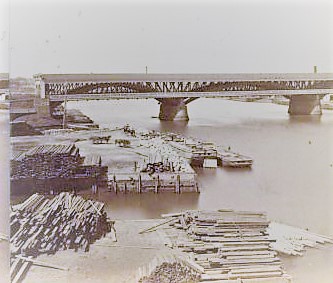
“Market Street Bridge” Date: approximately 1850-1930. Source: The New York Library Digital Collection.

John Holly was one of nineteen Philadelphia boys to die by drowning in the summer of 1848.

The eleven-year-old died on a clear August day where the temperature rose to 80° by mid-day. His parents buried him, with dignity, at Bethel Burying Ground.

Official Border

Eighty-year-old Sylvia Benson died this date, August 2nd, in 1841, and was buried at Bethel Burying Ground.

Posted by Terry Buckalew on August 2, 2020
Posted in: On This date. Tagged: African American burial grounds, African American cemeteries, African American History, African Methodist Episcopal Church, archaeology, Mother Bethel, Mother Bethel African Methodist Episcopal Church, Philadelphia, Richard Allen. Leave a comment

Sylvia Benson

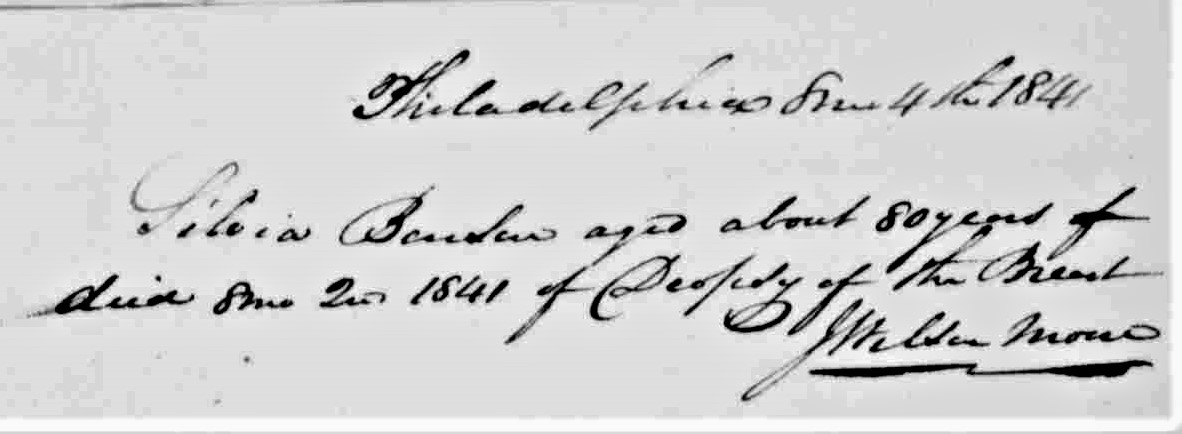
Eighty-year-old Sylvia Benson died this date, August 2nd, in 1841 of Breast Cancer and was buried at Bethel Burying Ground. A widow, Ms. Benson was characterized as a “gentlewoman” in the 1840 Philadelphia City Directory. The 1837 Philadelphia African American Census reports her occupation as a washwoman. The Census listed another woman living with Ms. Benson who also worked as a washwoman. Both were not natives of Pennsylvania.

Ms. Benson stated in the Census that she was formerly enslaved and her husband “bought” her freedom for $200. I don’t have the words.

Screenshot (13)

The red arrow indicates the location of Ms. Benson’s home at #96 Gaskill Street. The red pin illustrates the location and the proximity of Bethel AME Church at 6th and Lombard Streets. Ms. Benson reported to the 1837 census taker that she and her roommate both worshiped at Bethel Church. The women paid $4.15 a month in rent which is a considerable amount. Ms. Benson reported $155 of personal property which equates to approximately $4,475 in modern currency. 

Gaskill Street was a narrow crowded street that was home to hundreds of Black men, women, and children of all ages. It was a thoroughfare of poverty, disease, and the working poor. To alleviate some of the child care burdens, the Infant School Society of Philadelphia established a daycare and a school for one hundred Black infants and children of Gaskill Street. Ms. Benson was a daily witness to this hustle and bustle on her busy street.

Laundress

“Laundress,” New York Library Digital Collection.

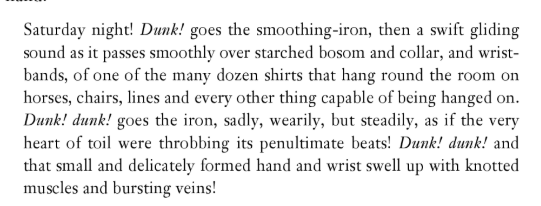
Washing clothes and bedding required incredible physical strength and perseverance as captured in Dr. James McCune Smith’s prose. The Black New York City physician contributed the following (in part) to Frederick Douglass’ Paper. Screenshot (15)

Sylvia Benson was born in approximately 1761 and likely in the Delaware or Maryland colonies.  Over the 19th century, Philadelphia was the journey’s end for a significant number of recently liberated Black women and men. Sadly, I could not find any information on her spouse or possible children. 

Sylvia Benson died on a day where the temperature rose to 82° by midday. The day started out clear but turned cloudy by early evening. She was buried, with dignity, at Bethel Burying Ground.

Official Border


Posts navigation

← Older Entries
Newer Entries →
  • Recent Posts

    • Three dead as church wall falls on this date, May 1st, in 1841.
    • The ten-month-old Baby Colgate died this date, June 20th, in 1847, and was buried at Bethel Burying Ground.
    • Fifty-eight-year-old Rachel Dawson died this date, May 3rd, in 1839, and was buried at Bethel Burying Ground.
    • Twenty-eight-year-old Robert Swails died on this date, March 31st in 1849, and was buried at Bethel Burying Ground.
    • Forty-year-old Jacob “Jesse” Howard died on this date, January 29th, in 1840, and was buried at Bethel Burying Ground.
  • Archives

    • May 2024
    • June 2023
    • May 2023
    • March 2023
    • January 2023
    • December 2022
    • November 2022
    • October 2022
    • September 2022
    • August 2022
    • May 2022
    • April 2022
    • March 2022
    • February 2022
    • January 2022
    • December 2021
    • November 2021
    • October 2021
    • September 2021
    • August 2021
    • July 2021
    • June 2021
    • May 2021
    • April 2021
    • March 2021
    • February 2021
    • January 2021
    • December 2020
    • November 2020
    • October 2020
    • September 2020
    • August 2020
    • July 2020
    • June 2020
    • May 2020
    • April 2020
    • March 2020
    • February 2020
    • January 2020
    • December 2019
    • November 2019
    • October 2019
    • September 2019
    • August 2019
    • July 2019
    • June 2019
    • May 2019
    • April 2019
    • March 2019
    • February 2019
    • January 2019
    • December 2018
    • November 2018
    • October 2018
    • September 2018
    • August 2018
    • July 2018
    • June 2018
    • May 2018
    • April 2018
    • March 2018
    • February 2018
    • January 2018
    • December 2017
    • November 2017
    • October 2017
    • September 2017
    • August 2017
    • July 2017
    • June 2017
    • May 2017
    • April 2017
    • March 2017
    • February 2017
    • January 2017
    • December 2016
    • November 2016
    • October 2016
    • September 2016
    • August 2016
    • July 2016
    • June 2016
    • May 2016
    • April 2016
    • March 2016
    • February 2016
    • January 2016
    • December 2015
    • November 2015
    • October 2015
    • September 2015
    • August 2015
    • July 2015
    • June 2015
    • May 2015
    • April 2015
    • March 2015
    • February 2015
    • January 2015
    • December 2014
    • November 2014
    • October 2014
  • Categories

    • Archaeology
    • BBG History
    • Bethel Burying Ground Name Directory
    • Bethel Burying Ground Timeline
    • Burial services
    • Diseases
    • Documents
    • Freemasonry
    • Ignatius Beck
    • It's a fact
    • Maps
    • Neighborhood
    • Newspaper Articles
    • On This date
    • Photographs
    • Uncategorized
    • Videos
  • Meta

    • Create account
    • Log in
    • Entries feed
    • Comments feed
    • WordPress.com
Blog at WordPress.com.
Bethel Burying Ground Project
Blog at WordPress.com.
  • Subscribe Subscribed
    • Bethel Burying Ground Project
    • Join 48 other subscribers
    • Already have a WordPress.com account? Log in now.
    • Bethel Burying Ground Project
    • Subscribe Subscribed
    • Sign up
    • Log in
    • Report this content
    • View site in Reader
    • Manage subscriptions
    • Collapse this bar
 

Loading Comments...