Bethel Burying Ground Project

Bethel Burying Ground Project

  • ABOUT THE BETHEL BURYING GROUND PROJECT

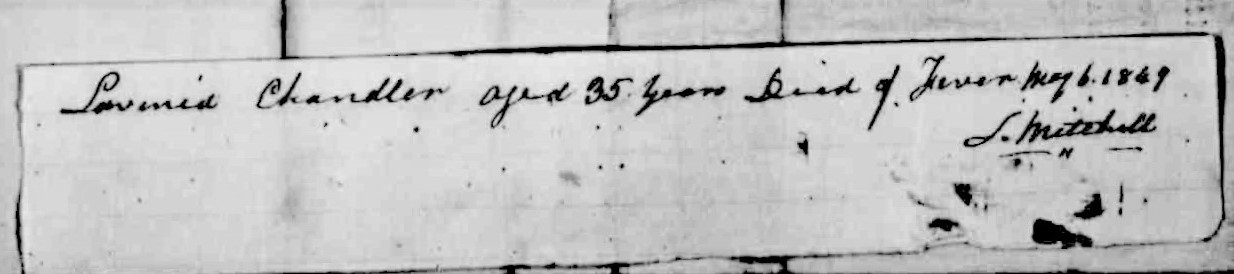
Thirty-five-year-old Lavinia Chandler died this date May 6th, in 1849, and was buried at Bethel Burying Ground.

Posted by Terry Buckalew on May 6, 2021
Posted in: On This date. Tagged: african, African American burial grounds, African American cemeteries, African American History, African Methodist Episcopal Church, archeology, Mother Bethel African Methodist Episcopal Church, Philadelphia, Richard Allen. Leave a comment

Thirty-five-year old Lavinia Chandler died this date May 6th, in 1849, of “Fever” and was buried at Bethel Burying Ground. Her daughter nine-month-old Margaret Jane died four days later on May 10th, presumably of the same illness. The baby was buried with her mother at Bethel Burying Ground. The Philadelphia Board of Health records for 1849 show a substantial number of deaths from Scarlet Fever. This could have been the cause of Ms. Chandler’s and her daughter’s deaths.

I believe there is enough evidence to state that Joseph Chandler was the father of Margaret Jane and the spouse of Margaret. Mr. Chandler worked at various laboring jobs while Margaret was employed as a domestic day worker. The couple had a second daughter whose age was only listed as below five years old. There are no other mentions of Chandler family members after the 1847 Census. Mr. Chandler may have moved from Philadelphia.
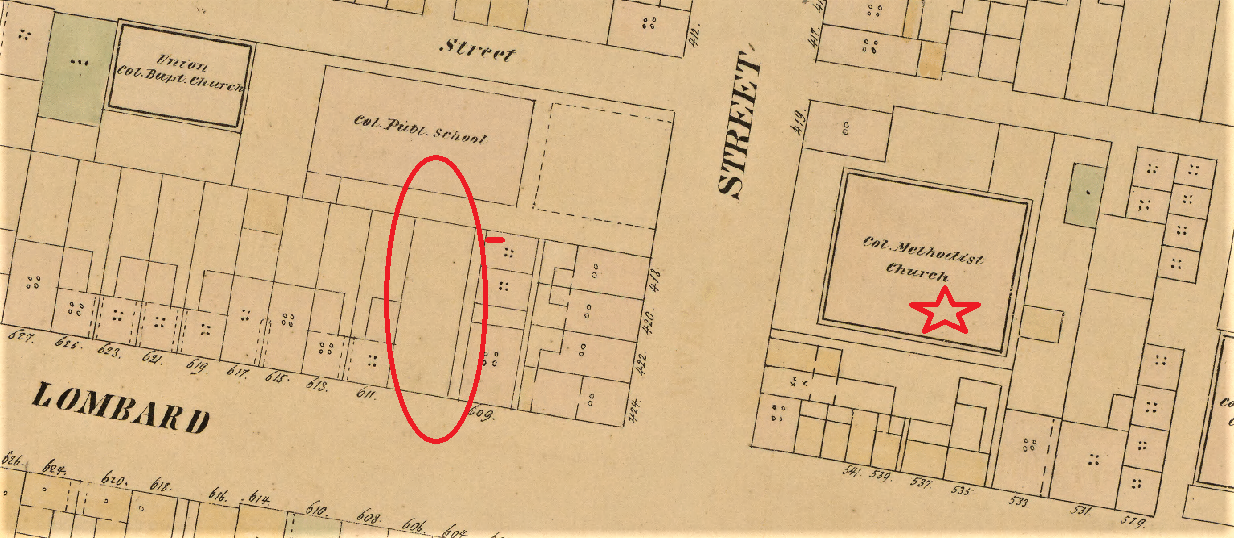
The circle indicates the location of Washington Court and the star illustrates the location and the close proximity of Bethel AME Church.

The Chandler family resided at #6 Washington Court. They lived in a 11’x11′ room for which they paid $2.75 a month. Poverty had its grip on the family, given they only had personal property valued at $15, according to the 1847 Philadelphia African American Census. They did belong to a beneficial society at Bethel Church. This was a savings account that could be used to defray burial expenses.
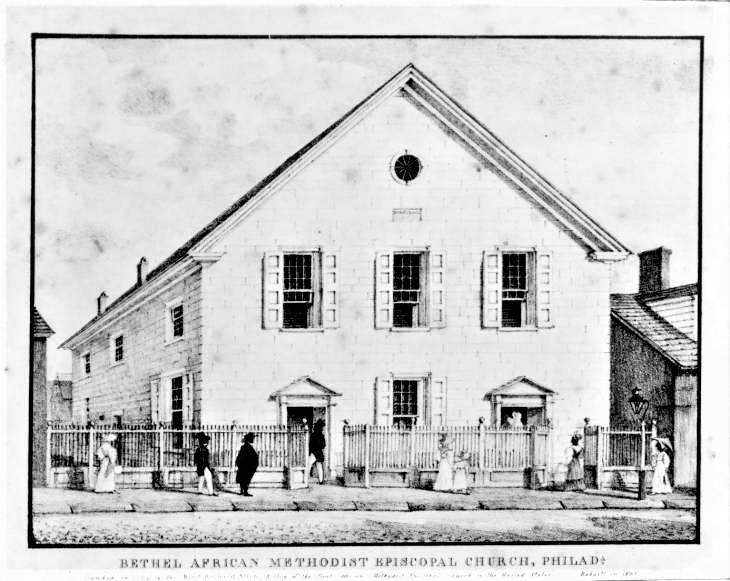
Bethel African Methodist Episcopal Church in the 19th Century.

Located close to Bethel A.M.E. Church, Washington Court contained thirty-three Black men, women, and children, according to the 1847 Census. The adults were employed as dressmakers, seamstresses, seamen, hod carriers, and carpenters. They even had their own herb doctor Mr. Randolph Stokes. Their young children attended the 6th and Lombard School.
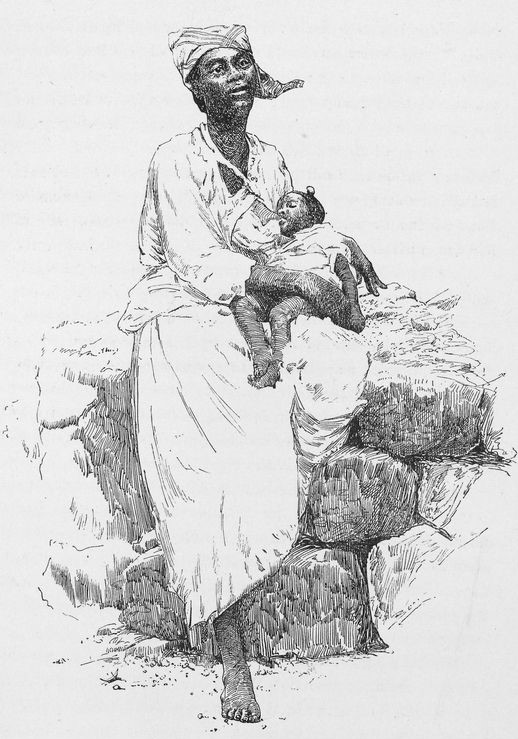
Upon her daughter’s death, mother and child were buried together at Bethel Bethel Burying Ground. Around eight o’clock in the evening on the day of Ms. Chandler’s death, a “strange cloud formation” appeared in the sky over Philadelphia. According to one newspaper report “This was doubtless a Boreal Aurora in one of its many phases.”(1)

(1) North American, 1 June 1849, p. 1.
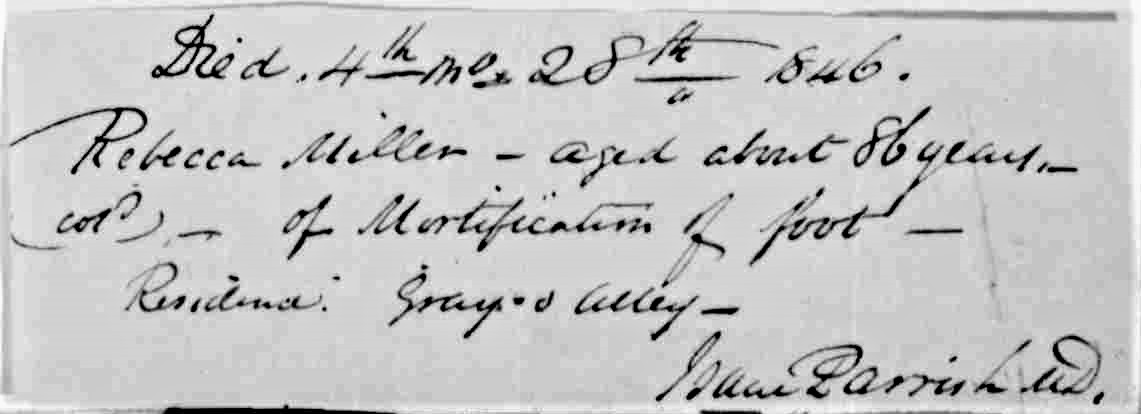
Eighty-six-year-old Rebecca Miller died this date, April 28th, in 1846 and was buried at Bethel Burying Ground.

Posted by Terry Buckalew on April 28, 2021
Posted in: On This date. Tagged: African American burial grounds, African American cemeteries, African American History, African Methodist Episcopal Church, archaeology, Bethel Burying Ground, Mother Bethel, Mother Bethel African Methodist Episcopal Church, Philadelphia, Richard Allen. Leave a comment

Approximately eighty-six-year-old Rebecca Miller died this date, April 28th, in 1846 of “mortification of the foot” and was buried at Bethel Burying Ground. It is likely that gangrene set in from a wound and that Ms. Miller died of sepsis and subsequent organ failure. It appears that Ms. Miller lived at #8 Gray’s Alley with Keziah Miller. According to the 1847 Philadelphia African American Census, Keziah was self-employed as a “day worker.” In 1847, she was reported between the ages of fifteen and forty-nine years old. In the Census, Keziah declined to answer whether she was born in Pennsylvania or in another state. The relationship between the two women is unknown.

The women lived in a single 12’x12′ room at #8 Gray’s Alley for which they paid $2 a month. The census taker commented that they were “poor, but respectable.”

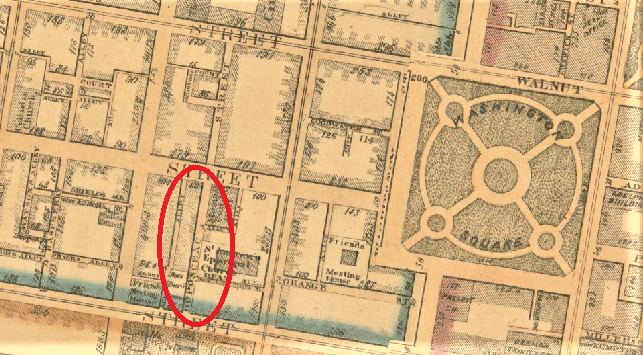
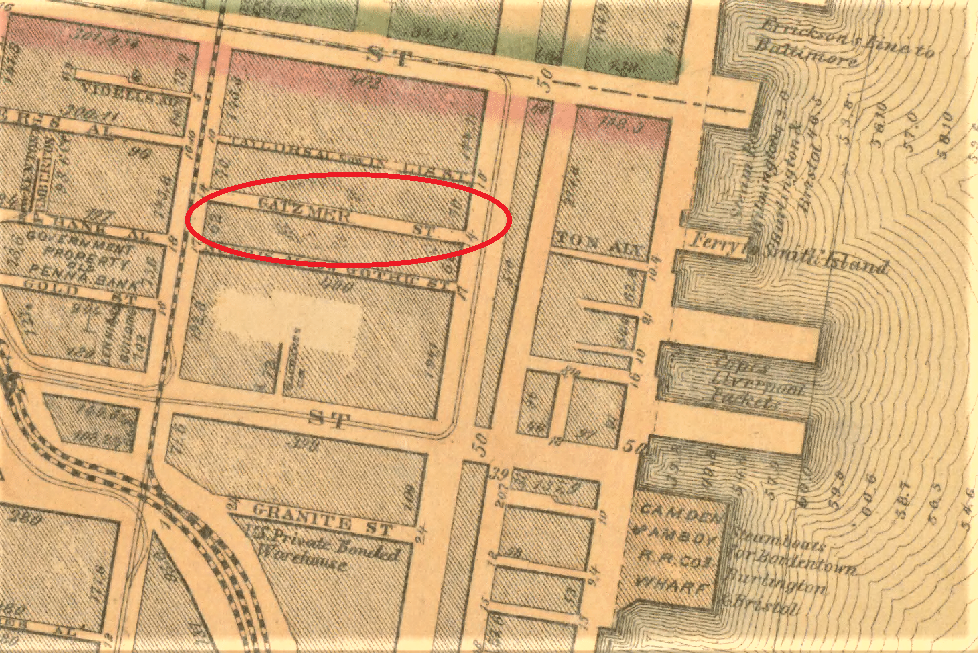
Gray’s Alley (later Gatzmer St.), highlighted by the red circle, is located very close to the Delaware River docks.

Gray’s Alley was a narrow, block long thoroughfare within sight of the tall masted ships docked on the Delaware wharves. According to the 1847 Census, there were seventy-three Black men, women, and children living in the alley. Most of the adult men were laborers, working to load and unload freight from the large vessels. Many others were porters delivering the goods around the city. The majority of the women in the alley were self-employed as laundresses and day workers. The very young children of Gray’s Alley were cared for at the 6th and Lombard Street School, while the older children went to either the Adelphia School or the Raspberry Alley School. Raspberry also had an evening school for adults where reading, writing, and math were taught.

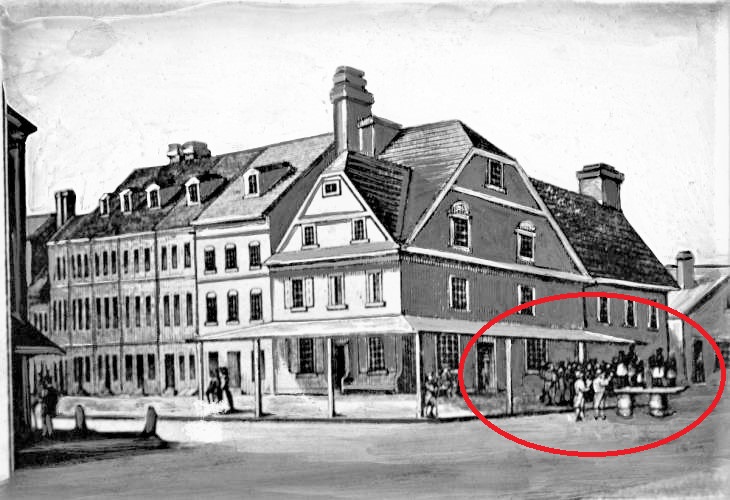
The London House at Front and Market Streets. The selling of Black men, women and children occurred outside on a make shift platform circled in red.

Ms. Miller was likely born to an enslaved mother and, consequently, she also was enslaved. Did she herself stand on that rickety platform, scared to death that she would be separated from her mother? What was she feeling when strange white men touched her, inspecting her body to determine her sale price? Was she freed by the British when they occupied the city during the American Revolutionary War?

Her home was very near the slave market. When she traveled to the Second Street market, buying food for her meals, did she travel a path so that she would circumvent the London Coffee House and the horrible memories that it would dredge up?

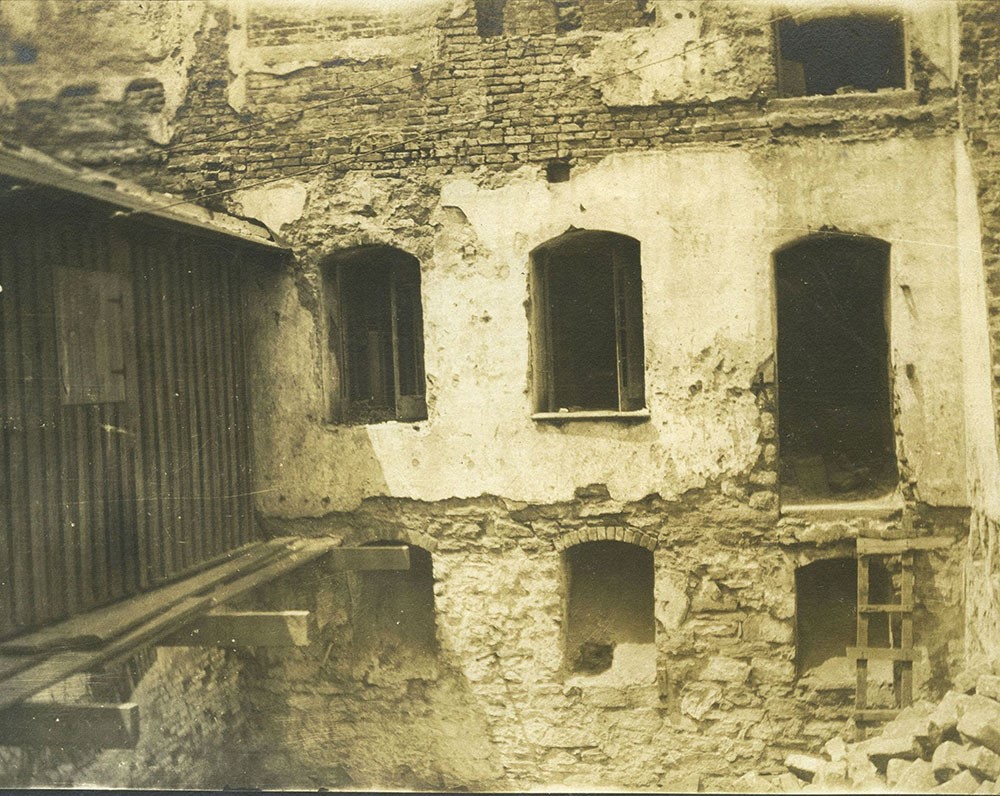
These were the “slave dungeons” next to the slave market and Front and Market Streets. Did Rebecca Miller and her family spend time in these hell holes?

Ms. Miller died on an overcast day in April. Heavy black clouds filled the sky in the evening. Her friends buried her, with dignity, at Bethel Burying Ground. (1)

(1) Public Ledger, 2 May 1846, p.1.

One-year-old William Augustus died this date, April 22nd, in 1846 and was buried at Bethel Burying Ground.

Posted by Terry Buckalew on April 22, 2021
Posted in: On This date. Tagged: African American burial grounds, African American cemeteries, African American History, African Methodist Episcopal Church, archeology, Mother Bethel, Mother Bethel African Methodist Episcopal Church, Philadelphia. Leave a comment

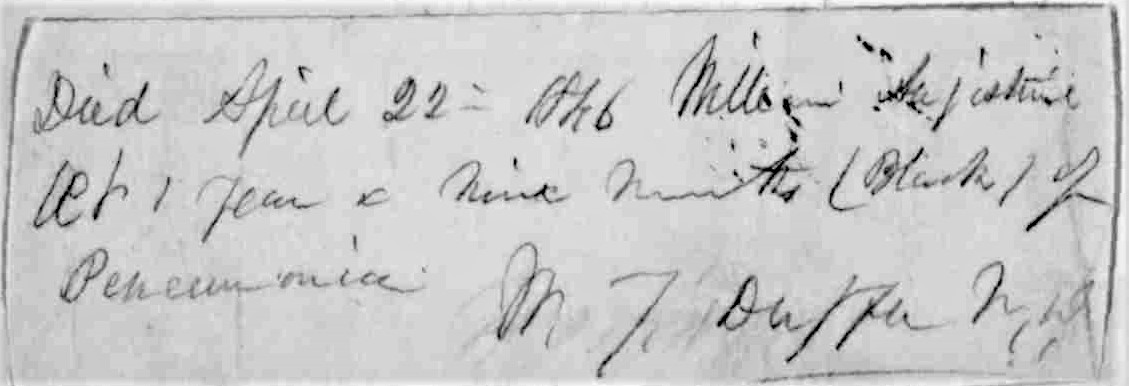
One year and nine month old William Augustus died this date, April 22nd, in 1846 of Pneumonia and was buried at Bethel Burying Ground. Although the attending physician wrote the family name as ‘Augustine,’ there is census and city directory evidence that the family’s name was actually ‘Augustus.’ The child’s parents were Samuel, age thirty-six, and Mary Augustus, age twenty-nine. He worked as a porter and Ms. Augustus as a laundress. They had a one-year-old daughter Elizabeth. It also appears that Ms. Augustus was pregnant with her son George, according to the 1850 U.S. Census.

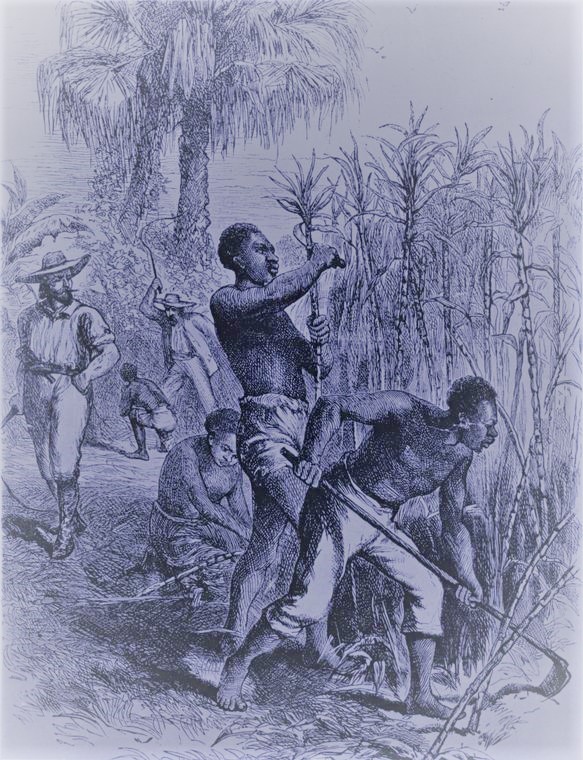
All the members of the family were born in Philadelphia with the exception of Ms. Augustus who was born in the West Indies. She was born to an enslaved mother on one of the many islands that used kidnapped Africans to grind away their lives harvesting sugar cane. The life expectancy of someone working in these killing fields was three years.

New York Library Digital Collection

We may never know how Ms. Augustus came to Philadelphia. In the 1850 U.S. Census, she declined to answer any questions concerning her enslaved past. She was born in 1817 and, curiously, that was the same year when all the Caribbean islands, large and small, were devastated by a powerful hurricane. The sugarcane fields were destroyed along with all structures including “negro houses.” (1)

A possibility is that Mary’s enslaver fled the island they lived on and resettled in Philadelphia. The city was a haven for French refugees because of Stephen Girard’s presence and the subsequent French community near the Delaware River waterfront. Any enslaved Blacks would be freed once they landed in the city. They might have to do several years of an indentureship but eventually would be liberated. The 1850 U.S. Census shows that Ms. Augustus was one of 254 city residents born in the “West Indies.”

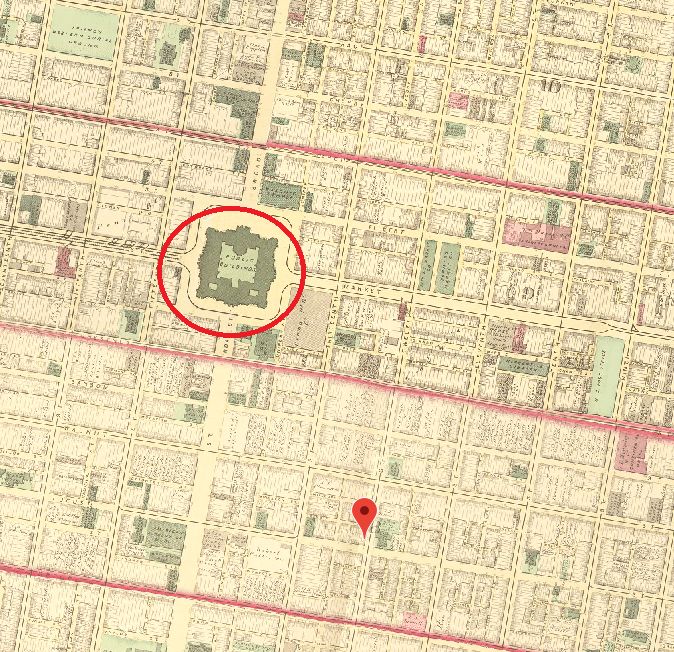
The Augustus family lived on Centre Street (red pin) five blocks from Center Square now Philadelphia City Hall (red circle).

When Baby Augustus died, he was living with his parents and sister in one room on Centre Street. The family paid $3.50 a month for rent. Mr. Augustus was employed as a porter earning $5 per week. Ms. Augustus, who was pregnant, was self-employed as a laundress, likely earning around $.50 a week. The Augustus family neighbors on Centre Street were Black men and women employed as waiters, barbers, dressmakers, shirt makers, seamen, and a “travelling preacher,” according to the 1847 Census. Their very young children were cared for at the 6th and Lombard Street School, while the older children went to either the Adelphia School or the Raspberry Alley School. The last school listed in the previous sentence also had a evening school for adults that taught reading, writing, and math.

Baby Augustus died on a cloudy April day where the temperature rose to a high of 63 degrees. His parents buried him, with dignity, at Bethel Burying Ground.

(1) Daily National Intelligence, Washington, DC, 26 November 1817, p. 2; Vermont Gazette, 2 December 1817, p. 3; Boston Commercial Gazette, 8 December 1817, p. 3.

Twenty-seven-years-old John Murphy died this date, April 8th, in 1845 and was buried at Bethel Burying Ground.

Posted by Terry Buckalew on April 8, 2021
Posted in: On This date. Tagged: African American burial grounds, African American cemeteries, African American History, African Methodist Episcopal Church, archeology, Bethel Burying Ground, Mother Bethel, Mother Bethel African Methodist Episcopal Church, Philadelphia. Leave a comment

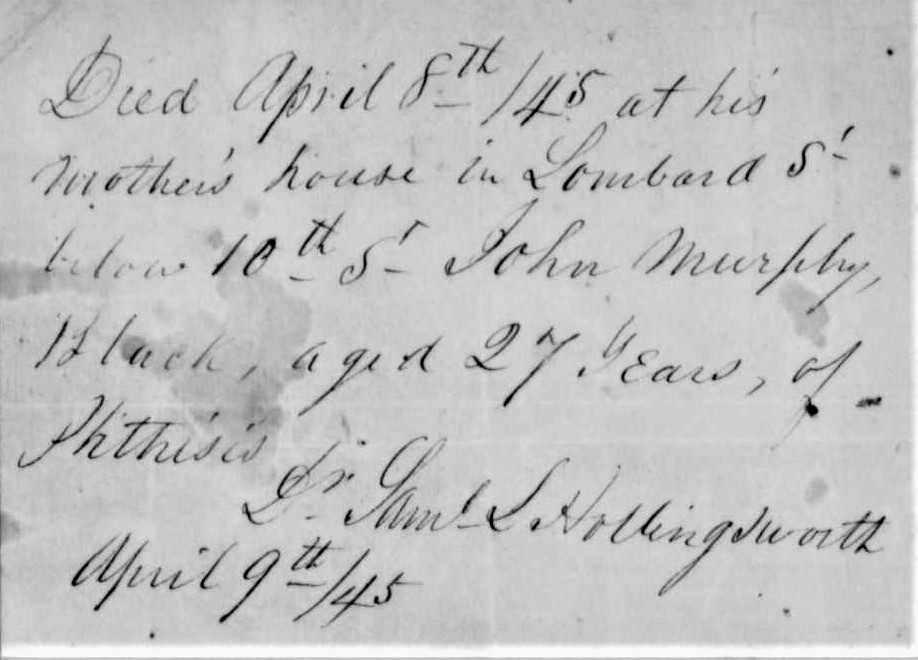
Twenty-seven-year-old John Murphy died this date, April 8th, in 1845 of Tuberculosis (Phthisis) and was buried at Bethel Burying Ground. He passed away at his mother’s house, according to Dr. Samuel S. Hollingsworth, the attending physician. Mr. Murphy was one of 1,633 Philadelphians to die of TB from 1844 to 1845. There is no mention of his occupation in census records or city directories. His mother, Emmaretta Murphy, was a widow and the head of the family at least since the 1838 Philadelphia African American Census. Ms. Murphy was a self-employed laundress, according to census records.

A snapshot of the Murphy family in the 1838 Census shows that there were a total of seven members in the household, four of whom were not born in Pennsylvania. Two were children in school and two members worshiped at Bethel A.M.E. Church. These individuals could have been family members or just boarders.

Two years after John’s death, the family consisted of Ms. Murphy and two males, one of which was under fifteen years old and and the other was under the age of fifty. The names and the relationships of the two males were not provided.

On the night of Tuesday, February 24th in 1845, as Mr. Murphy lay on his bed gasping for air in the last stages of his illness, his street erupted into violence. A white mob of “thirty to forty” men invaded the neighborhood and went on a rampage assaulting any African American they saw on the street. Two city watchmen tried to halt the gang and were severely beaten for their efforts. The rioters were members of the Moyamensing Hose Company, according to one newspaper report. The newspapers did not carry any details concerning the wounded African Americans. Sadly this was not an unusual event in the Philadelphia Black community. The newspapers called the mob members “rowdies.” (1)

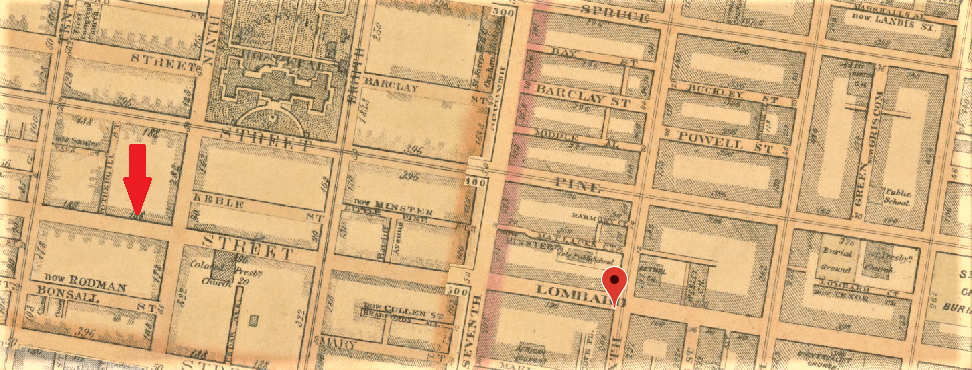
The red arrow illustrates the location of the Murphy home in the 900 block of Lombard Street just south of Pennsylvania Hospital. The red pin indicates the location of Bethel A.M.E. Church and its proximity to the Murphy residence.

On the April day that John Murphy died, the weather turned “cold, raw, windy” with snow flurries that gave the day “the appearance of the depth of winter.” He was buried, with dignity, by his mother at Bethel Burying Ground.

(1) Public Ledger, 25 February 1845, p.2.; North American, 25 February 1845, p. 2.

Fifty-five-year-old Anna Clarke died this date, April 6th, in 1853 and was buried at Bethel Burying Ground.

Posted by Terry Buckalew on April 7, 2021
Posted in: On This date. Tagged: African American burial grounds, African American cemeteries, African American History, archeology, Mother Bethel African Methodist Episcopal Church, Philadelphia. Leave a comment

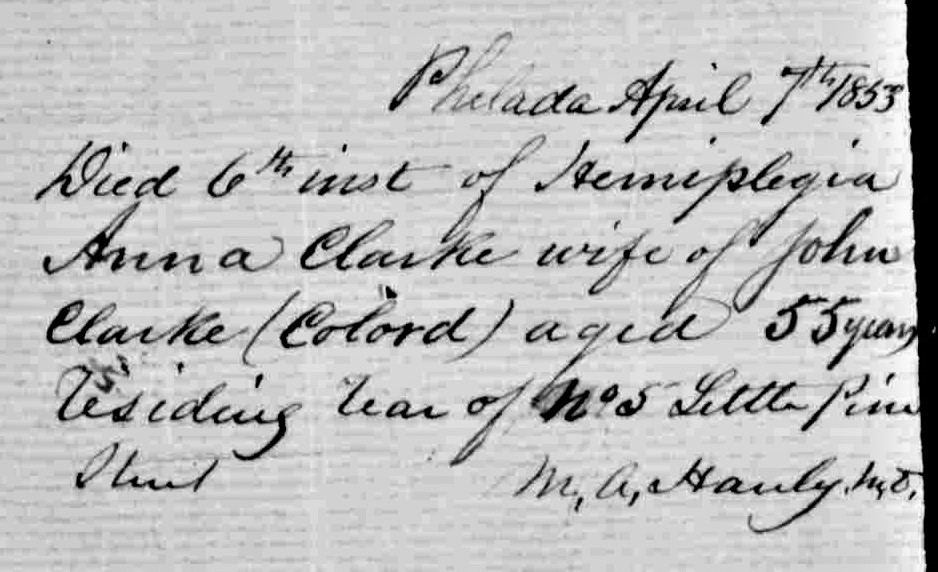
Fifty-five-year-old Anna Clarke died this date, April 6th in 1853 of “Hemiplegia.” This would be paralysis of one side of the body from a stroke or head injury. Six years earlier in the 1848 Philadelphia African American Census, Ms. Clarke reported she was self-employed as a laundress. It was a strenuous job, even for a young person. John, her husband, worked as a stevedore, loading and unloading cargo from the ships docked on the Delaware River wharfs. It too was a backbreaking job, even for someone half his age. We don’t know his exact age but we can assume it was close to his spouse’s age. In 1847, there was another female in the home listed in the census as someone between the ages of 14 and 50 who also worked as a laundress. Her relationship to the Clarkes’ was not recorded. Only two of the three residents were born in Pennsylvania. In 1847, the family lived in Rose Alley.

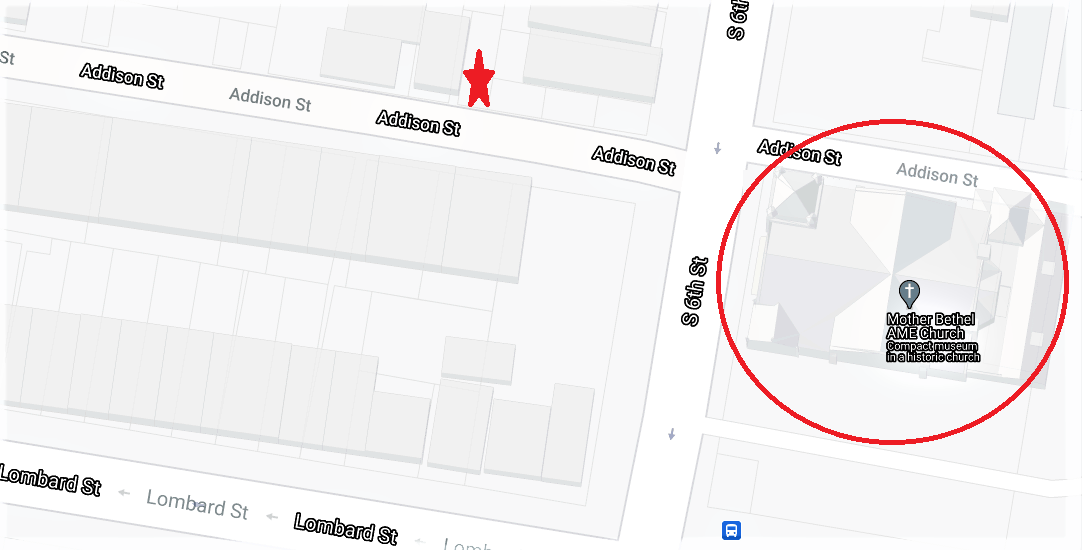
The red star indicates the location of the Clarkes’ family home in the rear of #5 Little Pine Street, now called Addison Street. The red circle indicates Bethel A.M.E. Church and the very close proximity of the two.

Little Pine Street was a thoroughfare of poor working Black families who mostly lived in one room, likely only 9’x9′. But there was another group who resided in the rear of these buildings like the Clarkes. Sheds, horse stables, and pig pens were covered with odd pieces of lumber and carpet and rented as shelter. The floors were dirt and would easily get muddy from the leaky “roof.” Renters would lay discarded pieces of carpet on the bare ground that would get soaked and gather mold. These hovels were the perfect environment for diseases to spread, especially Tuberculosis.

Anna and John Clarke lived on Little Pine Street with neighbors who were employed as a carpenter, painter, boot black, cook, laundress, and several who were seamen. Their children went to school at nearby 6th and Lombard School and Bethel Church. The church was a constant target for white mobs to attack. The Black house of worship was a threat to the white society in apartheid Philadelphia. Congregants were attacked as they left Sunday services. This often resulted in violent battles that also brought the Black residents of Little Pine Street to the clash.

This occurred on such a regular basis that a grand jury ruled that Bethel Church was a “nuisance” for attracting racist mobs. The worshippers at Bethel Church were accused of being a burden to the good order of things because of the color of their skin. It is very likely that the Clarkes were part of this “problem!” (1)

Anna Clarke died on a Spring day in 1853 and was buried by her husband, with dignity, at Bethel Burying Ground.

(1) Poulson’s, 10 July 1822; Public Ledger, 7 August 1837; Age, 11 March 1864.

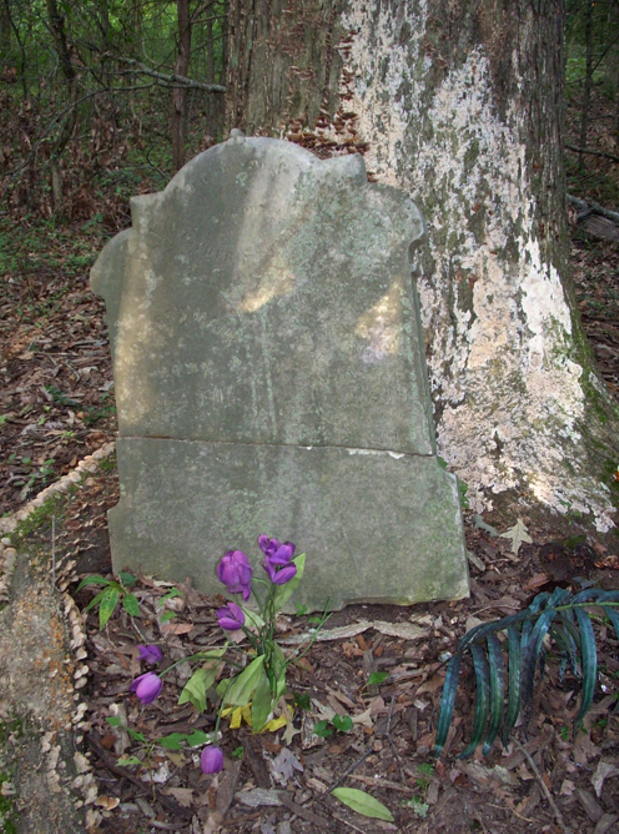
Forty-seven-year-old Gideon Miller died this date, March 10th in 1846 and was buried at Bethel Burying Ground.

Posted by Terry Buckalew on March 12, 2021
Posted in: On This date. Tagged: African American burial grounds, African American cemeteries, African American History, African Methodist Episcopal Church, archeology, Bethel Burying Ground, Mother Bethel, Mother Bethel African Methodist Episcopal Church, Philadelphia, Richard Allen. Leave a comment

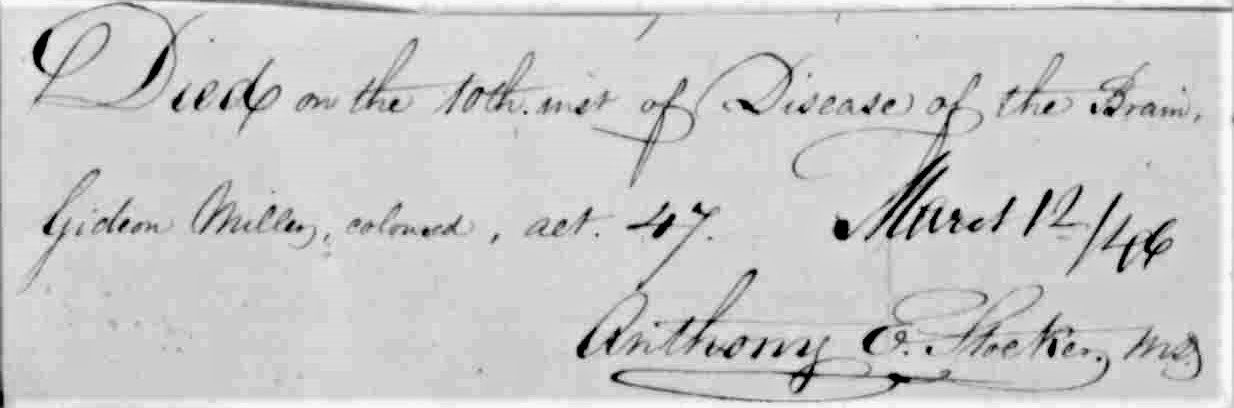
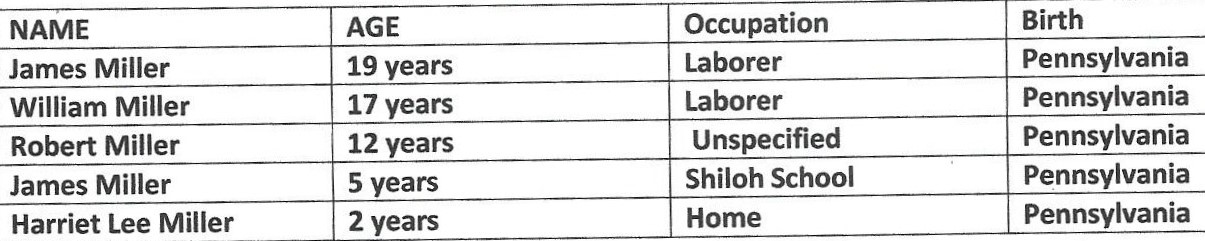
Forty-seven-year-old Gideon Miller died this date, March 10th, in 1846 of a non-specific brain disease and was buried at Bethel Burying Ground. At the time of his death, he was too ill to be employed, according to the 1847 Philadelphia African American Census. He had formerly worked as a waiter. His spouse, Mary Miller, was thirty-four years old and was self-employed as a laundress. Both were born enslaved in Maryland, according to the 1840 and 1850 U.S. Censuses. Mr. Miller’s death left Mary Miller the sole caretaker of her five children.

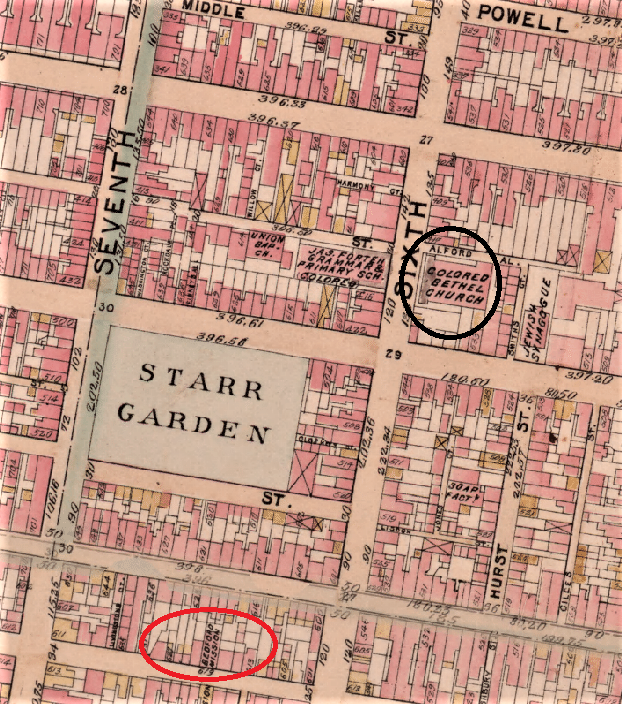
The family lived in one 10′ x 10′ room on Bedford Street for which they paid $0.50 a month. The census taker for the 1847 Census remarked that the building the Millers lived in was “a very old frame building not worth half the money – these persons are very poor from sickness in family,- one child a girl [is] Consumptive.” There were numerous alleys and streets in 19th Century Philadelphia that were not fit for humans to reside. Bedford Street was one of them. In 1846 it was a place of mayhem, squalor, disease, and home to the destitute. “Poverty is the worst kind of violence.” (Mahatma Ghandi)

The red circle above shows the heart of the “negro quarters” on Bedford Street. The black circle illustrates the location and proximity of Bethel African Methodist Episcopal Church.

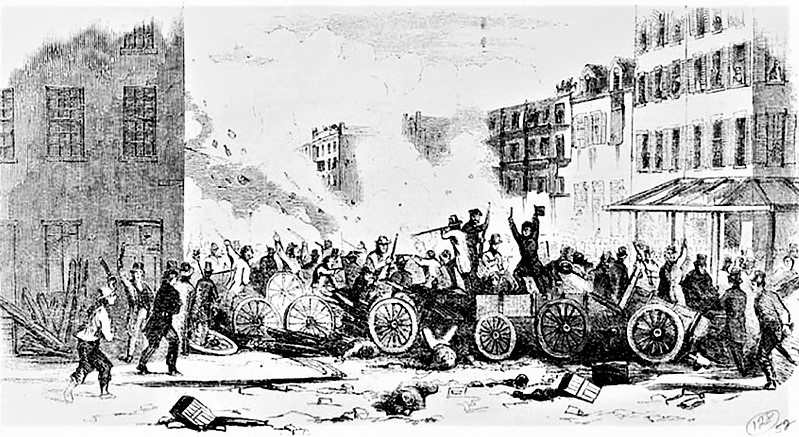
In 1846 all of the city and county of Philadelphia were an active battleground for the dozens of volunteer fire companies that were nothing more than dens of murderous white racist thugs. On the night of Sunday April 2nd in 1845, Mr. Miller, although an invalid, would still have been aware of the awful noises coming from the streets in the neighborhood. Over 500 white boys and men were on a rampage trying to kill each other with guns, knives, bats, and stones. The Weccacoe Hose Company, led by their gang the “Bouncers,” and the Moyamensing Hose Company, spearheaded by their gang “Killers,” engaged in a battle to murder each other for the sake of false religious pride. These riots had become so frequent that a local newspaper said it was concerned that the public was becoming “accustomed to the violence.” In a rare and dangerous condemnation the journalist stated that the police and courts had “failed” the citizens of the city. (1) It is impossible to imagine the anger and fear experienced by the Miller family as they huddled around their sick husband and father.

Frank Leslie’s Illustrated Newspaper, 4 (July 18, 1857), p. 108. A battle between two volunteer fire companies in NYC.

Mr. Miller died on a clear day in March where the temperature rose to a seasonable 50 degrees. He was buried by his family, with dignity, at Bethel Burying Ground.

(1) Daily Chronicle, 24 April 1845, p.2. The Weccacoe Company members were Protestant Nativists and the “Boys of Moya” were Roman Catholic. The majority of both were Irish immigrants.

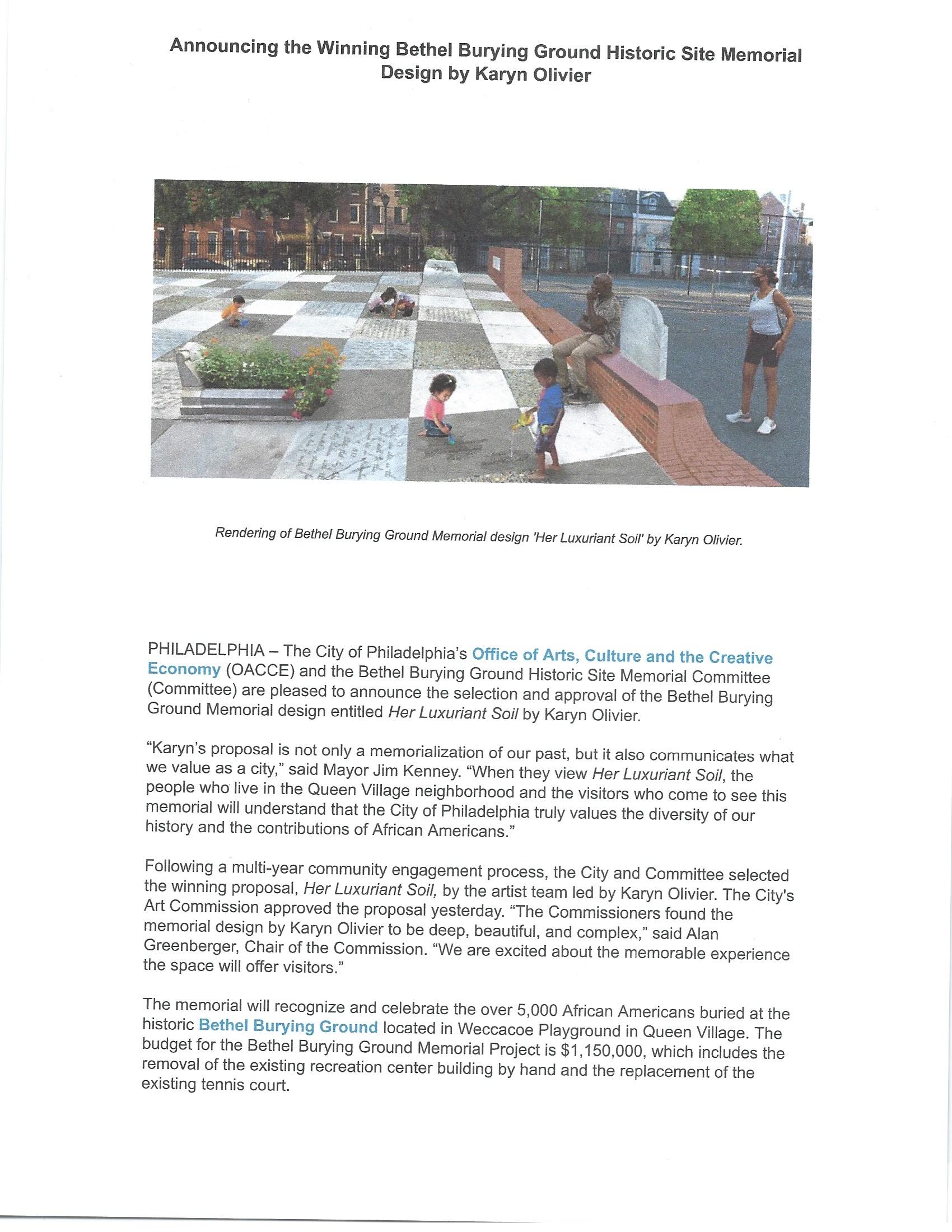
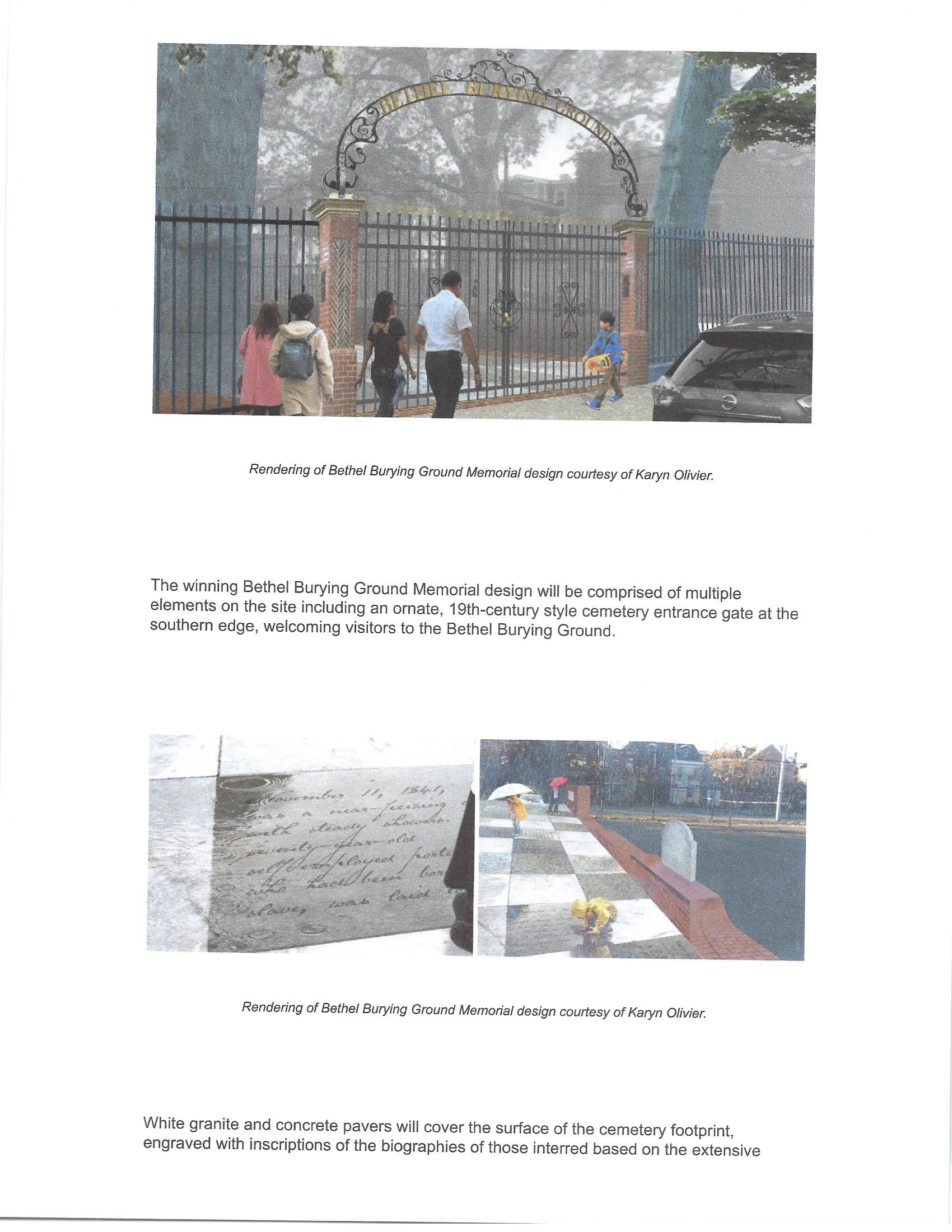
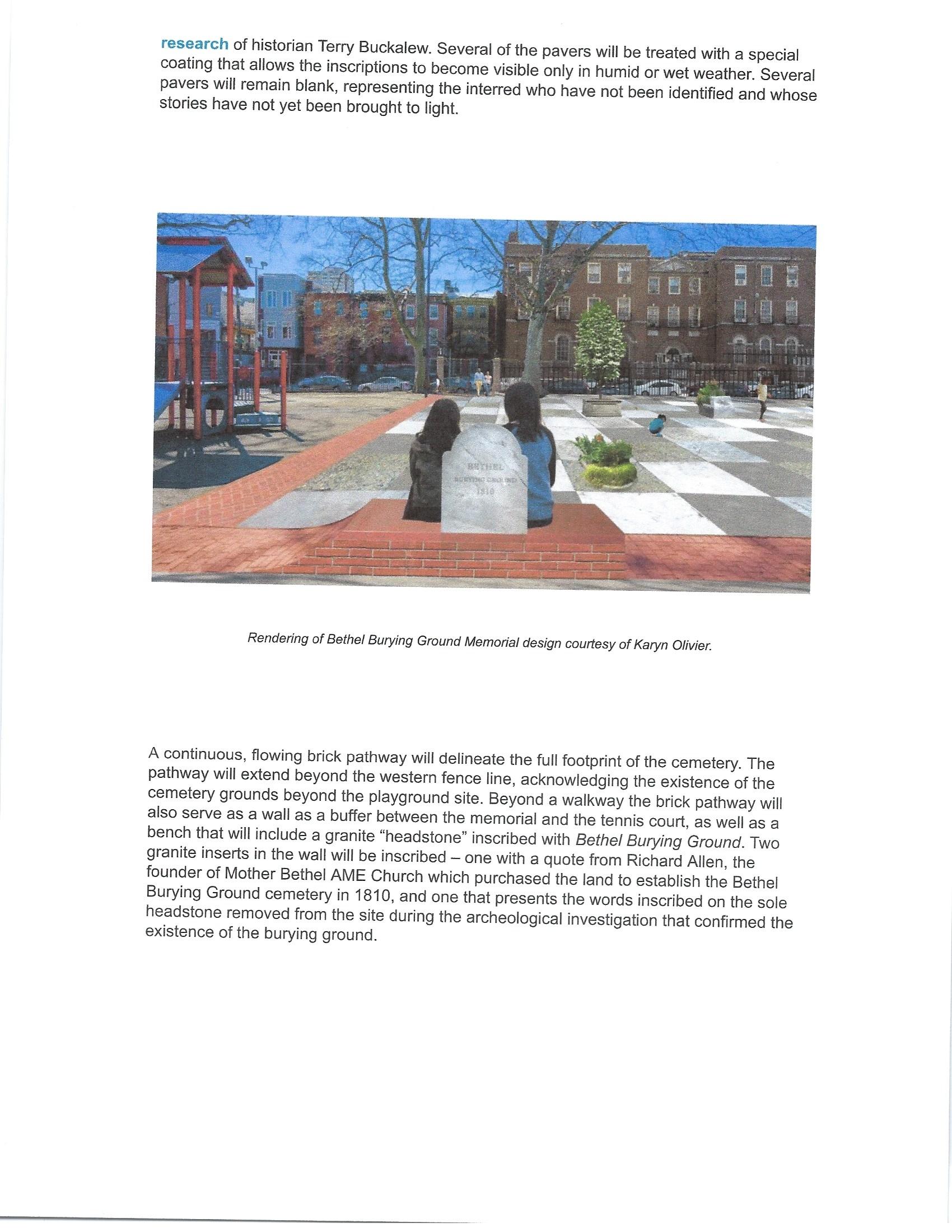
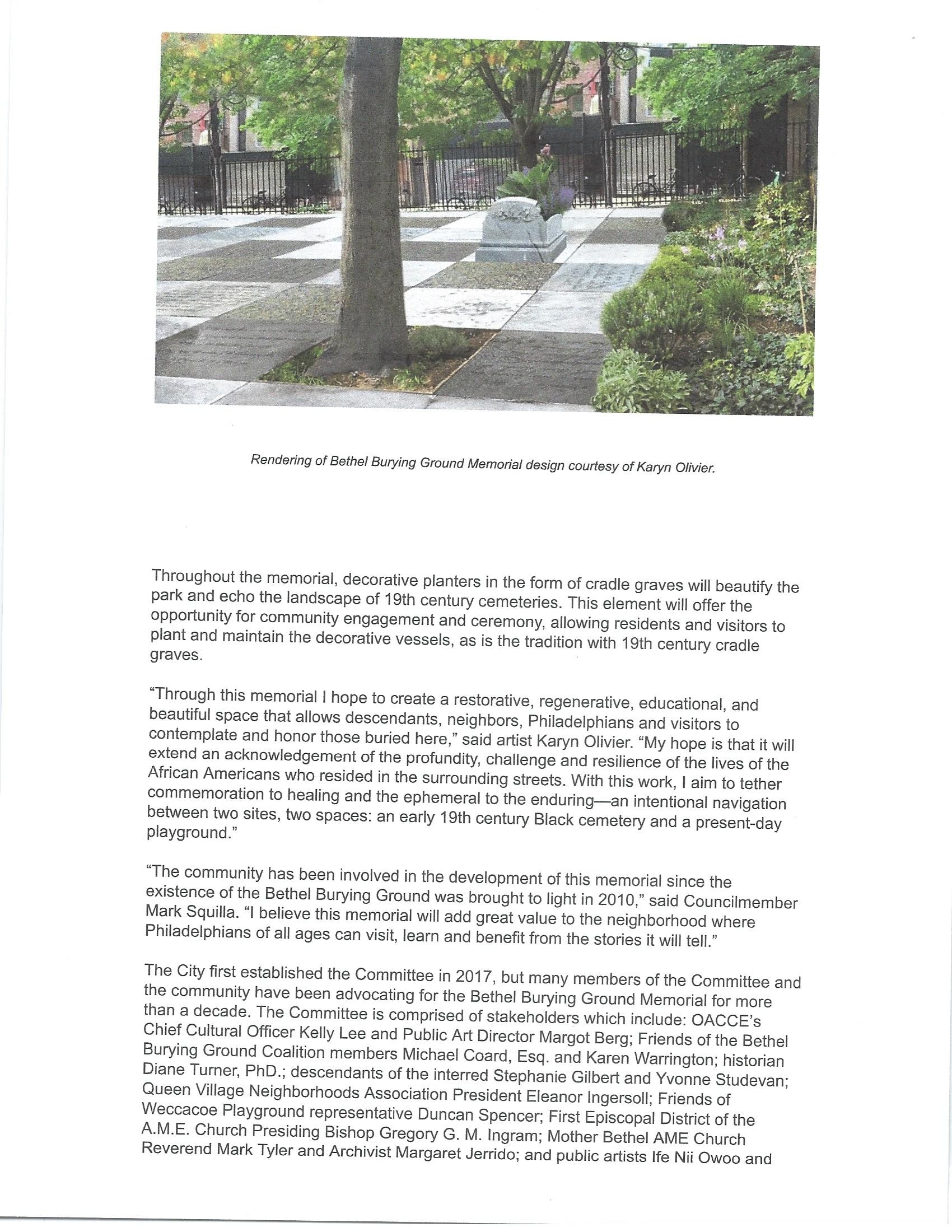
The Memorial for Bethel Burying Ground Has Been Chosen.

Posted by Terry Buckalew on March 11, 2021
Posted in: On This date. Leave a comment

Thirty-year-old Harriet Edwards died this date February 22nd, in 1851 and was buried at Bethel Burying Ground.

Posted by Terry Buckalew on February 22, 2021
Posted in: On This date. Tagged: African American burial grounds, African American cemeteries, African American History, African Methodist Episcopal Church, archeology, Bethel Burying Ground, Mother Bethel, Mother Bethel African Methodist Episcopal Church, Philadelphia, Richard Allen. Leave a comment

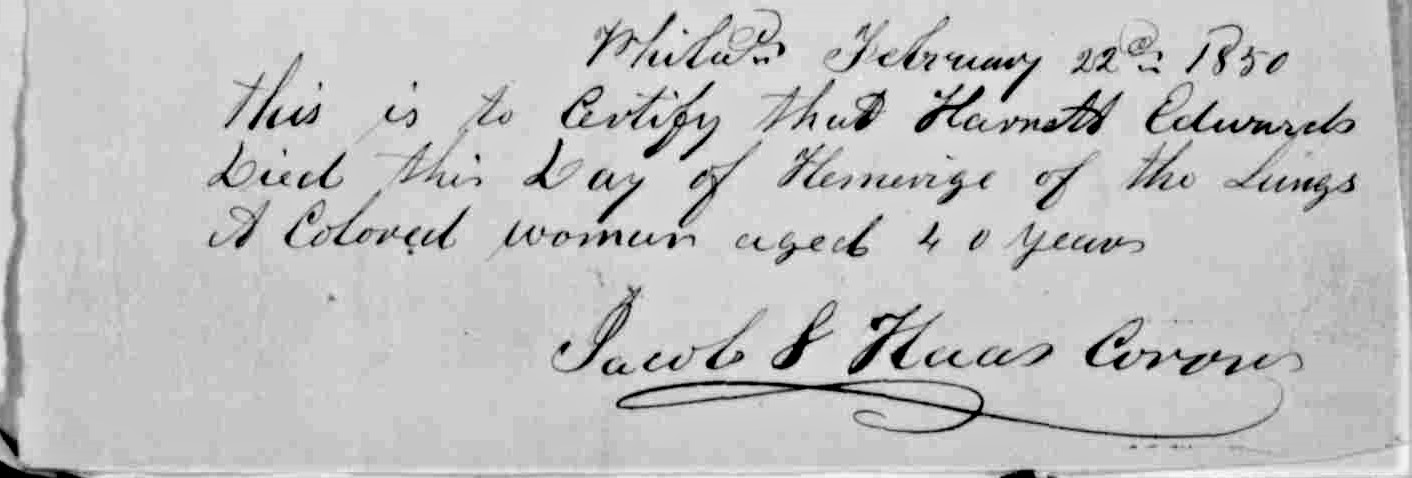
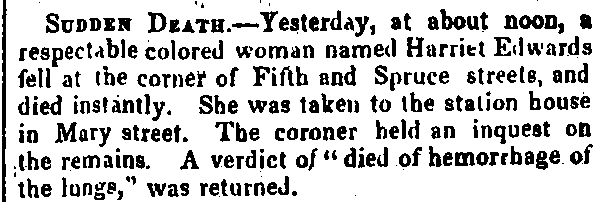
Thirty-year-old Harriet Edwards died this date February 22nd in 1851 of hemorrhaging of her lungs. Ms. Edwards reported to the 1850 federal census taker that she was thirty-years-old and stated the correct spelling of her name. The city coroner also errored in the date of her death. It was in 1851 not 1850.

Sunday Dispatch, 23 Feb 1851, p. 2.

Ms. Edwards collapsed at the corner of 5th and Spruce Streets in center city. The location was a block away from her home on Union Street. Her body was transported to the coroner’s office. Her husband Daniel was employed as a seaman and may not have been in the city. There is no record of the couple having children.

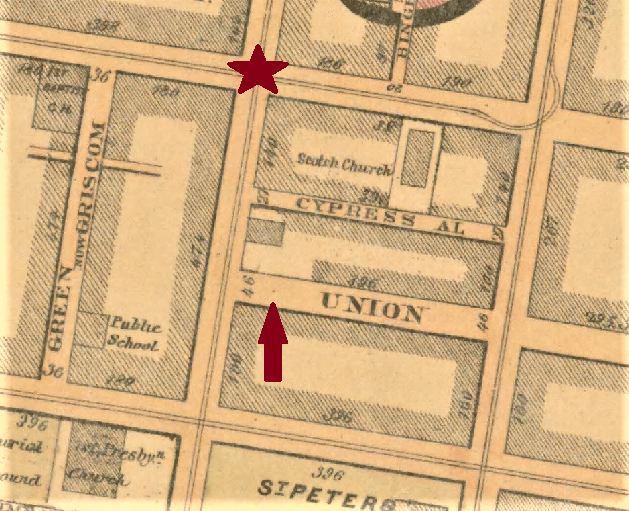
The red star illustrates the location where Ms. Edwards collapsed and died. The red arrow shows the approximate location of her home on Union Street located between 3rd and 4th Sts. just south of Spruce Street.

The 1847 Philadelphia African American Census reports that either Harriet or Daniel Edwards was formerly enslaved. It did not indicate which one. Both were born in Maryland. Ms. Edwards was self-employed as a laundress which was very strenuous work and dangerous to someone who had a serious illness. Mr. Edwards received $23 a month or $770 a month in modern currency as a “seaman.” The couple paid $3.50 a month or approximately $118.00 in modern currency for a room on Union Street. They belonged to a beneficial society that likely helped with the burial expenses.

Free Library of Philadelphia

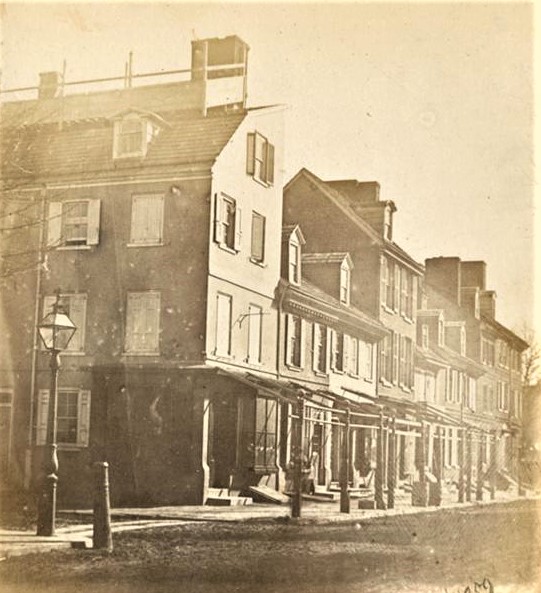
The above photograph is of the intersection where Ms. Edwards collapsed and died. It was taken in 1859, almost eight years to the day of her death. Ms. Edwards, a “respectable” woman, died on a clear day where the temperature rose to 40 degrees. Her husband buried her, with dignity, at Bethel Burying Ground.

Three-year-old Peter Proctor died this date, February 11th, in 1843 and was buried at Bethel Burying Ground.

Posted by Terry Buckalew on February 11, 2021
Posted in: On This date. Tagged: African American burial grounds, African American cemeteries, African American History, African Methodist Episcopal Church, archaeology, Bethel Burying Ground, Mother Bethel, Mother Bethel African Methodist Episcopal Church, Philadelphia, Richard Allen. Leave a comment

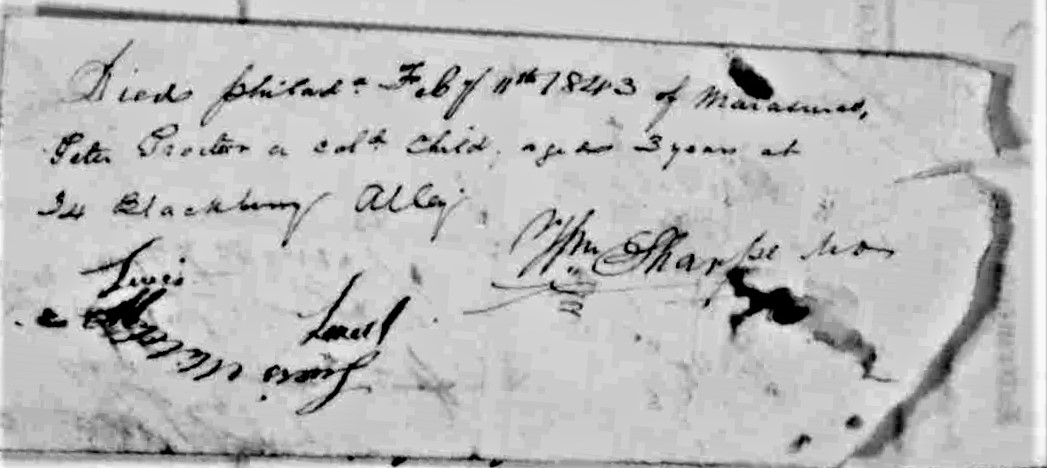
Three-year-old Peter Proctor died this date, February 11th, in 1843 of Marasmus and was buried at Bethel Burying Ground. “Withering” is the Greek translation of ‘Marasmus.’ Like many diagnoses by early 19th Century physicians, they only could declare a symptom as the cause of death and not the underlying pathology. The wasting of the child’s body could have been from pneumonia, meningitis, or any disease that would cause chronic diarrhea. On tragic occasions, the child of a destitute family could starve to death from lack of food. This was likely not the case in this instance.

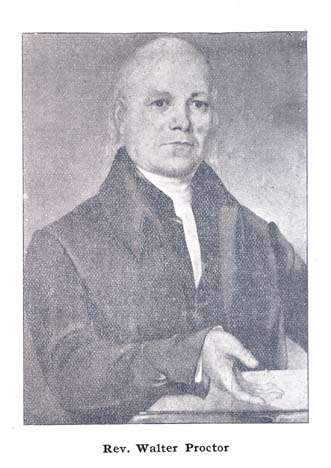
Young Peter was the son of Mary Ann LeCount Proctor and Rev. Walter Proctor. Ms. Proctor was forty-two-years old at the time of her son’s death. She was born in Kent County, Delaware and was a member of the LeCount family which was one of the most significant pillars of the 19th Century Philadelphia Black community. Ms. Proctor was self-employed as a dressmaker. Ms. Proctor gave birth to at least thirteen children. Only seven reached adulthood. For more information on the children please go to: https://www.familysearch.org/tree/pedigree/portrait/L1L8-MSC

NY Library Digital Collection

Rev. Proctor was fifty years old at the time of his son’s death. He was born in Port Tobacco, Charles County, Maryland. Like many Black ministers of the 19th century, he also had additional employment to make financial ends meet. Rev. Proctor was a successful shoemaker who also ran a barbering business, according to the 1847 Philadelphia African American Census.

Rev. Proctor was a long time friend and colleague of Bishop Richard Allen and he was called Allen’s “eyes and ears.” Rev. Proctor was known to be a popular choice to perform baptisms, weddings, and burial services at Bethel Church and Bethel Burying Ground. Rev. Proctor also had a history of marrying interracial couples. Not all Black ministers would do that and, certainly, no white ministers would perform the ceremony. Their churches would be burned down by white mobs and the clergymen would be lucky to get away with only a crippling assault. (1)

Rev. Proctor and Ms. Proctor were active members of the Vigilance Association of Philadelphia, popularly referred to as the ‘Vigilance Committee.’ Over the decades, the organization assisted thousands of Black women, men, and children fleeing their southern enslavement. They were provided protection, housing, food, cash, and, if needed, transportation to New England and Canada. Lawyers were provided to the unfortunate who were kidnapped by slave catchers. The Committee also could organize a flash mob to try to physically remove the arrested fugitive from the kidnappers and the police. Click on the following for further info: https://journals.psu.edu/pmhb/article/view/42412/42133.

According to the 1843 Philadelphia City Directory, the Proctor family lived at #34 Blackberry Alley illustrated by the red circle on the above map. Only a block west of Washington Square, it was known in the press as a “notorious haunt of iniquity” for its numerous and often rowdy houses of prostitution. The Proctors would be on the move every several years, finally settling on Bonsall Street (now Rodman), living next to Ms. Proctor’s family. (2)

Smithsonian American Art Museum

Young Peter Proctor died on a day where the temperature rose to 40 degrees with clear skies. He was buried by his family, with dignity, at Bethel Burying Ground. It is very likely that Rev. Proctor performed the burial service for his son.

(1) Daily Pennsylvanian, 2 Feb 1857.

(2) Public Ledger, 20 Dec 1837.

Vice President Kamala Devi Harris

Posted by Terry Buckalew on January 20, 2021
Posted in: BBG History, On This date. Tagged: African American burial grounds, African American cemeteries, African American History, African Methodist Episcopal Church, Bethel Burying Ground, Mother Bethel, Mother Bethel African Methodist Episcopal Church, Richard Allen. Leave a comment

Dear Friends


Today Senator Kamala Devi Harris will stand in the Capitol Building and she will take the oath of office for the Vice President of the United States. I hope you will take a moment to remember Ignatius Beck. In 1798 he was one of the four hundred enslaved Black men that were “rented” to the United States government to work on the erection of the Capitol building in Washington, D.C.


After his liberation, Mr. Beck eventually came to Philadelphia and became a valuable member of Mother Bethel and a significant conductor on the Underground Railroad. After a very full life he was buried by his family, with dignity, at Bethel Burying Ground.

As we watch the glorious moment Vice President Harris is sworn in, maybe take a moment to remember that two hundred twenty-three years ago a Black man lifted that stone that VP Harris is standing on.


Please say his name. Ignatius Beck.

Best Regards,
Terry

Posts navigation

← Older Entries
Newer Entries →
  • Recent Posts

    • Three dead as church wall falls on this date, May 1st, in 1841.
    • The ten-month-old Baby Colgate died this date, June 20th, in 1847, and was buried at Bethel Burying Ground.
    • Fifty-eight-year-old Rachel Dawson died this date, May 3rd, in 1839, and was buried at Bethel Burying Ground.
    • Twenty-eight-year-old Robert Swails died on this date, March 31st in 1849, and was buried at Bethel Burying Ground.
    • Forty-year-old Jacob “Jesse” Howard died on this date, January 29th, in 1840, and was buried at Bethel Burying Ground.
  • Archives

    • May 2024
    • June 2023
    • May 2023
    • March 2023
    • January 2023
    • December 2022
    • November 2022
    • October 2022
    • September 2022
    • August 2022
    • May 2022
    • April 2022
    • March 2022
    • February 2022
    • January 2022
    • December 2021
    • November 2021
    • October 2021
    • September 2021
    • August 2021
    • July 2021
    • June 2021
    • May 2021
    • April 2021
    • March 2021
    • February 2021
    • January 2021
    • December 2020
    • November 2020
    • October 2020
    • September 2020
    • August 2020
    • July 2020
    • June 2020
    • May 2020
    • April 2020
    • March 2020
    • February 2020
    • January 2020
    • December 2019
    • November 2019
    • October 2019
    • September 2019
    • August 2019
    • July 2019
    • June 2019
    • May 2019
    • April 2019
    • March 2019
    • February 2019
    • January 2019
    • December 2018
    • November 2018
    • October 2018
    • September 2018
    • August 2018
    • July 2018
    • June 2018
    • May 2018
    • April 2018
    • March 2018
    • February 2018
    • January 2018
    • December 2017
    • November 2017
    • October 2017
    • September 2017
    • August 2017
    • July 2017
    • June 2017
    • May 2017
    • April 2017
    • March 2017
    • February 2017
    • January 2017
    • December 2016
    • November 2016
    • October 2016
    • September 2016
    • August 2016
    • July 2016
    • June 2016
    • May 2016
    • April 2016
    • March 2016
    • February 2016
    • January 2016
    • December 2015
    • November 2015
    • October 2015
    • September 2015
    • August 2015
    • July 2015
    • June 2015
    • May 2015
    • April 2015
    • March 2015
    • February 2015
    • January 2015
    • December 2014
    • November 2014
    • October 2014
  • Categories

    • Archaeology
    • BBG History
    • Bethel Burying Ground Name Directory
    • Bethel Burying Ground Timeline
    • Burial services
    • Diseases
    • Documents
    • Freemasonry
    • Ignatius Beck
    • It's a fact
    • Maps
    • Neighborhood
    • Newspaper Articles
    • On This date
    • Photographs
    • Uncategorized
    • Videos
  • Meta

    • Create account
    • Log in
    • Entries feed
    • Comments feed
    • WordPress.com
Blog at WordPress.com.
Bethel Burying Ground Project
Blog at WordPress.com.
  • Subscribe Subscribed
    • Bethel Burying Ground Project
    • Join 48 other subscribers
    • Already have a WordPress.com account? Log in now.
    • Bethel Burying Ground Project
    • Subscribe Subscribed
    • Sign up
    • Log in
    • Report this content
    • View site in Reader
    • Manage subscriptions
    • Collapse this bar
 

Loading Comments...