Bethel Burying Ground Project

Bethel Burying Ground Project

  • ABOUT THE BETHEL BURYING GROUND PROJECT

Current “Bethel Burying Ground Name Directory”

Posted by Terry Buckalew on August 4, 2017
Posted in: Bethel Burying Ground Name Directory. Tagged: African American burial grounds, African American cemeteries, African American History, African Methodist Episcopal Church, archaeology, Mother Bethel, Mother Bethel African Methodist Episcopal Church, Philadelphia, Richard Allen. Leave a comment

Below is the link to the current Bethel Burying Ground Name Directory.

BETHEL BURYING GROUND NAME DIRECTORY

(Revised August 2, 2017)

The following is an alphabetical directory of some of the African American Philadelphians who were buried at Bethel Burying Ground from 1810 to 1864. Currently, 2,491 individuals have been identified through City of Philadelphia death records and historic newspapers. Research is ongoing to identify the remainder of the 5,000+ estimated to be buried on Queen Street in old Southwark.

Those names that are in bold type have short biographical sketches at https://bethelburyinggroundproject.com/.

Click on:

BBG Name Directory (pdf) 

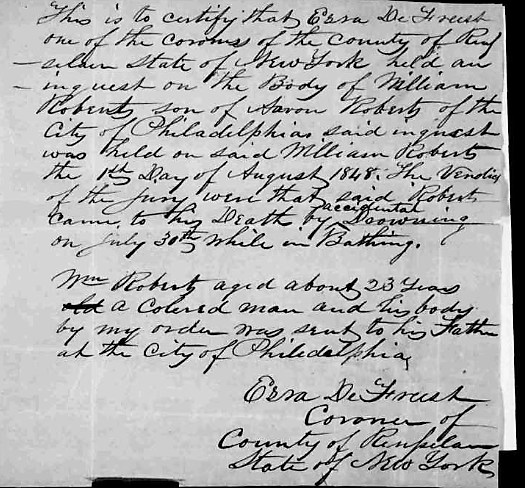
Twenty-three-year-old William Roberts died on July 30th and was buried at Bethel Burying Ground.

Posted by Terry Buckalew on July 31, 2017
Posted in: On This date. Tagged: African American burial grounds, African American cemeteries, African American History, African Methodist Episcopal Church, archaeology, Mother Bethel, Mother Bethel African Methodist Episcopal Church, Philadelphia, Richard Allen. Leave a comment

Wm roberts 2

The above document is a report by the Coroner of Rensselaer County of New York State that states twenty-three-year-old William Roberts drowned while bathing.* His body was transported to his father Aaron Roberts in Philadelphia. Rensselaer County is in the northeast part of New York and borders Massachusetts and Vermont. The county seat is Troy, NY. Young William went missing on July 30, 1848, and his body was recovered on August 1st when it was viewed by the coroner. William Roberts was buried at Bethel Burying Ground.

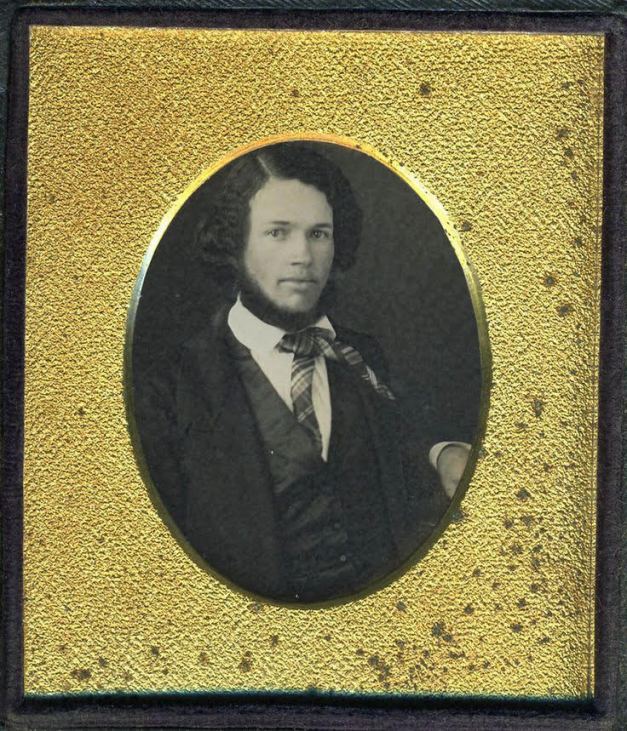
unnamed

Young 19th Century African American man

I could not locate any biographical information on William. However, Federal and local censuses reveal that his parents were Aaron and Rachel Roberts; both 50 years of age at the date of their son’s death. Aaron worked as a porter and Rachel as a laundress. Also in the home was a daughter Rebecca (18 y/o) and Matilda Miller (53 y/o). All members of the Roberts family were born in New Jersey and Ms. Miller in Maryland. The 1850 Federal Census reports all family members as being “mulatto.”  

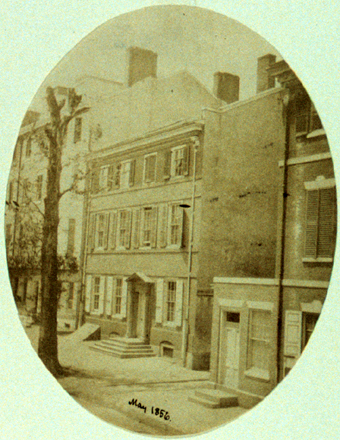
The family lived in a single room on Willing’s Street, a small thoroughfare that ran between Chestnut and Walnut Streets and 3rd and 4th Streets near the banks of the Delaware River. The rent was extremely low at $2.50 a week which indicates a very poor subsistence. Aaron reported in the 1847 African American Census that he earned $6 a week; approximately $150 in today’s currency. Rachel may have brought in a couple dollars more a week if she had the work.

willing

Willing’s Street (May 1856)

Willing’s Street has an interesting place in Philadelphia history. Starting in 1745, it was renowned as “Mansion Row” and was the home of wealthy merchants in the city. By the time the Roberts family moved there, the structures had been turned into boarding houses. Tucked in between the early marble and mahogany mansions was a small brick building that in 1770 began to house the Free African School. The school was founded by Anthony Benezet, a white French immigrant, and Quaker educator.  He was an early fervent abolitionist and founder of one of the world’s first anti-slavery organization. The school was only open for six years but broke many barriers in the education of Black Philadelphians. In its short span, it served approximately 250 African American children. Its graduates included Samuel E. Cornish who was to become an African Methodist Episcopal minister and civil rights leader and James Forten, a successful manufacturer and a tireless leader in the anti-slavery and equal rights movement in Philadelphia and nationally. Free School teachers included the remarkable Sarah Dougherty and Sarah Mapps Douglas who went on to teach and mentor the young Black women at the Institute for Colored Youths.

I have no way of knowing this but in the above photo of Willing’s Street, there is a one-story brick building. Could this have been the building that housed the Free School?


*I could not find any newspaper reports on William’s death. 


Two-year-old Mary Lavinia Singer died this date, July 14th, in 1849 and was buried at Bethel Burying Ground.

Posted by Terry Buckalew on July 14, 2017
Posted in: On This date. Tagged: African American burial grounds, African American cemeteries, African American History, African Methodist Episcopal Church, archaeology, Bethel Burying Ground, Mother Bethel, Mother Bethel African Methodist Episcopal Church, Philadelphia, Richard Allen. Leave a comment

SINGER

Two-year-old Mary Lavinia* Singer died this date, July 14th, in 1849 of “Tabes” (Tuberculosis) and was buried at Bethel Burying Ground. The research materials available pose a mystery – who were Mary’s parents? In the 1847 African American Census, the Singer family headed by Theodore Singer contained him and three others. There were two females and two males; two under 5 years and two under 50 years. Only one was not a native of Pennsylvania. We don’t know Mary’s exact birth date so she may or may not be included in this survey. 

Theodore was a waiter making a reported $12 a month and his spouse worked as a laundress, likely earning $1-$2 a week depending upon demand. The family lived in desperate poverty with the whole family living in a 10 ft. by 10 ft. room with no running water. They paid $3 a month in rent or an equivalent to approximately $75 in today’s cash. This room was located at 322 Cedar Street above 7th Street. Cedar is now called South Street. 

Mother and Children

Mother and children

Name                                    Age        Place of Birth     Occupation

Theodore Singer               45           PA                          Waiter

      Rebecca Singer                 27           NJ                           Unknown

         John Singer                         17           NJ                           Barber        

James Singer                    5           PA                          N/A

Eliza J. Singer                   2           PA                          N/A

Lavina Thomas                           48           NC                          Unknown

                                                         (Source: 1850 Federal Census)

Ms. Thomas died on January 2, 1854, of kidney disease and was buried at Bethel Burying Ground, likely with or next to Mary Lavina Thomas. Her age was reported to be 56 years old.

1-898443_orig

Tuberculosis accounted for less than one percent of deaths in children two years old and under. The majority of childhood deaths during the first year of life accounted for 47% of all childhood deaths during this era. Convulsions were the major cause of death in the first year of life and Cholera was the most prevalent in the second year of life. (A Biohistory of 19th Century Afro-Americans, Lesley M. Rankin-Hill, p. 77-78.)

*The correct spelling is likely “Lavina.”

Ten-year-old Alexander Samons died this date, July 4th, in 1842 and was buried at Bethel Burying Ground.

Posted by Terry Buckalew on July 4, 2017
Posted in: On This date. Tagged: African American burial grounds, African American cemeteries, African American History, African Methodist Episcopal Church, archaeology, Bethel Burying Ground, Mother Bethel, Mother Bethel African Methodist Episcopal Church, Philadelphia, Richard Allen. Leave a comment

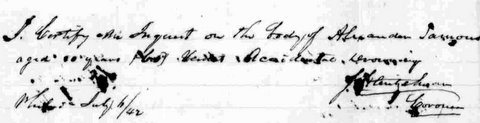
A. Samons (1)

Alex Samons

North American, 7 July 1842

Ten-year-old Alexander Samons died this date, July 4th, in 1842 of accidental drowning while bathing in the Schuylkill River. On the night on July 1st, a violent storm hit the Delaware Valley causing the Delaware and Schuylkill Rivers to overflow their banks flooding hundreds of homes in Philadelphia. The newspapers reported, “torrents of rain” from a storm that was the “severest” to occur in the area for many years – this by way of explaining what may have caused the boy to be swept away from the Grays Ferry Wharf by a swirling, powerful current. 

Attachment-1

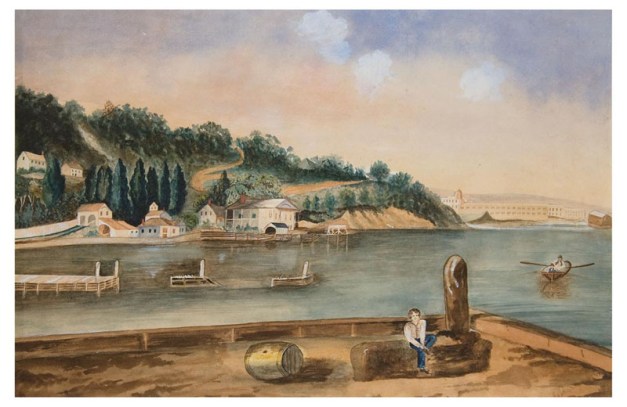
“Schuylkill River at Gray’s Ferry”, by P. Clark, (1835)

Above is a painting of the wharf from which Alexander may have been diving before he went under. There are others in the background to the left. The painting was done 6 or 7 years prior to his death in 1842.

It is not possible with any certainty to identify Alexander’s parents. The spelling of the last name by the coroner is probably incorrect. The name was “Sammons” and was an old African American family name in Philadelphia. There are several people with that name buried at Bethel Burying Ground.  

___________________________________________________________________________________________

NOTES

It looks like the boy’s body was pulled from the water by boatmen the same day he drowned and was brought to the Pine Street Wharf upstream from Grays Ferry where the City Coroner examined the body. If you look closely at the death certificate the ink looks like it has been smeared by water droplets. 

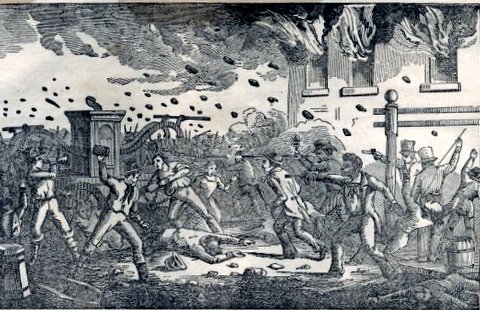
It is unlikely that Alexander was buried on the 4th of July. Black Philadelphia citizens would head out early morning on the 4th to do any food shopping so as to avoid the roving drunk violent white gangs who believed it was their patriotic duty to try and kill any Black man, woman or child they saw on the streets just going about their business. Churches, meeting halls, and homes were looted and burned. A funeral procession of Black citizens would surely have been attacked in Southwark where Bethel Burying Ground was located.

California House Riot

Eighty-year-old Isaac Davis died this date, June 30th, in 1864 and was buried at Bethel Burying Ground.

Posted by Terry Buckalew on June 29, 2017
Posted in: On This date. Tagged: African American burial grounds, African American cemeteries, African American History, African Methodist Episcopal Church, archaeology, Mother Bethel, Mother Bethel African Methodist Episcopal Church, Philadelphia, Richard Allen. Leave a comment

1-Issac Davis

Eighty-year-old Isaac Davis died this date, June 30th, of Typhoid Fever and was buried at Bethel Burying Ground. He was single and occupied as a woodsawyer. Mr. Davis was born in Philadelphia in 1784. Despite this, he is not recorded in any Federal Census or in the 1838 and 1847 African American censuses. City directories do list his occupation as “laborer” who was living at 518 S. 7th Street.

woodsawyer (1)

WOODSAWYER

After the City of Philadelphia and the County of Philadelphia consolidated in 1854, the Board of Health made it difficult for cemeteries to exist, except on the outer boundaries of the city. By the time Mr. Davis was buried, Bethel Burying Ground had been closed and virtually abandoned. Even closed cemeteries were sometimes allowed to bury an individual if he or she had family members interred there. It is impossible to ascertain if that is the case in this situation since there are a minimum of thirty individuals buried at BBG with the last name “Davis.” And it is probably closer to one hundred considering how many records were lost. In 1864, there is only one other individual recorded being buried on Queen Street. Mr. Davis was the last whose records have survived.

Sketch Jackie 2

Mr. Davis was buried on July 2, 1864, two days after his death from Typhoid Fever. One year after the Battle of Gettysburg. 

The 10-day-old Bailey child died this date, June 24th, in 1854 and was buried at Bethel Burying Ground.

Posted by Terry Buckalew on June 24, 2017
Posted in: On This date. Tagged: African American burial grounds, African American cemeteries, African American History, African Methodist Episcopal Church, archaeology, Bethel Burying Ground, Mother Bethel, Mother Bethel African Methodist Episcopal Church, Philadelphia, Richard Allen. Leave a comment

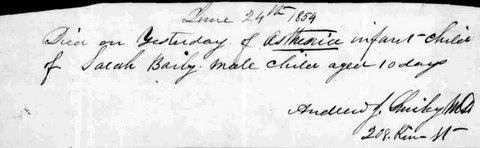
Baby Bailey

The 10-day-old son of Sarah Bailey died this date, June 24th, in 1854 of Asthenia and was buried at Bethel Burying Ground. Asthenia occurs at the end of the first or beginning of the second week of the infant’s life. It is an infection of the umbilical cord and causes severe symptoms that included a rash and swelling downwards over the lower abdomen and limbs with sloughing of the skin and exposure of muscles. Symptoms also include vomiting, diarrhea, drowsiness, and seizures. It is fatal in newborns.

Ms. Bailey sought help for her baby at the Southern Dispensary (clinic) at 318 Bainbridge Street and saw Dr. Andrew J. Smiley. There was nothing known to medical science at that time that could have saved the infant. 

I cannot determine with absolute certainty Ms. Bailey’s identity in city directories or local/federal censuses. It appears she may have been the spouse of Richard Bailey who lived at 263 Spruce Street, only three blocks from the clinic according to the 1847 African American Census (AAC).  Richard was a coal carrier and Sarah would have been a laundress. The Bailey’s were impoverished, according to the 1847 AAC.
g

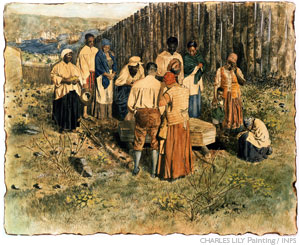
The tyrant, Death, came rushing in,

Last night his power did shew,

Out of this world this child did take,

Death laid its visage low.

No more the pleasant child is seen

To please the parent’s eye,

The tender plant, so fresh and green,

 Is in eternity.

Rev. Richard Allen (Hymn XLI, p. 64, “A Collection of Hymns and Spiritual Songs.”)


Twenty-year-old Elizabeth Brown died this date, June 12th, in 1846 and was buried at Bethel Burying Ground.

Posted by Terry Buckalew on June 12, 2017
Posted in: On This date. Tagged: African American burial grounds, African American cemeteries, African American History, African Methodist Episcopal Church, archaeology, Bethel Burying Ground, Mother Bethel, Mother Bethel African Methodist Episcopal Church, Philadelphia, Richard Allen. Leave a comment

E BROWN (1)

Twenty-year-old Elizabeth Brown died this date, June 12th, in 1846 of Tuberculosis and was buried at Bethel Burying Ground. She died at the house of her parents, Marcus (66 y/o) and Louisa Brown (59 y/o). She is also survived by her brothers Lewis (23 y/o) and John (18 y/o) who also lived with their parents. Marcus was a retired shoemaker who passed the business on to his sons who ran the business from their home in the 900 block of Bonsall Street (now Rodman) near the intersection of 9th and South Streets in the south area of the city of Philadelphia. Louisa Brown worked as a domestic as a younger woman according to Federal and local census records. 

In the Fall of 1860, Frederick Douglass visited Philadelphia and was taken on a tour of the many neighborhoods populated by African Americans. He visited the specific block that the Browns had lived on in 1846 and wrote this in an article for his October 1860 edition of his newspaper the “Douglass’ Monthly.” The city directory for 1860 does not list the Browns living on Rodman Street at the time of the article.

We passed with our guide up South Street to Ninth, and thence to Rodman street— Several fine dwellings. of three and four stories, fronted with white marble, and having doors of carved stone were exhibited upon those avenues. Rodman Street runs parallel with South Street, one-half square above it. It is peopled almost entirely by colored families.— We gazed with curiosity at its rows of tall, beautiful houses, and saw, with some interest, the clean pavements and street. In some places, fine ornamental trees stood upon the sidewalks, and in the doorways, the families of colored men are seated. By the imperfect moonlight, they seemed to be neatly dressed. There was no loud laughing or talking; in fact, it seemed to us that we had not remarked for the early evening such general decorum in any street in the city.

Image result for chain

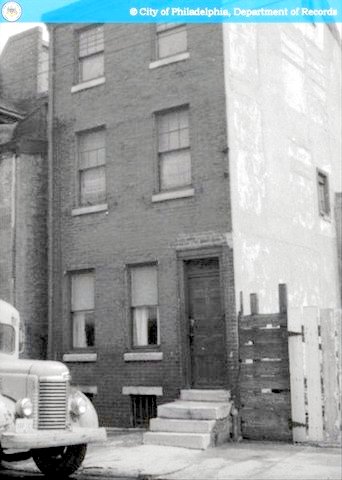
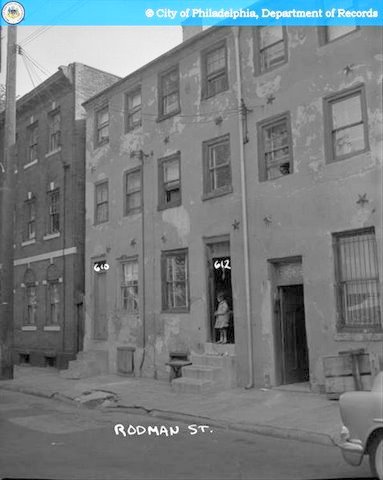
These photographs were taken in 1964 of the block that the Brown family lived on at the time of young Elizabeth’s death. The first photo is of 904 Rodman and the second is of 912 Rodman. The Browns lived at 906 according to the 1846 city directory. By 1964 it appears that address had been demolished. 

904 Rodman Street - taken in 1964612 Rodman St.


Fourteen-year-old John Fletcher died this week in June of 1852 and was buried at Bethel Burying Ground

Posted by Terry Buckalew on June 7, 2017
Posted in: On This date. Tagged: African American burial grounds, African American cemeteries, African American History, African Methodist Episcopal Church, archaeology, Bethel Burying Ground, Mother Bethel, Mother Bethel African Methodist Episcopal Church, Philadelphia, Richard Allen. 1 Comment

FLETCHER

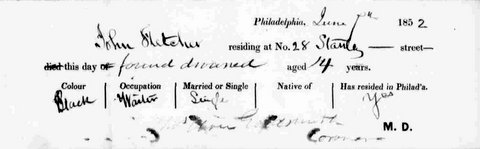
Fourteen-year-old John Fletcher was a waiter on the Delaware River steamboat New Philadelphia. On the 3rd of June in 1852, he went missing while the steamboat was docked at Bordentown, New Jersey. His body was discovered in the river on June 7th and transported to Philadelphia where the coroner ruled the death an accidental drowning on June 9th. He was subsequently interred at Bethel Burying Ground.

1-Fletcher newspaper

 During the work week, the steamboat ferried customers to railroad connections in Trenton and the Upper Delaware River. During the weekend the vessel was an excursion boat that took passengers on day trips to picnic locations such as Burlington and Bristol, both in Pennsylvania. The boat had a lively music band and refreshments were provided including ice cream that the young Mr. Fletcher would serve.

Mr. Fletcher lived at no. 28 Stanley Street which was a short thoroughfare between 3rd and 4th Streets just south of Bainbridge Street in the old Southward District of South Philadelphia.  It is not conclusive although it appears that John was an orphan adopted by Anthony Fletcher (drayman) and his spouse a laundress (name not recorded) according to the 1847 African American Census.

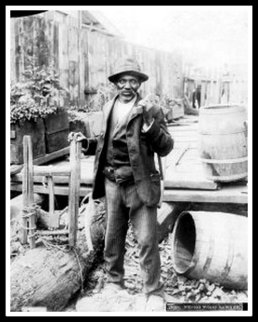
Young negro man

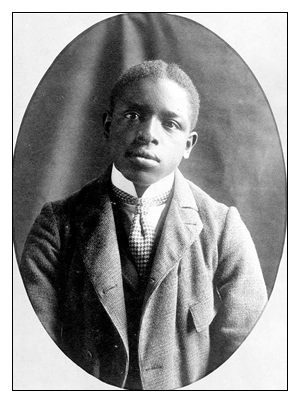
Nineteenth century African American teenager


BURYING GROUND BLUES

Posted by Terry Buckalew on May 31, 2017
Posted in: Uncategorized. Tagged: African American burial grounds, African American cemeteries, African American History, African Methodist Episcopal Church, archaeology, Bethel Burying Ground, Mother Bethel, Mother Bethel African Methodist Episcopal Church, Philadelphia, Richard Allen. Leave a comment

I got a letter this mornin’, this is the way my letter read
It says you better come home Muddy Water, tell me your baby’s dead

Started to write, but I believe I’ll go myself
No I ain’t gonna write, I believe I’ll go myself
Letter too slow, telegrams don’t get there

Said I wasn’t going, to my baby’s burying ground
Tell me what you mean
I ain’t going, to my baby’s burying ground
I was standing right there, when the grave-digger let her down

Church bell was tolling, my Muddy hearse was driving low
I didn’t say it, I didnt say it
Church bell was tolling, my Muddy hearse was driving low
Gotta be a rushing day, when I won’t see my baby’s face anymore


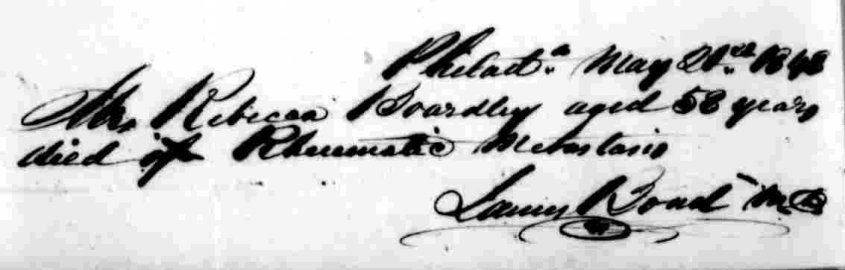
Fifty-eight-year-old Rebecca Boardley died this date, May 21th, in 1848 and was buried at Bethel Burying Ground

Posted by Terry Buckalew on May 21, 2017
Posted in: On This date. Tagged: African American burial grounds, African American cemeteries, African American History, African Methodist Episcopal Church, archaeology, Bethel Burying Ground, Mother Bethel, Mother Bethel African Methodist Episcopal Church, Philadelphia, Richard Allen. Leave a comment

Rebecca Boardley

Fifty-eight-year-old Rebecca Boardley died this date, May 21th, in 1848 of Cancer and was buried at Bethel Burying Ground. “Rheumatic Metastasis” is an archaic term no longer used. It most commonly meant cancer of the brain but could also mean cancer of the heart. 

When Ms. Boardley was forty-seven-years-old, eleven years previous, she reported her occupation as the proprietress of a clothing store according to the 1838 African American Census. Additionally, it records that she was not born into enslavement and owned $1,000 in personal property or approximately $5,000 in today’s currency. It is likely she was born in Delaware.

In the 1847 African American Census, Ms. Boardley reported her occupation as dressmaker and tailoress. She resided at 361 Lombard Street Alley near the intersection of Lombard Street and South 10th Street in the Cedar District of center city Philadelphia. 

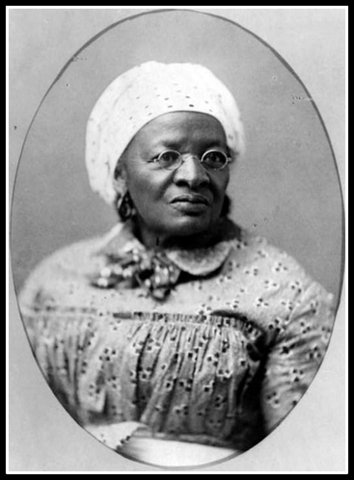
Black Matriarch

Unidentified 19th Century African American woman


Ms. Boardley was a widow and the matriarch of a large industrious family. Her seven adult children and their spouses lived with her and were employed as a lathe turner & wood carver, a tailor, two waiters and two who worked as domestics. All could read and write and attended religious services at Bethel A.M.E. Church (now Mother Bethel).

img054

Approximate location of the Boardley household. 


Posts navigation

← Older Entries
Newer Entries →
  • Recent Posts

    • Three dead as church wall falls on this date, May 1st, in 1841.
    • The ten-month-old Baby Colgate died this date, June 20th, in 1847, and was buried at Bethel Burying Ground.
    • Fifty-eight-year-old Rachel Dawson died this date, May 3rd, in 1839, and was buried at Bethel Burying Ground.
    • Twenty-eight-year-old Robert Swails died on this date, March 31st in 1849, and was buried at Bethel Burying Ground.
    • Forty-year-old Jacob “Jesse” Howard died on this date, January 29th, in 1840, and was buried at Bethel Burying Ground.
  • Archives

    • May 2024
    • June 2023
    • May 2023
    • March 2023
    • January 2023
    • December 2022
    • November 2022
    • October 2022
    • September 2022
    • August 2022
    • May 2022
    • April 2022
    • March 2022
    • February 2022
    • January 2022
    • December 2021
    • November 2021
    • October 2021
    • September 2021
    • August 2021
    • July 2021
    • June 2021
    • May 2021
    • April 2021
    • March 2021
    • February 2021
    • January 2021
    • December 2020
    • November 2020
    • October 2020
    • September 2020
    • August 2020
    • July 2020
    • June 2020
    • May 2020
    • April 2020
    • March 2020
    • February 2020
    • January 2020
    • December 2019
    • November 2019
    • October 2019
    • September 2019
    • August 2019
    • July 2019
    • June 2019
    • May 2019
    • April 2019
    • March 2019
    • February 2019
    • January 2019
    • December 2018
    • November 2018
    • October 2018
    • September 2018
    • August 2018
    • July 2018
    • June 2018
    • May 2018
    • April 2018
    • March 2018
    • February 2018
    • January 2018
    • December 2017
    • November 2017
    • October 2017
    • September 2017
    • August 2017
    • July 2017
    • June 2017
    • May 2017
    • April 2017
    • March 2017
    • February 2017
    • January 2017
    • December 2016
    • November 2016
    • October 2016
    • September 2016
    • August 2016
    • July 2016
    • June 2016
    • May 2016
    • April 2016
    • March 2016
    • February 2016
    • January 2016
    • December 2015
    • November 2015
    • October 2015
    • September 2015
    • August 2015
    • July 2015
    • June 2015
    • May 2015
    • April 2015
    • March 2015
    • February 2015
    • January 2015
    • December 2014
    • November 2014
    • October 2014
  • Categories

    • Archaeology
    • BBG History
    • Bethel Burying Ground Name Directory
    • Bethel Burying Ground Timeline
    • Burial services
    • Diseases
    • Documents
    • Freemasonry
    • Ignatius Beck
    • It's a fact
    • Maps
    • Neighborhood
    • Newspaper Articles
    • On This date
    • Photographs
    • Uncategorized
    • Videos
  • Meta

    • Create account
    • Log in
    • Entries feed
    • Comments feed
    • WordPress.com
Blog at WordPress.com.
Bethel Burying Ground Project
Blog at WordPress.com.
  • Subscribe Subscribed
    • Bethel Burying Ground Project
    • Join 48 other subscribers
    • Already have a WordPress.com account? Log in now.
    • Bethel Burying Ground Project
    • Subscribe Subscribed
    • Sign up
    • Log in
    • Report this content
    • View site in Reader
    • Manage subscriptions
    • Collapse this bar
 

Loading Comments...