Bethel Burying Ground Project

Bethel Burying Ground Project

  • ABOUT THE BETHEL BURYING GROUND PROJECT

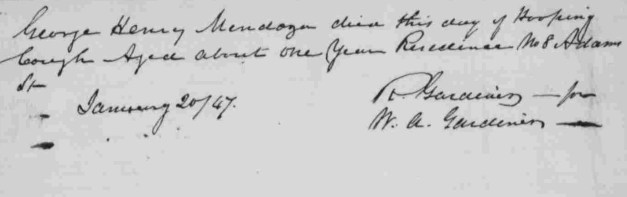
One-year-old George Henry Mendoza died this date, January 20th, in 1847 and was buried at Bethel Burying Ground.

Posted by Terry Buckalew on January 20, 2018
Posted in: On This date. Tagged: African American burial grounds, African American cemeteries, African American History, archaeology, Bethel Burying Ground, Mother Bethel, Mother Bethel African Methodist Episcopal Church, Philadelphia, Richard Allen. Leave a comment

MENDOZA

One-year-old George Henry Mendoza died this date, January 20th, in 1847 of Whooping Cough and was buried at Bethel Burying Ground. The child was the son of 17-year-old Louisa Mendoza, a single mother, who was employed as a domestic day worker, according to the 1847 African American Census and the 1850 Federal Census. This small family lived in a 10’x10′ room at 8 Adam Street for which Ms. Mendoza paid $2 a month. Records also report that she could read and write and that she did not attend religious services.  There are no records indicating who the child’s father might have been. 

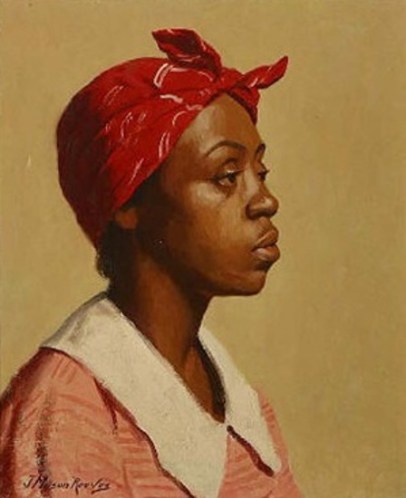
negro-woman-wearing-red-bandana

“Young Negro Woman”

From 1847 through 1848, a total of 154 Philadelphia children died from Whooping Cough.

Three years after her child died, Ms. Mendoza is listed in the 1850 Federal Census as a live-in domestic for a wealthy merchant family in center city Philadelphia.

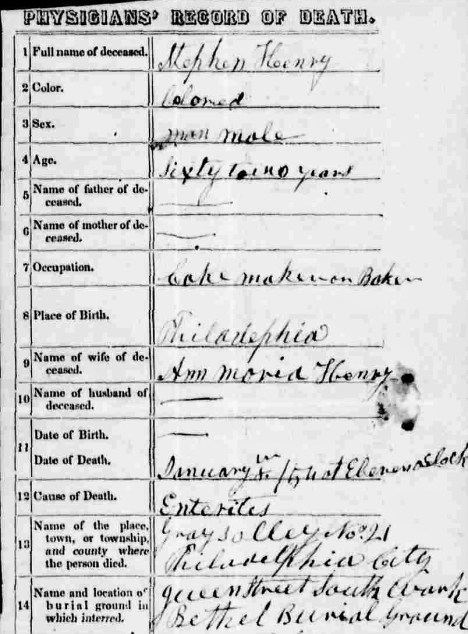
Sixty-one-year-old Stephen Henry died this date, January 8th, in 1854 and was buried at Bethel Burying Ground.

Posted by Terry Buckalew on January 8, 2018
Posted in: On This date. Tagged: African American burial grounds, African American cemeteries, African American History, African Methodist Episcopal Church, archaeology, Bethel Burying Ground, Mother Bethel, Mother Bethel African Methodist Episcopal Church, Philadelphia, Richard Allen. Leave a comment

STEPHEN HENRY

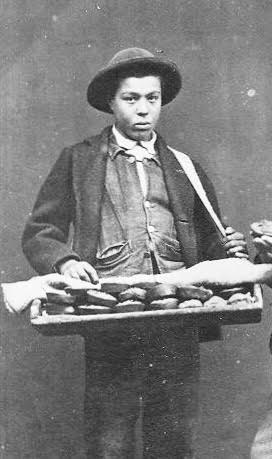
Sixty-one-year-old Stephen Henry died this date, January 8th, in 1854 of Enteritis* and was buried at Bethel Burying Ground. Mr. Henry and his spouse Ann Marie (49 y/o) were both bakers of cakes and pies that they sold on the street around the local farmers’ market. The family included one child William (14 y/o) and one-hundred-year-old Rachel Thompson who appears to be Ms. Henry’s mother as they both were born in Maryland. The males were born in Pennsylvania. According to the 1847 Philadelphia African American Census, Ms. Thompson was formerly enslaved and had suffered a stroke.

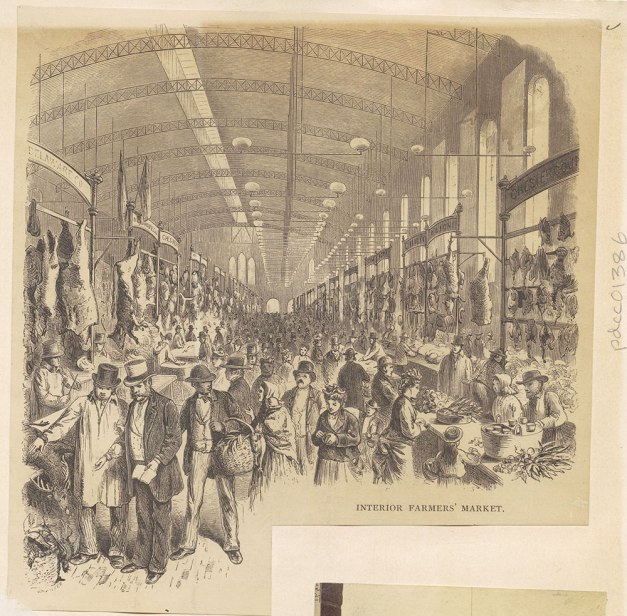
Philadelphia was peppered with farmers’ markets where citizens daily bought their meat, vegetables and dry goods such as candles and brooms. These markets were massive open-air structures with iron sheeted roofs. They would run for blocks often situated in the middle of the street. The vendors would rent stalls from the city that made and enforced laws governing the day to day operation of these markets. City officials would enforce the quality of the products being sold and also make sure that weights and measures were being honestly kept. There was one of these bazaars only a couple blocks from the Henry’s residence in Gray’s Alley and likely a place where they peddled their cakes and pies. 

Interior market shed

These “Market Houses” were open Monday through Saturday. On Sunday mornings and early afternoons, the massive sheds were used by itinerant preachers that held impromptu services. They were also a favorite place for politicians to hold political meetings and rallies.

With the death of Mr. Henry, the family would have needed fourteen-year-old William to work full time if he hadn’t been already. The family now faced not only a “spartan” existence but one where life itself hung precariously in the balance. 

PIE BOY

19th century “Pie Boy.”

As Mr. Henry’s coffin was lowered into his final resting place, Ms. Henry may have been silently reciting Psalm 44 to herself.

Our most gracious Lord

Life has beaten me down today

Lift me to see You in moments of my day

Let me feel Your presence in my pain 

Amen


*Enteritis: Inflammation of the intestine and possibly the stomach.

The six-month-old son of Elizabeth and James Massey died this date, January 2nd, in 1854 and was buried at Bethel Burying Ground.

Posted by Terry Buckalew on January 2, 2018
Posted in: On This date. Tagged: African American burial grounds, African American cemeteries, African American History, African Methodist Episcopal Church, archaeology, Bethel Burying Ground, Mother Bethel, Mother Bethel African Methodist Episcopal Church, Philadelphia, Richard Allen. Leave a comment

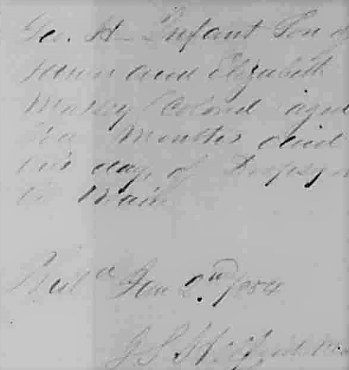
record-image_S3HY-6PWZ-C2H

The above Death Certificate is extremely faded but states that the six-month-old son of Elizabeth and James Massey died this date, January 2nd, in 1854 of swelling of the brain (“Dropsy”) and was buried at Bethel Burying Ground. James (34 y/o) was employed as a coachman and Elizabeth (29 y/o) as a laundress. He was born in Maryland and she was born in Pennsylvania. According to the 1847 Philadelphia African American Census, they had a male child under the age of five years old. In the 1850 Federal Census, this child is no longer reported and presumably had died during that time period.

The family lived at 14 Burd’s Court in a small room for which they paid $3.33 a month. The narrow block-long thoroughfare was near 10th and Spruce Streets in center city Philadelphia.

n

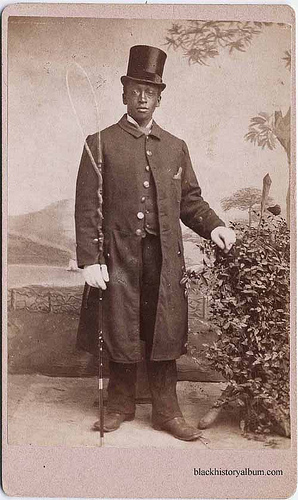
19th century African American coachman

From the available census records, it is apparent that Mr. Massey was a public hack driver as opposed to a private driver who is employed by a wealthy family and also has domestic duties in the family’s home, such as being a butler. Public drivers are divided into those that own their horse and carriage and those that work for a company that operates coaches, much like the taxi companies of today. Mr. Massey likely would have been the latter. The 1847 African American Census lists 106 Black men employed as coachmen. 

Laundress

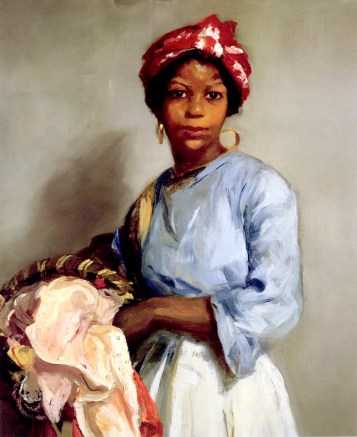
“The Laundress” by Robert Henri

Elizabeth Massey worked as a laundress. A job that taxed her body and spirit. Water had to be drawn and carried from the nearest hydrant, firewood had to be obtained, fires had to be started and heavy bundles of clothes had to be picked up and returned to her customers after the clothes and sheets were hung up, dried and folded. All this in the heat and cold, while taking care of children and shopping for and preparing the family’s meals, often while pregnant. It was an undertaking for only the strong and strong-willed.

After 1854, Elizabeth and James Massey disappear from public records. Their child died of swelling on the brain from either Meningitis or Encephalitis. The adults may also have succumbed to the infection, although there are no surviving death certificates on record of that occurring.


UP-TO-DATE BETHEL BURYING GROUND NAME DIRECTORY

Posted by Terry Buckalew on December 29, 2017
Posted in: Uncategorized. 1 Comment

Click on the link below to view the current Bethel Burying Ground Name Directory of the 2,483 individuals identified so far that were buried there between 1810 and 1864. Research is ongoing.

BBG Name Directory


IMG-5518

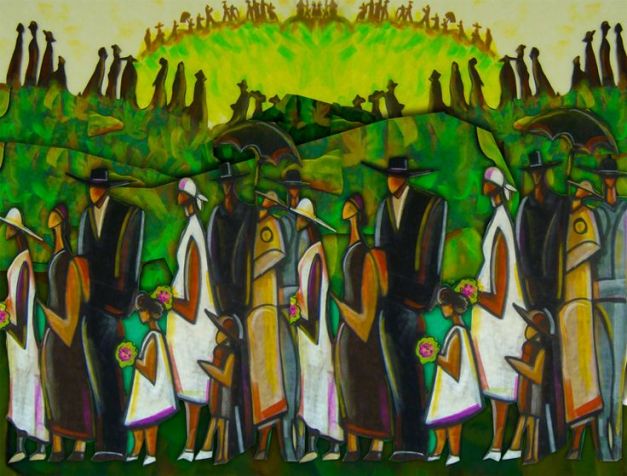
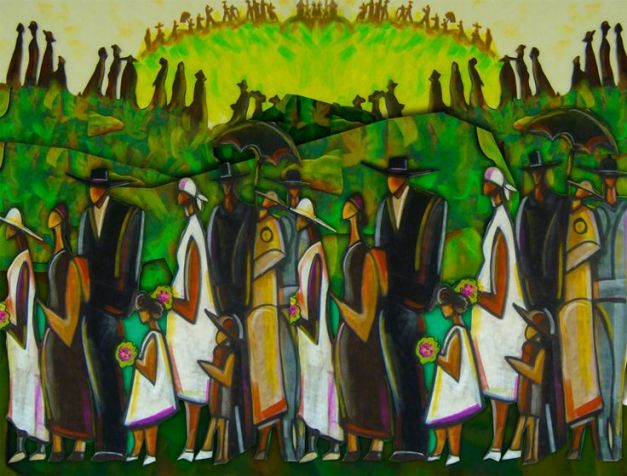
“Funeral Procession” by Ellis Wilson

Twenty-month-old Anna Matilda Rolley died this date, December 19th, in 1848 and was buried at Bethel Burying Ground.

Posted by Terry Buckalew on December 19, 2017
Posted in: On This date. Tagged: African American burial grounds, African American cemeteries, African American History, African Methodist Episcopal Church, archaeology, Bethel Burying Ground, Mother Bethel, Mother Bethel African Methodist Episcopal Church, Philadelphia, Richard Allen. Leave a comment

ROLLEY

Twenty-month-old Anna Matilda Rolley died this date, December 19th, in 1848 of burns from accidentally being scalded by boiling water and was buried at Bethel Burying Ground. The child’s family was one of the wealthiest African American families in Philadelphia.* Abner, the child’s father, was a barber who owned his own shop in a popular location and took on apprentices including his son. Mary Ann Rolley, the child’s mother, was a laundress and seamstress who also had employees. In addition to their large family, they took in an orphaned child. Below is how the 1847 census takers recorded the family.

1847 Philadelphia African American Census

Name:             Abner Rolley

Residence:      112 N. 5th Street

# in family:     9

Males:             5

Females:         4

Under 5 yrs.   1

    ”15 yrs.     3

     ”50 yrs.    4

Over 50 yrs.   1

Orphans         1

Can read        7

Can write       5

Male occupation: Barber

Female occupations: 1 laundress 1 dressmaker

Children under 20y: 2 apprentices

# at school: 1

Schools attended: 6th and Lombard Streets

Value of real estate:  $2,200 (Approximately $64,200 in today’s currency.)

Attend church: 8 (Bethel AME)

Remarks: The orphan boy’s mother died from a cold taken at the time of the 1st of August riot. His father died while in service.

          (The riot mentioned would have been in 1844. The father was a servant of some sort when he died.)
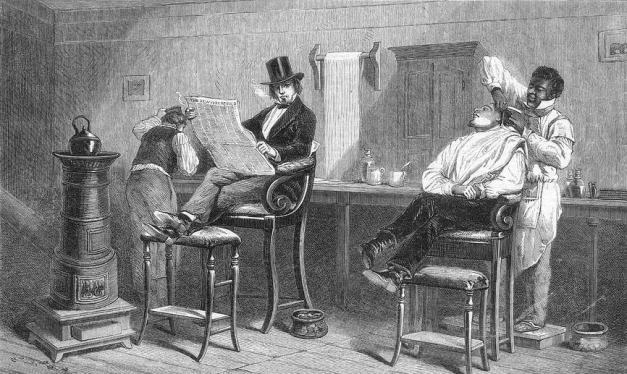
Antebellum Barber Shop

ANTEBELLUM BARBER SHOP

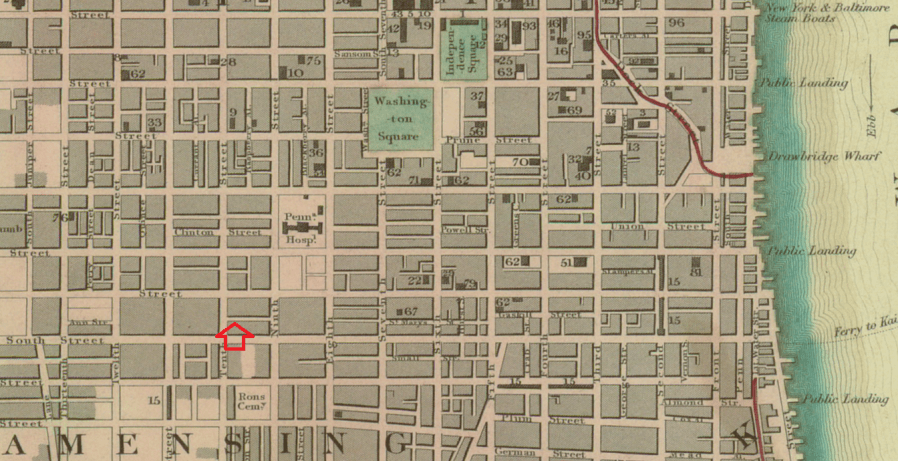
Barbershops owned by African Americans during this period had to choose whether they were going to service Black or white customers. The shop was “a kind of men’s club, where a customer above all felt at home.” That was only going to be achieved with one race or the other. It appears, given Abner Rolley’s success, his shop catered to white men.** It seems likely that the location of the shop also had to do with the business’s success. The Rolley family owned the building at 112 North 5th Street in center city Philadelphia. The shop was on the first floor and the family lived on the above floors. In addition, the address was in the middle of the largest market in the city. In the map below the white area represents the “Market House” on High Street, later named Market Street. The red arrow indicates the location of the Rolley’s business and home, one block north of Independence Hall.
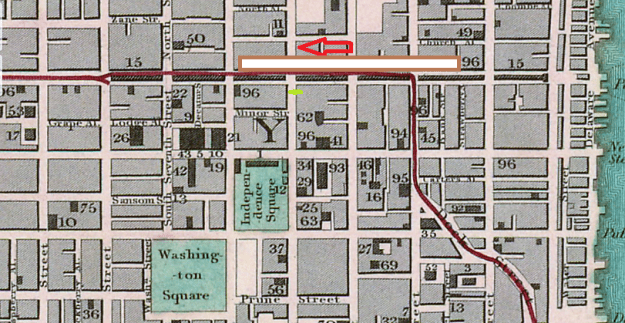
Rolley map

The 1850 Federal Census record on the Rolley family is below. Abner’s spouse, Mary Ann, is much younger than he is. It is very likely that she is his second wife, given the older children’s ages. Robert Miller appears to be the orphan mentioned in the 1847 Census and William Stevens is possibly another barber that lives at the residence. Mary Ann Means may be a daughter of Ms. Rolley from a previous marriage who works in the family businesses as a seamstress. 
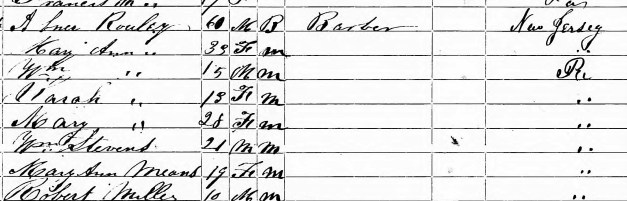
Rolley 1850

Tragically, Mr. Rolley died suddenly at seventy-three-years-old while he was at work in his shop on December 3, 1860, leaving a thriving business to his son William. 

***

*Roger Lane, Forging Freedom, 267.

**Roger Lane, William Dorsey’s Philadelphia and Ours, 115-118.


Ten-day-old James Hill died this day, December 4th, in 1828 and was buried at Bethel Burying Ground.

Posted by Terry Buckalew on December 4, 2017
Posted in: On This date. Tagged: African American burial grounds, African American cemeteries, African American History, African Methodist Episcopal Church, archaeology, Bethel Burying Ground, Mother Bethel, Mother Bethel African Methodist Episcopal Church, Philadelphia, Richard Allen. Leave a comment

James Hill

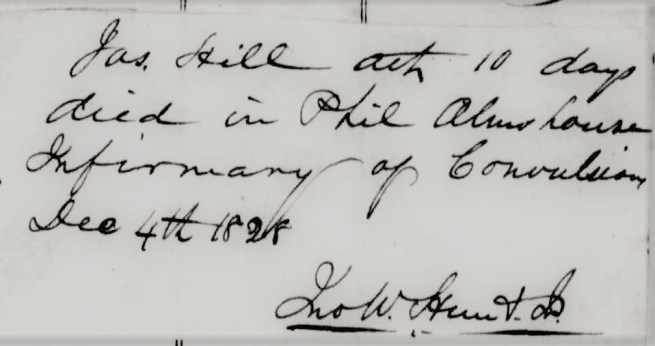
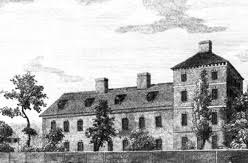
Ten-day-old James Hill died this day, December 4th, in 1828 of Convulsions and was buried at Bethel Burying Ground. He was born and died at the Philadelphia Almshouse Infirmary located in the 300 block of Spruce Street in center city. His unnamed mother would have had to beg for admission to the poorhouse. She would have been destitute, homeless and in immediate need of shelter, food, and medical attention. Fortunately, the institution offered these women specialized medical attention and postnatal care by midwives along with a temporary refuge and a diet of “hearty and nutritious food.”

alms 2

In 1828, 13% of the inmates of the Philadelphia Almshouse were African American, however, only between 6-9% of the residents of the city and districts were non-whites.

How was it that a financially destitute young woman was able to afford the cost of burying her son at a private cemetery? It is very likely that there were other Hill family members already buried at Bethel Burying Ground. It was a common practice for graveyard managers to allow families to inter young children in the same grave of a sibling or parent, thus lowering the cost for the impoverished family. The body of the child would simply be shrouded and laid in the open grave. Even the labor cost for this would have been out of reach for Ms. Hill and it was likely paid by an African American charitable organization. 

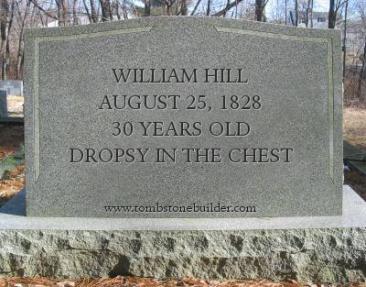
Below are Hill family members who are buried at Bethel Burying Ground and who may be related to Ms. Hill.

William Hill

Alfred Hill

M.A. HILL

There is no mention of William Hill in any federal or local censuses or city directories. Further research at the Philadelphia City Archives in the “Daily Occurrence Dockets” of the Philadelphia Almshouse for the months of November and December in 1828 may reveal Ms. Hill’s first name. 

Elizabeth Catlett

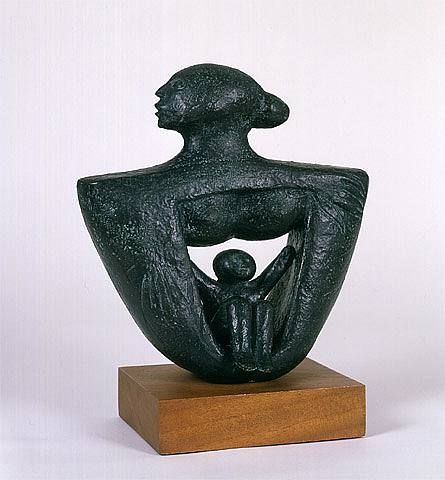
“Mother and Child” by Elizabeth Catlett


Suggested reading on the history of the Philadelphia Almshouse: “Welfare and the Poor in the Nineteenth-Century City: Philadelphia 1800-1854” by Priscilla Ferguson-Clement.


The two-year-old son of Sarah Marshall died this date, November twenty-fifth, in 1848 and was buried at Bethel Burying Ground.

Posted by Terry Buckalew on November 26, 2017
Posted in: On This date. Tagged: African American burial grounds, African American cemeteries, African American History, African Methodist Episcopal Church, archaeology, Bethel Burying Ground, Mother Bethel, Mother Bethel African Methodist Episcopal Church, Philadelphia, Richard Allen. Leave a comment

MARSHALL

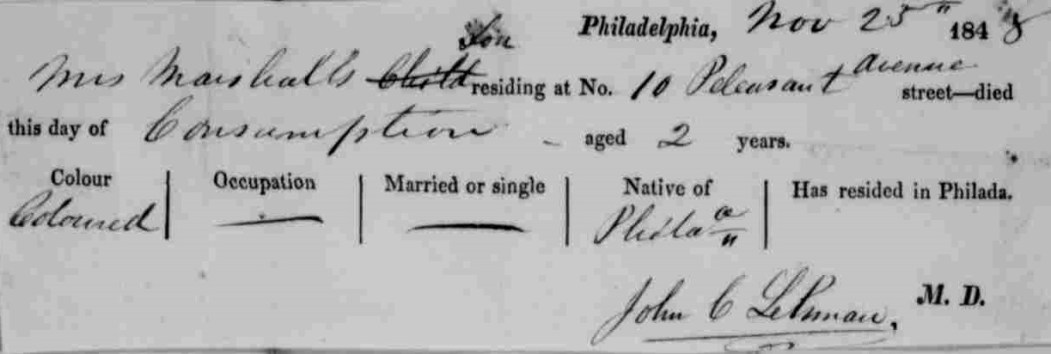
The two-year-old son of Sarah Marshall died this date, November 25th, in 1848 of Tuberculosis and was buried at Bethel Burying Ground. Ms. Marshall was a single mother working as a laundress residing at 10 Pleasant Avenue with a female child whose age was between six and fourteen years of age, according to the 1847 Philadelphia African American Census. This Census reports the younger child as a female, whereas the attending physician states that the child was a “son.” It appears that neither Dr. Lehman nor the manager of the cemetery was very familiar with the family as evidenced by the “Cemetery Return” (see below) filled out by the Bethel Church sexton Shephard Gibbs.

Marshall 2

Ms. Marshall lived in crushing poverty and received assistance from an aid organization in the form of firewood for her stove. In a good week, she likely earned $2-$3 and she paid $3.50 a month for a 10’x10′ room. Despite her situation, she sent her older child to one of the several private schools that took African American pupils. Ms. Marshall would not have been able to afford the burial expenses of buying a plot, having the grave dug and purchasing a coffin. It is possible that she had her child interred in an already existing grave of a spouse, another child or other family members. She would have needed assistance that was most probably from an African American beneficial society.

The_Times_Sun__Oct_13__1895_

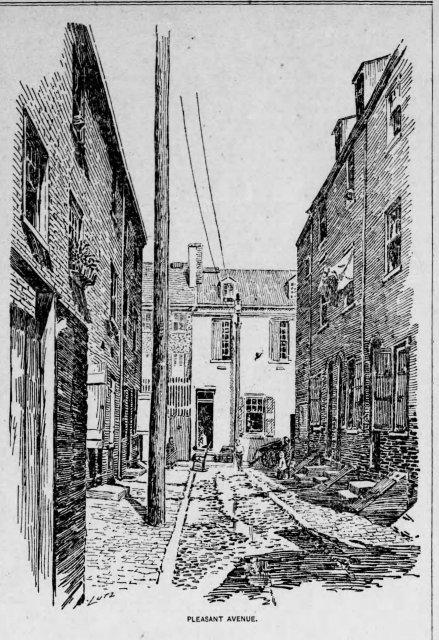
Pleasant Avenue was a dead end alley that ran north/south between Lombard Street and Minister Streets and between 7th and 8th Streets in center city Philadelphia. This street rarely appeared on a city street map. The ghettoization of African Americans in the city forced the poorest white and Black families to live on streets like Pleasant with notoriously crowded dwellings where diseases were quickly spread. What is missing from the above illustration is the piles of garbage laying in the street, clogging the gutters with black water that was home to numerous diseases that would kill hundreds. The city government would pay contractors to clean these alleys but it rarely happened unless an epidemic broke out in the neighborhoods and threatened adjoining white districts. 

The day that the child was buried, there would have been a Bethel Church minister over the grave. He may have recited the prayer that Rev. Richard Allen wrote for the death of a child. 

The tyrant, Death, came rushing in,

Last night his power did shew,

Out of this world this child did take,

Death laid its visage low.

No more the pleasant child is seen

To please the parent’s eye,

The tender plant, so fresh and green,

 Is in eternity.

Rev. Richard Allen (Hymn XLI, p. 64, “A Collection of Hymns and Spiritual Songs”)

black-family


Twelve-year-old Robert Sadler died this date, November 17th, in 1846 and was buried at Bethel Burying Ground.

Posted by Terry Buckalew on November 18, 2017
Posted in: On This date. Tagged: African American burial grounds, African American cemeteries, African American History, African Methodist Episcopal Church, archaeology, Bethel Burying Ground, Mother Bethel, Mother Bethel African Methodist Episcopal Church, Philadelphia, Richard Allen. Leave a comment

WILLIAM SADLER

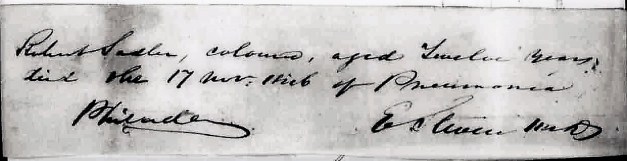
Twelve-year-old Robert Sadler died this date, November 17th, in 1846 of Pneumonia and was buried at Bethel Burying Ground. He was the son of William H. (37 y/o) and Hester Sadler (27 y/o). In addition, Robert was the brother of Ellen (possibly a twin) and three-year-old Rosana. Mr. Sadler worked as an oysterman and, during the winter months, as a waiter. Ms. Sadler worked as a laundress. All the children attended private daycare and school (Shiloh Infant School and Ms. Mary Till’s private school). The 1850 Federal census also lists Mary Davis (22 y/o) and Anna Harris (15 y/o) living with the Sadler family in the rear of #40 Bonsall Street (now Rodman Street). All of the Sadler family members and Ms. Davis were born in Pennsylvania. Ms. Harris was born in Delaware according to the 1850 Federal Census.

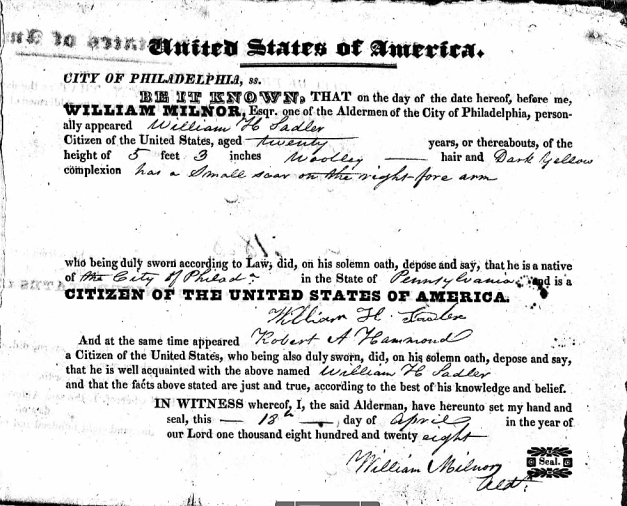
As a 20-year-old young man, William Sadler was a seaman as evidenced by his application for a U.S. Citizenship Affidavit of U.S. Born Seaman. This document was a nineteenth-century version of a passport that would assist an individual if an attempt was made against him to be kidnapped or “pressed” into service by the British. 

Sadler Seaman

Below is the approximate location of the Sadler home at 40 Bonsall Street. They lived in a shanty behind the main house that was little more than a shed or old stable for which they paid $4.85 a month for rent. The Sadlers were a proud family who regularly attended church services at Bethel AME and belonged to a beneficial society which likely assisted in paying for young Robert’s funeral expenses. William and Hester Sadler both were members of a temperance society, according to the 1838 and 1847 Philadelphia African American Censuses. 

Bonsall Street

Ms. Sadler died in January of 1869 of “old age” at 60 years of age. Living to sixty was well beyond the average life expectancy of a Black female of that era which was 35 years of age. For a Black male, it was 32.5 years; white female/ 42.9 years and white male/40.4 years. Mr. Sadler’s death certificate was not found.


Bethel Funeral Procession Attacked

Posted by Terry Buckalew on November 6, 2017
Posted in: BBG History. Tagged: African American burial grounds, African American cemeteries, African American History, African Methodist Episcopal Church, archaeology, Bethel Burying Ground, Mother Bethel, Mother Bethel African Methodist Episcopal Church, Philadelphia, Richard Allen. Leave a comment

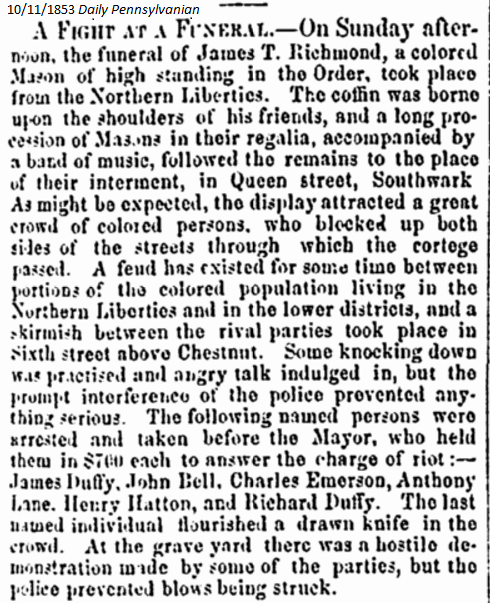
The African American community in Philadelphia was constantly under the threat of violence from the racist mobs that controlled the city. The year 1853 was a particularly ugly time in the northern districts of the city and the county. The deadly assaults on Black men walking alone in these areas started a couple weeks before the 4th of July and continued through the rest of the year. The white-owned newspapers even lamented about the unprovoked brutal physical attacks in the Northern Liberties, Fairmount and Spring Garden sections of the county. 

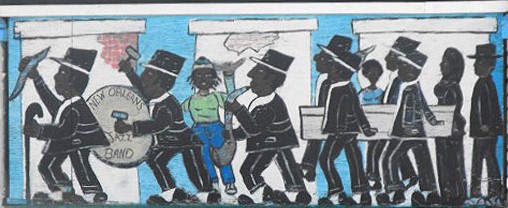
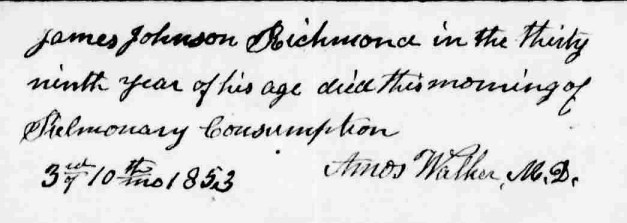
In October of that year, a funeral procession started out from the Northern Liberties District and was headed for the Bethel Burying Ground to inter an honored African American citizen, Mr. James Johnson Richmond. The procession was led by Mr. Richmond’s fellow Masons who carried the coffin on their shoulders for twelve miles to the cemetery followed by family and friends. The cortège was led by a marching band and the Masons in their formal uniforms followed by a “long line” of family and friends.

Funeral Band

The procession was harassed all along the eleven-mile route and the situation quickly escalated into a running battle between the mourners and the white mob. A mile from the cemetery the gauntlet worsens with the arrival of more gang members at 6th and Chestnut Street.

FIGHT AT A FUNERAL (1)

The latter half of 1853 was not only a time of heightening fears among whites in Philadelphia but throughout the country. In May the telegraph wires crackled with the breaking news that a large army of Black men, free and enslaved, were heading toward New Orleans to riot, rape, and pillage. The newspapers told the story of “half-crazed negroes” leading a “negro insurrection.” These rebels were goated on by abolitionists who were “depraved whites” creating a “negro mania.” Militias supposedly were called to arms to stop the wild horde. There was one problem. It never happened. There was no Black army, no insurgency and no army was rushing to the area. But that didn’t stop newspapers nationwide from speculating on the possible atrocities. What the hoax accomplished was the increase in tensions in the southern plantations and in the northern cities. 

JJR

In the end, Mr. James Richmond, a waiter, lately of 417 N. 4th Street was laid to rest by his battered and bruised family and friends. But the threat of violence wouldn’t stop the long funeral procession from coming – day after day and week after week.

IMG-5518

Sixty-two-year-old Hannah Claxton died this date, October 29th, in 1848 and was buried at Bethel Burying Ground.

Posted by Terry Buckalew on October 29, 2017
Posted in: On This date. Tagged: African American burial grounds, African American cemeteries, African American History, African Methodist Episcopal Church, archaeology, Bethel Burying Ground, Mother Bethel, Mother Bethel African Methodist Episcopal Church, Philadelphia, Richard Allen. Leave a comment

Hannah Claxton

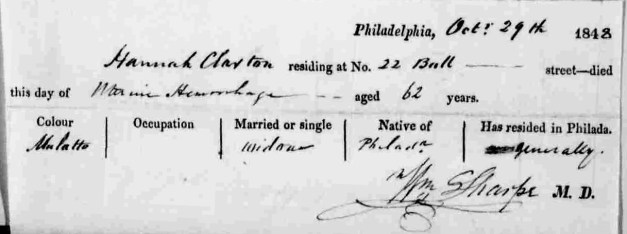
Sixty-two-year-old Hannah Claxton* died this date, October 29th, in 1848 of a uterine hemorrhage and was buried at Bethel Burying Ground. She was a widow who lived with her son Nathaniel Claxton at #22 Ball Alley. She was employed as a “pastry cook” earning $6 a week. Nathaniel worked as a painter, according to the 1846 Philadelphia African American Census and 1847 Philadelphia City Directory. The 1837 Philadelphia African American Census states that Ms. Claxton’s deceased husband was occupied as a painter and glazier. His name was also Nathaniel. 

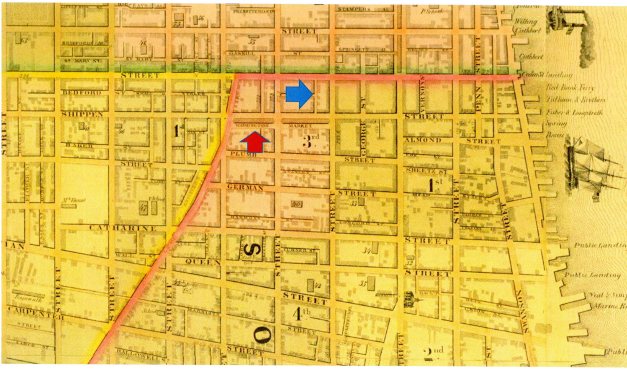
Eighty-seven years before Ms. Claxton’s death, Ball Alley was a center of entertainment for well-to-do white men of the colonial city. According to historian and author Michael Schreiber, “the long narrow alley” was surrounded by taverns where locals gathered for “ball games, drink, and gambling. On at least one occasion, even the president of the United States, John Adams, was entertained in Ball Alley. . . the long narrow Ball Alley would lend itself perfectly to forms of bowling – such as nine pins and skittles.” Groups could rent the whole alley for celebrations, dinners, and political meetings. The large sails of ships would span “the alley to give shelter to the dinner tables below.”**

Fast forward to the 19th century and the environment that the Claxton family lived in was very different. Schreiber comments that the alley now was known for its rowdiness, brothels, and alehouses with a very different clientele than its 18th-century cousins. A census taker for the 1847 Philadelphia African American Census commented that the buildings on Ball Alley were “very old tenements” and housed the “most destitute persons in this vicinity.” 

img023

The blue arrow indicates the location of the Claxton’s home and the red arrow indicates the location of the local market where Ms. Claxton probably sold her baked goods.

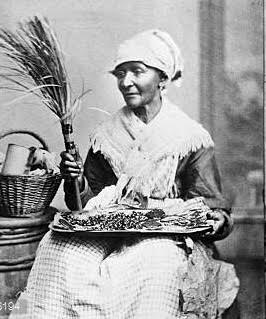
Ms. Claxton was a successful businesswoman earning $6 a week when the vast majority of African American men who labored for a living were lucky to be making $4-$5 a week, according to the 1847 Philadelphia African American Census. It is likely that Ms. Claxton’s living only a short distance from the Washington Market (see map) added greatly to her success. The Washington Market was a two block long covered shed with stalls. The structure contained designated stalls for everything from fresh produce, meats, and seafood to household items such as brooms and soaps. In the Washington Market, the stalls for “bread and cakes” were located at the far western end where Ms. Claxton probably could be seen daily hawking her fresh baked goods. 

In July of 1844, the entire structure was burned to the ground by anti-immigrant nativist rioters on their way to attempt to destroy St. Philip Neri Roman Catholic Church where Irish immigrants worshipped. After the smoke cleared, the market was rebuilt and the routine of daily life returned to the 19th-century bazaar. 

Black woman vendor

Nineteenth-century market vendor


*Other spellings of the name include “Clacton” and “Claixton.”

** For further reading on Ball Street go to Mr. Michael Schreiber’s essay at https://southwarkhistory.org/2014/05/the-black-bear-tavern-and-ball-alley/.


Posts navigation

← Older Entries
Newer Entries →
  • Recent Posts

    • Three dead as church wall falls on this date, May 1st, in 1841.
    • The ten-month-old Baby Colgate died this date, June 20th, in 1847, and was buried at Bethel Burying Ground.
    • Fifty-eight-year-old Rachel Dawson died this date, May 3rd, in 1839, and was buried at Bethel Burying Ground.
    • Twenty-eight-year-old Robert Swails died on this date, March 31st in 1849, and was buried at Bethel Burying Ground.
    • Forty-year-old Jacob “Jesse” Howard died on this date, January 29th, in 1840, and was buried at Bethel Burying Ground.
  • Archives

    • May 2024
    • June 2023
    • May 2023
    • March 2023
    • January 2023
    • December 2022
    • November 2022
    • October 2022
    • September 2022
    • August 2022
    • May 2022
    • April 2022
    • March 2022
    • February 2022
    • January 2022
    • December 2021
    • November 2021
    • October 2021
    • September 2021
    • August 2021
    • July 2021
    • June 2021
    • May 2021
    • April 2021
    • March 2021
    • February 2021
    • January 2021
    • December 2020
    • November 2020
    • October 2020
    • September 2020
    • August 2020
    • July 2020
    • June 2020
    • May 2020
    • April 2020
    • March 2020
    • February 2020
    • January 2020
    • December 2019
    • November 2019
    • October 2019
    • September 2019
    • August 2019
    • July 2019
    • June 2019
    • May 2019
    • April 2019
    • March 2019
    • February 2019
    • January 2019
    • December 2018
    • November 2018
    • October 2018
    • September 2018
    • August 2018
    • July 2018
    • June 2018
    • May 2018
    • April 2018
    • March 2018
    • February 2018
    • January 2018
    • December 2017
    • November 2017
    • October 2017
    • September 2017
    • August 2017
    • July 2017
    • June 2017
    • May 2017
    • April 2017
    • March 2017
    • February 2017
    • January 2017
    • December 2016
    • November 2016
    • October 2016
    • September 2016
    • August 2016
    • July 2016
    • June 2016
    • May 2016
    • April 2016
    • March 2016
    • February 2016
    • January 2016
    • December 2015
    • November 2015
    • October 2015
    • September 2015
    • August 2015
    • July 2015
    • June 2015
    • May 2015
    • April 2015
    • March 2015
    • February 2015
    • January 2015
    • December 2014
    • November 2014
    • October 2014
  • Categories

    • Archaeology
    • BBG History
    • Bethel Burying Ground Name Directory
    • Bethel Burying Ground Timeline
    • Burial services
    • Diseases
    • Documents
    • Freemasonry
    • Ignatius Beck
    • It's a fact
    • Maps
    • Neighborhood
    • Newspaper Articles
    • On This date
    • Photographs
    • Uncategorized
    • Videos
  • Meta

    • Create account
    • Log in
    • Entries feed
    • Comments feed
    • WordPress.com
Blog at WordPress.com.
Bethel Burying Ground Project
Blog at WordPress.com.
  • Subscribe Subscribed
    • Bethel Burying Ground Project
    • Join 48 other subscribers
    • Already have a WordPress.com account? Log in now.
    • Bethel Burying Ground Project
    • Subscribe Subscribed
    • Sign up
    • Log in
    • Report this content
    • View site in Reader
    • Manage subscriptions
    • Collapse this bar
 

Loading Comments...