
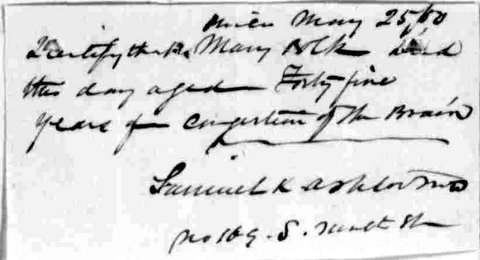
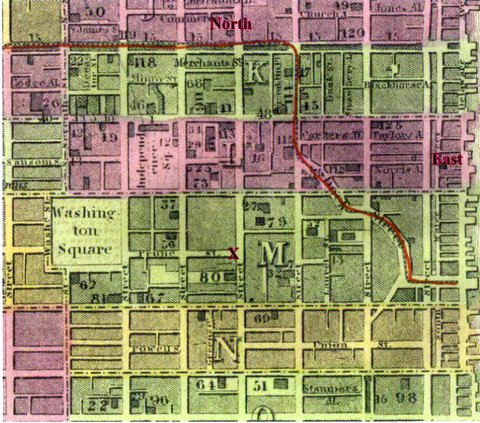
Forty-five-year-old Mary Polk died this date, May 25th, in 1850 of a “congestive brain” and was buried at Bethel Burying Ground. The term “congestive brain” can mean several things, but is most commonly a catch-all phrase for a stroke. According to 1850 Federal Census and the 1847 African American Census, Ms. Polk was married and mother of a daughter Caroline (18) and two sons Richard (13) and William (16) who was appreciating as a barber. She lived with her family in a shanty/shack in the backyard of 11 Prune Street which would currently equate to 411 Locust Street just east of Washington Square. Her residence is marked with a red X on the 1840 map below.
Mary Polk worked as a washwoman earning approximately $1.40 a week while her husband earned $1.50 a week as a laborer, according to the 1847 African American Census. This family was living on approximately 35% of what the average Black working poor were earning. They were paying $3.00 a month for what W.E.B. DuBois termed a “backyard tenement.” A dilapidated one-room shed/shack without heat, sewer or water. For more on this type of housing and environment see DuBois’ “The Philadelphia Negro,” especially pages 307-09 and 293-95.
The Polks belonged to a beneficial society where they saved money probably toward burial expenses. The family worshiped at Bethel Church (now Mother Bethel AME).
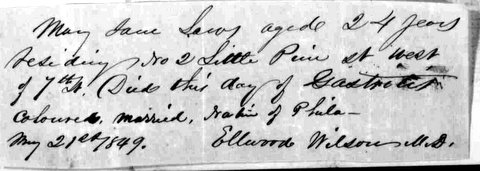
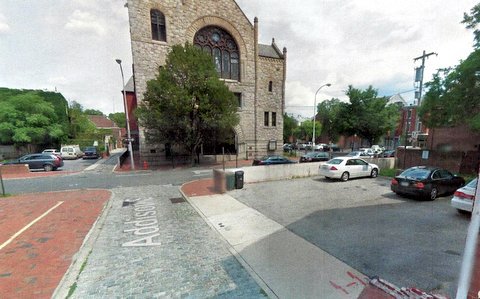
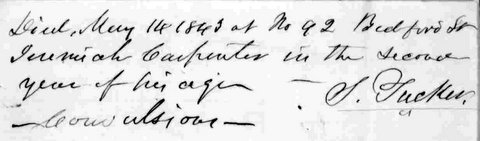
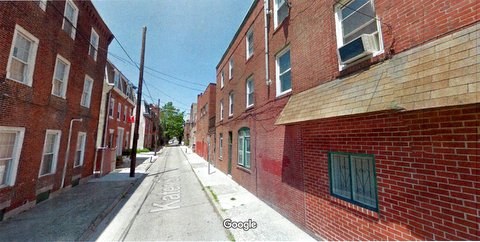
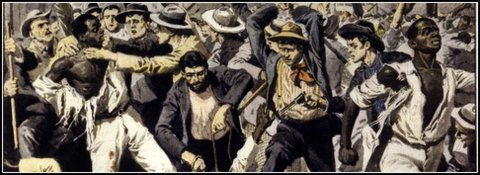 It is interesting to consider the possible experiences of the Carpenter family during the white supremacy violence of August 1-3, 1842. Unfortunately, their home was in the middle of some of the worst mob violence. The attack on Mother Bethel Church and the burning of Pennsylvania Hall are well known. Lesser acknowledge is the attacks on The Moyamensing Temperance Hall on Bedford Street near 8th Street only two blocks from the Carpenter residence. This new brick building, dedicated February 23, 1842, was the pride of the African American community. Alcoholism was devastating the community and this building and the organizing effort behind it was assisting in curbing the disease. This building became an instant threat to the vast Irish saloon business of Moyamensing, Southwark and the 7th Ward of Philadelphia. During the riot, there were two failed attempts to burn it down. What the mob failed to do the white city bureaucrats were more than happy to accomplish. A special grand jury ordered the building to be torn down because it was a “nuisance” and was in the interest of “public safety” simply because it existed. This occurred not two full blocks from the Carpenter’s home.



 Bethel Burying Ground Project